Snatched Meaning in Slang: Definition, Origin & How to Use It
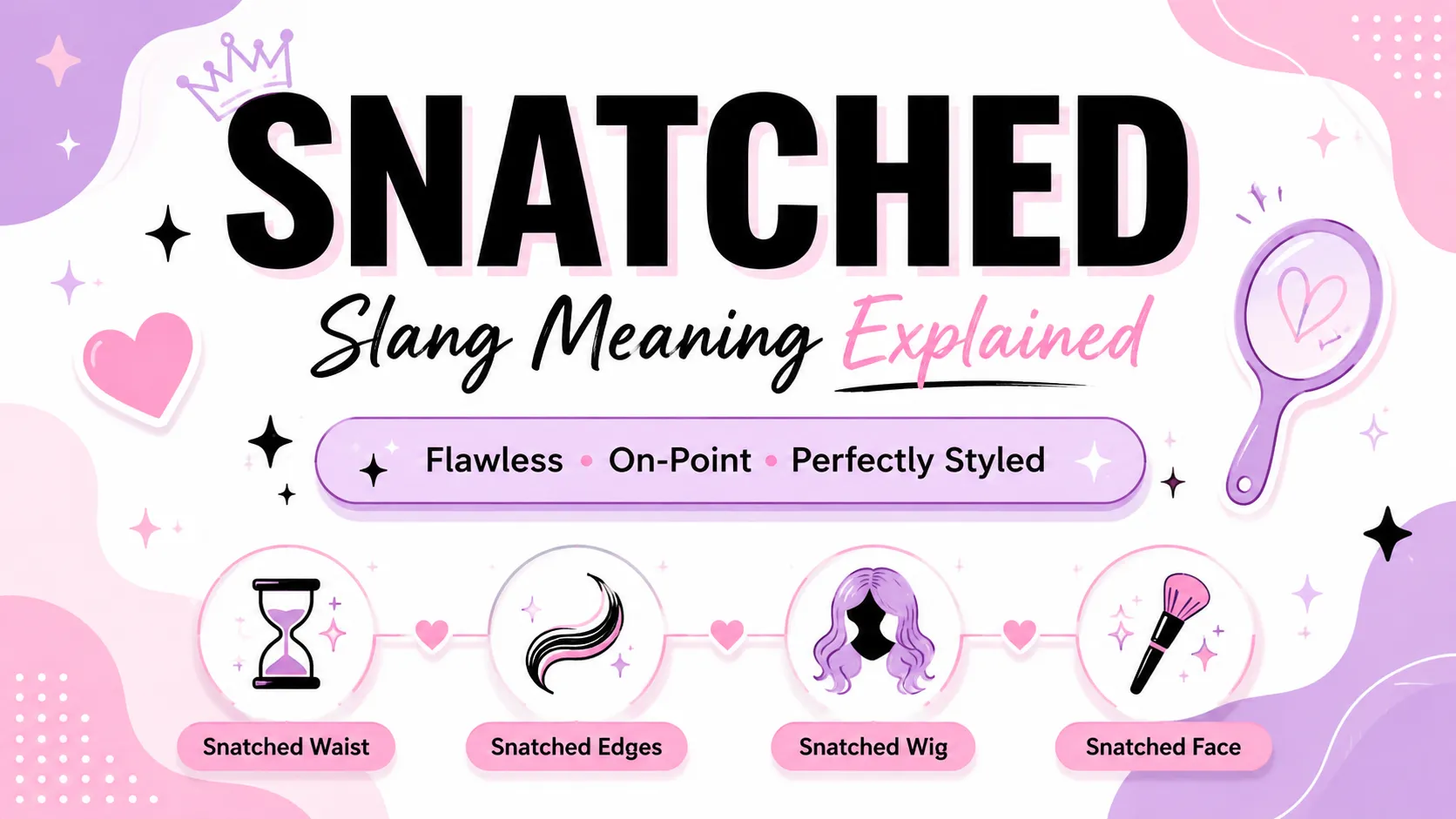
Snatched, In Slang, MeansFlawless, on point, or impressively well put-together — most often describing someone’s appearance, but increasingly used for anything executed perfectly. If a friend’s makeup, outfit, or hairline looks exactly right, you’d call it snatched.
People search for this word for a simple reason: they heard it in a comment, a TikTok caption, or from their kid, and the tone made clear it was a compliment — but the literal word (“grabbed,” “stolen”) doesn’t match. That gap between the old meaning and the new one is exactly what this guide untangles, including where the word actually came from and how it’s different from lookalike slang like slay or on fleek.
Quick Meaning Summary
| Part of speech | Adjective (slang) |
| Core meaning | Flawless, perfectly styled, impressive |
| Tone | Positive, complimentary, casual |
| Typically describes | Appearance, styling, makeup, body shape, occasionally skill/performance |
| Origin | Black and Latino drag/ballroom culture, 1990s |
| Mainstreamed by | RuPaul’s Drag Race, then Twitter/Instagram (~2016), then TikTok |
| Formality | Informal only — not for formal writing |
| Common phrases | snatched waist, snatched edges, snatched wig, “had my wig snatched” |
What Does “Snatched” Mean?
As slang, snatched describes something — usually a look — that is executed with total precision. It’s a stronger compliment than “nice” or “pretty.” It implies the person clearly put in real effort, and it paid off completely.
It’s used two main ways:
- As a descriptor: “Her makeup is snatched” = her makeup is flawless.
- As part of the phrase “had my wig snatched”: meaning something impressed or shocked you so much it figuratively knocked your wig off — used for anything from a great outfit to a plot twist in a show.
Unlike a lot of slang that fades fast, snatched has stayed in steady use for close to a decade, which is part of why it still ranks as a common “what does this mean” search.
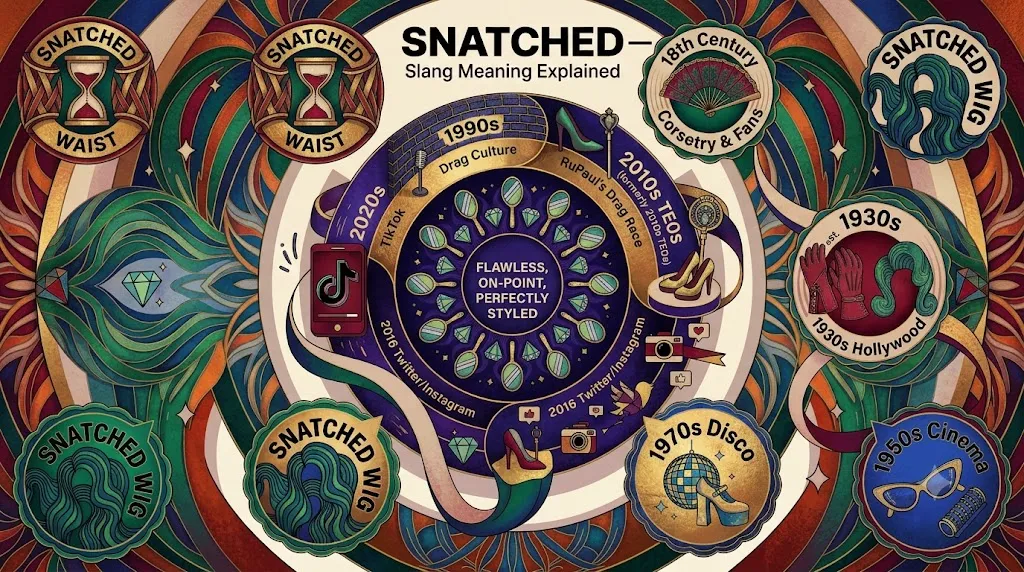
Origin and History
This is where most explanations of the word stop short — either vaguely calling it “internet slang” or citing one theory without the fuller timeline. Here’s the more complete version.
The literal root goes back centuries. “Snatch” has always meant to grab something suddenly. That plain meaning still exists side by side with the slang one (a thief snatched a bag).
The complimentary sense emerged in the early-to-mid 1990s. Language references note two threads: a possible link to a 1962 regional American use of “snatching” to mean attractive, and — more directly — its rise inside Black and Latino drag and ballroom culture, the same scene that gave English words like shade, reading, and fierce.
In drag performance, a look so flawless it seemed like it could “snatch someone’s wig off” was the highest compliment. Over time, the phrase shortened to just “snatched,” and it stopped being about wigs specifically — it became shorthand for any element of a look (waist, edges, face, outfit) done to perfection.
Timeline of how it spread:
- 1990s–2000s — Used within Black Drag And Ballroom Culture.
- 2010s — Reached a mainstream audience through RuPaul’s Drag Race.
- 2016 onward — Picked up steam on Twitter and Instagram as the older term “on fleek” fell out of use.
- 2020s–today — Fully mainstream on TikTok and in everyday texting, used well beyond its original community.
Why Is “Snatched” Popular?
Three things kept this word alive longer than most slang:
- It filled a gap. When “on fleek” faded, there wasn’t an obvious replacement word for “perfectly styled” — snatched slid right in.
- It’s visual and specific. Unlike vague praise (“cute,” “nice”), snatched implies precision, which makes it satisfying to use in captions about makeup, fitness, or fashion.
- Reality TV and short-form video kept it visible. RuPaul’s Drag Race reruns and clips, plus constant TikTok/Instagram usage, keep reintroducing it to new audiences.
How Is “Snatched” Used?
- “Girl, your outfit is snatched tonight.”
- “Her eyebrows are always so snatched.”
- “The choreography in that performance had my wig snatched.”
- “He posted his gym progress — that physique is snatched.”
- “Whoever did her makeup for prom had her face looking snatched.”
Grammar note: It functions as a predicate adjective (“her look is snatched”) or inside the fixed phrase “had my wig snatched.” It does not usually take the normal verb conjugations of literal “snatch” (you wouldn’t say “she snatches well”).
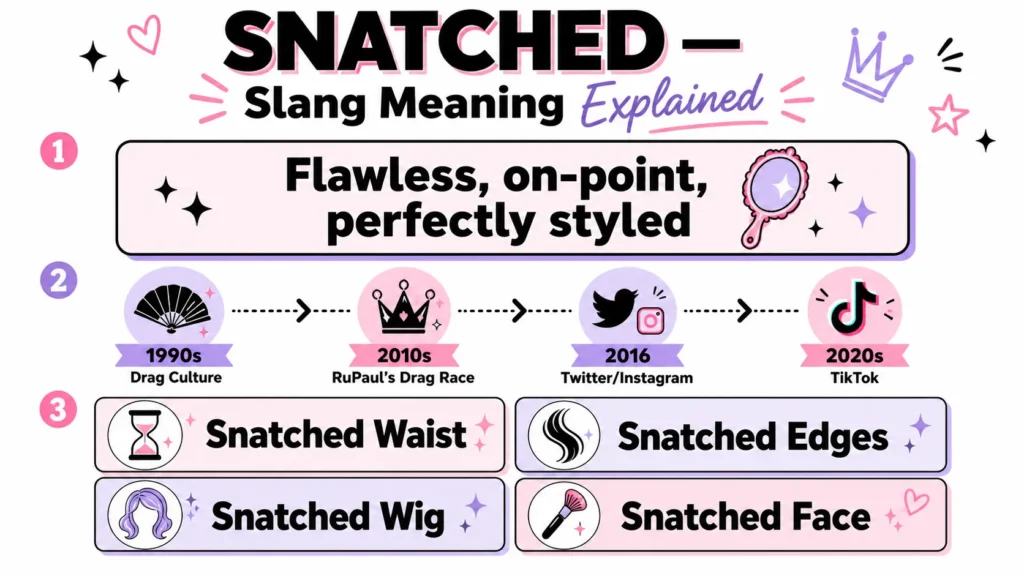
Snatched Waist, Edges, Wig: The Phrase Family
“Snatched” rarely stands alone — it usually pairs with a specific feature. This phrase-family breakdown is one of the most-searched-for details and the piece most competing definitions skip entirely.
| Phrase | What It Means |
| Snatched waist | A tightly cinched, hourglass-looking waistline — from styling, shapewear, or fitness |
| Snatched edges | A hairline/baby hairs styled with sharp precision |
| Snatched wig | A wig that blends so seamlessly it looks completely natural |
| Snatched face/cheeks | Makeup, especially contour and highlight, that sculpts the face |
| Snatched jawline | A sharp, well-defined jawline, real or contoured |
| “Had my wig snatched” | Was thoroughly impressed or shocked by something |
“Snatched” on Social Media
- TikTok — The world’s biggest current home. Used in captions and comments for makeup transformations, fitness progress, and outfit reveals (“#snatched,” “#snatchedwaist”).
- Instagram — Common in comments under photos and Reels, often paired with emojis (💅🔥) rather than long captions.
- Twitter/X — Where the term first broke into mainstream visibility around 2016–2019, often in reaction to drag performances or celebrity looks.
- Reddit/Discord — Used more sparingly and often self-aware or joking, since these spaces skew toward text-based, less appearance-focused conversation.
Snatched vs. Slay vs. On Fleek vs. Drip vs. Glow Up
These words get lumped together, but they’re not interchangeable. Here’s the actual distinction, which most “similar slang” lists skip in favor of a flat list with no explanation.
| Term | What It Focuses On | Current Status |
| Snatched | Precision — a look or feature done exactly right | Mainstream, still active |
| Slay | Performance or success in general, broader than appearance | Mainstream, still active |
| On fleek | Specifically eyebrows/makeup being perfectly groomed | Largely retired, sounds dated |
| Drip | Fashion sense, outfits, and accessories | Mainstream, fashion-specific |
| Glow up | A transformation over time, not a single moment | Mainstream, describes a process |
In short: slay = performing well; drip = the clothes; glow up = the journey; snatched = the finished, precise result.
Other (Non-Slang) Meanings of “Snatched”
Because the word also exists outside slang, a complete picture should note its other common uses so context doesn’t get confused:
- Standard English: past tense of “snatch” — grabbed quickly or without permission (“He snatched the phone from my hand”).
- Crime context: informal shorthand for theft or kidnapping (“Her bag was snatched”).
- Weightlifting: the “snatch” is an official Olympic lifting movement — raising a barbell from the floor to overhead in one motion.
- Older/vulgar slang: in some contexts “snatch” has a crude, dated meaning unrelated to the “flawless” compliment covered here. Worth knowing it exists so the two senses aren’t confused, but it has no connection to the modern usage.
Context makes the intended meaning clear almost every time.
Common Misunderstandings
- “It only means physically attractive.” Not quite — it specifically implies precision and effort, not just general attractiveness. A plain but neat hairline can be “snatched”; a naturally attractive but undone look usually isn’t.
- “It’s brand-new internet slang.” It’s actually been in steady use for over a decade and has real roots predating social media.
- “It only applies to women.” It’s gender-neutral and used to describe anyone’s look, styling, or execution.
- “It’s the same as ‘slay.'” Close, but slay is broader (performance/success), while snatched is specifically about a precisely executed look or detail.
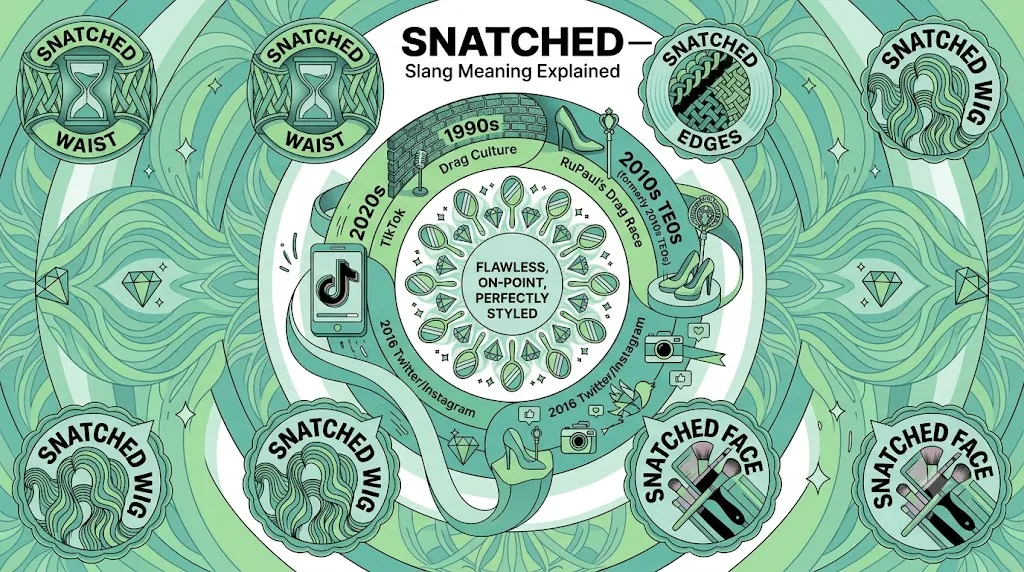
Is It Okay to Say “Snatched”?
Generally, yes — it’s widely used and welcomed outside the community it came from. But it does carry real cultural history from Black and Latino drag and ballroom culture, alongside words like shade, reading, and fierce. Using it as the genuine compliment it’s meant to be — rather than a joke about where it comes from — is the difference between using slang respectfully and not.
Interpretations and acceptable usage can vary by community, platform, and context; when in doubt, use it the way you’ve seen it used by the communities where it originated.
People Also Ask
Yes — in slang, it’s always positive, describing something flawlessly styled or executed.
It comes from Black and Latino drag and ballroom culture in the 1990s, where a “snatched” look was so flawless it seemed like it could snatch someone’s wig off. It reached the mainstream through RuPaul’s Drag Race and later social media.
Yes, it’s gender-neutral and applies to anyone’s look, outfit, or feature.
A tightly cinched, hourglass-looking waistline, often from clothing, shapewear, styling, or fitness.
No — it’s casual slang for texting, captions, and conversation, not formal or professional writing.
Snatched describes precision in a specific look or feature. Slay is broader, covering impressive performance or success generally.
As slang, no — it’s consistently positive. Its only negative sense is the older, literal meaning of something being stolen or grabbed, which is a separate use of the word.
It’s still active, especially on TikTok and Instagram, though as with all slang, its usage may narrow over time as new terms emerge
Conclusion
Snatched means flawless, precise, and impressively well put-together — a compliment that grew out of Black and Latino drag and ballroom culture, was carried into the mainstream by RuPaul’s Drag Race, and now lives on TikTok and Instagram as one of the most durable slang terms of the last decade. Whether it’s a snatched waist, snatched edges, or a whole snatched look, the word always signals the same thing: someone got every detail exactly right.