Fein Meaning: The Complete Guide to Fein Slang, Origin, Travis Scott’s “FE!N” & How to Use It
If you’ve seen “fein” pop up in a TikTok caption, a text from a friend, or chanted on repeat in a Travis Scott song, you’re not imagining things — it’s one of the fastest-spreading slang words of the last few years. Most people search “Fein Definition Slang“ right after hearing it somewhere and drawing a blank, because it isn’t in a traditional dictionary and it isn’t self-explanatory from spelling alone.
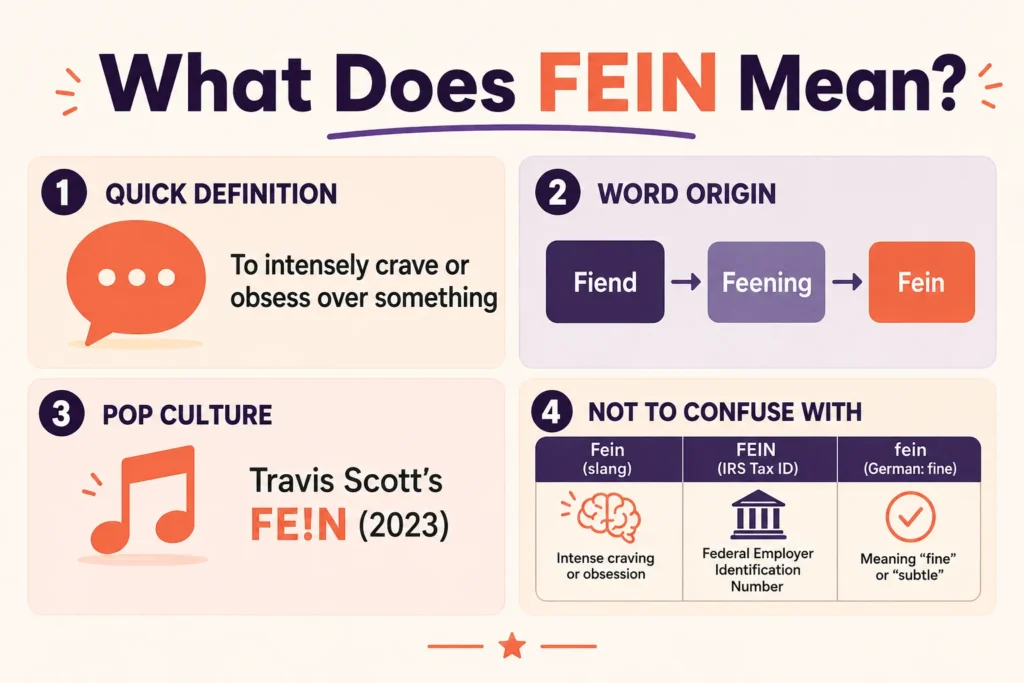
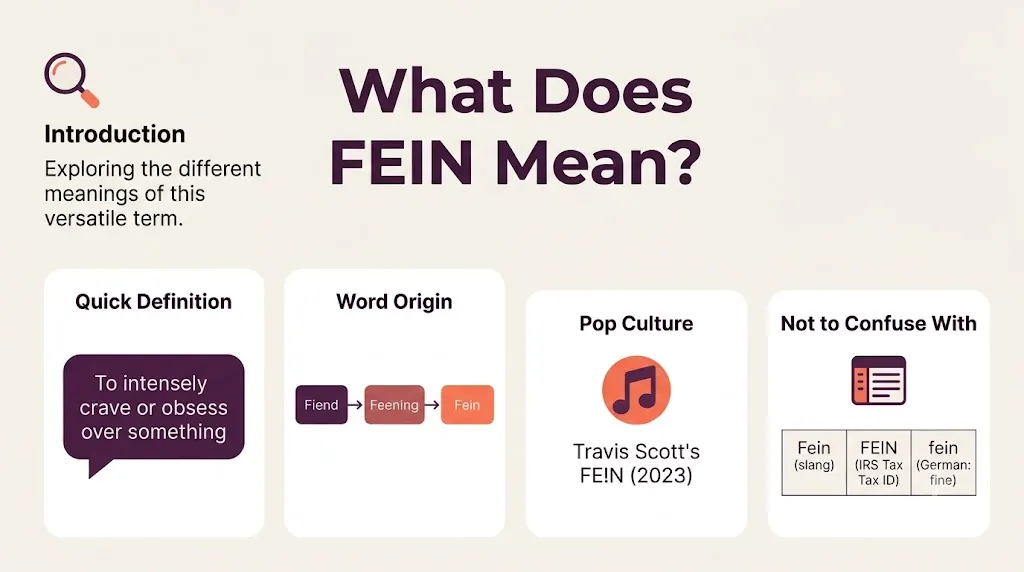
Here’s the short version: fein means to intensely crave, obsess over, or desperately want something. It’s a modern respelling of “feening,” which itself comes from the older word “fiend.” People use it for food, songs, crushes, sneakers — basically anything they can’t stop thinking about.
There’s also a completely unrelated “FEIN” that shows up in business and tax paperwork, plus a German word spelled the same way. This guide covers all of it, starting with the fast answer, then going deep on where the word actually comes from, how Travis Scott’s song pushed it into the mainstream, and exactly how to use it so you don’t sound off.
What Does “Fein” Mean?
Fein is slang for craving, obsessing over, or desperately wanting something. It’s the shortened, phonetic spelling of “feening” (or feenin’), which comes from “fiend.”
Example: “I’m fein for tacos right now” = “I’m craving tacos badly.”
It’s almost always informal — used in texting, captions, comments, and lyrics rather than formal writing.
Quick Meaning Summary
| Term | Category | Meaning | Where You’ll See It |
| Fein (slang) | Internet/hip-hop slang | To intensely crave or obsess over something | TikTok, texting, rap lyrics, gaming chats |
| Feening / Feenin’ | AAVE slang (verb form) | The ongoing act of craving something | Hip-hop lyrics, older slang usage |
| fein (German) | Foreign-language adjective | “Fine,” “delicate,” “refined” | German language, brand names |
| FEIN (tax/business) | U.S. tax acronym | Federal Employer Identification Number, a 9-digit IRS business ID | Tax forms, payroll, business registration |
If a form or accountant mentioned a “FEIN number,” that’s the IRS business ID — unrelated to the slang term, and always written as capital letters (F-E-I-N), not spoken like the slang word.
Origin and History: Where Does “Fein” Actually Come From?
Most explainer pages vaguely say “it comes from fiend” and stop there. Here’s the real progression:
- “Fiend” — historically meant an evil spirit or demon; by the 20th century, it had also become common slang for someone addicted to a substance (“a drug fiend”).
- “Feening” / “Feenin'” — African American Vernacular English (AAVE) turned “fiend” into a verb: to feen or to be feening for something, meaning to crave it intensely. This has circulated in hip-hop and R&B lyrics for decades, long before social media picked it up.
- “Fein” — social platforms, especially TikTok and X, re-spelled “feening” phonetically into “fein” (sometimes “fien”) because it’s faster to type and hits harder in a short caption.
In one sentence: fein is a modern respelling of “feening,” which is AAVE slang built from the older word “fiend” — an old idea (craving/obsession) with a new, faster spelling.
Why Is “Fein” So Popular Right Now?
The word had existed in hip-hop vocabulary for years, but one release turned it into everyday internet slang almost overnight — Travis Scott’s song, covered in detail below. Once it crossed into mainstream TikTok and Twitter usage, it got adopted the way most viral slang does: applied to anything and everything (food, crushes, games, songs), stripped of its heavier, addiction-specific original context.
Fein Meaning in Travis Scott’s “FE!N”
A large share of “fein meaning” searches trace back to one song, so here’s the real context:
- “FE!N“ is a track by Travis Scott featuring Playboi Carti, released July 28, 2023, as part of Scott’s album Utopia.
- The hook is a repeated, pitched-up chant of the word “fiend” — expressing an addictive pull toward fame, excess, and a lifestyle Scott can’t slow down from, not only literal substance use.
- It became a live-show phenomenon: Scott repeated it back-to-back multiple times during his Circus Maximus Tour, including a widely clipped moment where he played it ten times in a row at Brooklyn’s Barclays Center.
- Commercially, “FE!N” reached the top five of the Billboard Hot 100 and charted in the UK, Canada, and Australia, later surpassing a billion Spotify streams.
- It was also used as an entrance/theme song for WWE’s WrestleMania 41.
Important nuance: the song didn’t invent the word — it mainstreamed a term that already existed in Black American vernacular. That’s a piece of context most quick explainer pages skip entirely.
How Is “Fein” Used? Real Examples by Platform
Texting / DMs
- “I’m feining for your reply rn 😭”
- “Not me feining for that leftover pizza at 1 am”
TikTok / Instagram captions
- “POV: you’re feining for the new album to drop”
- “The way I’m fein for iced coffee every single morning”
Rap/music lyrics
- Used more literally — craving drugs, money, fame, or a lifestyle, closer to the word’s original AAVE meaning.
Gaming / Discord
- “Bro is feining for that new skin, he’s checked the shop five times today”
Reddit / X (Twitter)
- Used both sincerely and sarcastically in reply threads: “not me feining over a trailer”
Sarcastic/joking use
- “You’re such a fein for attention” — a lighthearted tease, not a literal accusation.
Grammar note: “fein” usually functions as a noun/label (“he’s a fein for X”), while “feening”/”feenin'” is the verb form describing the ongoing craving (“I’m feening for X”). Both are correct, just different parts of speech
Fein vs. Fiend vs. Feign vs. Fine — Don’t Mix These Up
| Word | Part of Speech | Meaning | Example |
| Fein / Feening | Slang noun/verb | Craving or obsessing over something | “I’m feening for tacos” |
| Fiend | Noun | Root word; an addict or evil spirit | “He’s a fiend for cigarettes” |
| Feign | Verb | To pretend or fake something | “She feigned interest in the meeting” |
| Fine | Adjective | Okay, acceptable, or high quality | “I’m fine, thanks” |
“Feign” is the word people confuse in writing most often — it sounds similar but means the opposite kind of thing (faking a feeling vs. genuinely craving something).
Common Variations and Spellings
- Feenin’ / Feening — the older verb form, rooted in AAVE and hip-hop
- Fein / Fien — the shortened, social-media-era spelling
- Feinin — a casual blend spelling
- Fein out — occasionally used to mean going overboard on a craving
Is “Fein” Offensive or Safe to Use?
Generally, no — in casual modern usage (food, music, a crush), it reads as harmless slang, similar to saying “obsessed” or “addicted” in an exaggerated, non-literal way.
Context still matters:
- Casual/joking use is widely accepted and won’t come across as offensive.
- Literal drug-related use carries more weight, given the word’s root in “fiend.” Using it to mock someone’s real struggle with addiction would be insensitive.
- Formal/professional writing — avoid it; it’s spoken/internet slang, not appropriate for resumes or work emails.
For parents trying to decode kids’ online language: the word on its own usually refers to food, entertainment, or crushes rather than anything concerning — but as with any slang tied to a drug-related root, context around it is what actually matters.
Common Misunderstandings
- “Fein” isn’t a typo for “fine.” They’re unrelated in slang usage, even though they look alike.
- “Fein” doesn’t always mean drug addiction. In 2024–2026 usage, it’s overwhelmingly used for food, entertainment, and crushes.
- The IRS “FEIN” and the slang word are unrelated, despite the identical spelling.
- Travis Scott didn’t create the word — he popularized an existing AAVE term.
People Also Ask
It means to intensely crave, obsess over, or desperately want something — food, a person, music, or an item. It comes from “Feening,” A Shortened Form Of “Fiend.”
Yes. “Feening”/”feenin'” is the verb form (“I’m feening for pizza”), while “fein” is typically used as a noun-style label (“he’s a fein for pizza”). Same root word.
It traces back to “fiend,” which became “feening” in African American Vernacular English, later re-spelled “fein” by social media users for a quicker caption style.
In “FE!N,” Travis Scott chants “fiend” (styled and pronounced “fein”) to express an all-consuming craving for fame, lifestyle, and excess. The song’s virality pushed the word into mainstream slang.
Yes, but it’s unrelated. FEIN stands for Federal Employer Identification Number, a 9-digit IRS business ID, always capitalized, with no connection to the slang meaning.
Not in casual use — it’s usually a lighthearted way to describe obsession. It reads more seriously when applied to literal drug addiction, so context matters.
As a noun: “She’s a total fein for iced coffee.” As a verb: “I’m feening for the new episode to drop.”
No — it’s internet/hip-hop slang, not a standard dictionary entry. It functions as an informal spelling of “feening.
Conclusion
Fein is slang for craving something intensely — a modern, phonetic spin on “feening,” which comes from “fiend.” It existed in hip-hop and AAVE long before it went viral, and Travis Scott’s 2023 song “FE!N” is the moment it broke into everyday texting and captions. It’s unrelated to the German word “fein” (fine/refined) and completely unrelated to the IRS’s “FEIN” business tax number — three different things that just happen to share a spelling. In nearly all everyday use, it’s harmless slang for being obsessed with or craving something, no different from saying “I’m dying for tacos.”