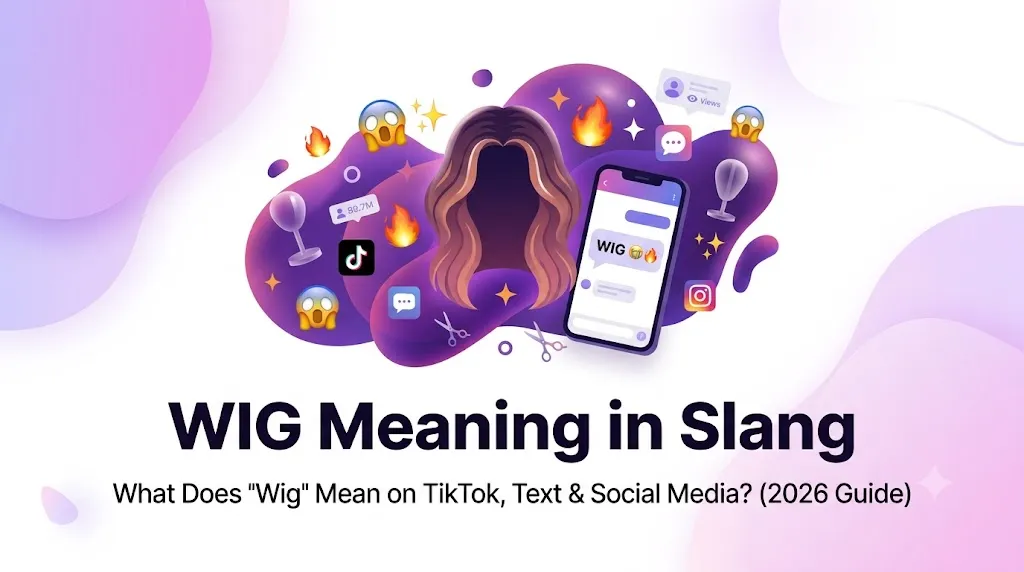
WIG Meaning in Slang: What Does “Wig” Mean on TikTok, Text & Social Media? (2026)
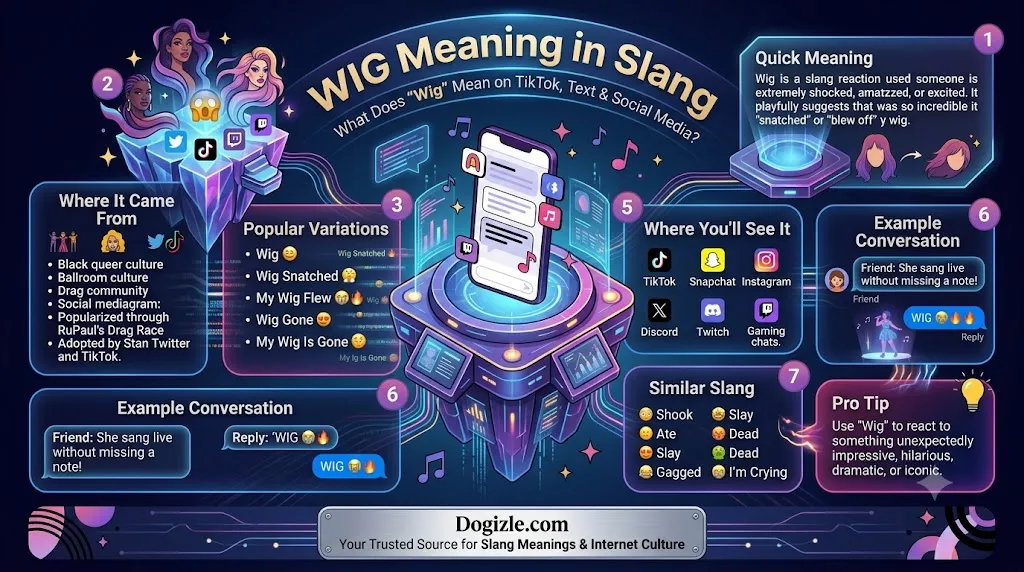
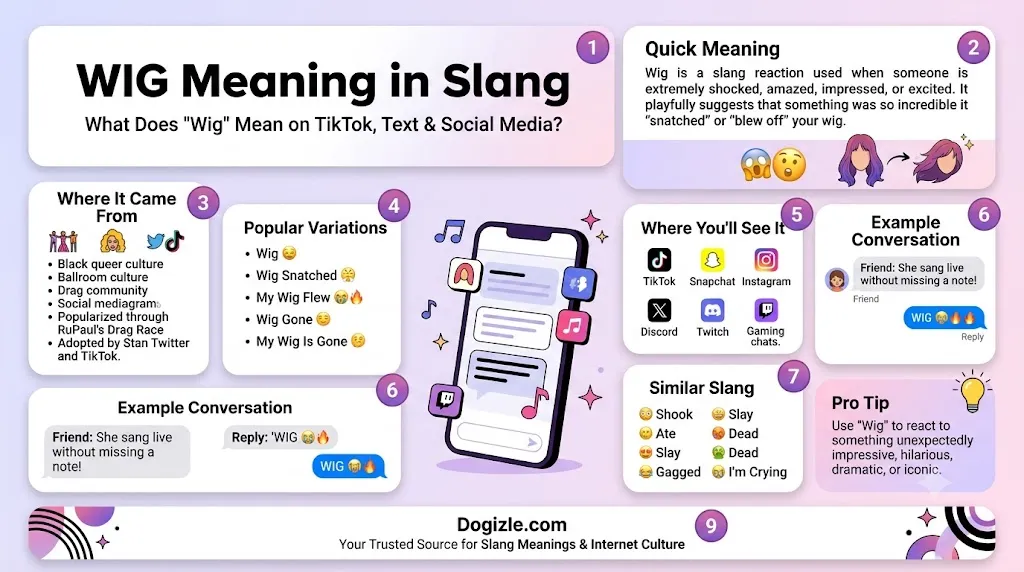
In slang, “wig” Is An Exclamation Used To Express extreme shock, excitement, or amazement — the online equivalent of saying “I’m speechless!” or “That blew my mind!” It’s typically used as a standalone reaction (“WIG!”) or paired with phrases like “wig snatched” or “my wig flew” to describe something so impressive it figuratively knocked a wig clean off someone’s head.
If someone comments “WIG” under your post, take it as a compliment. It means what you shared was so good it left them stunned.
What Does WIG Mean in Slang?
At its core, wig is a reaction word. It doesn’t refer to an actual hairpiece in this context — instead, it borrows the image of a wig flying off someone’s head to describe a moment of intense surprise or admiration.
Think of it like this: if you saw something so shocking that your hair (or in this case, your wig) physically left your head, that’s the energy “wig” is meant to capture. It’s dramatic, a little theatrical, and entirely intentional — the exaggeration is the point.
You’ll usually see it used in a few interchangeable ways:
- “WIG” — a one-word exclamation of shock or approval
- “Wig snatched” — something was so good it metaphorically snatched the wig off someone’s head
- “My wig flew” — a first-person version, meaning “I was completely floored”
All three carry the same emotional charge: overwhelming, positive surprise.
Why Do People Say “Wig”?
Language communities — especially online ones — love shorthand that communicates a big emotional reaction in as few words as possible. “Wig” does exactly that. Instead of typing out “I can’t believe how good that was,” a single word gets the message across instantly, and it signals that the speaker is fluent in a specific cultural vocabulary.
It also functions as a badge of belonging. Using slang like “wig” correctly and at the right moment signals membership in the communities where the word originated and where it continues to thrive online.
Origin of WIG Slang
Understanding where “wig” comes from adds important context to how — and when — it’s appropriately used.
Ballroom Culture
The term traces back to ballroom culture, the underground scene of competitive dance, voguing, and performance categories that emerged among Black and Latino LGBTQ+ communities in the United States, particularly in New York City, starting in the mid-20th century. Ballroom has long been a birthplace for expressive, high-energy language that later spreads far beyond its origin.
Black Queer Culture
“Wig” grew out of the broader vocabulary of Black queer culture, where vivid, performative language has always been central to communication. Reaction words tied to physical exaggeration — hair flying, wigs snatching, bodies shaking — are a hallmark of this linguistic tradition, built around theatrical delivery and emotional intensity.
Drag Community
The drag community popularized and refined the term. Because drag performers have long made wigs a staple of their art, people use the phrase “snatched your wig” to express shock or amazement while playfully referencing the traditions of drag performance.
How It Entered Mainstream Internet Culture
Slang from ballroom and drag culture has a well-documented history of migrating into mainstream pop culture through television, competition shows, and social media. <cite index=”1-1″>RuPaul’s Drag Race helped fuel many of pop culture’s most influential slang trends, bringing ballroom- and drag-rooted vocabulary into everyday online conversations..</cite> Terms like “wig,” “shade,” “reading,” and “slay” followed similar paths — starting in queer performance spaces, moving through stan Twitter and reality TV fandoms, and eventually landing in mainstream TikTok comment sections and group chats.
What Does “Wig Snatched” Mean?
“Wig snatched” describes a moment so impressive, shocking, or well-executed that it figuratively removed the wig from someone’s head. It’s typically used to praise:
- An outstanding performance (singing, dancing, acting)
- A stunning outfit or makeup look
- A plot twist in a show or movie
- A clever comeback or roast
Example: “That finale episode had my wig snatched, I did NOT see that ending coming.”
What Does “My Wig Flew” Mean?
“My wig flew” is the first-person, action-oriented version of the same idea. Instead of describing what happened to someone else, the speaker is describing their own reaction.
Example: “She hit that high note and my wig genuinely flew across the room.”
Both phrases are interchangeable in tone — the choice usually just comes down to whether you’re describing your own reaction or someone else’s.
TikTok
On TikTok, “wig” shows up constantly in comment sections under viral dance videos, transformation clips, and comedic sketches. A single-word comment like “WIG” under a video is a fast way to signal approval without writing a full sentence.
Snapchat
On Snapchat, the term tends to appear in captions or chat replies reacting to a friend’s photo, story, or outfit — often paired with wig or crying-laughing emojis for emphasis.
Instagram comments frequently use “wig” under transformation posts, glow-up photos, or standout fashion moments, functioning similarly to “obsessed” or “gorgeous.”
X (Twitter)
On X, “wig” is common in fandom spaces — stan Twitter in particular — reacting to new music drops, award show moments, or unexpected celebrity news.
Discord
In Discord servers, especially those built around fandoms, gaming, or pop culture, “wig” pops up in text chat as a quick reaction to a surprising clip, screenshot, or announcement shared in the channel.
Twitch
On Twitch, viewers may type “wig” in chat during a stream when something unexpected happens — a clutch gaming play, a funny moment, or a surprising reveal.
Gaming
Within gaming communities more broadly, “wig” (sometimes stylized as “WIG” in all caps for emphasis) gets used to react to an impressive kill, an unexpected win, or a hilarious in-game fail.
Examples of WIG in Conversations
Text Messages
- “Did you see her audition? WIG.”
- “He just texted me back after 3 months… my wig flew.”
- “Bro that plot twist had my wig SNATCHED.”
TikTok Comments
- “The way she nailed that transition… WIG 😭”
- “Wig officially snatched, I’m rewatching this 10 times”
Friends Chat
- “Wait she got the job?? WIG!!”
- “You did NOT just say that to him 💀 wig flew”
Gaming Chat
- “that clutch 1v4… wig”
- “bro’s aim is insane, WIG”
Meme Examples
Reaction memes often pair the word “wig” with an image of a cartoon wig flying off a character’s head, visually reinforcing the exaggerated shock the term describes.
When Should You Use WIG?
- Reacting to something genuinely impressive or surprising
- Complimenting a performance, look, or achievement
- Keeping up with fast-paced, casual online conversation
- Engaging playfully within fandom or friend-group chats
When You Should NOT Use WIG
- In formal, professional, or academic writing
- When talking to someone unfamiliar with internet slang, where it may cause confusion
- As a way to mock someone’s actual hair or wig — this can come across as genuinely insulting rather than playful
- In contexts where the exaggerated tone doesn’t fit (serious news, sensitive topics)
WIG vs Similar Slang
| Term | Core Meaning | Typical Use Case |
| Wig | Shock or amazement, exaggerated reaction | Impressive performances, looks, twists |
| Shook | Startled or surprised | Sudden, often less positive surprises |
| Ate | Did something exceptionally well | Praising a performance or outfit |
| Slay | Did something impressively | General praise/approval |
| Gagged | Speechless with shock | Similar to “wig,” often interchangeable |
| Dead | Something is extremely funny | Reacting to humor |
| I’m Crying | Something is hilarious | Reacting to comedy, often paired with laughing emojis |
While these terms overlap, “wig” and “gagged” are the closest in meaning — both describe being rendered speechless by something impressive — whereas “dead” and “I’m crying” lean specifically toward humor rather than general amazement.
Is WIG Positive or Negative?
“Wig” is almost always used positively. It signals admiration, excitement, or approval. It’s rarely, if ever, used to express genuine criticism or negativity — the exaggerated tone makes it clear the reaction is meant as a compliment.
Can WIG Be Used Ironically?
Yes. Like much internet slang, “wig” can be used sarcastically to poke fun at something that’s trying to be impressive but falls flat. In that context, tone and surrounding commentary usually make the irony clear — for example, using it after something awkward or cringeworthy happens, where the exaggerated reaction highlights the gap between the moment’s intended and actual impact.
Who Uses WIG Most?
- Gen Z — the primary drivers of the word’s current popularity online
- Millennials — many of whom picked up the term through drag and ballroom-adjacent media
- Stan Twitter — fandom communities that thrive on expressive reaction language
- Beauty Community — makeup and hair content creators, where the term carries a literal double meaning
- Drag Fans — audiences closely connected to the term’s cultural roots
- Pop Culture Fans — general audiences who picked up the phrase through reality TV and viral clips
Common Mistakes
- Using it to describe literal wigs without any context, which can confuse readers expecting the slang meaning
- Overusing it in formal writing, where it reads as out of place
- Assuming it’s an insult — it’s meant as praise, not mockery
- Forgetting the exaggerated tone — delivering it flatly loses the theatrical energy that makes the slang work
People Also Ask
On TikTok, “wig” is a comment or caption used to react to something shocking or impressive, similar to saying “I’m speechless” or “That Was Amazing.”
In texts, “wig” (or “my wig flew”) expresses that something surprised or impressed the sender so much it left them stunned.
No. “Wig” is almost always a compliment, used to express amazement or admiration rather than criticism.
“Wig snatched” means something was so impressive it figuratively knocked the wig off someone’s head — a dramatic way of saying “that was incredible.”
My wig flew” is the first-person version of “wig snatched,” used when the speaker describes their own reaction to something shocking or impressive.
Yes, “wig” remains actively used across TikTok, Instagram, and fandom Twitter/X communities, especially in comment sections reacting to performances and viral moments.
The term originated in ballroom and drag culture, rooted in the broader tradition of expressive language within Black queer communities, before spreading into mainstream internet slang.
While Gen Z popularized its widespread online use, the term’s roots go back further into ballroom and drag culture, making it a case of older community language being adopted by a newer generation.
Yes — the term isn’t gender-restricted. Anyone can use “wig” to react to something impressive, regardless of gender.
There isn’t a direct single-word opposite, but phrases like “that was mid” or “underwhelming” convey the opposite sentiment — a lack of impact rather than shock or amazemen
Conclusion
“Wig” is a small word carrying a big cultural history — from ballroom floors and drag stages to TikTok comment sections and group chats. Using it well means understanding not just what it means, but where it comes from and why it resonates the way it does. Whether you’re reacting to a jaw-dropping performance or a plot twist that caught you off guard, “wig” (or “wig snatched,” or “my wig flew”) is a quick, expressive way to say: that completely floored me.