Introduction
Dogs can eat oats, but the safest version is plain, cooked, and served in moderation. That is the consistent message across veterinary-style pet sources: oats are fine as an occasional add-on, while flavored packets, raw Oats, and sugary or toxic toppings are where most of the danger starts. The real question is not just whether oats are safe, but how to serve them in a way that helps your dog instead of upsetting the stomach.
For dog owners, this matters because oats are often seen as “healthy human food,” which makes them easy to share without much thought. But dogs do not need the same breakfast rules humans do, and extra ingredients can turn a harmless spoonful into a problem. The goal here is simple: give you the clearest possible answer, the safest feeding method, and the decision points that help you avoid common mistakes.
Quick answer
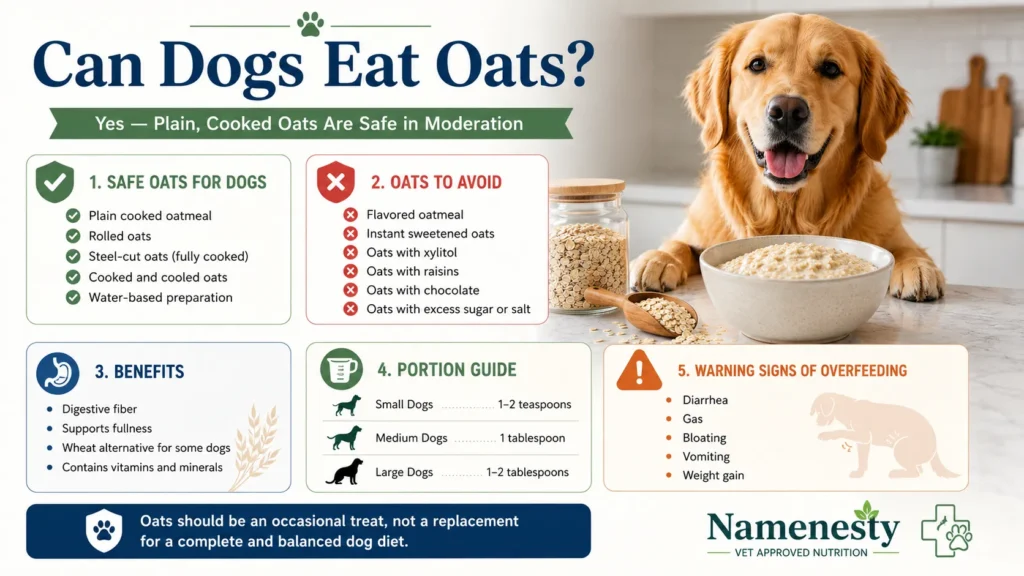
Yes, dogs can eat plain cooked oats in small amounts. Avoid flavored oatmeal, raw oats in large quantities, and any oat dish that contains xylitol, raisins, chocolate, grapes, added sugar, salt, or milk if your dog does not tolerate dairy well.
Are oats good for dogs?
Plain oats can be a useful occasional treat because they provide soluble fiber and some nutrients, including vitamins and minerals. PetMD notes that cooked plain oatmeal can support digestion and help a dog feel full longer, while AKC and Rover both describe oats as a safe, simple grain when prepared correctly. In general, oats fit best as a small snack or topper, not as a meal replacement.
That said, “good for dogs” does not mean “feed every day.” Dogs already get their main nutrition from a complete and balanced diet, and supplementing too much of any human food can throw off calories and digestive comfort. Oats are a helpful extra in small amounts, not a replacement for the food your dog actually needs.
Which oats are safe for dogs?
The safest choices are plain rolled oats, steel-cut oats, milled oats, or plain cooked oatmeal with no flavoring. Pure Pet Food and Rover both say plain oats are fine when prepared for dogs, and AKC recommends cooked, plain oats rather than raw or flavored versions.
Oat safety comparison table
| Oat type | Safe for dogs? | Best use | Notes |
| Cooked plain oatmeal | Yes | Occasional topper or treat | Cool to room temperature before serving. |
| Rolled oats | Yes, in moderation | Light topper, mixed into food | Easier to use after cooking. |
| Steel-cut oats | Yes, if cooked well | Plain homemade treat | Cook thoroughly so they are soft. |
| Instant flavored oats | No | None | Often contains sugar, salt, or toxic ingredients. |
| Raw oats in large amounts | Not recommended | None | Harder to digest and may upset the stomach. |
Can dogs eat raw oats?
Raw oats are not the best choice. PetMD says uncooked oats are difficult to digest and can cause an upset stomach, while Rover warns that raw oats may pose a choking risk and digestive issues. Pure Pet Food is a little more permissive about tiny amounts, but even that page still says raw oats are harder to digest than cooked Oats. The safest editorial position is simple: cook them first.
If a dog has a sensitive stomach, digestive disease, or a history of food intolerance, raw oats are an unnecessary risk. A plain, well-cooked bowl of oats is far easier for most dogs to handle than dry oats sprinkled over food.
Can dogs eat oatmeal?
Yes. Plain oatmeal is generally safe when cooked with water and served without sugar, salt, butter, milk, or flavor packets. PetMD and AKC both recommend room-temperature, plain oatmeal, and PetMD specifically says to use water instead of milk.
How to prepare oatmeal for dogs
- Cook plain oats in water.
- Do not add sugar, salt, butter, honey, or flavorings unless a veterinarian has specifically approved the recipe.
- Let the oats cool to room temperature.
- Start with a very small amount.
- Watch for loose stool, gas, vomiting, or itching after the first serving.
How much oats can dogs eat?
Keep the serving small. AKC gives a simple guide of about one tablespoon of cooked oatmeal per 20 pounds of body weight, while PetMD says only a few spoonfuls at a time is appropriate and that too much can cause diarrhea or digestive upset. Rover also warns that too much oatmeal can lead to weight gain.
Feeding guide table
| Dog size | Starting amount | Frequency | Notes |
| Toy / small dog | 1–2 teaspoons | Occasional | Start low; watch stool. |
| Medium dog | 1 tablespoon | Occasional | Best as a topper, not a meal. |
| Large dog | 1–2 tablespoons | Occasional | Avoid turning it into a daily habit. |
| Very active or larger dogs | Only if tolerated | Occasional | Calorie count still matters. |
A practical rule works better than an exact gram count for most readers: start smaller than you think, then only increase if your dog tolerates it well. Because human-food treats can crowd out balanced nutrition, the best approach is moderation, not routine.
What should never be mixed with oats?
This is where oat safety becomes very real. The oats themselves are usually not the problem. The problem is the add-ins.
Safe vs unsafe add-ins table
| Add-in | Safe for dogs? | Why it matters |
| Water | Yes | Best cooking liquid for dogs. |
| Plain cooked oats | Yes | Simple and low-risk in moderation. |
| Milk | Usually avoid | Can upset digestion in some dogs. |
| Sugar | Avoid | Adds empty calories and can trigger digestive issues. |
| Salt | Avoid | Unnecessary and not dog-friendly. |
| Butter | Avoid | Too rich for regular feeding. |
| Chocolate | Dangerous | Toxic to dogs. |
| Raisins/grapes | Dangerous | Can cause serious toxicity and kidney damage. |
| Xylitol | Emergency risk | Can cause severe poisoning very quickly. |
| Nutmeg | Avoid | Commonly listed as a risky spice for pets, keep oat dishes plain. |
| Honey | Small amounts only | Calorie-dense and not needed daily. |
FDA warns that xylitol can trigger symptoms within about 20 minutes, including vomiting, weakness, collapse, seizures, liver failure, and bleeding problems. ASPCA also warns that grapes and raisins can damage the kidneys. That is why flavored oatmeal packets, breakfast leftovers, and “healthy” human bowls can become dangerous fast.
Can dogs eat oats every day?
Usually, no. Oats should be an occasional treat, not a daily habit. Rover says too much oatmeal too often can cause digestive upset or weight gain, and Pure Pet Food also frames oats as a moderate food rather than a daily staple. The better long-term strategy is to feed a complete and balanced diet and use oats only as a small add-on.
This matters especially for dogs who are already prone to weight gain, soft stools, or begging behavior around breakfast time. A treat that seems harmless can become a calorie creep problem if it turns into a daily routine.
Can puppies eat oats?
Puppies can usually have a very small amount of plain, cooked oats if they tolerate it well, but the portion should stay tiny, and the recipe should stay simple. Puppies have sensitive digestive systems and very specific nutritional needs, so oats should never replace puppy food or become a frequent topper. That cautious approach fits the same moderation-first guidance used by the main pet-health sources.
Signs your dog ate too much Oats
Most problems show up as digestive discomfort. The common warning signs are loose stool, diarrhea, gas, bloating, vomiting, and sometimes reduced interest in food. PetMD specifically warns that too much oats can trigger diarrhea or digestive upset, and Rover notes that overeating can also contribute to weight gain.
Watch for these symptoms
- soft stool or diarrhea
- vomiting
- gas or bloating
- tummy rumbling
- scratching or irritation after flavored oats
- lethargy if the oatmeal contained a toxic ingredient
- collapse, weakness, or shaking if xylitol was involved
If xylitol, chocolate, or raisins were eaten, treat it as urgent. FDA says xylitol exposure can become severe quickly, and ASPCA Poison Control is available 24/7 for poison-related emergencies.
Are oats better than rice for dogs?
That depends on the situation. Oats can be a good plain treat, but when a dog needs a bland recovery diet, many veterinarians still prefer easier-to-digest options such as boiled rice and chicken. Pure Pet Food notes that oats may be fine nutritionally, while rice can be the gentler option for short-term bland feeding. For a normal treat, oats are fine; for a sensitive stomach or post-illness diet, ask your vet which carb is best.
Are oats a grain worth keeping in your dog’s diet?
Yes, for many dogs. PetMD’s nutrition guide says grains such as oats are well tolerated and absorbed in dogs, and it also notes that there is no specific required amount of carbohydrates for dogs. That means oats can be useful, but they are not mandatory, and they are not a license to skip balanced dog food.
For European and UK readers, this is a helpful way to frame the topic: keep oats in the “occasional treat” category and rely on a complete and balanced diet for the main nutritional base. UK Pet Food hosts the 2024 FEDIAF nutrition guide, and MSD Veterinary Manual emphasizes that complete and balanced commercial diets are formulated to provide required nutrients without intolerable excess.
Europe-specific practical advice
Many European dog owners live in apartments, walk dogs in busy city streets, and rely on packaged foods that are already designed to be complete and balanced. In that context, oats make sense as a small, simple topper, not a major carb source. Keep it plain, keep portions modest, and do not assume “natural” means “better for dogs.” A plain spoonful of cooked oats is one thing; a bowl of sweetened porridge with dairy and syrup is another.
Apartment living scenario
If you live in a flat and your dog gets less exercise, oats need extra caution because calories add up fast. A small, plain portion is fine, but a rich breakfast-style bowl can become unnecessary weight gain over time. Short walks, controlled treats, and measured portions matter more in lower-activity homes.
Cold weather and seasonal care
In colder months, some owners reach for comfort foods and warm breakfasts. That is fine for humans, but for dogs, the safe rule stays the same: plain, cooked, cooled, and small. Seasonal treats should still sit inside the dog’s total calorie budget.
Common mistakes dog owners make
- Using flavored instant packets
These often contain sugar, salt, and sometimes xylitol or other unsafe ingredients. - Feeding raw oats by the handful
Raw oats are harder to digest and may upset the stomach. - Adding milk, butter, or sweet toppings
These make the snack richer and less dog-friendly. - Letting oats become a daily habit
Oats are a treat, not a main meal. - Ignoring the label
The danger is often not the oat itself but the packet ingredients.
Expert tips for feeding oats safely
- Cook them plain in water
- cool to room temperature before serving
- start with a teaspoon-sized amount
- keep the recipe boring on purpose
- Use oats as a topper, not a full meal
- Stop feeding oats if stool softens or itching appears
- treat any xylitol exposure as urgent
Pros and cons of oats for dogs
Pros
- simple, budget-friendly treat
- can offer soluble fiber
- easy to prepare plain
- useful as a small topper for picky eaters
- generally well tolerated when cooked and fed in moderation
Cons
- easy to overfeed
- Flavored packets can contain unsafe ingredients
- Raw oats are less digestible
- Too much can cause diarrhea or weight gain
- not needed in a complete and balanced diet
People Also Ask
Yes, but only in a very small amount. Pure Pet Food notes that honey itself is safe, but the combo is calorie-dense, so it should stay occasional rather than routine.
It is better to avoid instant or flavored oats. They are more processed and often contain sugar, salt, or risky additives such as xylitol.
Sometimes, but only if the oats are plain, cooked, and introduced slowly. If your dog already has a sensitive gut, start very small and watch for loose stools or vomiting.
Yes, when plain and cooked properly. Rolled oats are one of the more practical oat forms for dog owners because they are simple, familiar, and easy to serve safely.
They can add calories, but oats are not a weight-gain strategy you should use casually. Because treats can crowd out balanced nutrition, any calorie increase should be planned with a vet.
Treat it as an emergency. FDA says symptoms can begin quickly, and you should call your vet, an emergency clinic, or poison control right away.
Final verdict
Can dogs eat oats? Yes — but only when they are plain, cooked, and fed in moderation. The most useful answer for dog owners is not just “yes,” but “yes, with clear rules.” Keep oats simple, keep the portion small, and keep the Dangerous add-ins out of the bowl. That is the safest, most useful, and most publishable angle for a pillar page on this keyword.
For Dogizle.com, the winning content position is to be the page that answers everything in one place: what oats are safe, how much to feed, what to avoid, what to do if a dog eats the wrong kind, and when to call the vet. That combination of clarity, practical safety, and trust is what makes a search result feel genuinely helpful.