
Introduction
Choosing the best dog food for a Cane Corso is not about grabbing the highest-protein bag on the shelf. Cane Corsos are large, muscular, deep-chested dogs, and their food needs to support lean muscle, healthy joints, steady energy, and safe digestion. AKC describes the breed as smart, trainable, and powerful, with a height range that places it firmly in the large-breed category. That size matters because large and giant dogs are more vulnerable to feeding mistakes, weight gain, and bloat-related risk.
The right food for a Cane Corso should be complete and balanced, matched to life stage, and paired with a feeding routine that reduces stress on the stomach. That means puppy food for growing dogs, adult food for stable maintenance, and senior food when calorie needs drop but protein quality still matters. In Europe, pet food labeling falls under animal feed rules, and FEDIAF’s nutrition guidelines are used as a practical reference for formulation and assessment.
Why Cane Corsos Need a Different Diet
Cane Corsos are not just “big dogs.” They are heavy, athletic guardian dogs with strong frames and a strong appetite for movement, training, and structure. That means the best diet must support muscle without pushing the dog toward excess weight, because extra body fat can strain large joints and reduce long-term mobility. WSAVA recommends using body condition score and muscle condition score as part of nutrition assessment, which is exactly the kind of practical check that matters for giant dogs like this.
There is also the bloat factor. Large, deep-chested dogs are the dogs most often discussed in GDV prevention, and bloat is a genuine emergency. Merck notes that bloat often follows a large meal and exercise, and that it can present with distress, drooling, retching, abdominal swelling, and weakness. Cornell and other veterinary sources emphasize that GDV is life-threatening and requires immediate care.
Mini summary:
A Cane Corso diet should protect joints, support lean muscle, and reduce bloat risk. Size, feeding routine, and body condition matter as much as the ingredients list.
What to Look for in the Best Dog Food for Cane Corso
Here is the standard that matters most: the food should be complete and balanced, appropriate for the dog’s Life Stage, and backed by clear feeding guidance. In the U.S., AAFCO label language helps indicate whether a food meets maintenance, growth, or all life stage standards. In Europe, FEDIAF guidance and EU feed-label rules shape how pet food is formulated and described.
Look for these qualities:
- Named animal protein as the first ingredient
- Controlled calories, especially for less active dogs
- Supportive fats such as omega-3s
- Joint-support ingredients like glucosamine and chondroitin
- Clear life-stage matching
- Digestibility that suits the dog’s stomach
- Feeding directions that make portion control easy
For active adults, a sensible protein-to-fat balance often works better than chasing the highest protein percentage. For puppies, rapid growth needs to be controlled carefully, not accelerated. FEDIAF specifically recommends regular weighing of puppies and individual correction of food intake to keep growth on target.
Ingredient analysis: what matters most
A good Cane Corso formula is usually built around a few simple principles: high-quality animal protein, digestible carbohydrates, useful fats, and joint support. A formula does not need a long list of exotic ingredients to be excellent. It needs to be complete, balanced, and appropriate for the dog in front of you. WSAVA’s framework supports individualized nutrition rather than marketing buzzwords.
Safe vs unsafe ingredient thinking
The most serious mistake is assuming that “grain-free” automatically means healthier. The FDA says it has received reports of non-hereditary DCM associated with both grain-free and grain-containing diets, and many reported diets had non-soy legumes and pulses high on the ingredient list. That does not prove a single ingredient is dangerous, but it does mean owners should avoid trend-driven decisions.
Mini summary:
Choose complete-and-balanced food, not marketing hype. Match the formula to age, activity, and digestion, and never use grain-free as a default rule.
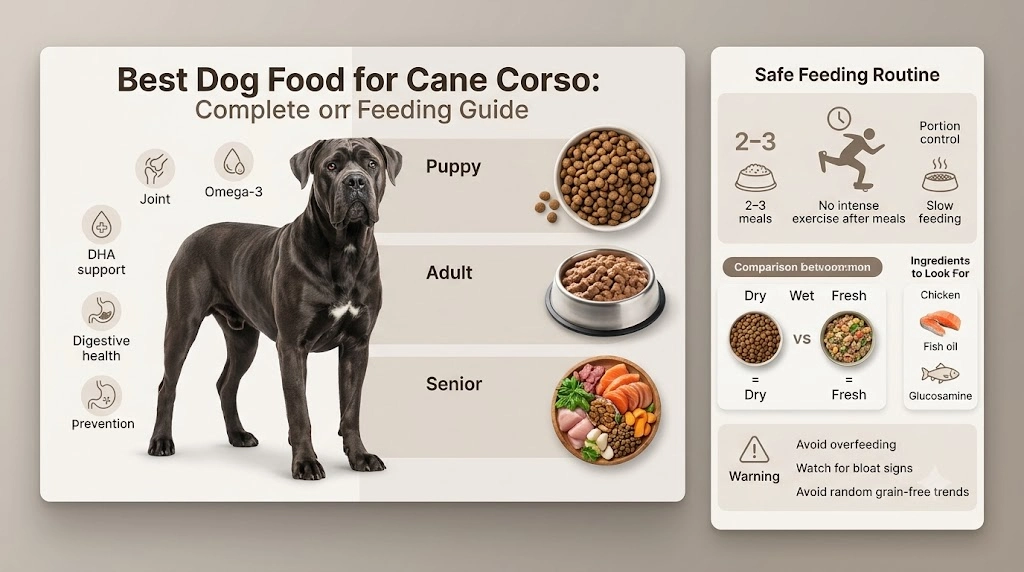
Feeding Guide Table for Cane Corsos
| Life stage | Best food type | Main goal | Feeding note |
| Puppy | Large-breed puppy food | Controlled growth, bone support, DHA | Weigh regularly and adjust portions as the puppy grows. |
| Adult | Large-breed adult food | Lean muscle, joint support, stable energy | Measure meals and avoid free-feeding. |
| Senior | Senior or controlled-calorie large-breed formula | Maintain muscle while reducing excess calories | Watch body condition and muscle loss closely. |
| Sensitive stomach | Highly digestible formula | Easier digestion | Change food gradually and monitor stool quality. |
| Bloat-prone dog | Smaller meals, calm routine | Lower GDV risk | Feed at least twice daily and avoid exercise around meals. |
Best Dog Food for Cane Corso Puppies
Cane Corso puppies grow fast, and fast growth is exactly where owners can make expensive mistakes. The safest starting point is a large-breed puppy formula that supports controlled development, not a random adult formula or a high-calorie “performance” recipe. FEDIAF highlights the importance of keeping a puppy on the right growth curve and adjusting food intake individually as the dog develops.
For a Cane Corso puppy, prioritize:
- Large-breed puppy designation
- DHA for brain and vision development
- Controlled mineral balance
- Digestible protein
- Measured growth, not rapid weight gain
What puppy owners should avoid
Avoid overfeeding, frequent treats, and switching foods too often. Also, avoid making “more protein” the only goal. In giant and large breeds, growth quality matters more than growth speed. That is why body condition and regular weighing are so useful.
Mini summary:
A Cane Corso puppy needs steady, controlled growth, not aggressive calorie loading. Choose a large-breed puppy formula and monitor growth closely.
Best Dog Food for Adult Cane Corsos
Adult Cane Corsos usually do best on a Large-Breed Adult Formula with solid protein quality, controlled calories, and joint support. Adult feeding should be consistent and measured, because these dogs can gain weight quickly if portions drift upward. WSAVA’s nutrition guidance supports assessing body condition at each visit rather than assuming the label is enough.
For active adults, you want:
- Quality animal protein for muscle maintenance
- Enough fat to support energy, but not so much that weight creeps up
- Omega-3 support for joints and coat
- A formula that your dog digests reliably
- A feeding schedule that stays predictable
How does activity change the food choice
A working or highly active Cane Corso may need a richer formula than a calmer family dog. But “more active” does not always mean “more calories forever.” It means matching the food to the dog’s real routine and checking the waistline often. WSAVA’s approach is useful here because it treats nutrition as an ongoing assessment, not a one-time decision.
Best Dog Food for Senior Cane Corsos
Senior Cane Corsos often need fewer calories, but they still need high-quality protein to help preserve muscle. This is where many owners overcorrect: they cut food too much, and the dog loses strength, or they keep feeding the same calories and the weight climbs. A senior-friendly formula should help maintain a healthy body condition while supporting joints and digestion.
Senior feeding priorities
- Keep protein quality strong
- Reduce unnecessary calories
- Support mobility with joint-friendly nutrients
- Watch muscle condition, not just body weight
- Keep meal timing calm and predictable
Dry vs Wet vs Fresh Food: What Works Best?
There is no single best format for every Cane Corso. The right choice depends on budget, convenience, digestion, and how easily your dog maintains a healthy weight. Dry food is usually the easiest for portion control. Wet food can improve palatability and hydration. Fresh food can work well for owners who want premium convenience, but it still needs to be complete and balanced.
| Food type | Pros | Cons | Best for |
| Dry food | Easy to store, easy to measure, often budget-friendly | Can be less palatable for some dogs | Daily maintenance feeding |
| Wet food | Tasty, moisture-rich | More expensive, less convenient in large amounts | Picky eaters, hydration support |
| Fresh food | Highly appealing, premium feel | Costly, must still meet nutrition standards | Owners who want premium feeding convenience |
In Europe, pet food labels must provide composition, additives, nutritional analysis, and feeding guidelines under EU feed rules, so label-reading matters whether the format is dry, wet, or fresh. FEDIAF also notes that its nutrition guidelines serve as a practical reference for healthy animals.
Mini summary:
The best format is the one your Cane Corso digests well, stays healthy on, and you can measure consistently. Format matters less than nutritional completeness and portion control.
How to Feed a Cane Corso Safely
Feeding routine matters almost as much as formula choice. Veterinary sources note that bloat is linked to large meals, exercise around meals, rapid eating, and deep-chested body shape. For large and giant breeds, feeding at least twice daily is a common safety step, and exercise should not happen immediately before or after meals.
Safer feeding routine
- Feed two or more measured meals a day.
- Keep meals calm and low-stress.
- Avoid hard exercise right before or after eating.
- Use slow-feeding strategies if your dog eats too fast.
- Track weight and body condition regularly.
Bloat warning signs you should never ignore
- Restlessness
- Repeated unproductive retching
- Abdominal swelling
- Drooling
- Weakness or collapse
- Signs of pain or shock
If these signs appear, this is not a wait-and-watch situation. GDV is an emergency. Merck and Cornell both describe it as life-threatening and Best Dog Food for Cane Corso requiring immediate veterinary intervention.
Ingredients to Look For
A Cane Corso diet does not need to be fancy. It needs to be practical and sensible.
Helpful ingredients include:
- Chicken, turkey, beef, lamb, salmon, or other named proteins
- Fish oil or other omega-3 sources
- Glucosamine and chondroitin for joint support
- DHA in puppy formulas
- Digestible grains or carbohydrates that the dog tolerates well
Ingredients to be careful with
Be careful with formulas that overpromise and under-explain. Avoid choosing a diet only because it is trendy, grain-free, or “ancestral.” The FDA has stated that DCM reports have involved both grain-free and grain-containing foods, often with legumes or pulses high in the ingredient list. That is a reason to think carefully, not a reason to panic.
Europe-Specific Practical Advice
For Dogizle’s European audience, the most useful Best Dog Food for Cane Corso thing you can teach is label literacy. In Europe, pet food labeling falls under EU feed legislation, and required label information includes composition, additives, nutritional analysis, and feeding guidelines. FEDIAF’s nutrition guidelines are widely used as a practical reference and are peer reviewed by independent veterinary nutritionists across Europe.
What European owners should check on the label
- Is the food complete and balanced?
- Does it match the dog’s life stage?
- Is the feeding guide clear?
- Does the formula support a large-breed dog?
- Is there a sensible explanation of the ingredient profile?
This is especially useful in the UK, Germany, France, Italy, Spain, the Netherlands, Sweden, Switzerland, Australia, and Canada, where owners often Best Dog Food for Cane Corso compare imported brands, local brands, and vet-recommended lines. FEDIAF and RSPCA-style guidance both support choosing a balanced commercial diet suitable for the dog’s life stage and health status.
Apartment Living, Urban Life, and Climate Considerations
Cane Corsos can live in urban settings, but food management becomes more important when the dog has less room to move freely. Apartment dogs often Best Dog Food for Cane Corso get more structured routines, fewer accidental calories, and more predictable exercise windows. That makes body-condition monitoring especially useful. WSAVA’s emphasis on body and muscle condition is helpful for urban owners who cannot rely on “he looks fine” as a health measure.
In colder climates, large breeds may seem rugged, but cold weather can still affect activity level, calorie use, and joint comfort. In warmer climates, appetite and Best Dog Food for Cane Corso hydration patterns can shift. The answer is not to guess; it is to watch the dog’s body condition and adjust the feeding plan as needed.
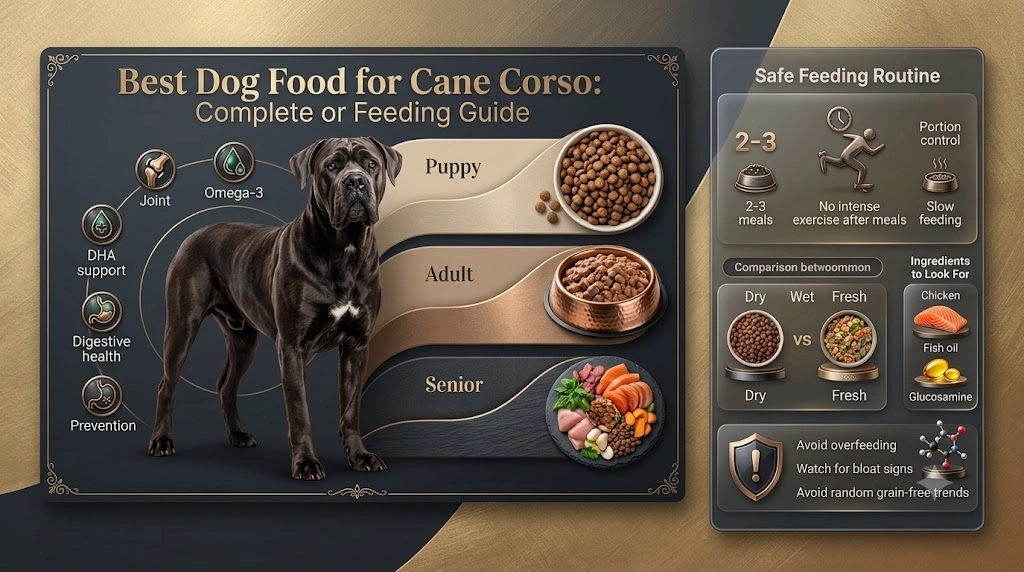
Pros and Cons of Cane Corso Ownership from a Feeding Perspective
Pros
- Usually does well on structured routines
- Responds well to clear feeding schedules
- Can thrive on large-breed nutrition
- Easy to monitor body condition when handled consistently
Cons
- Bloat risk makes feeding habits important
- A large frame means mistakes are expensive
- Rapid puppy growth must be controlled carefully
- Overfeeding can quietly damage long-term mobility
Common Mistakes Cane Corso Owners Make
- Choosing food only by protein percentage
- Switching foods too quickly
- Feeding one giant meal a day
- Ignoring body condition and muscle loss
- Using grain-free because it sounds premium
- Overfeeding treats during training
- Not adjusting food as the dog ages
Expert Tips for Better Cane Corso Feeding
- Keep a simple feeding log for the first few months.
- Weigh your dog regularly, especially during growth or weight-loss phases.
- Use the body condition score as your reality check, not just the scale.
- Make food changes gradually unless your veterinarian tells you otherwise.
- Keep mealtimes calm and predictable.
People Also Ask
A large-breed puppy food is the safest starting point. Look for controlled growth support, DHA, and clear life-stage labeling. FEDIAF recommends regular weighing of puppies and adjusting intake as they grow.
Not by default. The FDA has reported DCM cases linked to both grain-free and grain-containing diets, with many reports involving diets high in legumes or pulses. The better question is whether the food is complete, balanced, and appropriate for your dog.
At least twice daily is a safer routine than one large meal. Veterinary guidance also recommends avoiding exercise immediately before or after eating, especially for large, deep-chested dogs.
There is no universal amount. Use the feeding guide on the label as a starting point, then adjust using body condition score, activity level, and veterinary advice. WSAVA recommends body condition and muscle condition checks as part of the nutrition assessment.
Named animal proteins, digestible carbohydrates, omega-3 fats, and joint-support ingredients are all helpful. Puppies benefit from DHA, while adults often do well with large-breed adult formulas.
Final Verdict
The Best Dog Food for A Cane Corso is not one single brand. It is the formula that fits your dog’s age, body condition, digestion, and activity level while supporting large-breed needs. For puppies, focus on controlled growth and large-breed puppy nutrition. For adults, prioritize lean muscle, joint support, and calorie control. Its seniors, protect mobility and body condition without overfeeding. For all Cane Corsos, the feeding routine matters just as much as the food itself. Large, deep-chested dogs should be fed with care because bloat can be sudden and life-threatening.
If you want a dog food strategy that holds up in 2026 and beyond, think in terms of complete nutrition, large-breed safety, life-stage matching, and consistent feeding habits. That is the foundation of responsible Cane Corso ownership.