
Best Large Dog Breeds Gentle Giants, Family Picks & Expert Comparison
Choosing the Best Large Dog Breeds is never just a matter of appearance. A big dog can bring joy, structure, security, and emotional comfort into a home, but it also brings responsibility, cost, training, and long-term care. For the right family, a large breed becomes a trusted companion, a steady guardian, and a deeply affectionate member of the household. For the wrong setup, however, the same dog can become stressed, under-stimulated, difficult to manage, and expensive to maintain.
In 2026, dog owners across Europe and around the world are becoming more selective about breed choice. The modern pet parent is no longer simply asking, “Which dog looks impressive?” Instead, the smarter question is: “Which large breed actually matches my lifestyle, living space, budget, activity level, and experience?” That shift matters because breed compatibility strongly influences long-term success.
Some people need a family-friendly companion with a stable temperament. Others want a calm giant that can adapt to apartment life. Many are looking for a protective dog with strong loyalty and trainability. Still others want a breed that thrives in cold weather, enjoys outdoor activity, or fits an active, experienced household. This guide brings all of that together in one practical, research-informed, SEO-friendly resource.
You will find the top large dog breeds, their core behavioral traits, family suitability, training expectations, lifestyle compatibility, hidden ownership costs, and health considerations. You will also see how to compare them intelligently so you can make a confident decision rather than an emotional one. The goal is simple: help you choose a large dog breed that is not only beautiful, but also truly suitable for your home and routine.
Why Choosing the Right Large Dog Breed Matters
Large dogs are powerful, intelligent, and often highly devoted. They can be loving with children, deeply bonded to their owners, and naturally protective in the right environment. But a large breed is also a long-term commitment that demands planning.
When people choose a breed without enough thought, the problems usually appear later. The dog may have more energy than expected, need more exercise than the family can provide, or develop behavior issues because training was inconsistent. Some owners underestimate how much food a large dog consumes. Others ignore grooming, joint care, socialization, or the need for daily mental Best Large Dog Breeds stimulation. In many cases, the issue is not the dog; it is the mismatch between the dog’s needs and the owner’s lifestyle.
Before bringing home a large breed, it helps to think through a few important factors:
A large dog needs suitable living space. That does not always mean a huge house, but it does mean enough room for movement, rest, and stress-free living. A calm Great Dane may adapt better to an apartment than a high-drive dog with a lot of nervous energy, provided the owner gives sufficient exercise and structure.
Exercise is another major factor. Some breeds need long daily walks, active play, and training sessions that challenge the mind as much as the body. Others are more relaxed indoors but still need a routine to prevent boredom and unwanted habits.
What Makes a Dog a “Large Breed”?
A dog is generally considered a large breed when it exceeds typical medium-size proportions in weight, height, and physical structure. In practical terms, many large breeds weigh around 25 to 45 kilograms or more, and some well above that range. Height also tends to be greater, often reaching 55 to 70 centimeters or higher at the shoulder.
That can be powerful physically, which means training matters even more.
They often mature more slowly, both physically and mentally, than many smaller breeds.
Best Large Dog Breeds
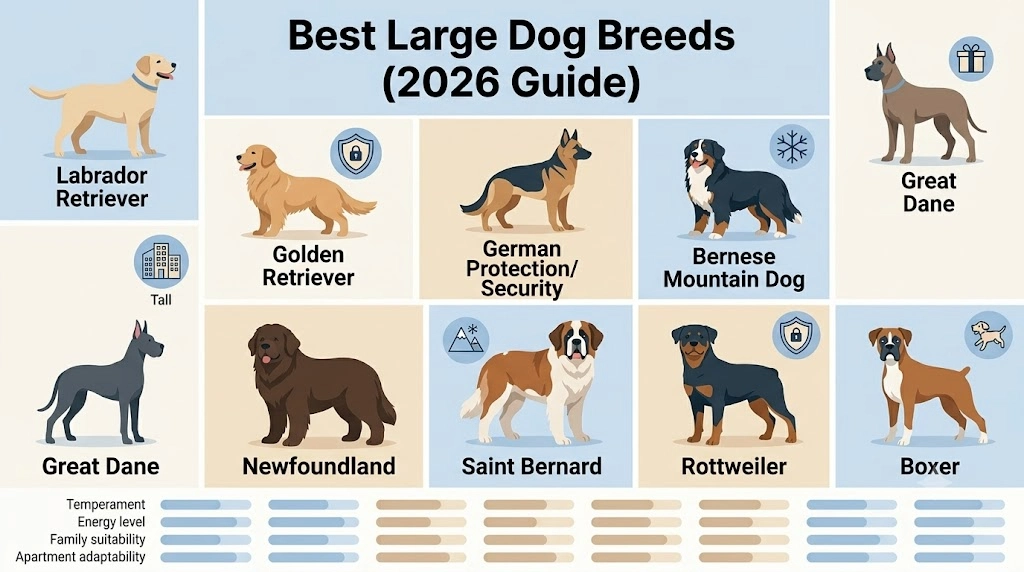
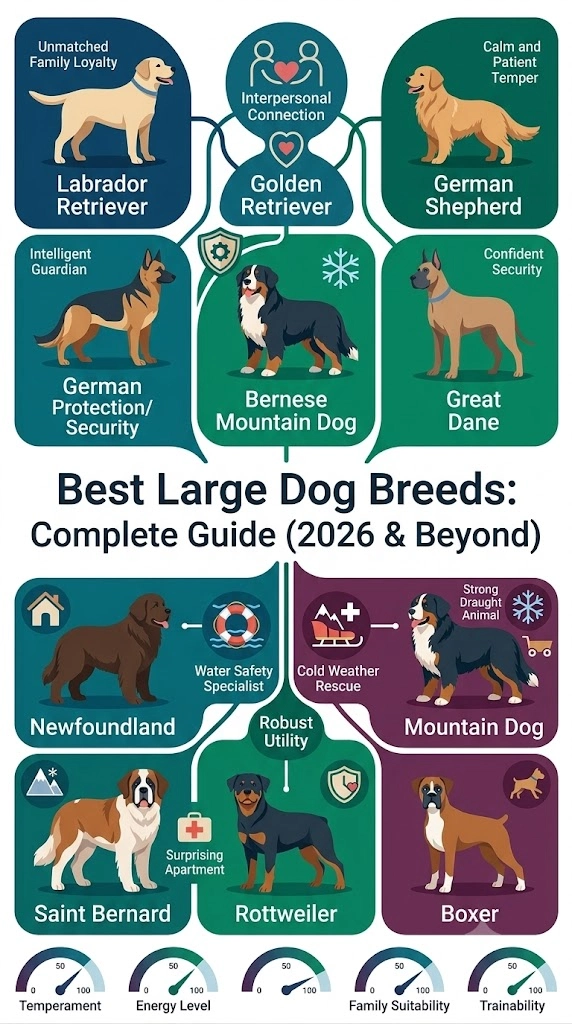
The breeds below are some of the most trusted large dog options for families, active homes, calm households, and owners who want a blend of temperament, trainability, and lifestyle adaptability. Each breed offers something different, so the “best” choice depends on your goals.
Labrador Retriever – Best Family Large Dog
The Labrador Retriever remains one of the most beloved family dogs in the world, and for good reason. It combines friendliness, intelligence, adaptability, and a steady temperament in a way that appeals to both first-time and experienced dog owners.
Labradors are social dogs. They usually enjoy being part of family life and are often eager to participate in activities, from walks and games to training and companionship. Their cooperative nature makes them highly trainable, which is one reason they are frequently chosen for service work, therapy roles, and assistance roles.
For households with children, the Labrador often stands out because of its tolerant and affectionate nature. It typically handles busy Best Large Dog Breeds homes better than many highly sensitive breeds. It tends to want inclusion rather than isolation, which is ideal for families that want a dog as a true member of the household.
That said, Labrador ownership still requires commitment. This is an active breed with a healthy appetite and a strong interest in people, movement, and play. Without exercise and boundaries, it may become boisterous, overexcited, or prone to unwanted habits.
Labradors are a strong fit for families, active first-time owners, and households that want a balanced, people-oriented dog. In Europe, they can adapt well to suburban and rural settings, and even some urban environments, as long as they receive enough daily physical and mental stimulation. For many people, the Labrador is the gold standard of the large family dog.
Golden Retriever – Most Balanced Temperament
The Golden Retriever is often praised for its gentle personality, emotional sensitivity, and easygoing manner. It is a breed that feels naturally at home in family settings because it tends to be patient, affectionate, and eager to please.
What makes the Golden Retriever especially appealing is its balance. It is active without being overwhelming, affectionate without being clingy in a problematic way, and intelligent without being overly difficult to manage. This makes it a favorite among owners who want a large dog with a calm emotional profile.
Golden Retrievers are usually very responsive to training. They enjoy structure, positive reinforcement, and shared activities. Their people-focused nature means they often flourish when they are included in day-to-day life rather than left alone for long stretches.
They are especially suitable for families with children, homes that want a loving companion, and owners who value emotional connection. They can also be excellent as therapy dogs or support-oriented companions because of their stable, empathetic temperament.
The breed does need regular exercise Best Large Dog Breeds and mental engagement. A bored Golden can become restless or develop undesirable habits, especially if it is under-stimulated. Grooming is another practical consideration, since the coat requires routine care.
Still, for households seeking a large breed that is gentle, intelligent, and widely adaptable, the Golden Retriever remains one of the strongest options available.
German Shepherd – Best Protection Dog
The German Shepherd is one of the most respected working breeds in the world. It is intelligent, alert, loyal, and highly capable. When properly trained, it can be an outstanding family guardian, working companion, or active household dog.
This breed is known for its sharp mind and strong willingness to learn. That makes it a favorite for obedience, protection work, police roles, search and rescue, and advanced training. Owners who enjoy teaching commands, building routines, and giving a dog meaningful tasks often find the German Shepherd deeply satisfying.
Its protective instincts are one of its defining traits. A well-bred, well-socialized German Shepherd is naturally watchful and responsive. This can be a major advantage for families who want a confident guardian. However, it also means the dog needs early socialization, consistent handling, and clear boundaries. Without that foundation, the breed may become anxious, reactive, or overly territorial.
The German Shepherd is best suited to Best Large Dog Breeds experienced owners or households that are willing to invest time in training. It needs regular exercise, mental challenge, and stable leadership. A busy, inconsistent environment is not ideal.
For security-focused families, active households, and owners who want a bright, loyal, trainable dog with a strong presence, the German Shepherd is a standout breed.
Bernese Mountain Dog – Calm Family Giant
The Bernese Mountain Dog is a classic gentle giant. Originating from Switzerland, it is known for its calm demeanor, affectionate nature, and family-friendly personality. It often makes an excellent choice for owners who want a large dog that feels steady, soft-hearted, and deeply connected to its people.
Bernese Mountain Dogs are typically very loving and patient. They often do well with children and are generally happiest in homes where they can be part of family life. Their temperament is one of the biggest reasons people fall in love with the breed. They tend to bring a peaceful, comforting presence into the home.
They are not usually high-strung, which can make them easier to live with in a calm environment. That said, they still need exercise and routine, and they are not a breed to ignore simply because they seem laid-back. They also Best Large Dog Breeds need proper grooming and health monitoring.
One important consideration is lifespan. Compared with some other breeds, Bernese Mountain Dogs often have a shorter average life expectancy, which is something potential owners should understand before making a commitment. Their size and genetic background make proactive health care especially important.
This breed is a strong choice for families who want a calm giant, for households with cooler climates, and for owners who appreciate a loving, gentle presence in a large frame. In the right environment, the Bernese Mountain Dog can be one of the most rewarding companions available.
Great Dane – The Gentle Giant
The Great Dane is one of the most recognizable large breeds in the world. With its towering height and elegant build, it makes a strong visual impression. Yet behind that imposing frame is often a surprisingly calm, affectionate, and low-drama companion.
Great Danes are frequently described as gentle giants because of their relaxed indoor behavior and sweet temperament. Many are content to lounge, follow their people from room to room, and enjoy quiet companionship. Despite their size, they are often less intense than some smaller, more excitable breeds.
This makes the Great Dane appealing for owners who want a large dog with a calm household profile. In some cases, it can even fit Best Large Dog Breeds apartment living better than a higher-energy dog, provided the dog gets sufficient exercise, space to move, and a clear daily structure.
Of course, size brings practical realities. A Great Dane needs a strong bed, durable equipment, proper nutrition, and close attention to joint health. Owners should also understand that giant breeds can have special veterinary needs, and their lifespan is often shorter than that of medium-sized dogs.
Even so, for people who want a majestic, affectionate, relatively calm giant, the Great Dane is hard to ignore. It combines presence and softness in a way that makes it one of the most iconic large breeds for modern homes.
Newfoundland – Best Water Rescue Dog
The Newfoundland is a powerful, noble, and remarkably gentle breed known for its history with water rescue and its extraordinary swimming ability. It has a reputation for patience, strength, and calm reliability, which makes it especially appealing to families and owners who value a steady temperament.
Newfoundlands are often good with children and usually come across as soft, composed, and affectionate. Their size is substantial, but their disposition is rarely harsh. Instead, they tend to be kind-hearted dogs that bond closely with their people.
Their love of water is one of the most unique features of the breed. If your lifestyle includes coastal living, lakes, rivers, boating, or outdoor water activities, a Newfoundland may be a wonderful fit. These dogs often enjoy purposeful work and physical activity, especially when it involves swimming.
The breed is also known for a thick coat, which requires grooming and regular upkeep. In warm climates, overheating can be a concern, so the environment matters. They are generally more comfortable in cooler conditions and homes that can support their physical needs.
For owners seeking a large, patient, family-oriented dog with a calm and protective spirit, the Newfoundland is an exceptional breed.
Saint Bernard – Cold Weather Companion
The Saint Bernard is one of the most legendary giant breeds, long associated with mountain rescue, snowy terrain, and dependable companionship. It carries an image of strength, endurance, and kindness, and much of that reputation is well earned.
Saint Bernards are typically calm, gentle, and steady. They often do well in family homes that appreciate a low-drama, affectionate dog with a loving disposition. Their temperament is one of the main reasons they remain so popular among giant-breed enthusiasts.
The breed does especially well in cold weather and is often best suited to cooler climates. Thick coats, heavy bodies, and a preference Best Large Dog Breeds for moderate activity make them more comfortable when temperatures are lower.
Owners should understand that Saint Bernards are a major responsibility. They are large, powerful, and can be expensive to care for. They may also have health challenges common to giant breeds, including orthopedic and weight-related concerns. Because of this, responsible feeding, joint support, and regular veterinary care are essential.
This breed is best for people who want a calm, protective, and deeply loyal giant, especially in colder regions or more spacious homes.
Rottweiler – Powerful Guardian Breed
The Rottweiler is a strong, confident breed with a reputation for loyalty, intelligence, and protection. When raised responsibly, it can become an outstanding companion for experienced owners who want a dependable guardian with a stable mind and a powerful presence.
Rottweilers are often deeply attached to their families. They can be affectionate, attentive, and highly bonded, but they also tend to have strong instincts related to guarding and territorial awareness. That combination can be an asset when managed correctly, but it requires discipline and early training.
A well-socialized Rottweiler is typically calm, composed, and responsive. However, without proper structure, the breed can become too dominant, overly suspicious, or difficult to control. This is why the Rottweiler is Best Large Dog Breeds usually recommended for owners who have experience, confidence, and consistency.
Exercise is important, as are obedience drills, controlled introductions, and ongoing mental stimulation. This breed is not for casual ownership or inconsistent routines. It thrives when it has a clear role, clear rules, and a calm handler.
For families or individuals seeking a powerful guardian that is also deeply loyal, the Rottweiler can be one of the most impressive large breeds available.
Boxer – Energetic Family Protector
The Boxer is a lively, athletic, and affectionate breed that combines playfulness with loyalty and watchfulness. It is often a strong fit for active families who want a dog that can keep up with movement, games, training, and daily interaction.
Boxers are known for their high energy and spirited personality. They often enjoy play, exercise, and time with children. Many owners love the breed because it feels fun, engaged, and emotionally expressive. A Boxer is not a passive dog; it wants to participate.
At the same time, the breed also has protective instincts and a devoted nature. It can be alert and serious when needed, which gives it a balanced personality. It may be playful in one moment and attentive in the next.
Because of its energy level, the Boxer is best suited to homes that can provide regular activity, structure, and involvement. It may not be the ideal choice for very sedentary households. Like other large breeds, it also benefits from training, socialization, and health monitoring.
For active families who want a large dog with enthusiasm, loyalty, and a strong bond with people, the Boxer is a compelling option.
Large Dog Breed Comparison Table
Below is a practical comparison of the breeds covered in this guide. It can help you quickly narrow down the best match for your household.
| Breed | Temperament | Trainability | Family Friendly | Energy Level | Apartment Suitability |
| Labrador Retriever | Friendly | Easy | Very High | High | Medium |
| Golden Retriever | Calm | Easy | Very High | Medium | Medium |
| German Shepherd | Protective | Medium | High | High | Low |
| Bernese Mountain Dog | Gentle | Medium | Very High | Low | Medium |
| Great Dane | Calm | Easy | High | Low | High |
| Newfoundland | Gentle | Medium | Very High | Low | Medium |
| Saint Bernard | Calm | Medium | High | Low | Low |
| Rottweiler | Protective | Medium | High | High | Low |
| Boxer | Energetic | Medium | High | High | Medium |
This table should not be read as a final verdict. Instead, it should be used as a decision-making filter. A breed with low apartment suitability may still work in a city home if the dog receives enough exercise, structure, and mental enrichment. A breed marked as family-friendly may still be a poor fit if the household cannot provide consistent leadership or proper supervision. Real-life compatibility is always more nuanced than a chart.
Best Large Dog Breeds by Lifestyle
Different households need different traits. Below is a lifestyle-based way to think about the breeds.
Family Homes
For families, the strongest options are usually breeds that combine patience, friendliness, stability, and trainability. In this category, the Labrador Retriever, Golden Retriever, and Bernese Mountain Dog are often top choices. These breeds tend to integrate well into household routines, enjoy being around people, and offer a temperament that is usually more forgiving than that of highly reactive dogs.
Apartment Living in Urban Europe
Large dogs can live in apartments more successfully than many people assume, but this depends on the breed and the owner’s discipline. A dog with a calmer indoor profile and lower energy needs is usually easier Best Large Dog Breeds to manage in a smaller living space. Great Danes are often a surprising fit because they tend to be relaxed indoors. Newfoundlands can also work well if they get the right exercise and the home environment suits their needs. Some Boxers can adapt too, but they require more activity and commitment.
First-Time Owners
First-time owners usually benefit from breeds that are responsive, people-oriented, and easier to train. The Labrador Retriever and Golden Retriever are often the safest starting points because they are more cooperative and typically easier to guide. This does not mean they are effortless, but they are generally more beginner-friendly than highly protective or intense working breeds.
Guard Dogs
If the goal is a protective large breed, the German Shepherd and Rottweiler are often the leading names. Both have strong protective instincts, intelligence, and the ability to become excellent guardians when raised properly. These breeds are best handled by owners who understand training, structure, and the importance of social stability.
Cold Climate Homes
For colder weather, the Bernese Mountain Dog, Saint Bernard, and Newfoundland are especially well-suited. Their coats, body structures, and historical backgrounds make them comfortable in cooler environments. They are often Best Large Dog Breeds better choices than breeds that struggle in heat or humidity.
Hidden Costs of Large Dog Ownership
One of the biggest mistakes people make is focusing only on the purchase price or adoption fee. The real cost of owning a large dog shows up over time.
Large breeds eat more food, and quality nutrition matters. A big dog with a fast-growing body or active lifestyle needs a diet that supports muscle maintenance, joint health, digestion, and long-term vitality. Cheap food can create bigger health bills later.
Veterinary care is another major expense. Large dogs often need regular checkups, vaccinations, parasite prevention, dental care, and sometimes more specialized orthopedic monitoring. If the dog develops bloat, hip dysplasia, or chronic joint issues, costs can rise quickly.
Grooming may also be significant, especially for coated breeds like the Golden Retriever, Bernese Mountain Dog, Newfoundland, or Saint Bernard. Brushing, de-shedding, bathing, nail care, and coat maintenance all take time and money.
Then there are the everyday items people forget to budget for: large beds, durable crates, strong harnesses, sturdy leads, oversized toys, and sometimes reinforced home equipment. Even basic supplies can cost more because they must be larger and more durable.
Training is another investment. Whether you train at home or hire a professional, large dogs benefit from obedience work, socialization, and behavior management. Skipping training often leads to much bigger problems later.
In many cases, large dogs can cost two to three times more annually than medium breeds, especially when food, vet care, and gear are included. That is why planning matters. A large dog can be worth every cent, but only when the owner is financially prepared.
Pros and Cons of Large Dog Ownership
Large breeds bring major rewards, but they also require serious responsibility.
Pros
Large dogs are often deeply loyal. Many form a powerful bond with their families and become emotionally important members of the household.
They can be excellent with children when properly matched and trained. Their size can even create a sense of stability and security.
They are often ideal outdoor companions. Whether you enjoy hiking, walking, training, swimming, or spending time in nature, a large dog can be a wonderful partner.
Many large breeds are naturally protective, which can be reassuring for owners who value watchfulness and confidence.
Their presence can be comforting. A calm giant often creates a strong emotional atmosphere in the home, which many families appreciate.
Cons
Large dogs are expensive to maintain. Food, health care, grooming, and supplies all add up.
Some large breeds have shorter average lifespans, which can be emotionally difficult for families.
They need space, or at least a lifestyle that allows enough exercise and movement. Without that, they may become restless.
Training is not optional. A big dog without structure can be difficult to handle physically and behaviorally.
Health risks such as hip issues, bloat, weight gain, and joint strain are more common in many large breeds, so preventive care is essential.
The truth is simple: large dogs are incredibly rewarding, but only when the owner understands the full responsibility behind the size.
Health Considerations for Large Breeds
Large dogs need preventive care from the start, not only when problems appear. Because of their body size and skeletal load, certain conditions are more common in larger breeds.
Hip dysplasia and elbow dysplasia are among the most widely discussed orthopedic issues. These conditions can affect mobility, comfort, and quality of life. Early monitoring, careful exercise, and maintaining a healthy weight help reduce strain.
Bloat, also called gastric torsion in severe cases, is another serious concern for some large and deep-chested breeds. This is one reason feeding habits, meal timing, and activity management around meals matter so much.
Heart disease can also appear in some breeds, especially as they age. Regular veterinary visits can help catch issues early and support long-term health.
Obesity is a major but preventable problem. Extra weight can significantly worsen pressure on joints, movement, breathing, and overall well-being. Overfeeding is easy to do with a large breed because their appetite can be strong, but weight control is one of the best health investments an owner can make.
Preventive veterinary care is a smart strategy. Regular checkups, ideally twice a year for many large dogs, allow early detection of issues. A controlled diet, appropriate exercise, joint supplements when recommended, and responsible breeding selection all contribute to a healthier life.
For owners in Europe, working with a trusted veterinarian and following breed-specific guidance can help reduce long-term risk and improve quality of life.
Common Mistakes Dog Owners Make
Many large dog problems begin with poor planning rather than bad luck. Some of the most common mistakes include choosing a dog because it looks impressive instead of because it fits the owner’s lifestyle.
People also underestimate exercise needs. A large breed that seems calm in a kennel or at the breeder’s home may still need far more movement than the owner expected.
Another frequent mistake is overfeeding. Because large dogs are imposing, owners often assume they need extra food or treats, but that can quickly lead to weight gain. In large breeds, excess weight can become a serious health burden.
Some owners skip early socialization. That is risky, especially with protective or powerful breeds. Socialization helps a dog become stable, confident, and manageable in real-world situations.
Training inconsistency is another major issue. A dog that receives mixed messages will test boundaries, especially if it is intelligent and physically strong.
Finally, some owners fail to research breed-specific health risks. Knowing what conditions are common in a breed allows you to act early and protect your dog better over time.
FAQs
The Labrador Retriever is widely considered the most balanced and family-friendly large breed. It combines trainability, social behavior, adaptability, and a stable personality in a way that works well for many households.
The Bernese Mountain Dog and Great Dane are often considered among the calmest large breeds. Both are known for their relaxed indoor nature and gentle presence.
Yes, but only if the breed and lifestyle are a good match. Calm breeds like Great Danes or some Newfoundlands may adapt well, as long as they receive enough exercise, structure, and daily attention.
The German Shepherd and Rottweiler are often regarded as top protective breeds. Both are intelligent, loyal, and naturally alert, making them strong guardian candidates when trained properly.
Yes, many large breeds do have shorter average lifespans than smaller breeds. A common range is around 8 to 12 years, although this varies depending on genetics, care, diet, and overall health.
Conclusion
The best large dog breeds are not simply the biggest or most famous names. They are the breeds that fit your lifestyle, your home, your budget, and your ability to provide structure, care, and affection over many years.
A Labrador Retriever may be the best match for a family that wants friendliness and trainability. A Golden Retriever may be ideal for a calm, emotionally connected household. A German Shepherd or Rottweiler may suit an owner looking for protection and strong loyalty. A Great Dane may be the right choice for someone who wants a calm giant in a more relaxed home setting. A Bernese Mountain Dog, Newfoundland, Saint Bernard, or Boxer may be perfect for very different types of families, climates, and routines.
The point is not to find the “best dog in general.” The point is to find the best dog for you.
When you evaluate temperament, exercise needs, grooming demands, trainability, health risks, and financial responsibility together, your decision becomes much clearer. That is how you choose a companion that will not only fit into your home, but enrich it.
A well-matched large dog is more than a pet. It becomes a loyal partner, a source of comfort, a protector, and a true family member.