Introduction
Bad Breath, yellow tartar, and gum irritation are the warning signs many dog owners notice first, but by then the problem is often already underway. The World Small Animal Veterinary Association says oral and dental disease is one of the most common medical conditions affecting companion animals, and AAHA notes that by age three, most dogs and cats already have some degree of dental disease. That is why the search for the best dog chews for teeth is really a search for something more useful than marketing: a chew that is safe, realistic, and actually helpful inside a broader dental routine.
This guide is built for dog owners who want a clear answer, not a vague roundup. You will learn what dental chews can do, what they cannot do, how to choose the right size and texture, which VOHC-accepted examples are worth shortlisting, and when chewing is not enough and a veterinarian should be involved. VOHC and AAHA both emphasize that brushing remains the gold standard, while VOHC-accepted chews can be a useful support tool when used as directed.
Why this page should outperform the usual roundup
Most competing pages get one thing right: they help people compare products quickly. But they miss the decision-making layer. A dog owner does not just need a brand name. They need to know whether the chew is right for a small dog, a fast chewer, a senior dog with missing teeth, a puppy, or a dog with a sensitive stomach. They also need honest safety guidance, because not every “dental” chew is appropriate for every mouth.
The real SEO opportunity is to answer the full job-to-be-done:
- What chew should I buy?
- Is it safe?
- How often should I give it?
- Does it replace brushing?
- What should I avoid?
- When do I need a vet instead?
That is the structure of a true pillar page, and that is what search engines reward when a query is commercial but still educational.
Do dog dental chews really work?
Yes, but only in the right context. VOHC exists to recognize products that meet preset standards for plaque and tartar reduction in dogs and cats, and the seal is awarded only after review of trial data conducted under VOHC protocols. VOHC also states that regular use of products carrying the seal will reduce the severity of periodontal disease.
The important part is the limitation: chews are support tools, not magic. They can help by increasing chewing time, mechanically rubbing the tooth surface, and encouraging a daily oral-care habit. But they do not clean every tooth equally, they do not remove established disease under the gumline, and they do not take the place of brushing or professional cleaning when needed. VOHC says daily oral hygiene is the ideal, with brushing as the gold standard.
Snippet-ready answer
Dog dental chews can help reduce plaque and tartar, but they work best as part of a full oral-care routine. Brushing is still the gold standard, and VOHC-accepted chews are the safest place to start.
What makes a dental chew worth buying?
The best dental chew is not the flashiest one. It is the one that combines evidence, the right size, proper supervision, and reasonable digestibility.
The buying framework that actually matters
| What to check | What good looks like | Why it matters |
| VOHC seal | The product appears on the VOHC accepted list | Gives you a better evidence filter than marketing claims |
| Size match | The chew fits your dog’s body weight and mouth size | Reduces the risk of swallowing and obstruction |
| Chewing time | Your dog needs real chewing effort, not one quick crunch | More contact time may help with plaque control |
| Supervision | You can watch your dog while chewing | VOHC specifically recommends observation |
| Calorie budget | The chew fits into daily treat calories | Dental chews are still treats |
| Digestibility | Ingredients are appropriate for your dog | Important for sensitive stomachs and weight control |
VOHC specifically warns that obstruction risk is reduced when owners give the right-sized product for the dog’s body weight and only offer it when they can watch the dog chew it. That is one of the most useful safety rules in the entire category.
What the VOHC seal really means
The VOHC seal is not a vague “vet-approved” sticker. VOHC says it does not test products itself. Instead, it reviews submitted data from trials that meet VOHC protocols, and products that pass receive the Seal of Acceptance. That makes the seal much more meaningful than “natural,” “fresh breath,” or “dental-style” wording on a package.
Mini summary
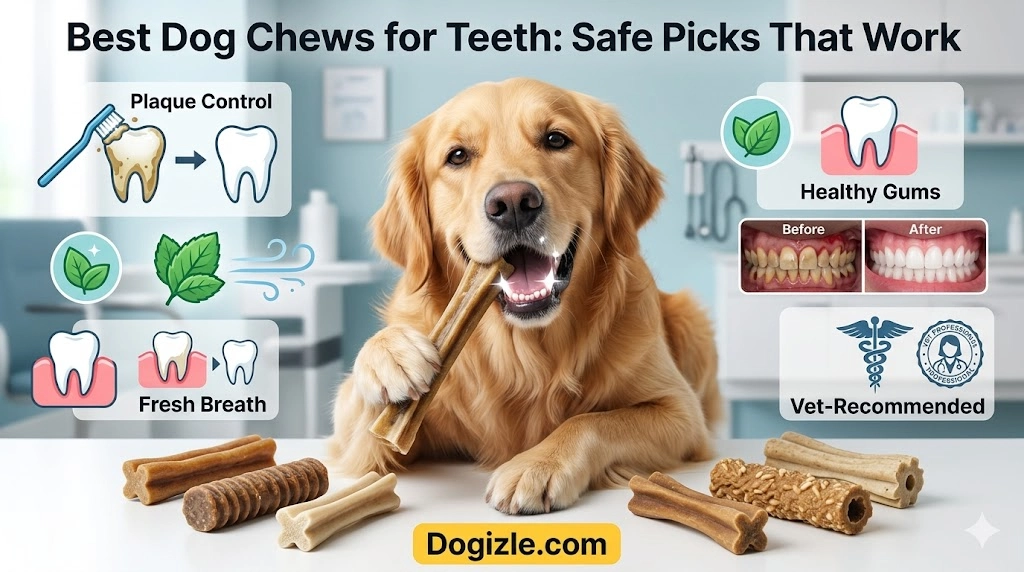
If you remember only one thing from this section, make it this: VOHC seal + right size + supervision + brushing is the safest and smartest framework.
Best dog chews for teeth by dog type
The easiest way to help readers is to stop thinking only by brand and start thinking by dog profile. The examples below are drawn from the current VOHC accepted dog products list, which was last updated in late 2025 and includes several chew lines available in North American, European, and UK sizes.
| Dog type/need | Good starting options to check | Why do these fit the use case |
| Small dogs | Canine Greenies, smaller sizes, WHIMZEES BRUSHZEES, C.E.T. VEGGIEDENT FR3SH | Easier to size correctly and less likely to overwhelm a small mouth |
| Large dogs | OraVet Dental Hygiene Chews, Purina DentaLife, Pedigree Dentastix Large Dog variants | Better for bigger jaws and longer chewing time |
| Puppies | Canine Greenies Puppy Dental Chews | Sized and positioned for younger dogs, but still needs supervision |
| Senior dogs | Canine Greenies Aging Care Dental Chews, gentler chew lines | Useful when chewing style changes with age |
| Sensitive stomachs | C.E.T. VEGGIEDENT Flex / Zen, Purina DentaLife Plus Digestive Support | Better starting point when digestibility is a concern |
| Budget shoppers | Purina DentaLife, Milk-Bone Brushing Chews, some Pedigree Dentastix lines | Lower-cost options can still be VOHC-accepted |
| European shoppers | Purina DentaLife European sizes, Pedigree Dentastix UK lines, ProDen PlaqueOff options | Better availability and region-friendly packaging |
VOHC’s current accepted dog list includes products such as Canine Greenies in several variations, Improved Milk-Bone Brushing Chews, OraVet Dental Hygiene Chews, Purina DentaLife in North American and European sizes, Hill’s Science Diet Oral Care Chews, ProDen PlaqueOff Dental Bites, Pedigree Dentastix in UK variants, and C.E.T. VEGGIEDENT chews in multiple versions.
Best starting point by shopping intent
Best for most dogs: a VOHC-accepted chew in the correct size range.
Best for nervous buyers: a product from the VOHC list that also matches your dog’s weight and chewing habits.
Best for European buyers: check the VOHC list for European-size or UK-specific variants, because some product families have region-specific versions.
Short take
Do not choose a chew first by brand and only later by size. Choose by dog profile first, then by accepted product line.
Best dog chews for teeth by category
This is the section most competitors underbuild. A true pillar page should make selection easier, not harder.
1) Best for small dogs
Small dogs need chews that fit their mouth and do not encourage gulping. A small chew is not just a convenience choice; it is a safety choice. VOHC’s own guidance says right-sized product selection matters for obstruction risk, and the accepted list includes several smaller-form-factor options across major brands.
2) Best for large dogs
Large dogs often need a chew that lasts long enough to create meaningful chewing time. That is one reason larger sizes and sturdier formulations matter. The goal is not “harder is better”; the goal is “right-sized, safely supervised, and not swallowed too quickly.” VOHC’s accepted list includes large-dog and multi-size variants from major brands.
3) Best for puppies
Puppies are still learning how to chew, and their mouths change quickly as they grow. Puppy-specific dental chews can make selection simpler, but owners still need to supervise closely and stop using a chew if it becomes small enough to swallow. VOHC currently includes puppy dental chews in its accepted dog list.
4) Best for senior dogs
Senior dogs may have worn teeth, missing teeth, jaw pain, or weaker chewing behavior. That means the best chew is often the one the dog can safely manage, not the one with the toughest texture. VOHC-accepted senior-focused options exist, including Greenies Aging Care Dental Chews.
5) Best for sensitive stomachs
When a dog has a sensitive stomach, the ingredient panel matters as much as the dental claim. A chew can be “dental” and still not suit a dog that reacts poorly to certain proteins or richer treats. VOHC’s current list includes lines such as C.E.T. VEGGIEDENT Flex and Zen, plus digestivesupport-oriented Purina DentaLife variations.
6) Best budget option
Budget should be judged by value per accepted chew, not the lowest sticker price. A cheap chew that is not evidence-backed is usually a false economy. Several VOHC-accepted lines sit in the more affordable tier, including certain Purina DentaLife, Pedigree Dentastix, and Milk-Bone Brushing Chews variants, depending on your market.
What to avoid in dog dental chews
This is where many buying guides stay too soft. A stronger article should tell readers what not to buy.
Avoid chews that are so hard they risk tooth injury, chews that are too large or too small for the dog, and chews you cannot supervise. VOHC explicitly advises right-sizing and observation because those two habits reduce obstruction risk.
Avoid products that are sold only as “dental” but have no credible evidence behind them. A label alone does not make a chew effective. VOHC exists precisely because the market is full of claims, and the seal is meant to separate evidence from marketing.
Avoid the idea that a chew can fix advanced dental disease. If there is pain, bleeding, swelling, foul breath, or trouble eating, the dog needs an examination rather than another treat.
Dangerous myths to avoid
- “If it is crunchy, it must clean teeth.”
- “A dental chew replaces brushing.”
- “Bad breath is normal dog odor.”
- “Harder chews are always better.”
- “If my dog is still eating, the mouth is fine.”
Those beliefs cost dogs comfort.
How to use dental chews safely
A good chew becomes unsafe when the routine is careless. The safest approach is simple and repeatable.
- Choose the correct size.
Match the chew to the dog’s body weight and mouth size. VOHC highlights this as a key safety step. - Only give the chew when you can watch.
Supervised chewing is not optional. It is the difference between a helpful treat and a swallowing risk. - Follow the label.
Do not exceed the recommended frequency just because the dog enjoys it. - Remove leftovers before they become swallowable.
Once a chew gets too small, it is time to take it away. - Treat it as part of the dental plan.
Use chews alongside brushing when possible, not instead of it. VOHC and AAHA both position brushing as the gold standard.
Mini summary
The safest chew is not only the right product. It is the right product used the right way.
Do dental chews replace brushing?
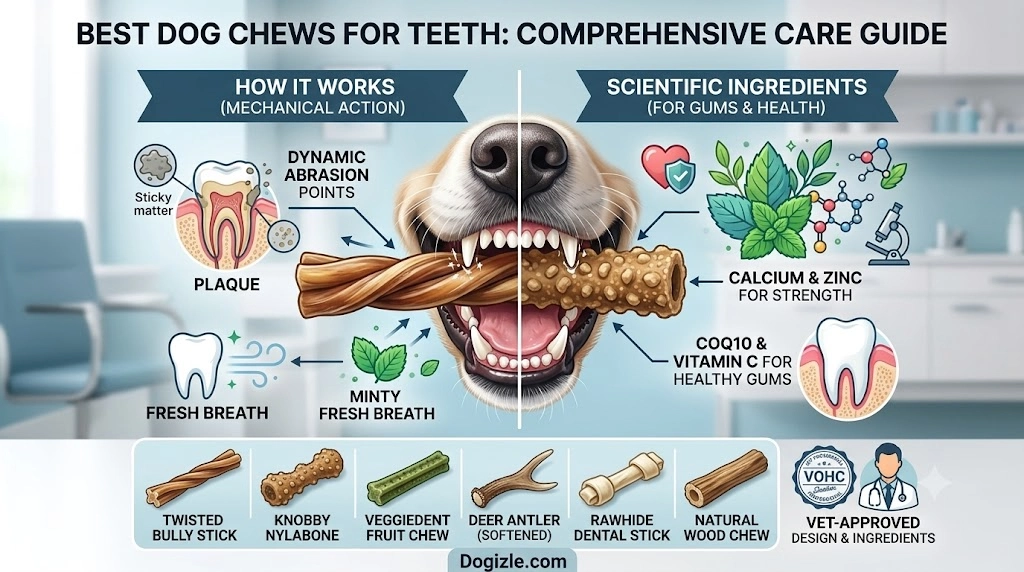
No. They help, but they do not replace brushing. VOHC explicitly says daily oral hygiene is ideal and that brushing is the gold standard, while AAHA also states that Best Dog Chews for Teeth brushing is the best at-home option for pet oral care.
That is one of the most important trust signals in your article. A page that admits limits is often more convincing than one that oversells. Readers do not need hype. They need a realistic dental hierarchy:
Best: professional dental care when needed
Best at home: tooth brushing
Helpful support: VOHC-accepted dental chews
Optional extras: rinses, gels, wipes, and other vet-approved supports.
Snippet-ready answer
Dental chews do not replace brushing. They are helpful support tools, but brushing is still the gold standard for home dental care.
Europe-specific and apartment-friendly advice
For Dogizle’s audience, this section matters a lot because many readers live in cities, apartments, or mixed-size households.
European shoppers should check for region-specific versions, because some VOHC-accepted product families are sold in European or UK sizes. The current VOHC dog list includes European-size Purina DentaLife and UK versions of Pedigree Dentastix, which is useful for readers who need locally available options rather than U.S.-only product names.
Apartment living also changes the buying decision. A quiet chew that does not leave a strong odor, crumbly mess, or greasy residue is often better for indoor use. In small flats, owners also tend to notice breathing problems faster because they Best Dog Chews for Teeth spend more close-up time with their dog.
Cold weather routine matters too. In winter, many dogs get shorter outdoor sessions and more indoor time, which makes dental routines easier to forget. The simplest fix is to attach the chew habit to an existing habit, such as after dinner or after the evening walk.
Practical Europe-focused buying tips
- Check the package weight range, not just the flavor.
- Confirm local market naming, because UK/EU product names can differ.
- Keep a simple treat budget in calories.
- Choose chews that are easy to store in a small kitchen or apartment pantry.
- If your dog travels between countries with you, look for brands that have regional equivalents.
Signs your dog needs a vet, not another chew
This section is essential for EEAT. The page should clearly explain when the problem has moved beyond home care. AAHA lists warning signs such as bad breath, drooling, yellow or brown teeth, red or swollen gums, blood on chew toys, tilting the head to eat, dropping food, nasal or ocular discharge, and facial swelling. Cornell also advises owners to contact a vet if they notice difficulty eating or decreased appetite, bleeding from the mouth, swelling Best Dog Chews for Teeth on the jaw or face, drooling, or nasal discharge.
Red flags table
| Sign | Why it matters | What to do |
| Persistent bad breath | May indicate dental disease or another health issue | Book a vet exam |
| Red, swollen, or bleeding gums | Often linked to gingivitis or periodontal disease | Stop relying on chews alone |
| Dropping food / chewing on one side | Possible pain or tooth damage | Vet assessment recommended |
| Facial swelling | Can signal infection | Treat as urgent |
| Blood on chew toys | Suggests mouth irritation or disease | Schedule an exam |
| Reduced appetite | Pain may be affecting eating | Do not wait |
AAHA also notes that bad breath is not a normal thing to ignore. In other words, “dog breath” is not a diagnosis. It is a symptomBest Dog Chews for Teeth worth checking.
Common mistakes dog owners make
This is the kind of practical section that improves dwell time and trust.
- Buying a chew that is too large, too small, or too hard
- Using dental chews as a full replacement for brushing
- Giving the chew unsupervised
- Ignoring bad breath because “all dogs smell that way.”
- Choosing by packaging claims instead of VOHC acceptance
- Forgetting that treats still add calories
- Continuing to use a chew even after the dog starts dropping food or chewing oddly
Expert tip
If a dog suddenly stops liking a chew it used to enjoy, do not assume it is picky. Sometimes that change is the first sign that the mouth hurts.
Expert tips for getting better results
- Start early. Puppies learn oral care habits faster than older dogs.
- Pair chewing with brushing. Even two or three successful brushings per week can be meaningful when the dog tolerates it.
- Use the treat as a ritual. Same time, same place, same supervision.
- Rotate only within evidence-backed products. Variety is fine, but evidence matters more than novelty.
- Keep a dental log. Note bad breath, gum color, chewing comfort, and appetite changes.
VOHC’s guidance and AAHA’s dental resources both support the same overall philosophy: daily oral care matters, and home care works Best Dog Chews for Teeth best when it is consistent rather than random.
Pros and cons of dental chews
Pros
- Easy to use
- Helpful for owners who struggle with brushing
- Can support plaque and tartar control when evidence-backed
- Better than offering random table scraps
- Can fit into a simple daily routine
Cons
- Not a replacement for brushing
- Can be misused if the size is wrong
- Add calories to the diet
- Some dogs swallow them too quickly
- Not appropriate for every dog or every mouth
Mini summary
Dental chews are useful when they are treated like a tool, not a miracle.
People also ask
Yes. VOHC-accepted products have been reviewed against protocol-based standards for plaque or tartar control, so they are a better starting point than unverified “dental” treats.
Brushing is still the best home option. VOHC calls it the gold standard, and AAHA says it is the best at-home choice.
Follow the package directions and your vet’s advice. More is not better if the chew adds too many calories or is not suited to your dog.
Yes, but only puppy-appropriate products and only under supervision. VOHC includes puppy dental chews on its accepted list.
Final verdict
The Best Dog Chews for Teeth are not the ones with the loudest promise. They are the ones that are VOHC-accepted, properly sized, safely supervised, and used as part of a real oral-care routine. Brushing is still the gold standard, but a good dental chew can absolutely be a smart support tool for busy dog owners, apartment households, seniors, puppies, and dogs that resist brushing.
For Dogizle, the winning angle is simple: help readers choose safer chews, show them how to use those chews correctly, and tell them honestly when a chew is not enough. That is how you build trust, keep people reading, and create a page that deserves to rank.
Bookmark this guide, share it with another dog owner, and keep building your dog’s oral-care routine one smart habit at a time.
This content is for educational and informational purposes only and does not replace professional veterinary advice. Always consult a licensed veterinarian for medical concerns regarding your dog.