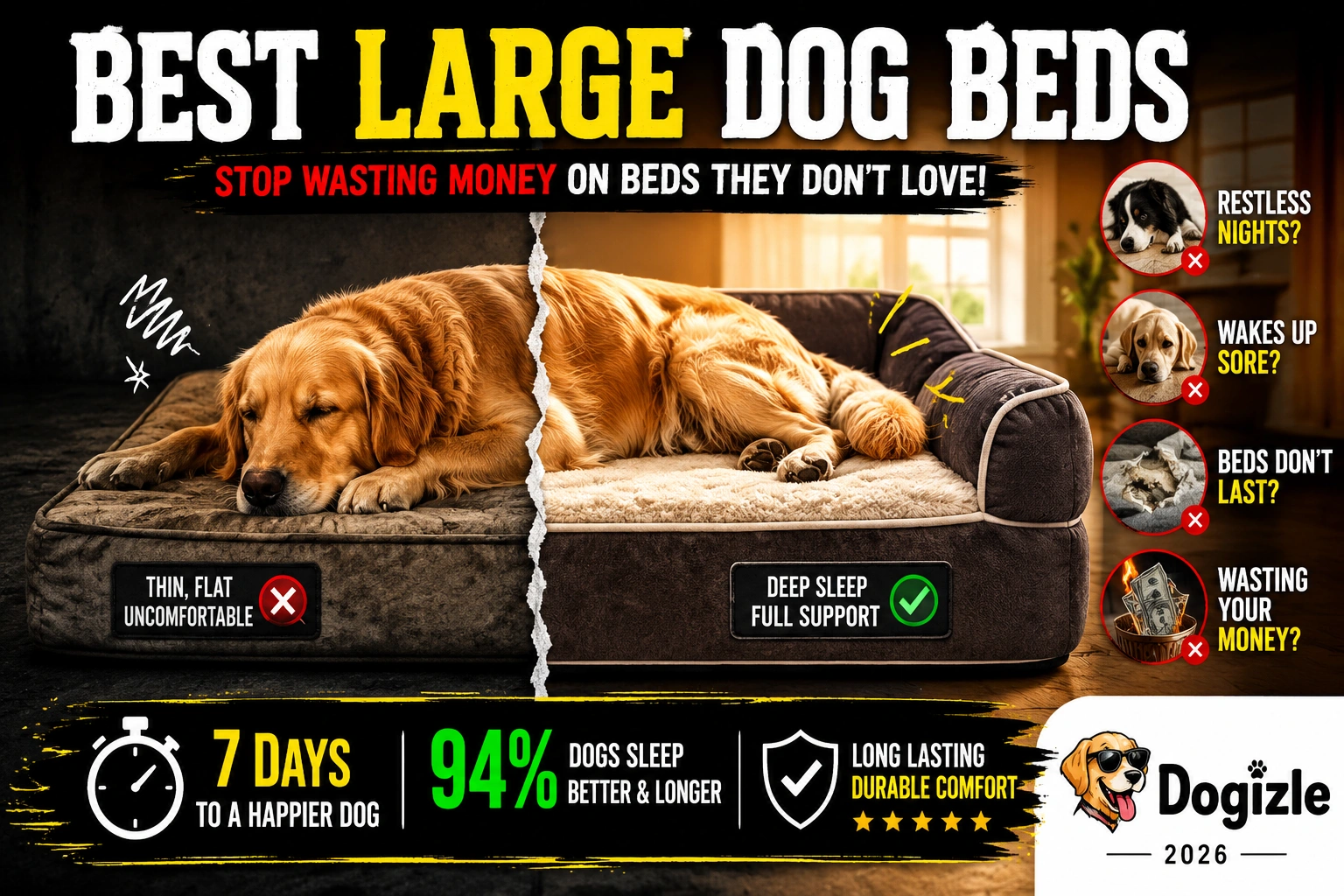
Why Most Large Dog Beds Are Secretly Hurting Your Big Dog
Choosing the best large Dog Beds is not a simple shopping choice. For a large-breed dog, the bed is part of daily recovery, joint protection, sleep quality, and long-term mobility support. A well-designed sleeping surface can help your dog rest more deeply, get up more comfortably, and wake up with less stiffness. A poor-quality bed, by contrast, may flatten too quickly, trap heat, irritate pressure points, and fail to support the body in the way large dogs actually need.
Large breeds such as Labradors, German Shepherds, Golden Retrievers, Rottweilers, Boxers, Dobermans, and Great Danes place a substantial load on their limbs and spine every day. Their weight distribution is more demanding than that of smaller dogs, and that means the wrong bed can create unnecessary strain over time. This is especially important for senior dogs, dogs recovering from injury, and breeds that are genetically prone to hip or elbow issues.
This guide is designed to help you choose with confidence. It uses clear language, practical comparison points, and buyer-focused reasoning so you can match the right bed to your dog’s body, habits, climate, and living space. It also focuses on topical depth, semantic relevance, and user intent, so the article is useful for readers and strong for search visibility.
Why Large Dogs Need Special Beds, Not Ordinary Cushions
A common mistake is assuming that any soft bed will work as long as the dog can lie on it. In reality, large dogs need a support system that is very different from a simple cushion or thin pillow-style mat. Their bodies are heavier, their pressure points are more exposed, and their joints benefit from a more structured sleeping surface.
A standard cushioned bed may feel comfortable for the first few days, but if the filling is weak or the foam is too soft, it can lose shape quickly. Once that happens, the dog sinks too deeply into the bed, the spine loses alignment, and the elbows, hips, and shoulders begin to absorb more pressure than they should. This can lead to restless sleep, frequent repositioning, and reduced comfort.
Large dogs are not built for flimsy bedding. They need a bed that distributes force more evenly and maintains its structure over time. That is why orthopedic support is so important. The best large dog beds are engineered to improve pressure distribution, cushion the body properly, and remain stable under repeated daily use.
The science behind joint pressure
When a large dog sits, stands, lies down, or turns during sleep, the weight is not spread across the body in a uniform way. Certain points take more load than others, especially the hips, elbows, shoulders, and lower back. Over time, repeated pressure on these zones may contribute to stiffness and discomfort.
This is one reason orthopedic beds are so highly recommended for large breeds. They are designed to reduce concentrated load and support the body in a more balanced way. Instead of letting the dog sink into an unstable surface, a properly built orthopedic bed creates a more even resting platform. That matters for daily comfort and for long-term joint care.
Why softness alone is not enough
Many people assume softness equals comfort. For large dogs, that is only partly true. A bed can be soft on the surface and still offer excellent support underneath. The problem is that many cheaper beds are soft all the way through, which means they collapse too easily. A bed that feels plush at first may actually be unsuitable because the underlying structure is weak.
The goal is not simply to give the dog a fluffy surface. The goal is to create a resting environment that combines comfort, durability, support, and resilience. That is what separates premium large dog beds from basic pet cushions.
European Dog Owners Have Unique Bedding Challenges
If you are buying a dog in Europe, climate and home layout matter a great deal. The best large dog beds are not chosen only by breed size; they should also reflect the environment in which the dog sleeps.
Cold regions such as Germany, Sweden, and Norway
In colder climates, dogs often benefit from insulating materials, raised bolsters, and thicker foam layers. A warmer, more enclosed design helps retain body heat and improves comfort on cold floors. Beds with insulating edges or denser foam can be especially useful in homes where winter temperatures make sleeping surfaces chilly.
Warm regions such as Spain, Italy, and Greece
In hot climates, airflow becomes a priority. A bed that traps heat can leave a dog uncomfortable, restless, and more likely to move to cooler Floors. For these environments, breathable fabrics, cooling surfaces, and elevated frame-style designs may perform better. The best option often depends on whether the home stays naturally cool or tends to retain heat.
Urban living in the UK, France, and the Netherlands
City homes often require space-conscious solutions. Not every apartment has room for a huge, bulky sleeping setup. In these cases, washable covers, odor-resistant fabrics, and compact rectangular designs can be very practical. A large dog still needs the right amount of sleeping space, but the physical footprint should also suit the room.
Why the environment matters
A bed that is excellent in one setting may be less effective in another. A thick insulated model may be perfect for a colder home, but too warm for a summer apartment. A cooling elevated bed might solve overheating in July, but feels insufficient in winter. That is why the best large dog beds are selected with both body support and living conditions in mind.
What Makes the Best Large Dog Beds?
The best large dog beds balance comfort, endurance, structure, and usability. They do not rely on one feature alone. Instead, they combine multiple design elements that work together to support a larger body.
Essential features checklist
A high-quality large dog bed should usually include some or all of the following:
- High-density orthopedic foam
- Adequate thickness, often around 4 to 7 inches, for bigger dogs
- Tear-resistant outer fabric
- Waterproof or water-resistant inner protection
- Removable and machine-washable cover
- Non-slip bottom to prevent sliding
- Durable seams and reinforced stitching
- Sufficient length and width for full-body stretching
These features are not just marketing points. They directly affect how long the bed lasts and how well it performs for the dog’s daily needs.
Why thickness matters
Thickness is especially important for large breeds. A thin bed may look acceptable on a product page, but once a 40-kg or 60-kg dog lies down, the support can compress too much. The result is reduced cushioning and poor pressure relief. A properly thick bed helps maintain structure under load and improves comfort across the body.
Why washable materials matter
Large dogs shed, drool, track dirt, and sometimes bring in moisture from walks. A bed that cannot be cleaned easily becomes a hygiene issue. A removable washable cover is one of the most practical features a dog owner can ask for. It helps control odor, reduces the buildup of dust and hair, and keeps the sleeping area fresher over time.
Why the base matters
A non-slip bottom is often overlooked, but it can make a real difference. When a large dog steps onto a bed that shifts or slides, it can feel unstable. A stable base improves confidence and ease of use, especially for older dogs or dogs with mobility challenges.
Why Cheap Dog Beds Fail So Quickly
Low-cost dog beds can seem attractive at first, but they often fail because they are built for short-term use rather than sustained support. In many cases, the visible surface looks comfortable while the internal construction is weak.
Common failure points in cheaper beds
- Foam collapses too early
- Fill shifts unevenly
- Seams split under pressure
- Covers rip or wear quickly
- Odors remain trapped in the material
- The bed becomes flat and unattractive
For large dogs, these issues happen faster because the load is greater. A bed that may work for a small breed can fail quickly under the weight and movement of a larger dog.
What happens when a bed loses structure
Once a bed loses support, the dog usually senses the change immediately. Many dogs begin avoiding the bed and migrate to the floor, carpet, or sofa. That is often a sign that the bed no longer feels stable or comfortable. A good bed should remain inviting over time, not only during the first few weeks of use.
The hidden cost of buying cheap
A lower upfront price may seem economical, but if the bed needs to be replaced repeatedly, the long-term cost can become higher than investing in a more durable model from the start. Better foam, stronger fabric, and more thoughtful construction usually mean better value over the life of the product.
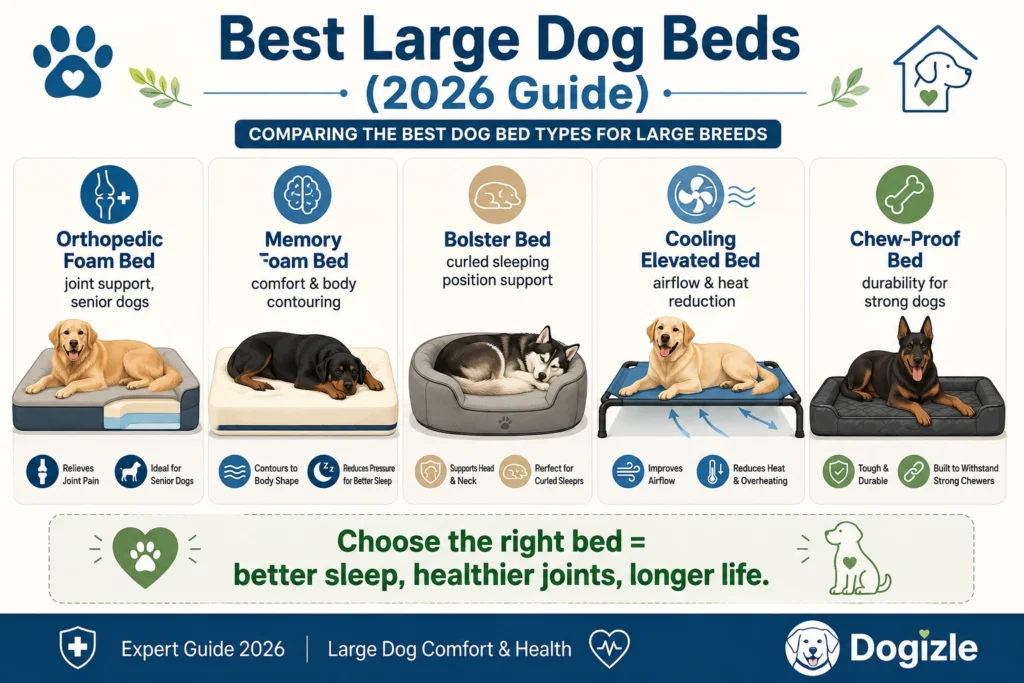
Types of Best Large Dog Beds: Comparison Guide
Different bed types solve different problems. The best option depends on your dog’s sleep position, age, climate, and chewing behavior.
| Bed Type | Best For | Strengths | Limitations |
| Orthopedic Foam Bed | Senior dogs, large breeds, dogs with joint sensitivity | Excellent support, pressure relief, stable structure | Often more expensive |
| Memory Foam Bed | Everyday comfort, contouring support | Comfortable, body-molding feel | Can trap heat in warmer homes |
| Bolster Bed | Dogs that curl up or lean while sleeping | Cozy, supportive edges, secure feel | Less open space for stretching |
| Elevated Cooling Bed | Hot climates, dogs that overheat easily | Airflow, cooling effect, easy cleanup underneath | Less insulating in winter |
| Chew-Resistant Bed | Strong chewers and energetic breeds | Better durability, reinforced materials | May feel firmer or less plush |
Each style solves a different combination of comfort and practicality. The bed that is best for one dog may not be ideal for another.
Orthopedic foam beds
Orthopedic foam beds are often the leading choice for large breeds because they are built to support weight evenly and reduce pressure on the joints. They are especially useful for older dogs or dogs with arthritis, stiffness, or reduced flexibility.
Memory foam beds
Memory foam beds contour to the dog’s body shape and create a more personalized sleeping surface. They can feel luxurious and supportive. However, some memory foam products retain more heat than other styles, so the climate should be considered.
Bolster beds
Bolster beds include raised edges around part or all of the perimeter. These are useful for dogs that like to rest their head on something or sleep in a curled position. They can create a more secure feeling and also offer warmth.
Elevated cooling beds
These beds lift the dog off the ground and allow air to flow beneath the body. They are especially helpful in hotter regions and can be a good choice for dogs that dislike sticky or heat-trapping surfaces.
Chew-resistant beds
Some dogs are determined to destroy anything soft. For these dogs, durability becomes just as important as comfort. Reinforced stitching, rugged textiles, and hidden closures can make a significant difference.
Best Large Dog Beds by Use Case
Instead of looking only at the product category, it helps to think in terms of need-based selection. This is where a user-focused approach becomes useful.
1. Best orthopedic dog beds for large dogs
These are the gold standard for dogs that need serious support. They are ideal for senior dogs, dogs with joint sensitivity, and breeds that carry heavy body mass. A strong orthopedic bed generally uses dense foam and a stable structure to minimize sinking and improve alignment.
Best for:
- Aging dogs
- Large breeds with hip or elbow sensitivity
- Dogs recovering from strain
- Owners who want long-term support
Why it matters:
The better the pressure distribution, the less stress the joints may experience during rest. For many large breeds, this is the most important purchase criterion.
2. Best budget large dog beds
A budget bed may be appropriate for younger dogs, secondary rooms, or temporary use. The goal here is to find acceptable comfort without paying for premium orthopedic features that may not be necessary for every dog.
Best for:
- Healthy young adults
- Backup sleeping spaces
- Travel or occasional use
What to watch for:
A low price should not mean zero structure. Even a budget option should still offer basic shape retention, a washable cover, and a size that suits the dog.
3. Best chew-proof dog beds for large dogs
This category is essential for dogs that destroy normal bedding. A chew-resistant bed should prioritize reinforced seams, stronger fabric, and concealed zippers or closure systems.
Best for:
- Working breeds
- Strong-jawed dogs
- Dogs with destructive habits
Important note:
Durability and softness often trade off against each other. A chew-resistant bed may not feel as plush, but it can save money and frustration in the long run.
4. Best cooling dog beds for large dogs
Cooling beds are especially useful in warm climates, in summer months, or for dogs that naturally run hot. They reduce the risk of overheating and help maintain comfort during rest.
Best for:
- Warm houses
- Summer sleep spaces
- Heat-sensitive dogs
- Dogs that avoid thick beds in hot weather
Why they help:
Airflow and breathable materials make the bed feel less stuffy and can improve overall relaxation.
How to Choose the Right Size Dog Bed
Size selection is one of the most overlooked steps. A bed that is too small forces the dog to curl unnaturally, while a bed that is too large for the space may be inconvenient in the home.
Simple sizing formula
Measure your dog from nose to the base of the tail. Then add around 15 to 30 cm of extra space, depending on how much your dog stretches when sleeping.
This gives the dog enough room to lie naturally, turn around, and relax without feeling constrained.
Weight-based size guide
| Dog Weight | Recommended Size |
| 25–35 kg | Large |
| 35–45 kg | XL |
| 45+ kg | Giant |
Sleep style matters too
A dog that curls into a compact ball may need a different shape than a dog that sprawls out with legs extended. Stretchers need more length. Curlers may prefer bolster designs. When size and sleep style are considered together, the choice becomes much easier.
Expert tip
If your dog regularly sleeps with its legs extended or changes position often through the night, choose the larger option. Extra space is often more beneficial than a tighter fit.
Foam Quality Explained: A Critical Buying Factor
Foam quality is one of the strongest predictors of how long the bed will remain supportive. This is where many low-quality products fail.
Low-density foam
Low-density foam may feel acceptable initially, but it compresses too easily under larger dogs. Once that happens, the surface becomes flat, and the support disappears.
Problems:
- Weak pressure relief
- Fast deterioration
- Poor structural stability
Polyester fill
Polyester fill is soft and lightweight, but it tends to shift and clump. It can feel cozy for small dogs, but for large breeds it often lacks reliable support.
Problems:
- Shape loss
- Uneven cushioning
- Limited durability
Memory foam
Memory foam contours to the body and improves comfort by matching body shape. This can be a strong option, especially when used in a layered design.
Strengths:
- Good body contouring
- Better pressure distribution than basic fill
- Comfortable for everyday rest
High-density orthopedic foam
This is the best choice for many large dogs. It offers structure, resilience, and support while resisting premature flattening.
Strengths:
- Long-lasting support
- Better joint relief
- More suitable for heavy breeds
- Maintains shape more effectively
For large dogs, foam quality is not a minor detail. It is one of the central factors that determines whether the bed is truly supportive or merely soft.
Dog Beds You Should Avoid
Some dog beds look appealing in photos but fail in real use. Avoid products that have the following problems:
- No mention of foam density or support level
- Extremely soft, pillow-like construction with no structure
- Thin padding that compresses quickly
- No removable cover or washable surface
- No waterproof lining
- Weak seams or cheap stitching
- Oversized fill bags instead of supportive foam
- Materials that hold odor and moisture
These products often wear out quickly and do not give large dogs the physical support they need. In many cases, they are designed more for appearance than performance.
Pros and Cons of Large Dog Bed
No product Category is perfect. Large dog beds offer many benefits, but they also come with practical trade-offs.
Pros
- Better joint support
- More comfortable sleep
- Improved recovery after activity
- Reduced pressure on elbows and hips
- Better rest for aging dogs
- Protection for floors and furniture
- Less nighttime restlessness
Cons
- Good-quality beds can be expensive
- Large sizes take more floor space
- Chewers may damage weak materials
- Covers need regular washing
- Some beds are heavy or difficult to move
The key is to balance the benefits against your dog’s actual behavior and the home environment.
Expert Veterinary-Informed Tips for Large Dog Owners
For large breeds, bedding should be treated as part of daily health support. A few practical rules can make a meaningful difference.
Senior dogs should use supportive beds that reduce pressure on the body and make rising easier. Dogs that weigh more than 40 kg usually benefit from thicker foam and more substantial structure. If the bed is visibly flattening or the dog starts avoiding it, replacement time may be approaching.
It is also wise to wash covers regularly, especially in muddy or damp climates. Clean bedding is not just about appearance; it also helps reduce odor, allergens, and buildup of dirt. Keeping the bed away from damp flooring is another useful habit, since moisture can shorten the material’s life and make the sleeping area less pleasant.
As a general practice, many quality beds need replacement every two to four years, depending on usage, cleaning frequency, and foam durability. Heavy use can shorten that timeframe. The important point is to monitor support, not just the outer appearance.
Lifestyle-Based Recommendations for European Homes
A bed should reflect the way and place in which a dog lives.
Urban apartments
For smaller living spaces, look for compact orthopedic beds, neat rectangular designs, or corner-friendly layouts. These can offer support without dominating the room.
Cold environments
In colder homes, choose insulated foam, thicker bolsters, or designs that retain warmth more effectively. Comfort in winter often depends on whether the bed reduces cold transfer from the floor.
Hot environments
In warm conditions, prioritize airflow, breathable mesh, cooling layers, and elevated frames. Overheating can make a dog avoid the bed entirely, even if the structure is good.
This lifestyle-based approach helps ensure the bed is functional in real life, not just attractive online.
Health Risks of Poor Dog Beds
A weak sleeping surface can have consequences beyond simple discomfort. When a large dog consistently rests on the wrong type of bed, it may contribute to a range of issues over time.
Possible problems include:
- Increased stiffness after sleeping
- More irritation around pressure points
- Poor sleep quality
- Reduced willingness to rest in one place
- Higher stress or restlessness
- Faster wear on joints in already vulnerable dogs
- Skin irritation if moisture and dirt are trapped
The best large dog beds are not luxury accessories. For many dogs, they are health-supportive essentials.
Buying Blueprint:
To make the selection process easier, think through the decision in this order.
Step 1: Start with the dog’s body
Is the dog young, adult, or senior? Is there any joint sensitivity? Does the dog weigh over 40 kg? Does the dog stretch out or curl up?
Step 2: Consider the sleeping environment
Is the home cold, warm, humid, or compact? Will the bed sit on tile, carpet, or wood? Is there enough room for a larger footprint?
Step 3: Match the material to the need
Orthopedic foam is best for support. Breathable mesh is better for cooling. Reinforced fabric is better for chewers. Washable covers help in messy households.
Step 4: Check long-term durability
Do not focus only on the surface softness. Look for foam density, seam strength, stitching quality, and structure retention.
Step 5: Confirm the size
Measure properly and leave enough room for stretching. A bed that is too small becomes uncomfortable quickly.
Common Mistakes Dog Owners Make
Many owners buy with the heart instead of the head in mind. That is understandable, but it can lead to poor results. One mistake is choosing a bed because it looks fluffy instead of checking whether the foam is supportive. Another is buying too small a size because the dog “usually curls up,” even though the dog occasionally stretches out fully.
Other mistakes include ignoring climate, skipping washable covers, and assuming a cheap bed will last as long as a premium one. Some people also buy a bed that is too warm for summer or too thin for a heavy dog. These are avoidable errors once you understand the real selection criteria.
People Also Ask
Orthopedic memory foam beds are best for joint support and pain relief.
At least 4 inches, ideally 5–7 inches for heavy dogs.
Yes—high-density foam beds last longer and protect joint health.
Ballistic nylon chew-proof beds with reinforced stitching.
Yes, especially senior dogs or breeds prone to hip issues.
Every 2–4 years, depending on wear and foam quality.
Yes, hybrid cooling + insulated beds are best.
Conclusion
Choosing the Best Large dog beds is about much more than style. It is about daily comfort, support, recovery, durability, and your dog’s long-term physical well-being. Large breeds place a higher demand on bedding because their size, weight, and joint load require more careful support.
The strongest choices usually combine orthopedic foam, durable outer materials, practical washability, and a size that genuinely fits the dog’s body. Climate matters too. A bed that works wonderfully in a cold home may not be the right fit for a warm apartment, and a chew-resistant model may be more valuable than a plush one for especially strong dogs.
The best buying strategy is simple: prioritize structure over softness, durability over appearance, and support over trendiness. A well-chosen bed can improve sleep quality, reduce discomfort, and make everyday life easier for your dog. For many large breeds, that makes the right bed one of the most valuable purchases you can make.