Why Do Dogs Eat Grass? — 7 Vet-Explained Reasons Owners Ignore
Dogs eat grass for many reasons, including boredom, digestion issues, instinct, or nutritional gaps. Worried it means your dog is sick? This vet-explained guide reveals the real reasons behind grass eating, warning signs most owners ignore, and when it could signal a hidden health problem. Some causes may surprise even experienced dog parents. You are walking your Dog through a park in London, Berlin, Paris, Amsterdam, or any other busy city. Everything seems perfectly ordinary. Your
Dogs eat grass for many reasons, including boredom, digestion issues, instinct, or nutritional gaps. Worried it means your dog is sick? This vet-explained guide reveals the real reasons behind grass eating, warning signs most owners ignore, and when it could signal a hidden health problem. Some causes may surprise even experienced dog parents. is sniffing, exploring, and enjoying the walk. Then, without warning, the dog stops, lowers its head, and begins chewing grass like it has found a gourmet meal.
That moment can instantly trigger worry.
Is this a sign of illness?
Should you stop it immediately?
Is your dog trying to vomit?
Could it be something dangerous?
The truth is more nuanced than most pet blogs explain. Grass-eating in dogs is usually a normal, natural, and often harmless behavior. At the same time, it can occasionally point to digestive discomfort, boredom, stress, dietary imbalance, or environmental risk. That is why the topic creates confusion: some owners panic too quickly, while others ignore real warning signs.
This guide is designed to give you a clear, evidence-based, and practical answer. You will learn the seven most likely reasons dogs eat grass, what the behavior may mean in different situations, when it is safe, when it becomes concerning, and how to respond in a smart, calm, and responsible way. We will also look at European pet-care considerations such as public park exposure, treated lawns, and contamination risks.
By the end, you will understand the behavior from both a biological and behavioral perspective, so you can make better decisions for your dog without guessing or overreacting.
Is It Normal for Dogs to Eat Grass? — When You Should Worry
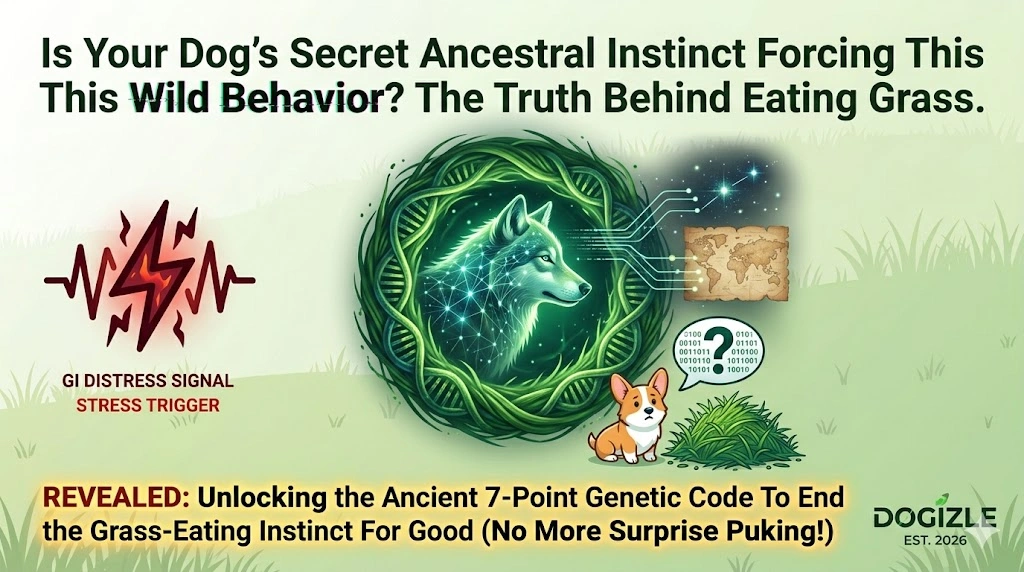
One of the most important explanations is instinct.
Domestic dogs may live in homes, sleep on couches, and eat from bowls, but biologically, they still carry a great deal of wild ancestry. Their evolutionary roots connect them to wolves and other canids that survived by eating far more than just muscle meat. In the wild, a predator does not only consume a clean cut of protein. It often eats the stomach contents of prey, the plant matter inside that prey, and sometimes vegetation directly.
That means the impulse to mouth, nibble, sample, or ingest plant material is not random. It can be deeply embedded in the canine instinctive framework. In other words, your dog is not “acting weird” when it eats grass. It may simply be showing a behavior pattern that has existed for thousands of years.
This instinctual behavior can appear in dogs of all ages and breeds. A puppy may do it out of curiosity, a healthy adult may do it out of habit, and an older dog may do it because the pattern has been reinforced over time. The behavior does not automatically mean something is wrong.
From a semantic SEO perspective, this point is important because it connects several related search intents: ancestral behavior, wolf-like instincts, natural dog habits, and canid evolution. All of these ideas point to the same core explanation: grass-eating is often part of normal canine biology rather than a sign of abnormality.
There is also a psychological component here. Dogs are exploratory animals. They use their mouths the way humans use their hands. If something interesting is in front of them, they investigate it. Grass is everywhere, smells alive, and changes texture with weather, season, and moisture. That makes it a highly available environmental stimulus.
So when your dog eats grass, the simplest interpretation may be the most accurate: it is behaving like a dog, not necessarily like a patient with a medical problem.
2) Digestive Support and Fiber Seeking
Another common reason dogs eat grass is related to digestion.
Grass contains plant fiber, and fiber can influence stool quality, bowel movement regularity, and gut function. Dogs that are not getting enough fiber from their regular diet may look for plant material in their environment. This does not mean grass is a complete nutritional solution. It is not. But it may serve as a rough, instinctive way to supplement what the dog’s body is missing.
Fiber is linked to gastrointestinal movement because it helps add bulk and support regular elimination. Some dogs seem to seek out grass when their diet is highly processed, very repetitive, or lacking in variety. Others may be eating enough total calories but still not be getting the right balance of nutrients or roughage.
This matters especially in dogs fed lower-quality food, highly refined kibble, or a monotonous routine with little dietary diversity. Even pets on regulated commercial diets can still have individualized needs. Not every dog digests every formula the same way. Some dogs do better with more fiber, while others need a diet adjustment for different reasons.
Does Grass Eating Mean Your Dog Is Sick?
In practical terms, a dog may eat grass because it is trying to self-regulate digestion. That is not the same as saying the dog has a disease. It simply means the body may be responding to an internal sensation or need.
This is one reason it helps to think beyond the surface behavior. The visible action is grass-eating. The stronger possibility is digestive feedback. The dog may be sensing that its stomach, intestines, or elimination pattern is not quite optimal, and grass becomes one of the available options.
Owners often search for terms like “dogs eating grass for fiber,” “dog fiber deficiency,” or “natural digestive support in dogs.” Those are all adjacent ways of asking the same underlying question. The answer is that, yes, in some cases, dogs may be drawn to grass as a primitive form of digestive assistance.
That said, it is still only a clue, not a diagnosis. If the behavior is frequent, paired with loose stool, constipation, or a sudden change in appetite, a veterinary review is worth considering.
3) Upset Stomach, But Not Always in the Way People Think
This is probably the most talked-about explanation, and also the most misunderstood.
Many people assume dogs eat grass because they already feel sick and want to make themselves vomit. That idea sounds intuitive, but it is not always correct. In reality, the relationship between grass and vomiting is more complicated.
Sometimes a dog eats grass and later vomits. In those cases, the grass may irritate the stomach and trigger a vomiting reflex. That means the grass is not always the cause of the initial nausea; it may be the thing that leads to regurgitation after the fact. In other words, the dog may not have chosen grass as a “medicine.” It may have been drawn to it for another reason, and the grass then irritated the stomach lining.
Other times, the dog eats grass, and nothing happens.Not vomiting. No diarrhea. No distress. Just a brief grazing episode, and then the walk continues as normal. That pattern strongly suggests the behavior was not driven by illness in a serious sense.
So the most accurate interpretation is this: grass-eating and upset stomach can be connected, but one does not automatically prove the other.
Why Dogs Instinctively Chew Grass in the Wild
A dog may also show signs of an empty or mildly unsettled stomach, then begin grazing. Some dogs vomit yellow bile later, especially if they have not eaten for a while. That can make owners think the grass caused the sickness, when the fuller explanation may be that the dog had an empty stomach already.
This distinction matters because it changes how you respond. If your dog occasionally eats grass and remains energetic, alert, and otherwise normal, there may be nothing to worry about. If the behavior appears alongside repeated vomiting, lethargy, abdominal discomfort, or loss of appetite, then it becomes much more important.
The key lesson is not to assume a single universal explanation. Grass-eating can be connected to nausea, but it is not a guaranteed sickness signal. That nuance is exactly why the topic deserves a careful, vet-informed explanation rather than a one-line answer.
4) Hunger or an Empty Stomach
A simple but very realistic reason is hunger.
Dogs often eat grass when they have gone too long without food, when meal timing is inconsistent, or when portion sizes may not be satisfying their needs. Some dogs are highly routine-oriented. If feeding times shift too much, or if they experience a long gap between meals, they may start searching for something to put in their mouth.
Grass is immediate, available, and easy to access. If there is no food bowl nearby and no snack available, the dog may still respond to internal hunger cues by sampling whatever is around. This does not mean the Dog is Starving. It means the body is sending a signal, and the dog is acting on it.
This pattern is especially noticeable in dogs that eat only once per day, dogs with long fasting windows, or dogs that are highly active and burn more energy than expected. In those cases, the behavior may reflect a practical issue rather than a behavioral problem. The dog may need a more consistent schedule, a better-balanced diet, or a feeding strategy that better matches energy expenditure.
You may also notice that some dogs vomit yellow foam or bile after grazing on grass. That often happens when the stomach is empty for too long. Again, this does not mean grass was the true cause. It can be a symptom of an underlying scheduling or hunger issue.
From a behavior-analysis standpoint, this is a helpful reminder that dogs are not abstract thinkers. They respond to bodily sensations, environmental availability, and learned routines. If they are hungry, they will seek something edible. Grass may become a fallback option.
So if grass-eating happens before meals, around feeding delays, or during especially active days, hunger should be high on your list of possibilities
5) Boredom and Lack of Mental Stimulation
This is one of the most underrated causes.
A dog’s behavior is shaped not only by food and health, but also by environment, enrichment, and emotional engagement. Dogs that live in apartments, small homes, or low-stimulation settings may not get enough novelty during the day. If exercise is limited, training is minimal, and there are not enough interesting outlets, the dog may start creating its own entertainment.
Grass-eating can become a repetitive behavior, a self-soothing habit, or simply something to do during a walk. The dog is not necessarily hungry or sick. It may just be under-stimulated.
This is especially relevant in urban areas where dogs spend a lot of time indoors, on leash, or in controlled spaces. Without enough physical movement and mental challenge, dogs can become restless. That restlessness sometimes shows up as chewing furniture, excessive licking, pacing, barking, or grass-eating.
Think of it as a behavioral substitute. The dog needs an activity. Grass is right there. The mouth needs to do something. The dog does what dogs do.
This explanation is especially helpful when the behavior happens in predictable settings. For example, a dog may always eat grass on a long, boring walk, after waiting alone for hours, or when not sufficiently exercised. In those cases, the grass itself may be less important than the lifestyle pattern surrounding it.
A bored dog often needs more than a longer walk. It may need puzzle toys, scent games, obedience practice, social interaction, or more structured play. Physical exercise alone is often not enough. Dogs are cognitive beings as well as physical ones. They need problem-solving, variety, and purpose.
This is why grass-eating should sometimes be viewed not as a stomach problem, but as an environmental signal. The dog may be telling you that its day is too empty
6) They Simply Like It
Sometimes the reason is very simple: dogs enjoy it.
Not every behavior has a dramatic explanation. Not every grass-eating episode means illness, deficiency, or emotional distress. Some dogs just like the taste, texture, smell, or sensation of fresh grass. Young blades of grass can be soft, cool, moist, and mildly sweet. In spring, especially, the grass may be more tender and appealing.
Humans snack for pleasure all the time. We do not always eat because we need a nutrient. Sometimes we eat because something tastes good or feels satisfying. Dogs can have similar tendencies. They may sample grass because they find it pleasant or interesting.
This is important because many owners search for a single universal reason. But canine behavior is rarely that tidy. A dog may eat grass out of instinct one day, boredom another day, and simple preference on a third day. The same visible action can have multiple causes.
When a dog seems otherwise healthy, energetic, and content, and the grass-eating is occasional rather than obsessive, “they like it” may be the best explanation. It is straightforward, but it should not be dismissed just because it sounds too simple.
Behavioral science often reminds us that repeated actions can be reinforced by reward. If the dog has eaten grass several times and experienced no negative outcome, the behavior can become self-reinforcing. The dog learns, consciously or unconsciously, that grass is available and enjoyable. That makes the behavior more likely to continue.
So yes, some dogs eat grass because they genuinely enjoy it. Not every canine choice is a medical mystery.
7) Anxiety, Stress, or Emotional Regulation
Dogs are emotional animals. They do not only react to hunger or instinct. They also respond to stress, uncertainty, routine changes, and social tension.
Grass-eating can sometimes function as a displacement behavior. That means the dog performs the action to cope with a feeling rather than because the grass itself is the target. The dog may be anxious, overstimulated, uncertain, or unsettled, and chewing grass becomes a calming outlet.
This can happen during major changes such as moving homes, changes in family routine, long periods of separation, new pets in the house, travel, or inconsistent daily structure. Naturally sensitive dogs may show these patterns more clearly.
The behavior can also appear during overstimulating outings. A dog may be excited, nervous, or conflicted in a busy public area and begin grazing on grass as a way to self-regulate. That does not mean the dog is broken or misbehaving. It means the nervous system is looking for a coping strategy.
Stress-related grass-eating is often part of a bigger picture. You may see other signs too: panting when not hot, clinginess, pacing, vocalizing, reduced appetite, over-grooming, or avoidance. When grass-eating is paired with these broader behavioral signals, the emotional dimension becomes much more likely.
From a training and behavior-management perspective, the solution is not punishment. Punishment does not address anxiety. Instead, the focus should be on routine stability, confidence-building, positive reinforcement, enrichment, and removing obvious stressors where possible.
In simple terms, some dogs eat grass the way people may fidget, snack, or scroll when nervous. It is a coping pattern. Understanding that helps you respond with patience instead of frustration.
Is It Bad for Dogs to Eat Grass?
In many cases, no.
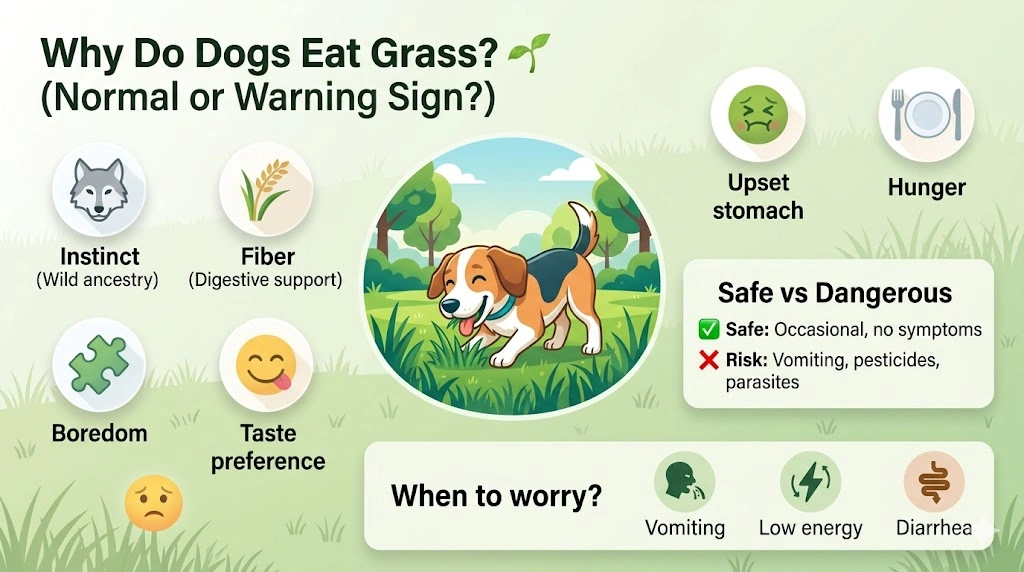
Occasional grass-eating in a healthy dog is usually not a major concern. If the dog is bright, active, eating well, maintaining normal stools, and not showing recurring vomiting or discomfort, then the behavior is often harmless.
However, there are important exceptions.
Grass can become risky when the environment is contaminated or when the behavior becomes excessive. Public lawns, park edges, roadside patches, and shared green spaces may contain pesticide residue, parasite contamination, chemical fertilizers, or other environmental hazards. Dogs do not know the difference between a clean lawn and a treated one. They just see grass.
This is particularly relevant in Europe, where many urban and suburban dogs spend time in communal parks and shared outdoor spaces. Those spaces are practical and enjoyable, but they are not always controlled or clean. The more common the dog traffic, the greater the potential exposure to contamination from feces, parasites, or soil pollutants.
That is why grass-eating should not be judged only by the act itself. The setting matters. Clean, untreated grass in a safe space is very different from unknown grass near road runoff, public waste, or chemical treatment.
So the correct answer is balanced:
Occasional grass-eating is usually fine.
Frequent, compulsive, or symptom-linked grass-eating deserves closer attention.
Risk Factors to Keep in Mind
Several environmental risks can make grass-eating more concerning:
- Pesticides and herbicides: These can irritate the digestive system or expose your dog to toxic residues.
- Parasites: Shared outdoor areas may carry eggs or larvae from other animals.
- Urban pollution: Soil near roads or heavily used public areas may contain contaminants.
- Fecal contamination: Grass may be contaminated by droppings from other dogs or wildlife.
This is why the safety of grass-eating depends not just on the dog, but on the location. A private, untreated lawn is one situation. A busy public park is another.
For that reason, owners should pay attention not only to the behavior but also to the environment in which the behavior occurs.
When Should You Worry?
You should pay closer attention if the grass-eating is accompanied by any of the following:
- repeated vomiting
- diarrhea
- lethargy or low energy
- loss of appetite
- weight loss
- abdominal pain or obvious discomfort
- sudden behavioral change
- compulsive or obsessive grazing
A one-off episode is usually not alarming. A pattern combined with symptoms is a different matter.
If the dog is eating grass every day, vomiting frequently, or showing any sign of illness, it is wise to contact a veterinarian. Persistent behavior often deserves a deeper look. The issue may be dietary, gastrointestinal, emotional, or environmental.
It is also important to observe the timing. Does the behavior happen before meals? After boredom? During stressful outings? In the same park every time? Pattern recognition is one of the most useful tools owners have. Repeated context can reveal the cause.
Myth vs Truth: What People Get Wrong
Myth: Dogs eat grass because they want to vomit.
Truth: Sometimes they vomit afterward, but that is not always the original reason.
Myth: Grass-eating means the dog is sick.
Truth: Many healthy dogs eat grass occasionally and show no illness at all.
Myth: Only unhealthy dogs do this.
Truth: Healthy, well-fed dogs often do it too.
Myth: It must always be stopped.
Truth: Not always. Occasional, harmless grazing may not need intervention.
Myth: Grass is always safe.
Truth: Not necessarily. The environment matters a lot.
These distinctions matter because they prevent unnecessary panic while still keeping owners alert to genuine warning signs.
Should You Stop Your Dog From Eating Grass?
The answer depends on the context.
You should be more active in preventing the behavior if:
- The grass may be chemically treated
- The dog is eating excessive amounts
- The behavior is obsessive or repetitive
- Your dog is also vomiting, having diarrhea, or acting unwell
You do not necessarily need to stop it if:
- It happens only occasionally
- Your dog is otherwise healthy
- The grass is clean, untreated, and safe
- No other symptoms are present
The goal is not automatic suppression. The goal is informed observation.
In many cases, trying to punish or aggressively interrupt the behavior is not helpful. It may create confusion without solving the cause. A better strategy is to manage the environment, improve the diet, increase enrichment, and monitor the overall pattern.
How to Reduce Grass-Eating If Needed
If the behavior becomes frequent or bothersome, there are several practical ways to reduce it.
1) Improve the diet
A more Balanced diet with appropriate fiber may help. Some dogs benefit from better-quality food, more consistent portions, or a vet-guided nutritional adjustment. Do not make major dietary changes blindly. The point is to support digestion, not guess.
2) Increase exercise
A dog that gets enough physical activity is often less likely to graze out of boredom. Walks, play, sprinting in safe areas, and breed-appropriate exercise can all help.
3) Add mental enrichment
Puzzle feeders, scent work, obedience games, and interactive toys can reduce under-stimulation. Mental fatigue is often just as useful as physical fatigue.
4) Feed on schedule
A predictable routine can reduce hunger-driven searching. Consistency helps many dogs feel more settled.
5) Track patterns
Notice when, where, and how often grass-eating happens. Patterns often reveal the reason. That information can be very useful if you later talk to a vet.
Real-Life European Scenarios
Apartment Dogs in Cities
Dogs living in apartments in places like Paris, Berlin, or Amsterdam may have less daily variety. They may be more prone to boredom-driven behavior, including grass-eating, especially if walks are short or repetitive.
Cold-Climate Regions
In colder regions such as Sweden or Switzerland, limited outdoor access during parts of the year can reduce stimulation. When spring arrives and grass becomes more available, some dogs may suddenly show more interest.
Urban Parks in Major Cities
In places like London or Madrid, grass in public parks may carry more exposure risk due to heavy foot traffic, environmental residue, or contamination. Dogs in these areas may still graze, but owners should be more attentive to cleanliness and safety.
These scenarios do not change the biology of the dog. They change the environment around the behavior, which can influence both frequency and risk.
Safety and Health Considerations
A responsible dog owner should keep the following in mind:
- avoid known treated lawns
- Monitor for sudden changes in behavior
- Keep vaccinations and parasite prevention current
- Pay attention to the dog’s stomach symptoms
- Watch for repeated patterns in public spaces
A calm, observant approach is often better than an emotional one. Most grass-eating is ordinary. The real task is knowing when the ordinary becomes meaningful.
Common Mistakes Dog Owners Make
One common mistake is overreacting to a single harmless episode and assuming the dog is seriously ill. Another is ignoring repeated vomiting because “grass-eating is normal.” Both extremes can be unhelpful.
Other mistakes include:
- feeding an unbalanced or poor-quality diet
- not giving enough exercise
- neglecting mental stimulation
- overlooking contamination risks in public areas
- failing to track patterns over time
The best owners look at the whole picture, not just the grass in the mouth.
Expert-Level Perspective
From a broader behavioral and veterinary perspective, grass-eating is rarely explained by only one factor. It often sits at the intersection of instinct, diet, emotion, environment, and habit.
That means the smartest interpretation is usually a layered one:
- Instinct may make the behavior possible
- Digestion may make it relevant
- boredom may make it more frequent
- Stress may make it repetitive
- taste may make it enjoyable
- Hunger may make it situational
- The environment may make it risky
That is why this behavior is so interesting. It is simple on the surface, but complex underneath.
The best response is to observe, categorize, and react proportionately. If the dog is healthy and the behavior is occasional, there may be no reason to worry. If the behavior escalates, becomes compulsive, or appears with symptoms, that is the moment to investigate more seriously.
Quick Summary Table
| Possible Cause | How Likely It Is | What It Suggests |
| Instinct | High | Normal canine behavior |
| Fiber seeking | Medium | Possible diet imbalance |
| Upset stomach | Medium | Watch for vomiting or discomfort |
| Hunger | Medium | Feeding schedule may need adjustment |
| Boredom | High | Needs more activity or enrichment |
| Taste preference | Medium | The feeding schedule may need adjustment |
| Stress or anxiety | Medium | Emotional coping behavior |
FAQs
Daily grass eating may suggest boredom, habit formation, a feeding issue, or a behavioral pattern that is being reinforced over time.
This often happens when the stomach is empty for too long, although other digestive issues may also play a role.
Sometimes they may be seeking fiber or trying to support digestion, but grass is not a proper food source for nutrition.
Yes. Puppies often use their mouths to explore the world, so grass sampling is especially common during early development.
Only if the area appears clean, untreated, and free from obvious contamination or chemical exposure.
Conclusion
So, why do Dogs eat grass?
The honest answer is: there isn’t just one reason—there are several. From instinctive behavior rooted in their wild ancestry to simple curiosity, digestion support, hunger, boredom, taste preference, or even emotional stress, grass-eating is a multi-cause behavior.
In most cases, it’s completely normal and harmless.
A healthy dog that occasionally nibbles on grass without showing any other symptoms is usually just expressing natural canine behavior.
However, context matters.
If the behavior becomes frequent, obsessive, or is combined with warning signs like vomiting, diarrhea, lethargy, or appetite loss, then it may be your dog’s way of signaling that something isn’t right. In those situations, paying closer attention—and consulting a veterinarian—is the smart move