How Dogs Really See the World
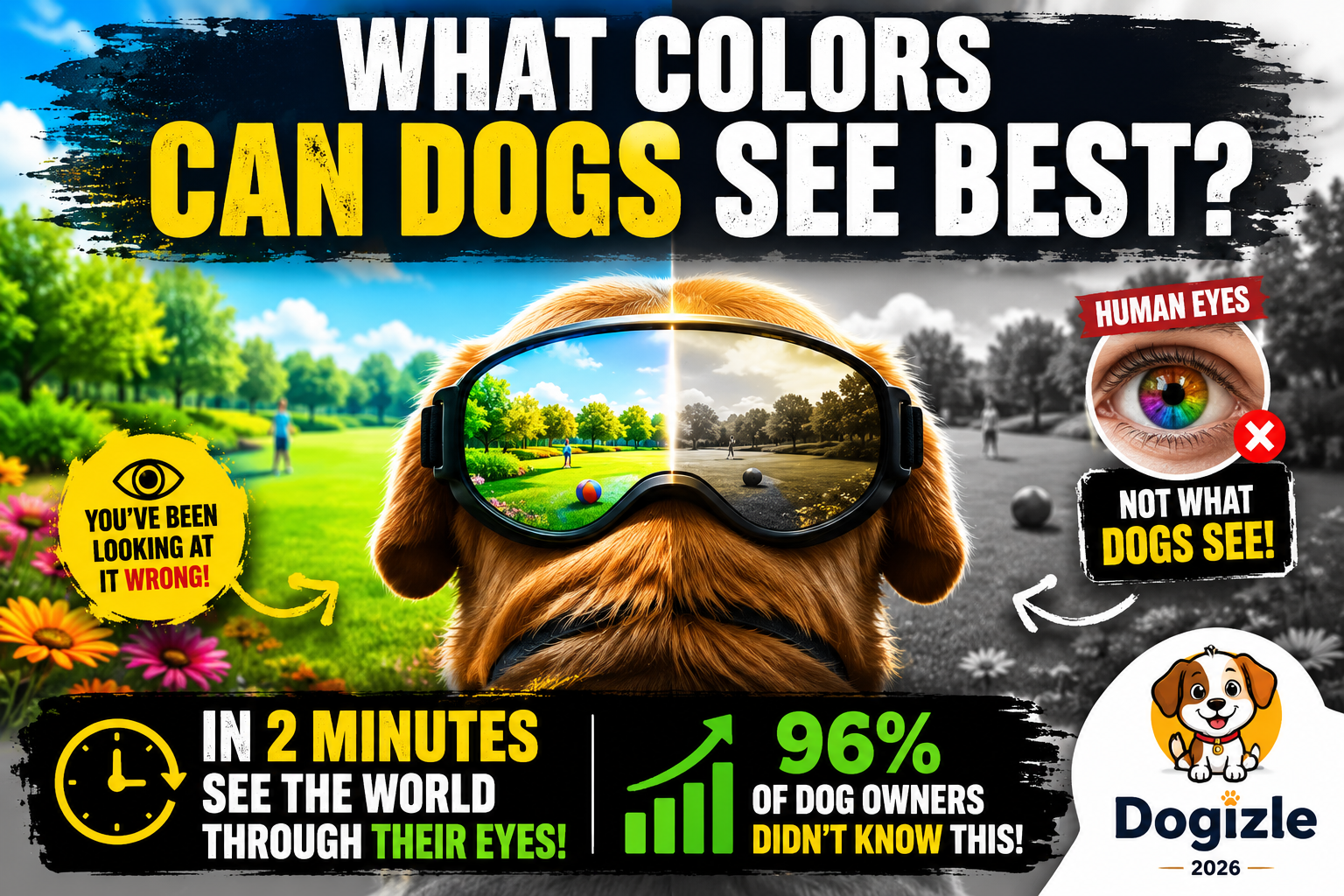
Have you ever tossed a red ball onto green grass and watched your dog hesitate, sniff, circle, and search as if the toy had vanished? Then, the moment you swap it for a blue object, your dog locks on instantly and runs straight to it.
That is not a coincidence. It is a visibility problem.
The question of what Color’s dogs can see best matters far beyond curiosity. It affects how dogs learn, how they play, how they move through their environment, and how easily they can locate toys, markers, bowls, and training tools. In real-world terms, color contrast can influence obedience training, fetch performance, agility work, enrichment games, and even day-to-day safety.
For a long time, people repeated the idea that dogs see only in black and white. Modern veterinary science has shown that this is not correct. Dogs do see color, but their color range is narrower than ours. Their visual system is adapted less for decorative detail and more for practical survival: movement detection, low-light awareness, and fast response to change.
That means the dog’s world is not colorless. It is simply different.
In practical language, dogs see the strongest contrast in blue and yellow tones, while red, green, and orange often appear muted, brownish, grayish, or difficult to separate from the background. This is why a red toy can disappear in the grass, while a blue toy seems obvious at a glance.
In this guide, you will learn exactly what colors dogs see best, why their eyes work this way, how canine vision compares with human vision, what toy colors are best for training and play, and how to use this knowledge to make daily life easier for your dog. The goal is not just to explain dog vision. The goal is to turn that knowledge into better choices.
How Dog Vision Works (Simple Science Explained)
To understand what colors dogs see best, it helps to understand the basic structure of canine vision. A dog does not process the world the same way a human does, because the eye is built with different priorities.
Rods and Cones in Dog Eyes
The retina, which is the light-sensitive layer at the back of the eye, contains two major kinds of cells:
Rods
Rods are specialized for detecting light, movement, and shape in low-visibility conditions. They are highly useful at dawn, dusk, and nighttime. Rods do not create rich color detail, but they help dogs notice motion very quickly. That is one reason dogs can react sharply to a moving object even when the object is not especially bright.
Cones
Cones are the cells responsible for color perception. Dogs have cones too, but fewer of them than humans, and fewer cone types overall. That means their chromatic range is limited. They can distinguish certain colors, but not with the same depth or spectrum that humans enjoy.
Human vs Dog Color Vision
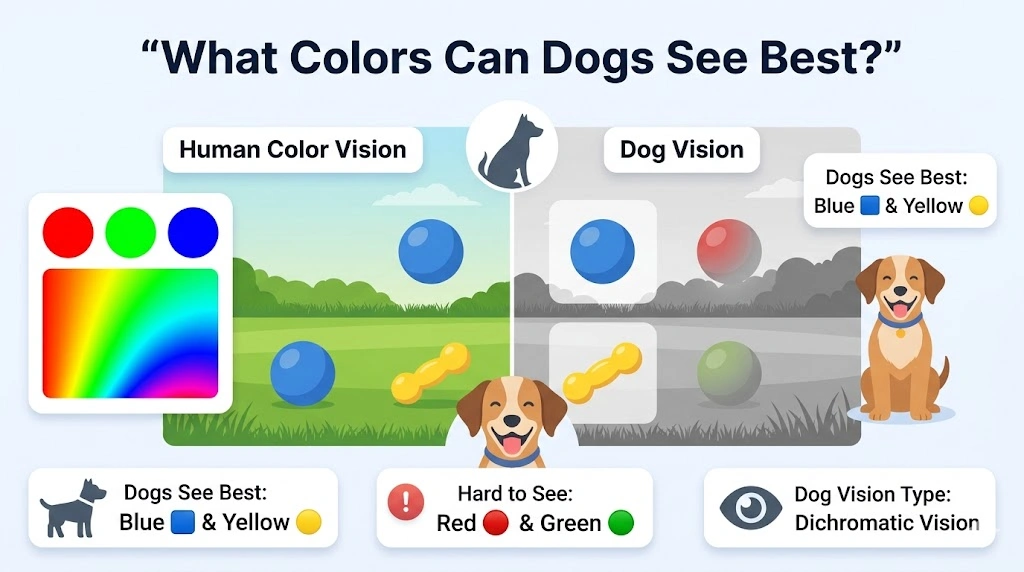
Humans have three types of cones. This is called trichromatic vision. Our cone types are sensitive to red, green, and blue light. Because of this, we can perceive a wide spectrum of colors, subtle shades, and rich visual detail.
Dogs have only two main cone types. This is called dichromatic vision. Their cone system is tuned primarily to wavelengths that make blue and yellow easier to notice. The result is a world with fewer color distinctions and more reliance on contrast, brightness, and movement.
Simple Conclusion
Dogs do not live in a black-and-white universe. They live in a narrower chromatic world.
Their visual landscape is strongest in:
- Blue
- Yellow
- Gray and neutral shades
Meanwhile, colors such as red, green, and orange may blend together or appear washed out. That is why the same toy can seem obvious to a human but nearly invisible to a dog, depending on the background.
What Colors Can Dogs See Best?
Now to the main question.
Dogs see blue and yellow best. These are the colors that stand out most clearly in their visual system. If you want high visibility, better recognition, and stronger contrast, those are the two shades that matter most.
Blue: The Strongest Color Dogs See
Blue is usually the easiest color for dogs to detect. It stands out clearly because it contrasts well with the most common natural backgrounds, including grass, soil, concrete, wood, and indoor flooring.
A blue ball in a green park is easy to find. A blue toy on a tan carpet is easier to notice than a red one. Blue also works especially well for outdoor play because it stays visually separate from the environment rather than blending into it.
Why blue is so effective:
- It creates a strong contrast in nature
- It remains visible in many lighting conditions
- It is easy for dogs to locate during fetch or tracking games
- It supports clearer orientation during training
Blue is one of the best choices for:
- Fetch toys
- Agility markers
- Training props
- Balls, frisbees, and retrieval tools
If your goal is fast visual detection, blue is the most reliable option.
Yellow: The Second Best Color
Yellow is the other major color dogs perceive well. It can stand out clearly against darker backgrounds and remain visible indoors. In many situations, yellow is almost as useful as blue, especially when the surrounding environment is not too bright or visually cluttered.
Why yellow works well:
- It offers a strong contrast in many home and outdoor settings
- It is easy to see on floors, pathways, and mats
- It often remains noticeable in low-light environments
- It is useful for toys, collars, and training markers
Yellow is especially practical for:
- Indoor toys
- Puppy enrichment items
- Training cones or markers
- High-visibility objects used in supervised activity
For many owners, blue and yellow together create the easiest visual system for a dog to follow.
Neutral Colors: Gray, Brown, White, and Beige
Dogs can still see neutral tones, but these do not feel vivid in the same way colors do for humans. Gray, brown, beige, and white may be visible, but they often lack the strong distinction dogs need to identify an object quickly.
These tones become more useful when the contrast is strong. For example, a white toy may stand out on dark flooring but disappear in bright sand or snow. A gray object may be visible in one room and nearly invisible in another.
Neutral colors are not necessarily bad. They are simply less dependable when speed and recognition matter.
Colors Dogs Struggle to See
Some colors are difficult for dogs because they do not fall into the strongest part of canine color sensitivity.
Red
Red often looks dark, brownish, or gray to dogs. On grass, soil, or carpets, it may lose definition and become much harder to spot.
Green
Green can be confused with yellow-gray or muted brown tones. In outdoor environments, especially grass or foliage, green objects often disappear into the background.
Orange
Orange may appear dull or muddy to dogs. It usually does not provide enough separation from many natural surfaces.
This is why many bright human-friendly toys are not dog-friendly from a visual standpoint. A toy that looks exciting to us may be almost flat and unremarkable to a dog.
Why Dogs See Fewer Colors (Evolution Explained)
To understand canine color vision, it helps to think like evolution. Dogs did not evolve to admire a rainbow. They evolved to survive, track, hunt, and respond to the environment.
Survival Came Before Color
Early canines needed to detect movement, locate prey, avoid danger, and function in dim light. That meant the most valuable visual skills were not decorative color differences. The most valuable skills were:
- Detecting motion quickly
- Seeing in low light
- Recognizing shape and movement at a distance
- Reacting fast to environmental changes
A dog’s visual system became optimized around these priorities.
Why Fewer Color Cones Make Sense
Color discrimination requires more specialized cone cells. But cone-rich vision is not always the best survival strategy. For animals like dogs, having more rods and stronger motion detection can be more useful than having a full human-like color range.
So evolution made a tradeoff:
- Less detailed color perception
- Better low-light performance
- Faster motion detection
- Stronger survival awareness
That tradeoff makes perfect sense from a biological perspective.
Dogs Trade Color Detail for Performance
Dogs did not lose visual skills. They specialized.
Instead of seeing every shade of the spectrum, they became highly effective at noticing movement, tracking targets, and navigating in imperfect lighting. Their eyes are built for function, not luxury.
That is why a dog may ignore a red toy in the grass but instantly notice a moving squirrel, a bouncing blue ball, or a hand signal during training.
Dog Vision vs Human Vision (Full Comparison)
The difference between dog and human vision is easier to understand when you compare the major features side by side.
| Feature | Dogs | Humans |
| Color vision | Blue and yellow range | Broad full-spectrum color vision |
| Red detection | Weak | Strong |
| Green detection | Weak | Strong |
| Night vision | Strong | Moderate |
| Motion detection | Very strong | Moderate |
| Visual detail | Lower | Higher |
| Field of view | Wider | Narrower |
What This Means in Real Life
Humans see more color variety and more detail. Dogs see fewer colors, but their vision is not inferior in every way. It is simply tuned for different tasks.
For example:
- Humans may recognize a toy by color.
- Dogs may recognize it by shape, movement, odor, and contrast.
- Humans may rely on visual detail.
- Dogs often rely on smell first and vision second.
So when you see a dog failing to notice an object that seems obvious to you, the issue is not laziness or distraction. It is often a genuine visibility problem.
Best Colors for Dog Toys (Practical Guide)
Once you understand canine color perception, choosing the right toy color becomes much easier. Toy color affects how quickly a dog can locate the object, track it during movement, and stay engaged in play.
Blue Toys
Blue toys are among the best choices for dogs because they are easy to detect in many environments. They work well in grass, indoor rooms, and mixed-light conditions.
Blue toys are ideal for:
- Fetch
- Fetch training
- Agility exercises
- Outdoor games
- Visual retrieval practice
Yellow Toys
Yellow toys are also highly visible and are often excellent for indoor spaces. They can stand out well against floors, rugs, walls, and neutral surfaces.
Yellow toys are ideal for:
- Training sessions
- Puppy play
- Indoor enrichment
- Marker-based games
- Low-distraction environments
Worst Toy Colors for Dogs
Some toy colors look attractive to people but are poor choices for canine visibility.
Red toys
These can blend into grass, dirt, or brown flooring. Dogs may not distinguish them clearly.
Green toys
These can disappear into lawns, trees, and garden areas.
Orange toys
These may appear dull, muddy, or low-contrast.
The problem is not that these colors are “bad.” The problem is that they may not provide the visual separation a dog needs.
Why Contrast Matters More Than Beauty
Humans often buy toys based on what looks bright or cheerful to us. Dogs care more about contrast. A toy with strong visual separation is easier to track, easier to find, and easier to enjoy.
So the smartest toy choice is not the prettiest one. It is the most visible one.
Can Dogs See Better at Night?
Yes. Dogs usually see better than humans in low-light conditions.
Why Dogs See Better at Night
Dogs have several advantages when the light gets dim:
- More rod cells, which are better for low-light detection
- Larger pupils, allowing more light to enter
- A reflective structure called the tapetum lucidum, which helps reflect light back through the retina
- A vision system built to prioritize movement and brightness over detail
These features help dogs function at dawn, dusk, and in partially dark areas.
What Dogs Can Do at Night
Dogs can often:
- Notice motion in the dark
- Move through low-light spaces more confidently
- Track movement better than humans
- Rely on smell and hearing to compensate when vision is limited
What Dogs Cannot Do at Night
Dogs still cannot magically see in complete darkness. They are better than humans in low light, not superhuman. They also cannot use color vision effectively when the light becomes too weak.
At night, dogs lean more heavily on:
- Smell
- Hearing
- Memory of the environment
- Movement cues
That is why a familiar dog can seem highly confident walking through a dim yard while a person may struggle to see anything at all.
How Dogs See the World (Simple Mental Image)
The easiest way to imagine a dog’s visual world is to picture a landscape built from contrast rather than rich color.
Think of it like this:
- Blue elements stand out clearly
- Yellow elements are visible and useful
- Gray, brown, and neutral shades dominate much of the scene
- Red and green lose intensity
- Fine detail is less important than movement and shape
That does not mean dogs see a dull world in the emotional sense. It simply means their visual priorities are different.
A dog does not need a full rainbow to live well. A dog needs enough visual information to move, learn, hunt, and interact safely.
Dogs do not see “worse.” They see differently.
That difference matters when you choose toys, training tools, leashes, bowls, collars, and even the color of a mat or marker in a learning environment.
Real-Life Scenarios for Dog Owners
This is where the science becomes useful.
Parks and Outdoor Play
In outdoor areas, grass, trees, dirt, and shrubs can make many colors hard to distinguish. A red toy may disappear into the environment. A green toy may practically vanish against the lawn.
Best choices for parks:
- Blue
- Yellow
- Very dark contrast colors, depending on the background
If you play fetch regularly, a blue or yellow ball will usually outperform a red or orange one.
Snowy Areas
Snow creates a different visibility problem. White-on-white objects can be difficult to spot, and bright reflections can reduce contrast.
In snowy conditions, toys with deeper contrast, such as blue, can often be easier to track.
Indoor Spaces
Inside the home, lighting, flooring, carpet, and furniture color all influence visibility. A yellow toy may stand out nicely on darker floors. A blue toy may pop against beige or wood tones.
The best indoor color depends on the room, but blue and yellow remain the strongest general choices.
Training Areas
Training requires quick recognition. Whether you are working on recall, retrieving, target touches, or obstacle practice, a visible marker helps reduce confusion and speeds up learning.
Using the right color improves:
- Focus
- Responsiveness
- Object identification
- Reinforcement timing
A dog that can clearly see the target is more likely to succeed.
Common Mistakes Dog Owners Make
Many well-meaning dog owners accidentally choose colors that are harder for dogs to see.
Mistake 1: Buying Red Toys
Red looks energetic to humans, but dogs often struggle with it. In grass or dirt, red toys may become difficult to track.
Mistake 2: Ignoring the Background
Color alone is not enough. Contrast matters more than color in isolation. A yellow toy might look obvious in one environment and less visible in another.
Mistake 3: Assuming Dogs See Like Humans
This is one of the biggest misunderstandings. Dogs do not process color the same way we do, so human color preferences are not always dog-friendly.
Mistake 4: Choosing Too Many Competing Colors
Bright, busy patterns can look exciting to people but confusing to dogs. A clean, high-contrast object is usually easier for a dog to understand.
Mistake 5: Prioritizing Style Over Function
Cute toys are fine. But if the goal is play, training, and visibility, function should come first. A toy is successful when the dog can notice it quickly and enjoy using it.
Breed-Specific Vision Differences
Not all dogs behave exactly the same, but the basic color range is similar across breeds. What changes more dramatically is behavior, motivation, prey drive, and how much each dog relies on sight versus scent.
Working Dogs
Breeds such as German Shepherds and Border Collies often show strong visual responsiveness, especially to movement and training cues. Blue and yellow equipment is usually a smart choice for these dogs.
Hunting and Scent-Oriented Dogs
Breeds such as Beagles and Labradors may lean heavily on smell. That does not mean vision is unimportant. It simply means visual color is only one part of how they evaluate the world.
Smaller Companion Breeds
Small breeds such as Chihuahuas or Pomeranians still have the same basic color limits, but their visual habits may differ because of their size, environment, and daily routines.
The key point is simple: breed may influence behavior, but it does not change the fundamental fact that dogs see blue and yellow more clearly than red and green.
Training Tips Based on Dog Vision
If you want your training to feel clearer and more effective, align your tools with your dog’s visual strengths.
Use Blue and Yellow Markers
These colors are easier for dogs to identify quickly. That helps reduce hesitation and makes the learning process smoother.
Avoid Red-Green Confusion
Do not rely on red or green objects when visibility matters. These colors may seem fine to you, but they are less reliable for dogs.
Train in Good Lighting
Even though dogs see better in low light than humans, clear lighting still improves object recognition and reduces unnecessary frustration.
Use High Contrast
A visible object is often more important than a colorful one. Contrast between the object and the background helps your dog understand where to look.
Reward Movement-Based Behavior
Because dogs are so motion-sensitive, moving the reward, toy, or marker can often be more effective than holding a static object in place.
The best training is not just repetitive. It is perceptually clear.
Safety & Health Considerations
Color vision not only affects fun. It can also affect safety and comfort.
Low-Contrast Toys Can Cause Frustration
If a dog cannot easily find a toy, the game may become less enjoyable. The dog may stop engaging or lose interest.
Poor Visibility Can Slow Training
When a dog struggles to locate a target, the learning process can take longer and become less efficient. Better visibility supports faster comprehension.
No Evidence of Normal Eye Strain From Everyday Color Choice
Using the wrong toy color is not usually a medical problem. It is mainly a usability issue. The concern is not eye damage. The concern is reduced visibility and weaker performance.
Contrast Still Matters for Older Dogs
Senior dogs may experience age-related vision changes. For them, an obvious contrast can be even more helpful. Clear, visible toys and markers support easier interaction.
People Also Ask
Dogs see blue and yellow best. These colors stand out more clearly in their visual system than red, green, or orange.
No. Dogs do not see the full human range of color. Their vision is limited compared with ours because they have fewer cone types.
Dogs struggle with red. It often appears dark, muted, brownish, or grayish rather than bright red.
Yes, but green does not stand out the same way it does for humans. It may appear dull, yellowish, or less distinct from the background.
Yes, dogs usually see better than humans in low light. Their eyes are adapted for movement and dim conditions, though not complete darkness.
Blue and yellow are the best toy colors for most dogs because they are easier to detect and follow.
Dogs evolved with survival priorities that favored motion detection, low-light vision, and scent-based awareness over rich color discrimination.
Conclusion
Understanding what colors dogs can see best gives you a real advantage as a dog owner. It helps you make better choices about toys, training tools, play environments, and everyday interaction.
Dogs live in a visual world that is strongest in:
- Blue
- Yellow
- Gray and neutral shades
They do not see the world in black and white, but they also do not see it the way humans do. Their eyes are designed for practical survival, not vivid color appreciation. That means motion, contrast, and visibility matter more than decorative brightness.