IGU Meaning in Text: What Does IGU Really Mean?
If you’ve searched this, you’ve probably already run into the problem: half the internet says IGU means “I Give Up,” the other half swears it means “I Got You,” and a handful insist it means “I Get You.” Every one of those answers is technically correct, and that contradiction is exactly why the term trips so many people up.
IGU is a context-dependent acronym, not a fixed one. Unlike “LOL” or “BRB, “PLEASE This guide doesn’t just hand you one definition and hope it’s the right one. This guide shows you exactly how to identify which IGU someone means in seconds. It also explains where each meaning came from, how people use it across TikTok, Snapchat, Instagram, and Discord, and the mistakes users most often make.
1. What Does IGU Mean in Text?
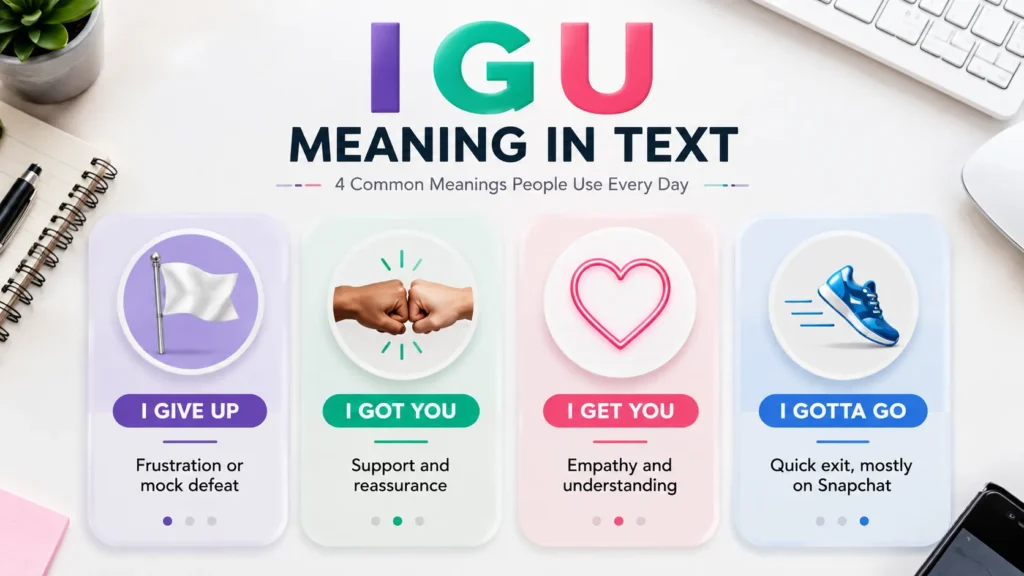
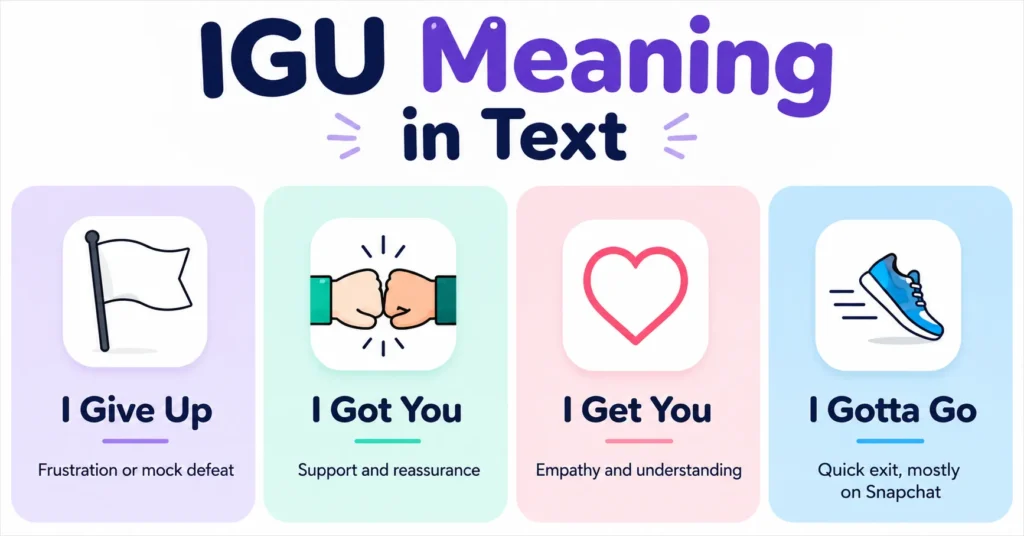
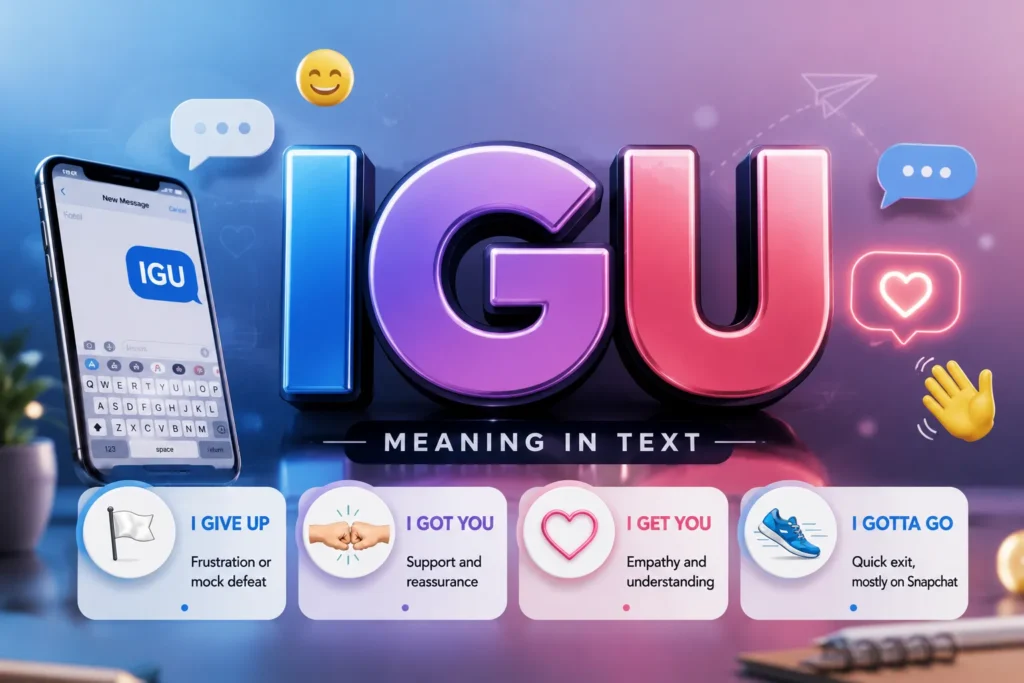
At its core, IGU is a three-letter texting acronym that stands for one of four different phrases, depending on the conversation it appears in:
- I Give Up
- I Got You (or I Gotchu)
- I Get You
- I Gotta Go
That range is unusually wide for a slang term this short. Most texting acronyms lock onto a single, stable meaning the moment they catch on — “IDK” always means “I don’t know,” “SMH” always means “shaking my head.” IGU never fully standardized that way, because three separate everyday phrases happened to compress into the same three letters at roughly the same time, and all three stuck.
That’s the reason a simple Google search for “IGU meaning” turns up conflicting answers from site to site. Understanding that upfront is the single most useful thing you can take from this article, because it reframes the question from “what does IGU mean” to “what does IGU mean in this specific message” — and that second question is much easier to answer.
2. Quick Meaning Summary Table
Here’s the fastest possible reference if you just need an answer right now:
| Meaning | Full Form | Tone | Most Common On |
| I Give Up | Surrender, frustration, mock defeat | Frustrated or playful | TikTok, Discord, gaming chats |
| I Got You | Support, reassurance, “I’ll handle it” | Warm, reassuring | Instagram DMs, close-friend texts |
| I Get You | Empathy, understanding, agreement | Validating | General texting, cousin of “IFY” |
| I Gotta Go | Exiting a conversation | Casual, abrupt | Snapchat |
Bookmark this table if nothing else. In the vast majority of real conversations, matching the tone of the message before “IGU” to one of these four rows will get you the correct meaning immediately, without needing to read any further.
3. IGU Meaning: “I Give Up”
This is the most frequently cited meaning of IGU across slang dictionaries, TikTok comment sections, and gaming chats. It expresses frustration, resignation, or comedic surrender — and it’s rarely as serious as it sounds on paper.
Typical examples:
- “Tried parking three times. IGU.”
- “This boss fight is unbeatable, IGU for tonight.”
- “IGU, you pick the restaurant this time.”
Notice the pattern: none of these are genuine cries of despair. They’re closer to a digital shrug than an actual white flag. Someone typing “IGU” after failing a video game level, losing an argument over where to eat, or bombing at parallel parking isn’t quitting on life — they’re using a lighthearted shorthand for “this isn’t worth fighting anymore.” Reading too much emotional weight into this version of IGU is one of the most common misreads people make, and it’s covered in more detail later in this guide.
The surrender meaning tends to show up most in situations involving:
- Failed attempts at a task, game, or challenge
- Losing a friendly debate or disagreement
- Reacting to something overwhelming, chaotic, or absurd
- Comedic exaggeration in group chats
4. IGU Meaning: “I Got You” / “I Gotchu”
The second major meaning sits almost opposite the first one: instead of surrender, it signals support, backup, or reassurance. This version is common between close friends, romantic partners, and coworkers who already have a casual rapport.
Typical examples:
- “I forgot my wallet.” → “Don’t worry, IGU.“
- “Can you cover my shift Friday?” → “IGU, no problem.”
- “Nervous about the interview.” → “You’ll do great — IGU if you want to practice answers.”
What separates this meaning from the others is the shape of the message right before it. “I Got You” almost always follows a request, a favor, or a moment where someone needs backup — not a complaint and not a feeling. If a friend asks for help and gets a one-word “IGU” back, they’re not being told someone gave up on them; they’re being told the opposite.
This version also carries a slightly warmer, more personal tone than the surrender meaning, which is part of why it’s so common in one-on-one DMs rather than public comment sections.
5. IGU Meaning: “I Get You”
Less dominant than the first two, but still very much in active use, this version expresses empathy, understanding, or agreement — functioning as a shorter, slightly less common cousin of “IFY” (I feel you).
Typical examples:
- “Work’s been so draining lately.” → “IGU. Take a breather.”
- “I just need a minute to process this.” → “IGU, take your time.”
- “Family stuff has been a lot lately.” → “IGU, that sounds exhausting.”
This meaning tends to follow a vent, a personal update, or someone sharing how they feel — not a request and not a complaint about a task. It’s a validating response, meant to say “I understand where you’re coming from” without writing out a full sentence. Because it overlaps so closely with IFY in both spelling pattern and function, the two get confused constantly, which is why there’s a dedicated comparison section further down this page.
6. IGU Meaning: “I Gotta Go”
The fourth and least universal meaning shows up mostly on Snapchat, where fast-moving, disappearing messages favor quick exits over drawn-out goodbyes.
Typical examples:
- “Wait, one more thing—” → “IGU, talk later!”
- “Mom’s calling — IGU, talk tomorrow?”
This meaning is far more platform-specific than the other three. You’re unlikely to see it much on Instagram or in a text message thread, but on Snapchat, where conversations are quick and ephemeral, it functions almost identically to “gtg” (got to go). If IGU shows up as the very last message in a thread, with nothing following it, this is usually the meaning at play.
7. How to Tell Which IGU Meaning Is Intended
Because IGU can mean nearly opposite things depending on the conversation, context is everything. Here’s a fast decision framework:
| What came right before it | Likely meaning |
| A complaint, failed attempt, or difficult task | I Give Up |
| A request for help, a favor, or money | I Got You |
| A feeling, personal update, or vent | I Get You |
| Nothing — it’s the last message in the thread | I Gotta Go |
| Paired with 😩💀😭 or “lol” | I Give Up |
| Paired with 🤝❤️👍 | I Got You |
The simplest possible rule: ask yourself whether the previous message was a problem, a request, or a feeling. A problem points to “I give up.” A request points to “I got you.” A feeling points to “I get you.” Nine times out of ten, that single question resolves the ambiguity instantly, and you won’t need to guess at all.
If you genuinely can’t tell, it’s completely normal to just ask. Even native English speakers who use IGU regularly will occasionally clarify with something like “wait, IGU as in you’re giving up, or you got this?” — this acronym is ambiguous enough that double-checking isn’t awkward or embarrassing.
8. Origin and History of IGU
IGU doesn’t have one clean origin story, because three different phrases independently compressed into the same three letters over time.
As SMS character limits and early instant messaging popularized abbreviation culture, alongside now-classic terms like “LOL,” “BRB,” and “IDK,” all three underlying phrases got flattened into the same three-letter acronym. That’s the core reason IGU never fully standardized around a single meaning the way most slang eventually does — it was never really one term to begin with, just three unrelated phrases that happened to share the same abbreviation.
9. Why Is IGU Popular in 2026?
IGU fits neatly into a broader shift in digital communication toward speed and emotional shorthand. Gen Z and Gen Alpha texting culture increasingly favors compressed, tone-carrying replies over full sentences, and a three-letter response that can convey defeat, support, or empathy — depending entirely on context — is efficient precisely because it does more communicative work per character than a single-meaning acronym ever could.
Platform design also plays a role. TikTok comments, Snapchat threads, and group chats are all built around fast, low-effort replies, which is exactly the environment where multi-meaning shorthand like IGU spreads fastest. A term that can flex to fit frustration, reassurance, or empathy without needing three different acronyms is, in a sense, more efficient than having separate terms for each — even if that efficiency comes at the cost of occasional confusion.
IGU also benefits from staying power through meme culture. Because it regularly shows up attached to relatable, humorous, or emotionally resonant content, it keeps getting reintroduced to new users, which has kept it relevant well past the point where many similarly niche acronyms have faded out
10. IGU Meaning on TikTok
On TikTok, IGU is most commonly used as “I Give Up,” typically showing up in comment sections reacting to relatable, chaotic, or overwhelming content. It often pairs with skull emojis, crying-laughing emojis, or “lol” to signal that the surrender is playful rather than genuine.
It also appears in self-worth and relationship-themed content, where the tone shifts slightly toward mock defeat about people or effort rather than tasks — something closer to “I’m done trying with people who don’t try back.” Because TikTok thrives on short, emotionally punchy reactions, this compressed acronym fits the platform’s comment culture particularly well, which is a large part of why it shows up there more consistently than on other platforms.
11. IGU Meaning on Snapchat
Snapchat is the one platform where the “I Gotta Go” meaning shows up with any real frequency. Because messages disappear and conversations move quickly, users lean on the shortest possible version of whatever they mean, and abrupt, no-explanation exits are common.
Alongside that, “I Got You” also appears fairly often on Snapchat as a quick reassurance between friends — “running late, can you grab it?” followed by a fast “IGU” is a typical exchange. The combination of speed and informality on this platform makes both the exit meaning and the support meaning more common here than the surrender meaning, which is more associated with TikTok and gaming spaces.
12. IGU Meaning on Instagram and Discord
On Instagram, usage skews toward DMs and comment replies, with “I Got You” being especially common between friends offering quick reassurance in private conversations. Public comments lean slightly more toward the “I Give Up” meaning, mirroring TikTok’s comment culture, though less intensely.
Discord tells a different story. “I Give Up” dominates almost entirely here, and it’s usually a direct callback to the term’s gaming-culture origin — appearing right after a failed match, a lost boss fight, or a puzzle someone can’t crack. Because Discord servers are so heavily tied to gaming communities, this platform preserves the original surrender meaning more consistently than almost anywhere else IGU shows up.
13. IGU vs IFY: What’s the Difference?
These two acronyms get confused constantly, largely because both are three-letter, emotionally toned texting responses that often show up in similar conversational moments.
| Acronym | Stands For | Meaning Range |
| IFY | I Feel You | Always means empathy or agreement — a single, fixed meaning |
| IGU | I Get You / I Got You / I Give Up | Multiple meanings — context decides |
The key distinction is consistency. IFY only ever means one thing: “I understand and share your feeling.” IGU, by contrast, is a genuinely flexible acronym that shifts between surrender, support, and empathy depending on the message around it. If you’re the one typing and want to guarantee your meaning comes across without any ambiguity, IFY is the safer choice specifically for expressing pure empathy. IGU works fine too, but only if the person reading it has enough context to interpret it correctly — which isn’t always guaranteed.
14. Non-Slang Meanings of IGU
Not every instance of “IGU” is texting slang, and running into the acronym outside a casual chat context usually signals a completely different meaning.
International Gas Union is a global not-for-profit organization representing the natural gas industry, headquartered in London, best known for organizing the World Gas Conference and publishing annual industry reports. Insulated Glass Unit is a construction and window-manufacturing term referring to double- or triple-pane glass designed for thermal insulation — a completely unrelated technical use of the same three letters, common in building and architecture contexts
Explore More https://dogizle.com/zznthn-meaning-in-text/
15. Common Mistakes People Make With IGU
A handful of misunderstandings account for most of the confusion around this acronym, and knowing them in advance makes it much easier to read IGU correctly the first time.
Assuming it only has one meaning is by far the most common mistake. Using it in professional communication is another frequent misstep — IGU is casual slang through and through, and it reads as unprofessional or simply confusing in work emails, client messages, or any context where clarity matters. Confusing it with IFY trips up plenty of people too, since IFY has a single fixed meaning while IGU does not, and treating them as interchangeable can send the wrong signal. Finally, misreading the tone is a subtler but very real mistake — treating a lighthearted “I give up” as genuine distress, or the reverse, misjudging a serious moment as playful, both happen easily if you don’t check the message right before it and any attached emoji.
Avoiding these four mistakes covers the vast majority of real-world confusion around IGU, and combined with the context framework earlier in this guide, should make the acronym easy to interpret correctly going forward.
People Also Ask
IGU most often means “I Give Up,” but it can also mean “I Got You,” “I Get You,” or, on Snapchat, “I Gotta Go” — the correct meaning depends on what was said right before it.
On TikTok, IGU is most commonly used as “I Give Up” in comment sections reacting to relatable or overwhelming content.
On Snapchat, IGU usually means either “I Got You” as a quick reassurance, or “I Gotta Go” when someone is wrapping up the conversation.
No — IFY always means “I feel you,” while IGU shifts between several meanings depending on context.
Yes, it’s one of its recognized meanings, especially in supportive one-on-one texts, though “I give up” is generally cited as the more common overall usage.
Yes, it remains active across texting, TikTok, Snapchat, and group chats, especially among Gen Z and Gen Alpha users.
No — it’s informal slang and doesn’t belong in work emails or client-facing communication.
Conclusion
IGU isn’t a single-Meaning Acronym — it’s three or four different phrases compressed into the same three letters, and no dictionary entry by itself can tell you which one you’re looking at in any given message. The fastest way to know for sure is to look at what came right before it: a complaint points to “I give up,” a request points to “I got you,” a feeling points to “I get you,” and an empty follow-up points to “I gotta go.” Once that pattern clicks, a stray “IGU” in your messages will never leave you guessing again.