Introduction
The history of solfege dates back almost one thousand years.
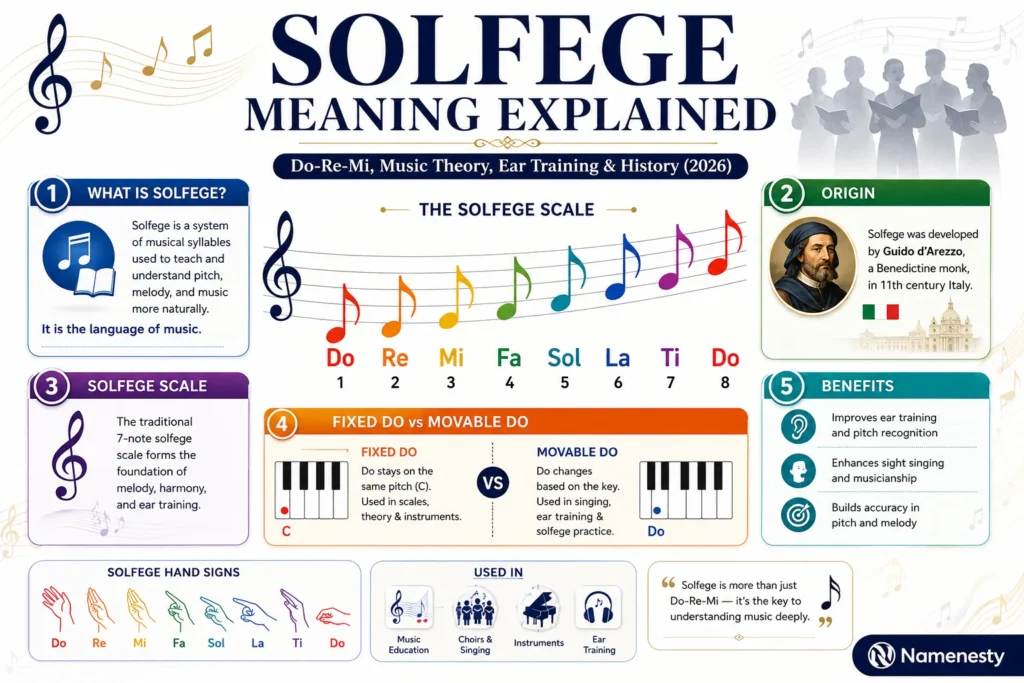
In the 11th century, Italian monk and music theorist Guido d’Arezzo developed a revolutionary teaching method to help church singers Memorize Chants More Efficiently.
He based his system on the Latin hymn Ut Queant Laxis, where each line began with a progressively higher note.
The original syllables were
- “Ut” changing to “Do”
- The addition of “Ti” as the seventh scale degree
This innovation transformed Western music education and remains one of the most influential teaching systems ever created.
Why Is Solfege Important?
Solfege develops several essential musical skills.
Improves Ear Training
Musicians learn to identify pitches and intervals by listening.
Develops Sight Singing
Students can sing written music accurately without hearing it first.
Strengthens Pitch Accuracy
Singers become more precise and consistent.
Improves Musical Memory
Patterns become easier to recognize and remember.
Builds Music Theory Understanding
Musicians learn how notes function within a key rather than memorizing isolated pitches.
The Solfege Syllables Explained
| Solfege | Musical Function | Emotional Quality |
| Do | Tonic/Home | Stable |
| Re | Supertonic | Moving |
| Mi | Mediant | Bright |
| Fa | Subdominant | Expectant |
| Sol | Dominant | Strong |
| La | Submediant | Warm |
| Ti | Leading Tone | Suspenseful |
Professional musicians often describe these syllables as having emotional characteristics because each note creates a different sense of musical tension and release.
Fixed Do vs Movable Do Explained
One of the biggest differences in solfege education is the distinction between Fixed Do and Movable Do.
| Feature | Fixed Do | Movable Do |
| Do Represents | Always C | The tonic of the key |
| Focus | Absolute pitch | Relative pitch |
| Common Regions | Europe, Latin America | US, UK |
| Best For | Instrumental study | Ear training |
Fixed Do
In Fixed Do systems:
| Note | Solfege |
| C | Do |
| D | Re |
| E | Mi |
Do never change.
Movable Do
In Movable Do systems:
| Key | First Note | Solfege |
| C Major | C | Do |
| G Major | G | Do |
| D Major | D | Do |
Do changes according to the key center.
Solfege Hand Signs
The Kodály Method introduced hand signs to reinforce musical understanding through physical movement.
| Solfege | Hand Shape |
| Do | Closed fist |
| Re | Slanted hand |
| Mi | Flat hand |
| Fa | Thumb down |
| Sol | Open palm |
| La | Curved hand |
| Ti | Pointing finger |
Hand signs connect:
- Hearing
- Visual learning
- Physical movement
- Memory retention
Solfege vs Solfeggio
Many people confuse these two terms.
| Solfege | Solfeggio |
| Modern educational term | Original Italian Term |
| Common worldwide usage | Historical terminology |
| Uses DDo-Re-Me | Same educational concept |
In practice, both terms refer to the same musical learning system.
How Beginners Can Learn Solfege
Beginners can learn solfege through a simple process.
Step 1: Learn the Major Scale
Start with the C major scale.
Step 2: Memorize the Syllables
Practice:
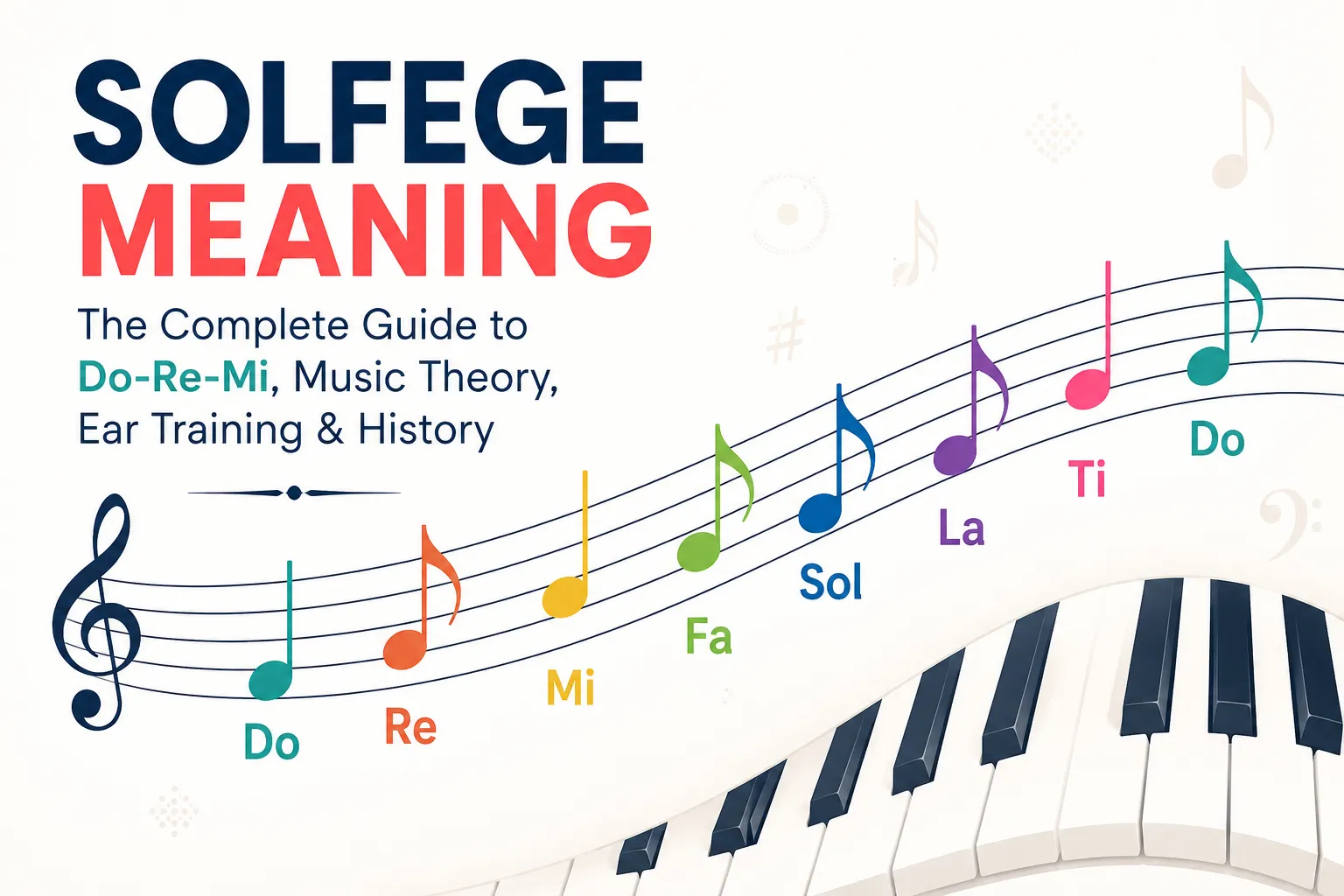
Do-Re-Mi-Fa-Sol-La-Ti-Do
Step 3: Practice Intervals
Learn how notes sound relative to each other.
Step 4: Sing Familiar Songs
Apply solfege to melodies you already know.
Step 5: Practice Daily
Even ten minutes each day can dramatically improve musical hearing.
Solfege Exercises for Beginners
Exercise 1
Do Re Mi Re Do
Exercise 2
Do Mi Sol Mi Do
Exercise 3
Do Re Mi Fa Sol Fa Mi Re Do
Exercise 4
Do Sol Do
Practice slowly and focus on Hearing Each interval clearly.
Solfege in Modern Music Education
Today, solfege remains essential in:
- Choir education
- Music conservatories
- Universities
- Vocal coaching
- Children’s music education
- Ear training software
- Film scoring programs
- Professional music production courses
Many elite music schools continue to consider solfege a foundational skill.
Common Misunderstandings About Solfege
Myth: Solfege Is Only for Singers
False. Instrumentalists use solfege extensively.
Myth: Solfege Is Outdated
False. It remains a core component of modern music education.
Myth: Solfege Requires Perfect Pitch
False. Most solfege training develops relative pitch.
Myth: Do-Re-Me Is Just a Children’s Song
False. Professional musicians use solfege throughout their careers.
People Also Ask
Solfege is a music education system that uses Syllables like Do, Re, Mi, Fa, Sol, La, and Ti to teach pitch recognition, ear training, and sight-singing.
Yes. Do-Re-Me is the most famous representation of the solfege system and refers to its musical syllables.
Solfege was developed by Guido d’Arezzo during the 11th century to help singers learn church music more efficiently.
Fixed do assigns syllables to specific notes, while movable do assigns syllables according to a key’s scale degrees.
Yes. Solfege remains one of the world’s most widely taught music education methods.
Absolutely. Solfege helps beginners develop pitch accuracy, ear training, and music-reading skills.
Conclusion
Solfege is much more than simply singing “Do-Re-Me.” It is a powerful musical language that has helped musicians learn, understand, and perform music for nearly a thousand years. From improving ear training and sight-singing to developing musical memory and pitch accuracy, solfege remains one of the most effective educational tools in music.
Whether you’re a complete beginner, a choir singer, a music student, or a professional performer, learning solfege can fundamentally change the way you hear, understand, and create music.