Introduction
Have you ever felt strangely empty, unmotivated, and disconnected from life—even when everything appears to be going well?
That feeling may be ennui.
Unlike ordinary boredom, Ennui describes a profound sense of emotional dissatisfaction, listlessness, and lack of purpose. It is a complex psychological and philosophical concept that has fascinated writers, philosophers, psychologists, and artists for centuries.
Today, the term has become increasingly relevant in a world filled with constant entertainment, social media stimulation, and modern burnout. Ironically, despite having more distractions than ever before, many people experience deeper feelings of meaninglessness and emotional exhaustion.
In this complete guide, you’ll discover:
- The exact meaning of ennui
- Its pronunciation
- French origins and historical evolution
- The psychological and philosophical dimensions
- Real-life examples
- How ennui differs from ordinary boredom
- Causes, symptoms, and solutions
- Modern social media and cultural relevance
What Does Ennui Mean?
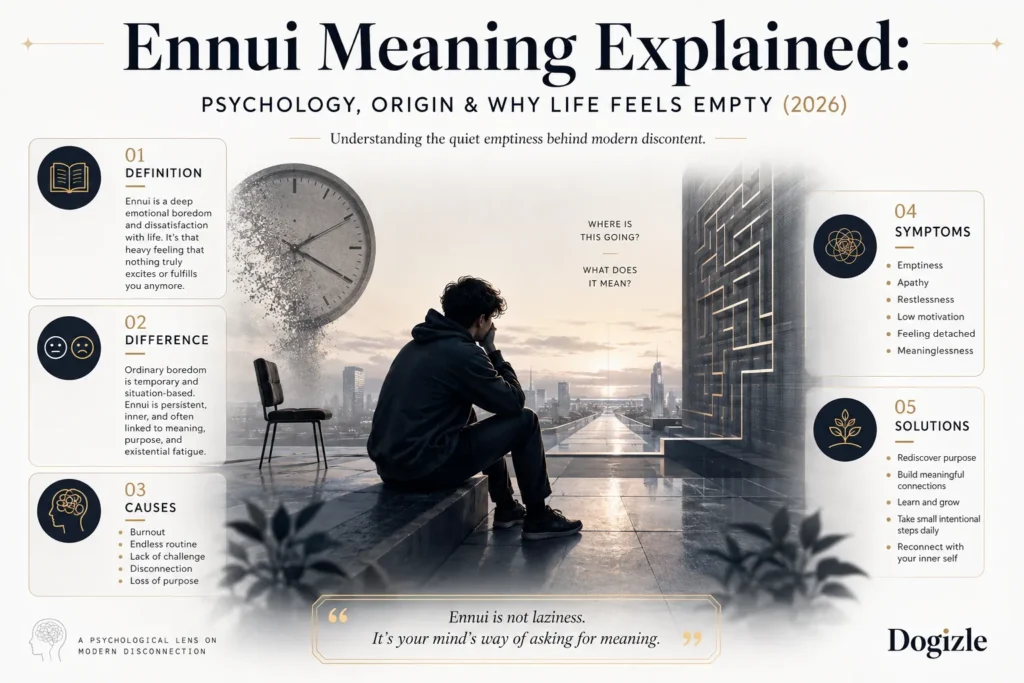
Ennui refers to a deep feeling of emotional boredom, dissatisfaction, weariness, and lack of purpose that extends beyond ordinary boredom.
Featured Snippet Definition:
Ennui is a prolonged feeling of dissatisfaction, emotional emptiness, and lack of meaning or engagement in life. Unlike temporary boredom, ennui often involves psychological and existential dimensions.
Simple Definition
Ennui = deep boredom + emotional dissatisfaction + lack of meaning.
Example
“Despite achieving career success, he struggled with a persistent feeling of ennui.”
Quick Meaning Summary
| Aspect | Description |
| Word | Ennui |
| Origin | French |
| Pronunciation | ahn-WEE |
| Meaning | Deep dissatisfaction and emotional boredom |
| Category | Psychological and existential state |
| Opposite | Fulfillment, enthusiasm |
| Related Concepts | Boredom, apathy, existential crisis |
| Common Usage | Psychology, philosophy, literature |
How to Pronounce Ennui
The correct pronunciation of ennui is:
American English
ahn-WEE
British English
on-WEE
IPA Pronunciation
/ɑːnˈwiː/
Because the term comes directly from French, many English speakers initially mispronounce it as “en-noo-ee” or “en-you-eye.”
The Origin and History of Ennui
The word ennui comes from the French language and entered English during the 17th century.
Historical Development
| Period | Meaning |
| Old French | annoyance, trouble |
| Middle French | dissatisfaction |
| Modern French | boredom, weariness |
| English Adoption | existential dissatisfaction |
Originally, the term referred to annoyance and frustration. Over time, writers and philosophers expanded its meaning to describe Profound Emotional Dissatisfaction and spiritual emptiness.
Ennui vs Boredom: What’s the Difference?
One of the biggest misconceptions is assuming that ennui and boredom mean the same thing.
| Boredom | Ennui |
| Temporary | Long-lasting |
| Caused by a lack of activity | Caused by a lack of meaning |
| Easily solved | Difficult to overcome |
| Surface emotion | Deep emotional state |
| Situational | Existential |
Example of Boredom
“I’m bored because my flight is delayed.”
Example of Ennui
“My life is comfortable, but I still feel emotionally empty.”
The Psychological Meaning of Ennui
In psychology, ennui is viewed as a state of emotional disengagement and dissatisfaction characterized by:
- emotional exhaustion
- lack of motivation
- reduced pleasure
- mental fatigue
- purposelessness
- apathy
- chronic dissatisfaction
Researchers have found that prolonged experiences of ennui may overlap with:
- burnout
- depression symptoms
- anxiety
- emotional withdrawal
- decreased life satisfaction
However, ennui itself is not classified as a mental disorder.
Existential Ennui: When Life Loses Meaning
Existential ennui occurs when individuals begin questioning the purpose and meaning of their lives.
Common questions include:
- Why am I doing this?
- What is the purpose of my existence?
- Why doesn’t success make me happy?
- Is this all there is?
Common triggers include:
- career stagnation
- retirement
- major life transitions
- social isolation
- prolonged routine
- burnout
Ennui in Philosophy
The concept of ennui has fascinated philosophers for centuries.
Major Philosophical Themes
- meaninglessness
- alienation
- dissatisfaction
- freedom
- existential anxiety
- human purpose
Philosophers associated with ideas related to ennui include:
- Jean-Paul Sartre
- Albert Camus
- Arthur Schopenhauer
These thinkers argued that feelings of emptiness may arise naturally from human consciousness and our search for meaning.
Ennui in Literature
Literature has long used ennui to portray emotional complexity.
Common literary themes include:
- aristocratic boredom
- urban loneliness
- existential suffering
- emotional detachment
- spiritual emptiness
Notable authors who explored ennui include:
- Charles Baudelaire
- Gustave Flaubert
- Marcel Proust
What Causes Ennui?
Several factors may contribute to feelings of ennui.
1. Repetitive Routines
Performing identical activities daily reduces mental stimulation.
2. Lack of Purpose
Humans seek meaning and direction.
3. Social Isolation
Reduced connection often intensifies emotional dissatisfaction.
4. Digital Overstimulation
Constant entertainment may reduce genuine engagement.
5. Burnout
Mental exhaustion frequently resembles ennui.
6. Unfulfilled Expectations
Achieving goals without finding satisfaction can trigger existential questioning.
Common Symptoms of Ennui
You may be experiencing ennui if you regularly feel:
- emotionally empty
- mentally exhausted
- purposeless
- disconnected
- unmotivated
- restless
- dissatisfied
- chronically bored
- uninterested in hobbies
- emotionally numb
Examples of Ennui in Everyday Life
Work
“After spending fifteen years in the same career, she developed a profound sense of ennui.”
Relationships
“Their relationship was stable, yet both partners experienced emotional ennui.”
Social Media
“Hours of scrolling created a strange feeling of digital ennui.”
Retirement
“Without meaningful activities, retirement brought unexpected ennui.”
Why Ennui Is More Common Today
Modern society creates several conditions that may increase ennui:
- social media overload,
- remote work isolation
- Burnout Culture
- digital addiction
- excessive entertainment
- declining community engagement
- information overload
Paradoxically, unlimited entertainment does not always create fulfillment.
Synonyms of Ennui
- boredom
- apathy
- listlessness
- weariness
- melancholy
- dissatisfaction
- tedium
- languor
- lassitude
- doldrums
Antonyms of Ennui
- enthusiasm
- excitement
- passion
- fulfillment
- inspiration
- purpose
- motivation
- engagement
- fascination
Common Misunderstandings About Ennui
| Myth | Reality |
| Ennui means simple boredom | It involves deeper dissatisfaction |
| Only unhappy people experience ennui | Successful people can experience it too |
| Ennui is a mental illness | It is an emotional state, not a diagnosis |
| More entertainment fixes ennui | Meaning and purpose matter more |
Related Terms and Similar Meanings
existential crisis
burnout
apathy
melancholy
listlessness
emotional exhaustion
dissatisfaction
boredom
alienation
purposelessness
People Also Ask
No. Boredom is usually temporary, while ennui involves deeper feelings of dissatisfaction and meaninglessness.
No. Ennui itself is not classified as a mental Disorder, Although it may occur alongside depression or burnout.
Yes. Ennui originated in French and was adopted into English in the 17th century.
Absolutely. Wealth, comfort, and achievement do not always prevent feelings of emptiness or lack of purpose.
The standard pronunciation is ahn-WEE.
Common causes include burnout, life transitions, isolation, routine, and questions about purpose.
They can overlap, but ennui and depression are not identical experiences.
Conclusion
Ennui is far more than ordinary boredom. It represents a deep sense of dissatisfaction, emotional emptiness, and lack of purpose that has fascinated psychologists, philosophers, and writers for centuries.
Understanding ennui helps us recognize an important truth: when life feels empty, what we often need isn’t more entertainment—it’s more meaning, purpose, connection, and fulfillment.
Whether encountered through psychology, philosophy, literature, or everyday life, ennui remains one of the most powerful words for describing the Uniquely Human Experience of feeling disconnected from meaning itself.