ROFL Meaning in Text: Full Form, Origin, and How to Use It in 2026
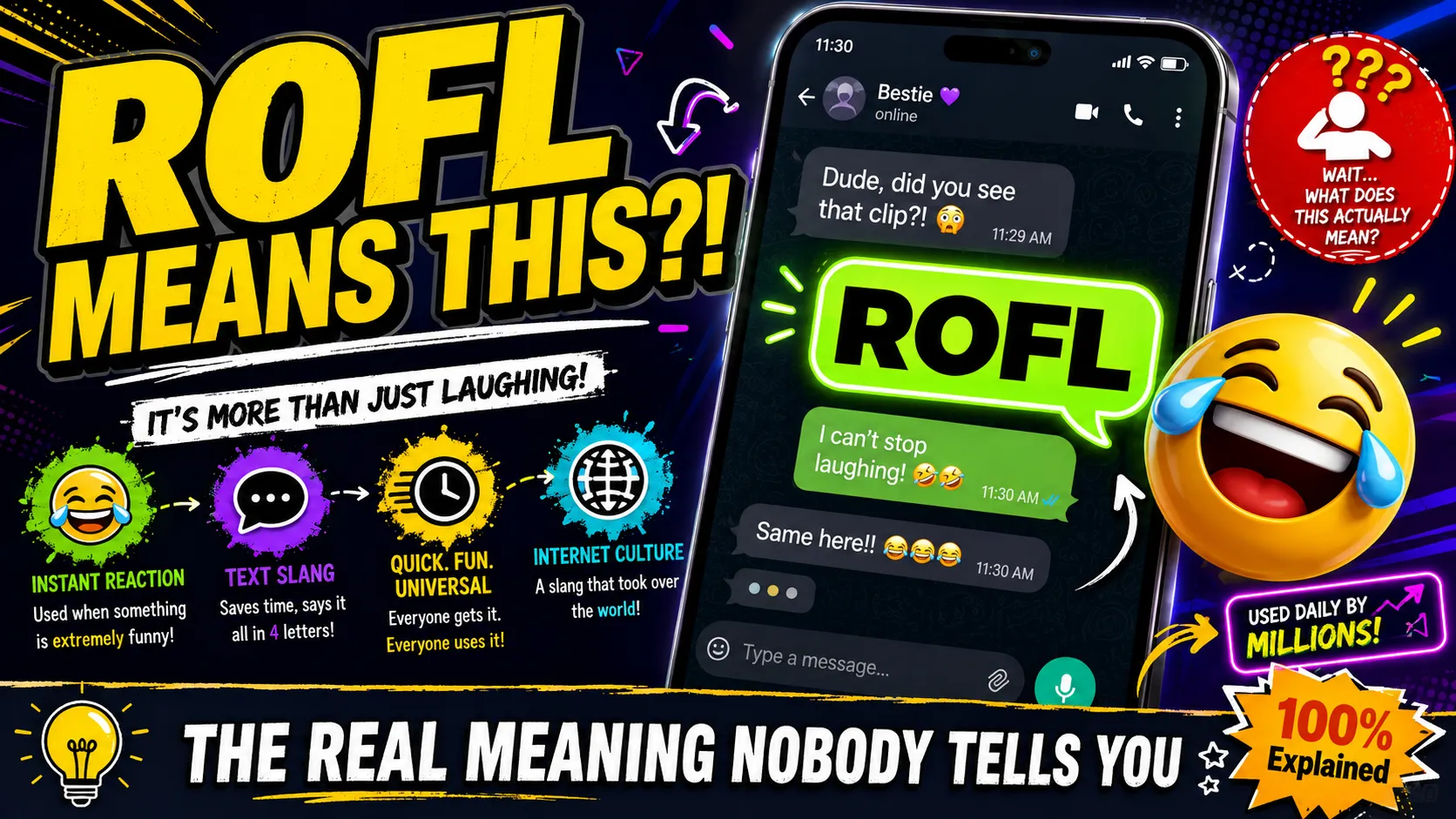
ROFL means “Rolling On the Floor Laughing.” It’s an internet acronym used in texts, DMs, and comments to signal that something is extremely funny — more intense than a casual “lol,” though usually milder than “lmfao.” It’s informal, harmless, and traces back to 1980s–90s internet relay chat (IRC) rooms, later spreading through instant messaging, texting, and now social media.
That’s the short version. Below is everything else worth knowing: where it came from, how it stacks up against LOL and LMAO, whether it’s still relevant in 2026, and how to use it (or avoid it) without misjudging the room.
1. What Does ROFL Mean?
ROFL stands for Rolling On the Floor Laughing. It’s an initialism used almost entirely in written digital communication, expressing that something struck the sender as hilarious — funny enough to (hypothetically) knock them off their chair.
Nobody is literally on the floor. Like “I’m dying” or “I can’t breathe,” it’s hyperbole — a stock exaggeration for strong amusement, not a literal report of what’s happening.
Pronunciation: Usually said as a word, rhyming with “waffle” (/rɒfəl/), though spelling it letter-by-letter is also understood and common in speech among people quoting a text out loud.
2. Quick Meaning Summary
| Attribute | Detail |
| Full form | Rolling On the Floor Laughing |
| Type | Internet acronym / initialism |
| Meaning | Intense, genuine laughter |
| Formality | Informal only |
| First appeared | Late 1980s–1990s (IRC chat) |
| Common platforms | WhatsApp, Discord, Instagram, TikTok, texting |
| Related terms | LOL, LMAO, LMFAO, ROFLMAO, IJBOL |
| Still in use (2026)? | Yes, but less dominant among Gen Alpha/younger Gen Z |
3. Origin and History
ROFL emerged from the internet relay chat (IRC) communities of the late 1980s and early 1990s, alongside sibling acronyms like LOL, BRB, and AFK. Early online communication was slow and text-only, so users developed shorthand to express emotional reactions that plain text couldn’t otherwise convey — tone, laughter, and emphasis all had to be typed out.
The phrase likely draws on older idioms like “rolling in the aisles,” a pre-internet expression describing an audience laughing uncontrollably in a theater, suggesting the “collapsing with laughter” image existed long before the acronym did.
From IRC and early AOL chat rooms, ROFL moved into instant messengers (AIM, MSN Messenger) in the late 1990s and 2000s, then into SMS texting as mobile phones went mainstream, and eventually into social media comments and DMs. Its usage peaked in the mid-to-late 2000s, right as texting culture exploded — before emoji like 😂 and 🤣 began absorbing much of the same communicative function.
4. Why Is ROFL Still Popular?
ROFL persists for a few concrete reasons:
- Universal recognizability — it’s one of the small handful of acronyms (with LOL and BRB) that virtually every internet-literate person, across generations and many non-English-speaking countries, immediately understands.
- No ambiguity — unlike newer slang that shifts meaning by community or platform, ROFL has one stable, agreed-upon meaning.
- Low risk — it’s not offensive, doesn’t carry profanity (unlike LMFAO), and works in almost any casual setting without misreading the room.
- Cross-platform habit — because it predates modern social platforms, it’s baked into how millennials and older Gen Z default to texting, and it persists in gaming and forum communities that have used it for decades.
5. How Is ROFL Used in Real Conversations?
In practice, ROFL functions as a reaction, not a statement — it’s typed in response to something funny rather than used to build a sentence. Common real-world patterns:
- Reacting to a joke or story — “ROFL, that punchline caught me off guard”
- Responding to a funny video or clip — “I just watched that clip… ROFL”
- In group chats — “You actually said that to your boss? ROFL”
- Commenting on memes — “ROFL this is literally me on Fridays”
- Playful exaggeration or teasing — “ROFL, you’re so dramatic”
It’s almost always confined to informal settings — friends, family group chats, casual social media, and relaxed workplace chat, not formal or professional writing.
6. Examples of ROFL in Sentences
- “ROFL, I can’t believe you wore that to the party.”
- “That dog video? ROFL. I’ve watched it five times.”
- “You really said that? ROFL!”
- “I just tripped over nothing. ROFL at myself.”
- “Stop, I’m ROFL right now.”
- “ROFL, that plot twist made zero sense.”
7. ROFL on Social Media and Chat Platforms
ROFL doesn’t behave identically everywhere — context changes how it’s used:
- WhatsApp / iMessage / SMS — most common in group chats reacting to a shared joke, meme, or voice note, often paired with 😂.
- Instagram & TikTok — used as a quick reaction in comments under funny reels or clips, frequently stretched for emphasis (“ROFLLLL”).
- Discord & gaming chat — genuinely common here; older gaming communities never fully dropped IRC-era slang. Often reacts to an in-game fail or clutch play.
- Slack / workplace chat — usable only in casual, low-formality team cultures; skip it in client-facing or leadership channels.
- Reddit & forums — occasionally used, though largely displaced by “lol,” “lmao,” or reaction gifs.
- X (Twitter) — rare as a standalone reply; more often folded into a quote-tweet or reply for comedic emphasis.
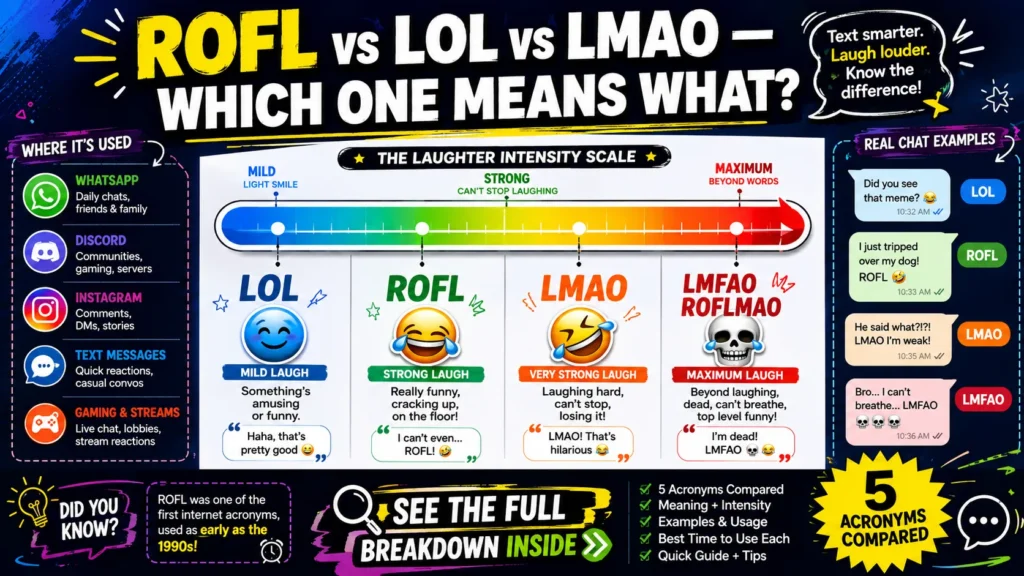
8. ROFL vs LOL vs LMAO vs LMFAO vs ROFLMAO
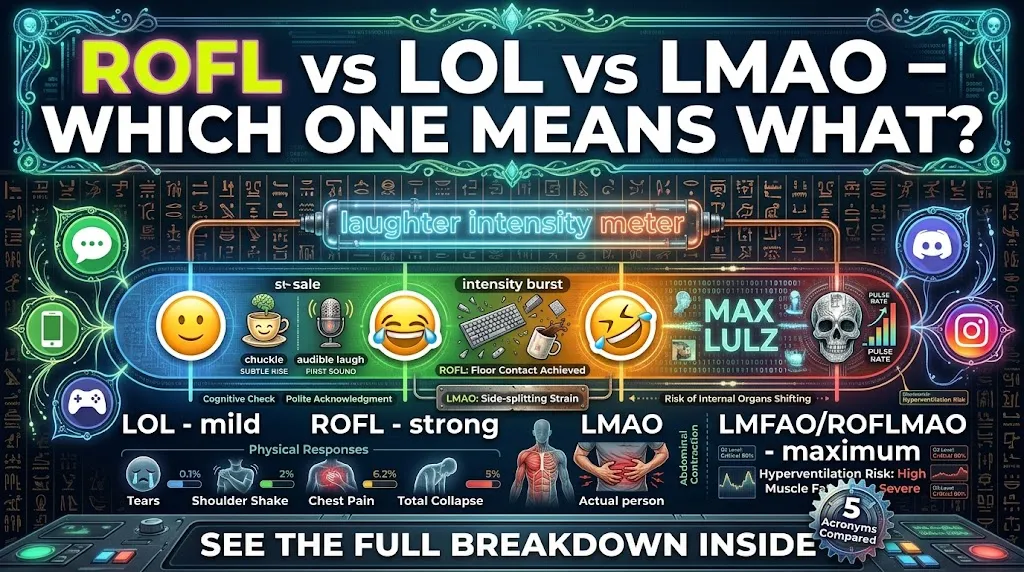
All five acronyms mean “laughing,” but not the same amount of laughing — mixing them up can send the wrong tone.
| Acronym | Full Form | Intensity | Typical Tone |
| LOL | Laughing Out Loud | Mild | Default, low-key reaction — often typed reflexively |
| ROFL | Rolling On the Floor Laughing | Strong | Genuine, enthusiastic laughter — a step up from LOL |
| LMAO | Laughing My Ass Off | Strong | Similar intensity to ROFL, slightly more sarcastic/edgy |
| LMFAO | Laughing My F***ing Ass Off | Very strong | Most intense of the common variants; crude/casual |
| ROFLMAO | Rolling On the Floor Laughing My Ass Off | Maximum | Deliberately exaggerated stacking of ROFL + LMAO |
A simple way to remember it: LOL is a reflex, ROFL is a reaction. LOL gets typed almost automatically, even for mild amusement, while ROFL traditionally signals you actually laughed hard. In everyday use that line has blurred — many people now use all of these interchangeably regardless of true amusement level, which is part of why emoji have taken over so much of this territory.
9. Is ROFL Still Used in 2026?
Yes — but it’s no longer anyone’s default reaction.
- Emoji have absorbed most of ROFL’s job. 😂 and 🤣 do the same communicative work faster, without typing, which is the biggest driver of ROFL’s decline.
- Generational data supports this. A UCLA sociolinguistics comparison of Gen Z and Gen Alpha online laughter found verbal acronyms like “lol” and “lmao” still see heavy use among Gen Z (70–80%), while Gen Alpha relies far more on emoji and visual reactions than text acronyms.
- Newer slang is chipping away at its territory. Expressions like “I’m dead,” the 💀 skull emoji, and newer coinages like IJBOL (“I just burst out laughing”) have become trendier among younger Gen Z users — some of whom now associate ROFL and LMAO with millennial-coded texting.
- It’s become “classic,” not obsolete. ROFL sits alongside LOL as instantly recognizable and still functional, occasionally used semi-ironically or nostalgically, but rarely a first instinct anymore. It remains genuinely common in gaming chats, older group texts, forums, and international messaging where English acronyms serve as a shared shorthand.
Using ROFL today won’t confuse anyone — it just reads a little more “classic internet” than “cutting edge.”
10. When Not to Use ROFL
ROFL is safe and inoffensive, but strictly informal. Avoid it in:
- Professional emails or client communication — reads as unprofessional outside chat contexts.
- Serious or sensitive conversations — using it in response to bad news or someone venting can come across as dismissive.
- Formal or academic writing — self-explanatory.
- Early professional conversations with someone you don’t know well, where tone hasn’t been established yet.
11. Common Misunderstandings
“People are literally rolling on the floor.” No — it’s hyperbole, the same move as “I’m dying” or “I can’t even.”
“ROFL and LOL mean exactly the same thing.” Not quite — ROFL traditionally signals stronger amusement, even though casual use has softened the distinction.
“ROFL is dead.” Inaccurate — it’s less dominant among the youngest users but still widely understood and actively used elsewhere.
“It’s always sarcastic.” Usually it’s genuine; sarcastic use exists but isn’t the default meaning.
“It’s rude or inappropriate.” Not inherently — context determines how it lands, not the acronym itself.
Explore More:https://dogizle.com/oms-meaning-in-text/
12. Related Terms and Similar Meanings
- LOL — Laughing Out Loud (milder)
- LMAO — Laughing My Ass Off (similar intensity, edgier)
- LMFAO — stronger, more crude variant
- ROFLMAO — combined, maximum-intensity variant
- IJBOL — “I Just Burst Out Laughing,” a newer Gen Z alternative
- 😂 / 🤣 / 💀 — emoji equivalents that have partly replaced text acronyms
13. People Also Ask
It means the sender found something extremely funny — “Rolling On the Floor Laughing” — used to express strong laughter in casual chat.
Not exactly. LOL typically signals mild, almost reflexive amusement, while ROFL is meant to convey a stronger, more genuine laugh reaction.
Strictly informal. It works in texts, DMs, and casual chat, but should be avoided in professional emails or formal writing.
Yes, though less than in the 2000s. It’s still widely understood, particularly outside Gen Z/Gen Alpha, who lean more on emoji and newer slang like “I’m dead” or “IJBOL.”
Most commonly as a word rhyming with “waffle,” though spelling it out letter by letter is also understood.
? LMFAO and ROFLMAO are generally considered more intense, exaggerated versions of the same laughter category.
It originated in internet relay chat (IRC) communities in the late 1980s and 1990s, part of the same wave of shorthand that produced LOL, BRB, and AFK.
14. Conclusion
ROFL means “Rolling On the Floor Laughing” — a hyperbolic acronym for strong, genuine amusement that dates back to 1980s–90s internet chat culture. It sits between LOL and LMAO in intensity, remains informal-only, and while emoji and newer slang like IJBOL have chipped into its territory among the youngest users, it’s still instantly recognizable and actively used across texting, gaming, and social platforms in 2026.
If you found this useful, the related guides below break down LOL, LMAO, and other common chat acronyms in the same depth.