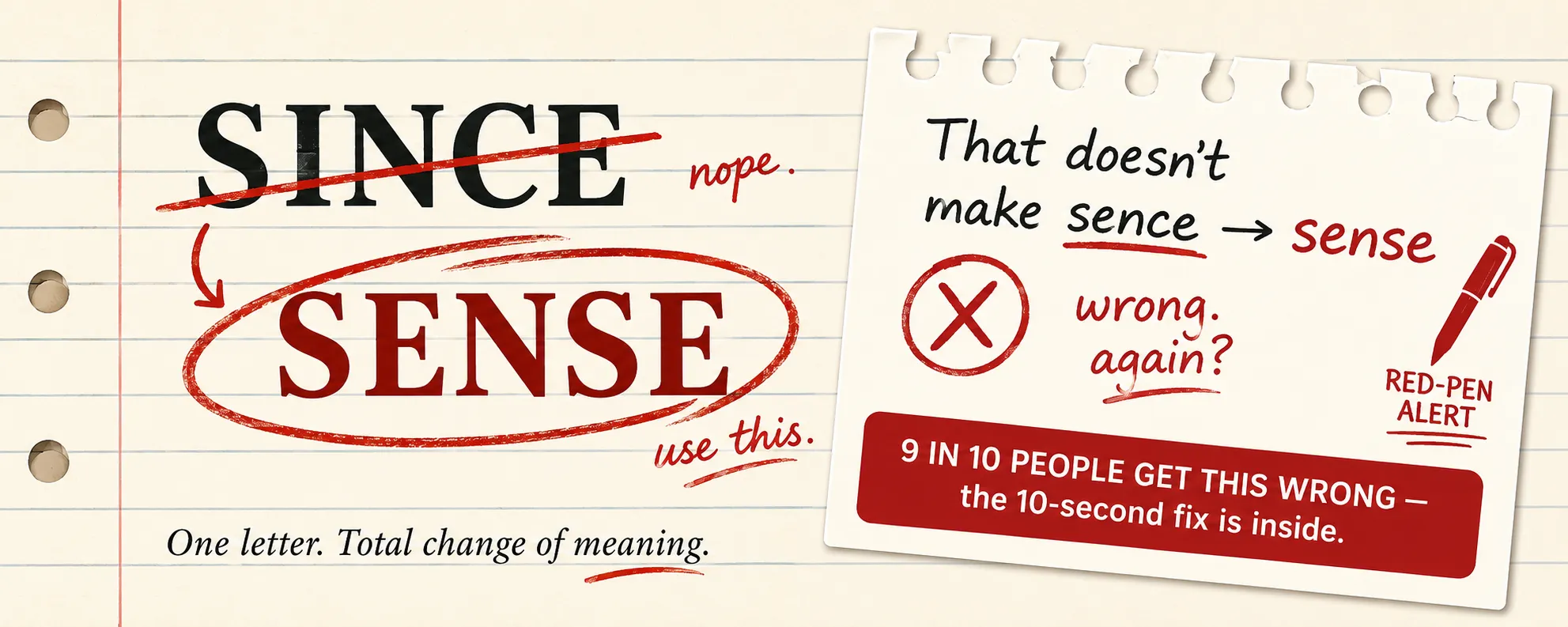
Since vs Sense: The Complete Guide to Using Them Correctly
“I’ve known her since high school” or “I’ve known her sense high school”? If you had to pause even for a second, you’re not alone — “since” and “sense” are two of the most commonly confused word pairs in English, and the mix-up shows up everywhere from text messages to business emails.
This guide covers everything the other explainers leave out: precise pronunciation, the “makes sense vs makes since” rule, the often-ignored third member of this word family (cense), a common-mistakes checklist, and a quick quiz so you can prove you’ve got it.
Quick Answer
| Since | Sense | |
| Part of speech | Conjunction, preposition, adverb | Noun, verb |
| Core meaning | Time (from a point in the past until now) or reason (= “because”) | Perception, feeling, meaning, or understanding |
| Pronunciation | /sɪns/ — rhymes with “mince” | /sɛns/ — rhymes with “fence” |
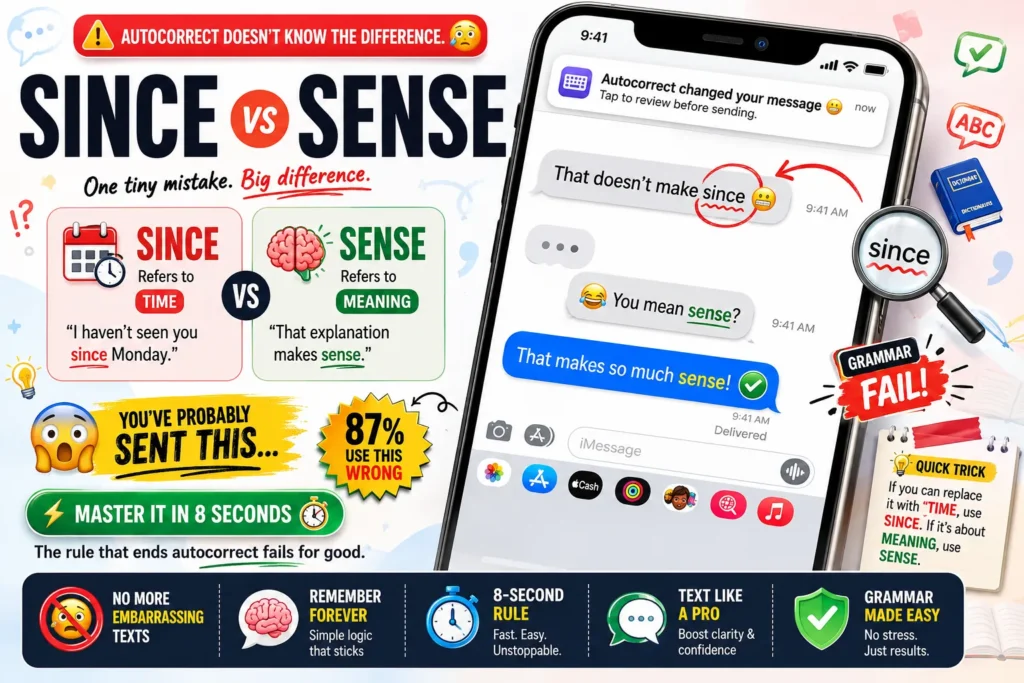
| Example | “I haven’t slept since yesterday.” | “That doesn’t make sense.” |
| Quick swap test | Can you replace it with “because” or “from a point in time”? Use since. | Can you replace it with “meaning” or “perception”? Use sense. |
If you remember nothing else: since is about time or reason, sense is about meaning or perception. Everything below builds on that one distinction.
What Does “Since” Mean?
“Since” is a conjunction, preposition, or adverb — never a noun. It always points to time or cause, and it comes from Old English siþþan, meaning “after that.”
1. Since as a conjunction (time)
Marks the starting point of something that continues to the present.
- “She’s worked here since 2019.”
- “I haven’t eaten since breakfast.”
2. Since as a conjunction (reason)
Functions exactly like “because.”
- “Since it’s raining, let’s stay in.” → “Because it’s raining, let’s stay in.”
3. Since as a preposition
Introduces a specific starting time.
- “I’ve known him since college.”
4. Since as an adverb
Stands alone, referring back to a previously mentioned time.
- “He left in March and hasn’t been back since.”
Quick test: If you can swap the word for “because” or “from that time on” and the sentence still works, it’s since.
What Does “Sense” Mean?
“Sense” is primarily a noun, though it also works as a verb. It traces back to the Latin sensus (“perception, feeling”), from sentire (“to feel”).
1. Sense as a noun — perception
Refers to the five physical senses: sight, hearing, smell, taste, touch.
- “Dogs have an incredible sense of smell.”
2. Sense as a noun — understanding or judgment
- “She has a good sense of direction.”
- “Use some common sense.”
3. Sense as a noun — meaning
- “This sentence doesn’t make any sense.”
4. Sense as a verb — to perceive or detect
- “I could sense something was wrong.”
Quick test: If you can swap the word for “meaning,” “feeling,” or “perception,” it’s sense.
Since vs Sense: Side-by-Side Comparison
| Feature | Since | Sense |
| Grammatical role | Conjunction / preposition / adverb | Noun / verb |
| Refers to | Time or cause | Meaning, feeling, or perception |
| Common phrases | “ever since,” “long since,” “since then” | “makes sense,” “sixth sense,” “sense of humor” |
| Origin | Old English siþþan | Latin sensus |
| Typical sentence position | Start or mid-sentence, joining clauses | Usually the object of a verb (“makes,” “have,” “lost”) |
Why People Confuse Them: The Pronunciation Difference
A lot of guides call “since” and “sense” homophones. They’re not, technically — that’s actually one reason confusion persists, because people assume they sound identical when they don’t:
- Since → /sɪns/ — short “i,” rhymes with mince, quince, prince
- Sense → /sɛns/ — short “e,” rhymes with fence, dense, tense
Say “mince” and “fence” out loud back to back. That’s the real difference. The confusion is really about spelling and fast speech, not identical sound — in casual or fast speech, especially in accents where short vowels flatten, the gap narrows enough to cause writing errors even when the speaker knows the difference out loud.
“Makes Sense” or “Makes Since”? (The #1 Search Behind This Confusion)
This is the single most common error tied to this word pair — and it’s always wrong the same way.
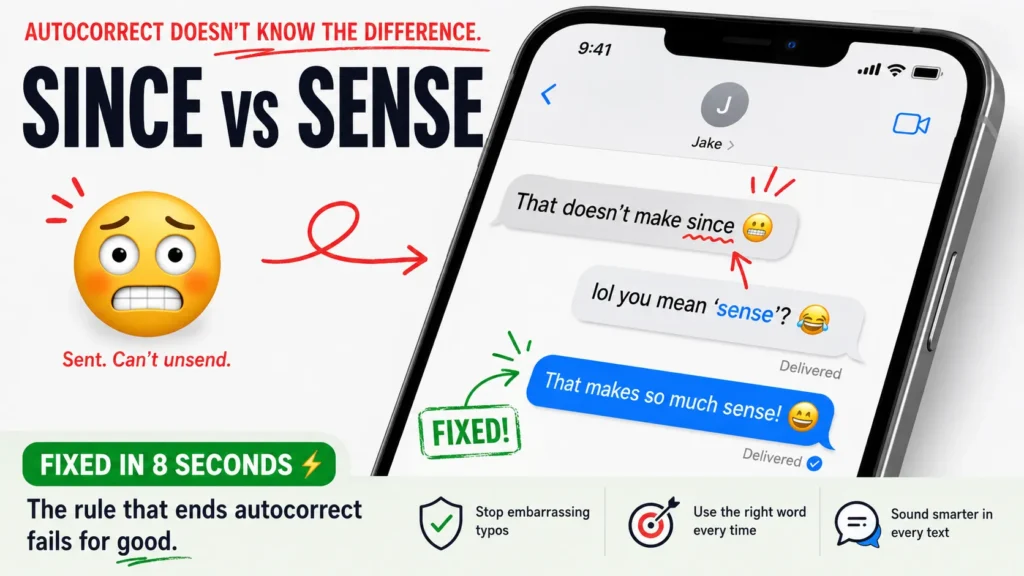
Only “makes sense” is correct. “Makes since” is a spelling mistake, full stop — there’s no grammatical context where “since” replaces “sense” here, because “since” cannot function as a noun.
| ❌ Incorrect | ✅ Correct |
| That makes since. | That makes sense. |
| Does this makes since to you? | Does this make sense to you? |
| It finally makes since now. | It finally makes sense now. |
If you’re ever unsure which one to type, this phrase is a safe rule of thumb: “sense” always follows “make/makes/making.” There is no version of that phrase that uses “since.”
Since vs Sense vs Cense: The Trio Almost Nobody Mentions
Here’s something most guides skip entirely: there’s a third word in this family — cense — and knowing it actually makes the other two easier to remember.
Cense (verb, uncommon) means to burn incense or perfume something with smoke, typically in religious ceremonies.
- “The priest censed the altar before the service.”
You’ll rarely need to use “cense” yourself, but recognizing it helps in two ways:
- If you ever see it in older or ceremonial texts, you won’t misread it as a typo of “sense.”
- Its root — related to “incense” — is a useful anchor: cense = ceremony/smoke, sense = sensation, since = interval/time. Three different roots, three different jobs.
Common Mistakes (And How to Fix Them Instantly)
| Mistake | Why it happens | Correction |
| “I haven’t seen her sense Monday.” | Sound confusion when writing quickly | “I haven’t seen her since Monday.” |
| “That doesn’t make since.” | Treating “since” as a noun | “That doesn’t make sense.” |
| “I have a good since of humor.” | Same sound confusion, reversed | “I have a good sense of humor.” |
| “Since the movie, I can since something’s off.” | Using “since” twice for two different jobs | “Since the movie, I can sense something’s off.” |
Memory Tricks That Actually Work
- “Since” has an I for Interval — it deals with time intervals (I → interval → since).
- “Sense” has an S for Sensation — both start the same way, so pair them mentally: sense = sensation.
- The “because” test — if “because” fits, it’s “since.” If “meaning” or “feeling” fits, it’s “sense.”
- The “makes” trap — “makes sense” is the only correct combo; there is no “makes since.”
Since vs Sense in Real Sentences
Business email
- “Since our last conversation, I’ve reviewed the proposal, and it makes much more sense now.”
Academic writing
- “The theory has remained influential since its publication, though critics question the sense in which ‘progress’ is defined.”
Everyday conversation
- “I’ve had this cough since Tuesday — does it make sense to see a doctor?”
Creative writing
- “She hadn’t felt at peace since the accident, and yet, somehow, standing there, everything made sense.”
Synonyms and Alternatives
For “since” (time): from, after, following For “since” (reason): because, as, due to, inasmuch as For “sense” (perception/feeling): sensation, perception, awareness, intuition For “sense” (meaning): meaning, significance, understanding, interpretation
Word Origins
Since comes from Old English siþþan (“after that”), which evolved through Middle English forms like sithens and sithence before settling into “since” by the 16th century.
Sense comes from Latin sensus (“feeling, perception”), from the verb sentire (“to feel”), entering Middle English around the 14th century as “sens.”
Different roots, different centuries, different jobs in a sentence — which is exactly why, despite the similar sound, they never actually overlap in meaning.
Explore More:https://dogizle.com/cancellation-vs-cancelation/
Quick Self-Test
Fill in “since” or “sense”:
- I haven’t traveled abroad ___ 2020.
- That explanation doesn’t make any ___.
- ___ you’re already here, help me carry these boxes.
- She has a great ___ of humor.
- He’s been quieter ever ___ the news broke.
Answers: 1. since 2. sense 3. Since 4. sense 5. since
People Also Ask
No — they’re near-homophones. “Since” is pronounced /sɪns/ and “sense” is pronounced /sɛns/, with different vowel sounds, though they’re close enough in fast speech to cause spelling confusion.
“Ever since” emphasizes continuity from a point to now (“I’ve loved music ever since”). “Since then” refers back to a specific previously mentioned moment (“The store closed in 2020; since then, the building has been empty”).
No. “Sense” never carries a time meaning — that job belongs entirely to “since.”
Never. It’s always a misspelling of “makes sense.”
Cense” is a rare verb meaning to burn incense ceremonially. It shares a sound with “since” and “sense” but comes from a completely different root and has nothing to do with time or perception.
Conclusion
Since and sense may sound alike, but they never do the same job. Since points to time or reason — think starting points and cause. Sense points to meaning, feeling, or perception — think understanding and awareness.
When in doubt, run the swap test: if “because” fits, use since. If “meaning” or “feeling” fits, use sense. And remember the one rule that trips up almost everyone — it’s always “makes sense,” never “Makes Since.”
Bookmark this guide, run through the quick self-test above, and you’ll never second-guess this word pair again.