Pre vs Post: The Complete Guide to Using These Prefixes Correctly
If you’ve ever paused mid-sentence wondering whether something happened “pre-launch” or “post-launch,” you’re not alone — pre vs post is one of the most commonly searched prefix comparisons in English, and for good reason: get it backward, and your meaning flips entirely.
The short version: pre- means before, and post- means after. People search this less because they don’t know that rule, and more because they hit a specific case where it’s genuinely unclear — an ambiguous event boundary, an unfamiliar word pair, or a question about whether to hyphenate. This guide covers the quick rule first, then goes further than any other resource on this topic: a 60+ word reference table organized by field, a decision test for ambiguous cases, and the actual AP/MLA/Chicago hyphenation rules that most explanations skip entirely.
What Does “Pre vs Post” Mean?
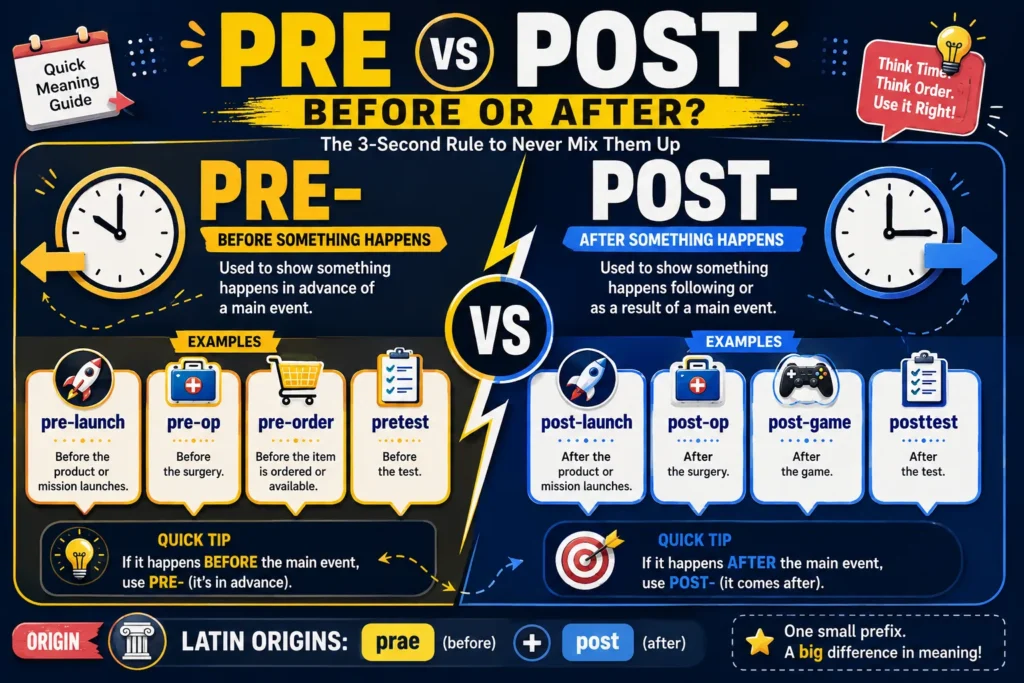
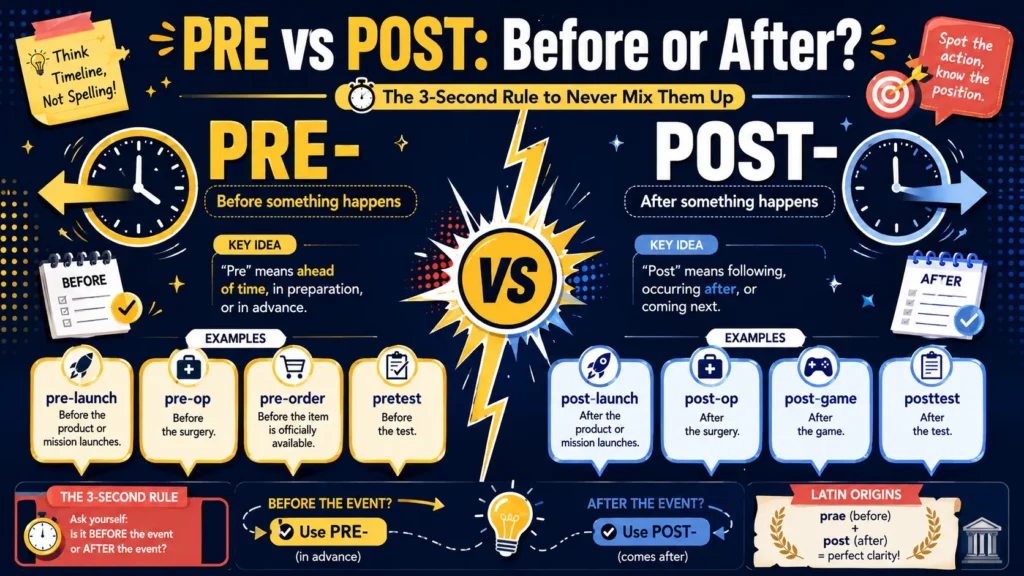
Pre means before — it points backward in time to something that hasn’t happened yet. Post means after — it points forward, to something that has already occurred. If you can swap the word for “before X,” use pre-. If you can swap it for “after X,” use post-. That’s the entire rule — everything else in this guide is detail, edge cases, and the parts other explanations leave out.
Quick Meaning Summary
| Pre | Post | |
| Meaning | Before, prior to, in advance of | After, following, subsequent to |
| Latin root | prae (“before, in front of”) | post (“after, behind”) |
| Direction on a timeline | Points backward (earlier) | Points forward (later) |
| Typical function | Preparation, anticipation, setup | Reflection, result, follow-up |
| Example word | pre-order | post-mortem |
| Opposite pair example | pretest | posttest |
| Common fields | Retail, events, medicine, academia | Medicine, media, business, academia |
Origin and History
Both prefixes are Latin imports that entered English through Old French in the medieval period. Pre- comes from prae, meaning “before” or “in front of,” and shows up in some of English’s oldest borrowed vocabulary — words like precede and prevent date to the 14th and 15th centuries. Post- comes directly from the Latin preposition post, meaning “after” or “behind,” and is preserved almost unchanged in phrases like post meridiem (p.m., “after midday”) and post mortem (“after death”).
What most explanations of pre vs post skip is why English kept both as productive prefixes rather than letting one fade out: they’re not simple opposites of a single word, they’re a matched pair of time-relation markers. Linguists classify them as “locative” prefixes repurposed for temporal sequencing — the same mental model that lets you say something is “in front of” or “behind” a building lets you say an action is “before” or “after” an event. That’s why both attach so easily to almost any noun or verb describing a process: test, game, war, natal, season, launch. Any activity with a clear starting or ending point can take either prefix.
Why Pre vs Post Trips People Up
The confusion isn’t really about definitions — most people already know pre means before and post means after. It happens in three specific situations:
- Under time pressure. Labeling a document, writing a subject line, or captioning a photo fast, and the wrong prefix slips out.
- When the “event” is ambiguous. Is a wedding reception part of the wedding, or after it? Is pre-season before the season starts, or the first part of it? The prefix is easy; identifying the reference point it’s anchored to is the actual hard part.
- When a word looks correct either way. Postpartum and prepartum both exist and both sound plausible without context — you need to know which stage of pregnancy is being described, not just which prefix means what.
How to Use Pre and Post Correctly
Use pre- when:
- The action happens before a specific, named event (pre-flight, pre-wedding, pre-launch)
- You’re describing preparation, anticipation, or advance arrangement (prepay, preorder, pre-approved)
- You want to signal something is preliminary or not yet final (pre-draft)
Use post- when:
- The action happens after a specific, named event (post-game, post-op, post-election)
- You’re describing a result, reflection, or aftermath (postmortem, post-mortem analysis, postscript)
- You’re marking a period that follows a defined era (postwar, post-pandemic, post-Soviet)
The 3-Second Test
Take the sentence and mentally insert the full phrase in place of the prefixed word:
“We’ll finalize numbers (before / after) the campaign.”
If “before the campaign” is what you mean → pre-campaign. If “after the campaign” is what you mean → post-campaign. This single substitution test resolves the vast majority of real-world mix-ups — mislabeling a “pre-campaign” report that actually contained results is one of the most common errors in marketing and analytics writing, precisely because nobody ran this test before hitting send.
Examples of Pre vs Post (60+ Real-World Word Pairs)
Most guides give you five or six examples. Here’s a working reference table organized by field.
| Pre- | Post- |
| pre-op / preoperative | post-op / postoperative |
| prenatal | postnatal |
| pretest | posttest |
| pre-diagnosis | post-diagnosis |
| pre-treatment | post-treatment |
| pre-surgical | post-surgical |
| premenopausal | postmenopausal |
| pre-exposure | post-exposure |

Pre vs Post in Business & Marketing
| Pre- | Post- |
| pre-launch | post-launch |
| pre-sale | post-sale |
| pre-campaign | post-campaign |
| pre-money (valuation) | post-money (valuation) |
| pre-order | — (no common post- pair) |
| pre-approval | post-approval |
| pre-meeting | post-meeting |
| pre-IPO | post-IPO |
| Pre- | Post- |
| pre-assessment | post-assessment |
| pre-degree | postgraduate |
| pre-registration | — |
| pre-req(uisite) | — |
| pretest score | posttest score |
| Pre- | Post- |
| pregame | postgame |
| pre-show | post-show |
| pre-production | postproduction |
| pre-party | post-party (afterparty is more common) |
| pre-season | postseason |
| pre-war | postwar |
| pre-pandemic | post-pandemic |
Notice the asymmetry in a few rows — not every pre- word has a matching post- word in common use (nobody says “post-order”), and not every post- word has a common pre- pair (“postscript” has no “prescript” in modern use). This is one of the biggest gaps in most explanations of pre vs post: they imply the two prefixes are perfectly mirrored, when in practice usage is lopsided depending on which side of the event people actually talk about most.
Hyphenation Rules: AP, MLA & Chicago Compared
This is the part nearly every article on this topic skips entirely, and it’s the single most common real-world question once someone understands the basic meaning: do I hyphenate it?
- AP Stylebook (2024 update): AP no longer generally hyphenates pre-, post-, out-, or re- unless the unhyphenated form is confusing or the next word is capitalized or a number (e.g., pre-1990, pre-Renaissance). Default to closing the word up: preorder, postelection.
- MLA Style: Follows Merriam-Webster and also skips the hyphen in most cases — coauthor, prealgebra — with hyphens reserved for capitalized words (pre-Renaissance) or genuine misreadings (re-cover vs. recover).
- Chicago Manual of Style: Generally closes up prefixes too, but hyphenates when the word would otherwise double a vowel awkwardly (pre-eminent, pre-existing) or precede a capital letter or numeral.
The universal exceptions, across every style guide:
- Before a capitalized word or proper noun → pre-Columbian, post-Soviet
- Before a numeral → pre-1950, post-9/11
- When closing the word up would double a vowel awkwardly → pre-eminent, pre-empt
- When the closed-up form would be misread as a different word → re-cover (cover again) vs. recover (get better)
If you’re writing for a general audience with noHOuse style, the safest default in 2026 is: close it up unless one of the four exceptions above applies.
Explore More: https://dogizle.com/requester-vs-requestor/
Common Misunderstandings
- “Pre and post are exact opposites.” Not quite — they’re opposite directions, but not always interchangeable opposites for the same root word. Prepone (the informal opposite of “postpone”) is standard in Indian English but non-standard in American and British English.
- “Post always means ‘after an event.'” Not when it’s a verb on its own — “I’ll post the update” means “publish,” a separate sense of post unrelated to the prefix.
- “You can drop the prefix and keep the meaning.” Postpone doesn’t mean “pone after” — the prefix has fully fused into a standalone word with its own meaning (“delay”).
- “Pre- always implies something good, post- always implies reflection.” Neither prefix carries an inherent tone. Pre-crisis isn’t optimistic, and post-victory isn’t melancholy — the tone comes from the noun, not the prefix.
Related Terms Worth Knowing
- Ante- — also means “before” (as in antebellum), but is far less productive than pre- in modern English.
- Peri- — means “during” or “around” (e.g., perioperative covers before, during, and after surgery).
- Ex- — means “former” or “out of,” a different kind of “past” than post- (an ex-president isn’t a “post-president”).
- Sub-/Super- — unrelated to time; these mark position (below/above) or degree.
People Also Ask
unctionally yes — Pre-And Post- are the prefix (word-part) versions of “before” and “after,” used to build a single compact word instead of a phrase.
“Pre” is the closest opposite when talking about time. As a verb (to publish something), “post” doesn’t have “pre” as its opposite.
Not quite any word — they attach productively to nouns and verbs describing events, processes, or states with a clear boundary (a game, a test, a war, a surgery).
Usage develops around what people actually need to talk about. “Pre-order” is common because retailers need a word for buying in advance; “post-order” never caught on.
t’s standard in Indian English, meaning to move something to an earlier time. It isn’t standard in American or British English, where writers say “move up” or “bring forward” instead.
Anchor it to a word you already know cold: preview happens before the main event, so pre- = before. Postscript is added after the main letter is finished, so post- = after.
Conclusion
Pre vs post comes Aafter” — but the details that actually cause mistakes live outside that basic definition: knowing which event a prefix is anchored to, matching real-world word pairs correctly, and knowing when style guides expect a hyphen and when they don’t. Run any doubtful case through the 3-second substitution test above, check the word-pair table for the exact term you need, and you’ll never mislabel a pre- document as a post- one again.