
NVM Meaning in Text: What It Really Means (2026 Guide)
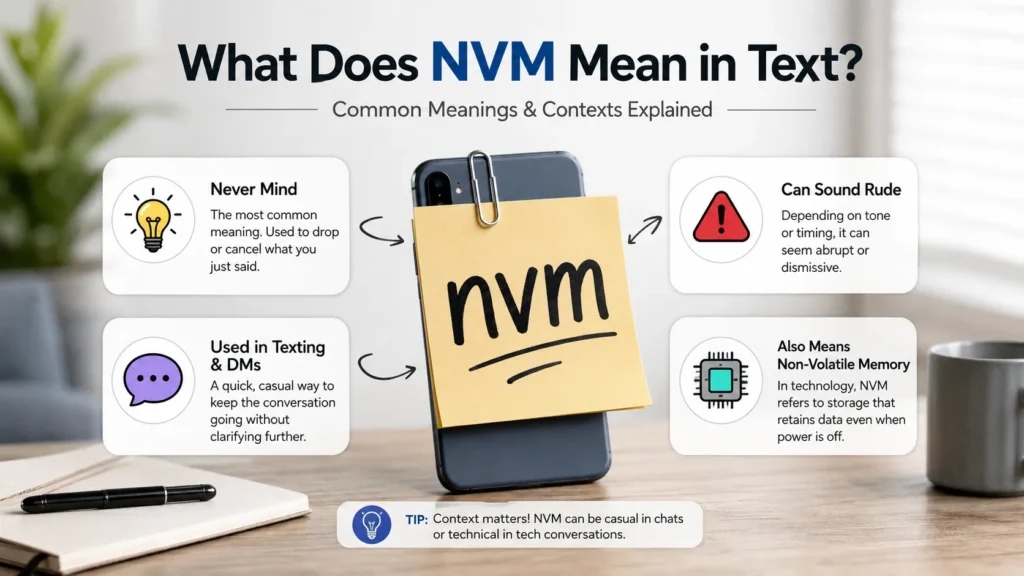
Quick answer: NVM stands for “Never Mind.” It’s used in texting, DMs, and online chat to tell someone to disregard what you just said — usually because you found the answer yourself, changed your mind, or decided the topic isn’t worth discussing anymore. It can be written in caps or lowercase (“NVM” or “nvm”) and works the same either way.
That one-line definition is where most articles stop. But NVM carries a lot more nuance than that — it can sound casual, dismissive, or even a little cold depending on how and when it’s used. This guide covers everything: the origin, every alternate meaning, how to use it naturally, whether it’s considered rude, how to respond to it, and when you should avoid it entirely.
What Does NVM Mean? NVM = “Never Mind.”
It’s an initialism (not technically an acronym, since you don’t pronounce it as a word — you say the letters, or more often you just read it silently). People type NVM when they want to:
- Retract or cancel a question or comment they just sent
- Signal they solved their own problem before anyone replied
- End a topic they no longer want to pursue
- Brush off an awkward moment or mistake
- Avoid explaining themselves further
Example:
“Hey do you know if the store closes at 8 or— nvm, I just checked, it’s 9.”
It’s almost exclusively used in informal, written communication: text messages, DMs, group chats, comments, and casual social posts. You’ll rarely hear someone say “N-V-M” out loud — in speech, people just say “never mind.”
Quick Meaning Summary
| Full Form | Never Mind |
| Type | Texting/internet initialism |
| First Used | Early SMS & chatroom era (late 1990s–2000s) |
| Common Platforms | Texting, Instagram, Snapchat, WhatsApp, Discord, Reddit, X |
| Formality | Casual only — avoid in professional writing |
| Tone | Neutral to dismissive, depending on context |
| Other Meanings | Non-volatile memory, Node Version Manager, “not very much” |
Where NVM Came From
“Never mind” itself dates back centuries as a way of saying “don’t worry about it” or “disregard that.” The abbreviated form NVM emerged with the rise of SMS texting and early internet chatrooms (IRC, AIM, MSN Messenger) in the late 1990s and 2000s, when character limits and typing speed pushed people toward shorthand — the same trend that gave us LOL, BRB, and OMG.
As smartphones and social media took over, NVM stuck around because it’s fast to type, universally understood, and low-effort — exactly what casual digital conversation rewards.
NVM: Full Form and Origin
To break it down simply:
- N = Never
- V = (silent letter carried over from the contraction, representing the sound bridge in “nev-er”)
- M = Mind
In practice, most people don’t think about the letter-by-letter breakdown at all — NVM has become its own visual shorthand, recognized instantly rather than decoded. That’s part of why it survived while more awkward abbreviations from the same era (like “NM4U” or “NVMD”) quietly disappeared. It’s short, clean, and doesn’t require any real effort to read or type.
Why NVM Became So Popular
NVM survived while dozens of other early texting abbreviations faded because it solves a real, recurring problem: how do you gracefully back out of something you already said?
A few reasons it stuck around:
- It’s unambiguous. Unlike “nm,” which can mean two different things, NVM reliably means one thing.
- It de-escalates instantly. Typing three letters is faster than explaining why you changed your mind.
- It travels across platforms. The same three letters work identically in a text, a Discord server, or an Instagram comment, so there’s no need to relearn slang per app.
- It fits modern texting norms, where brevity and low-effort responses are the default, not the exception.
- It’s keyboard-efficient, requiring no autocorrect fights or special characters, which matters more than it sounds like on mobile typing.
Every Meaning of NVM
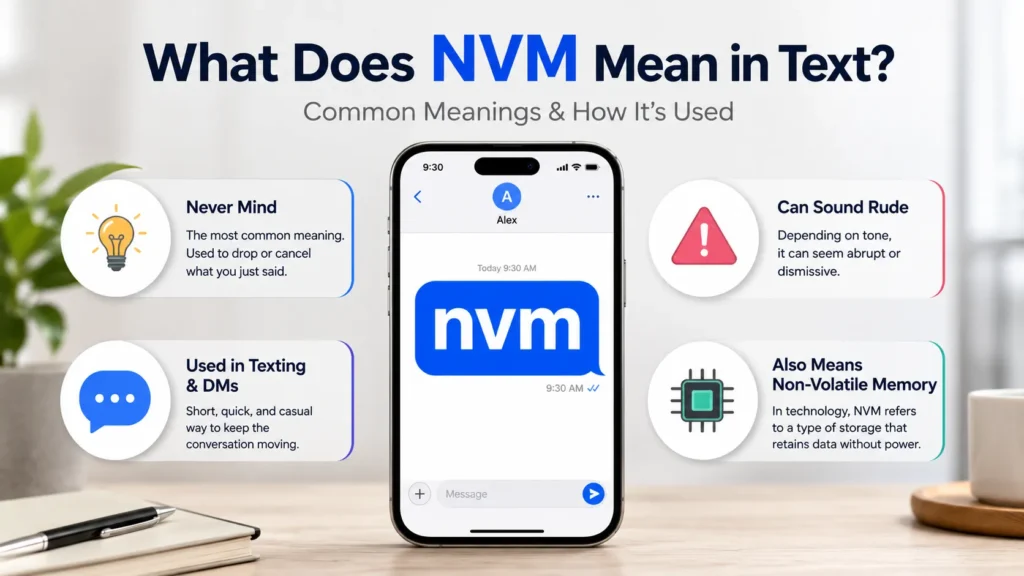
While “never mind” covers well over 95% of real-world use, NVM has a few other meanings depending on context:
| Meaning | Where You’ll See It |
| Never mind | Texting, DMs, social media, group chats (by far the most common) |
| Non-volatile memory | Computer science / tech — memory that keeps data without power (e.g., SSDs, ROM) |
| Node Version Manager | Software development — a command-line tool for managing Node.js versions |
| Not very much | Occasionally used casually, e.g., “How much homework do you have? NVM” |
| Not visible mark | Printing/manufacturing industry — a defect not immediately visible |
If you clicked this article after seeing “NVM” in a text, group chat, or comment section, you’re almost certainly looking at meaning #1. Jump to the tech sections below if you’re a developer or came here from a computing context.
NVM Meaning in Chat vs. Texting
NVM means the same thing everywhere, but how it lands can differ slightly between SMS texting and live chat apps:
- In SMS/iMessage: Conversations are usually slower-paced, so NVM often follows a noticeable pause — which can make it read as more deliberate or, occasionally, more pointed.
- In live chat (Discord, Slack, group chats): Conversations move fast, so NVM is often reflexive — someone gets their answer from another message before you even reply, and NVM is just a quick acknowledgment, not a loaded statement.
- In DMs (Instagram, Snapchat): Tends to sit somewhere in between — casual, but often softened with emojis or exclamation points since these are more relationship-driven spaces.
Context speed matters: the faster the platform, the more neutral NVM tends to read.
How to Use NVM in a Sentence
NVM works as a standalone reply or as part of a longer message. Here’s how it plays out in real conversations:
Retracting a question:
“Wait, what time does the movie start— nvm, I found the tickets, it’s 7:15.”
After solving your own problem:
“Can someone help me reset my password? Nvm, figured it out.”
Ending an argument or disagreement:
“I really don’t think that’s true, but nvm, it’s not a big deal.”
Covering an awkward moment:
“Wait are you free Saturd— nvm, I just remembered you’re out of town.”
Sarcastic or annoyed tone:
“Nvm. Forget I asked.”
Note how the punctuation and context change the meaning entirely. “Nvm, figured it out!” reads as upbeat. “Nvm.” with a period and nothing else often reads as cold or annoyed. That tonal flexibility is exactly why so many people search “is NVM rude” — which we’ll break down next.
NVM vs. Similar Abbreviations
NVM isn’t the only way to say “drop it.” Here’s how it compares to the abbreviations people often confuse it with:
| Abbreviation | Meaning | Tone |
| NVM | Never mind | Neutral to slightly dismissive |
| NM | Never mind (rarer) / “not much” (when replying to “what’s up”) | Context-dependent |
| IDC | I don’t care | More blunt, can sound dismissive |
| Forget it | Similar to NVM, spelled out | Slightly more emphatic/final |
| It’s fine | Downplays the issue | Can sound passive-aggressive if terse |
| Whatever | Dismissive, often annoyed | Usually reads as irritated |
The key distinction: NM is ambiguous (it can mean “never mind” or “not much” depending on the question), while NVM almost always means “never mind” — which is one reason NVM has become more popular in modern texting.
Is NVM Rude or Passive-Aggressive?
This is genuinely one of the most-searched questions around NVM, and the honest answer is: it depends entirely on context, punctuation, and your relationship with the sender.
NVM usually reads as neutral or friendly when:
- It follows a question you already answered yourself
- It’s paired with an explanation (“nvm, I found it!”)
- It includes a laughing emoji, exclamation point, or friendly follow-up
NVM can read as cold, annoyed, or passive-aggressive when:
- It’s sent alone with no explanation, especially after a pause
- It follows an unanswered question (feels like giving up on you)
- It’s used to shut down a disagreement instead of resolving it
- It’s capitalized with a period: “NVM.” — this often signals irritation
If you receive a blunt, unexplained “nvm,” it’s often a signal the person felt ignored, dismissed, or didn’t want to keep explaining themselves — not necessarily anger, but disengagement. Tone in text is famously hard to read, so when in doubt, it’s fair to ask rather than assume.
How to Respond to NVM
Getting an unexplained “nvm” can feel like a conversational dead end. Here’s how to handle it depending on the vibe:
If it seems casual/neutral:
“Haha okay!” or “No worries, lmk if you figure it out”
If you’re curious what they were going to say:
“Wait no tell me, now I’m curious”
If it feels like they’re annoyed or shutting down:
“You sure? You can tell me, I don’t mind”
If it followed a question you didn’t get to answer:
“Sorry, I missed this — what’s up?”
The safest move is almost always to acknowledge it rather than ignore it. Ignoring an “nvm” can make the other person feel more dismissed, especially if it wasn’t meant that way.
When You Should NOT Use NVM
NVM is strictly casual. Avoid it in:
- Professional emails — use “please disregard my previous message” instead
- Work Slack/Teams messages with clients or leadership — spelling it out reads as more polished
- Formal writing — essays, reports, cover letters
- First conversations with someone you don’t know well — it can come across as curt before you’ve established rapport
A good rule of thumb: if you wouldn’t casually text this person a meme, save NVM for a spelled-out alternative.
NVM in Professional and Formal Communication
Since NVM is built entirely for casual speed, it doesn’t translate well into contexts where clarity and professionalism matter. Instead of NVM, professional writing generally favors:
| Instead of NVM | Use This |
| “nvm, ignore that email” | “Please disregard my previous email.” |
| “nvm lol my bad” | “Apologies for the confusion — please disregard.” |
| “nvm figured it out” | “I’ve resolved this on my end — no further action needed.” |
| “nvm, doesn’t matter” | “This is no longer relevant, thank you for your time.” |
Even in casual internal workplace chat, it’s worth reading the room — some teams treat Slack like texting, others treat it like email. When unsure, spelling it out costs almost nothing and avoids any risk of sounding curt to a colleague or client.
NVM on Social Media & Different Platforms
NVM’s tone shifts slightly depending on where it’s used:
- Texting (iMessage/SMS): The most common use case — casual, quick, often used mid-conversation to retract a message.
- TikTok: Shows up in comments to dismiss a take, or in captions/replies when someone reconsiders a point they made.
- Instagram/Snapchat DMs: Frequently paired with emojis to soften the tone; extremely common in casual conversations.
- Facebook: Used similarly to texting, though slightly more likely to appear as full “never mind” among older users.
- Reddit: Common in comment threads as a quick edit-note (“nvm, someone already answered this”) or to retract a take after being corrected.
- Discord: Used constantly in fast-moving chat channels to cancel a question once it’s answered by someone else in the server.
- X (Twitter): Appears in replies and quote-tweets, often to concede a point or drop an argument thread.
- WhatsApp/group chats: Frequently used to withdraw a question once someone else has already answered it.
- Slack/Teams (workplace): Generally discouraged in formal channels; acceptable in casual internal chat with close teammates.
NVM Meaning Among Gen Z
NVM is especially common in Gen Z texting culture, where minimal-effort responses are often the norm rather than a sign of disinterest. A few things worth knowing:
- It’s rarely dramatic. Among younger texters, NVM is often used dozens of times a day for tiny, low-stakes retractions — it doesn’t carry the same emotional weight it might for someone less used to fast digital conversation.
- It pairs heavily with emojis and reaction stickers to add tone that the bare word can’t carry on its own.
- It’s often used ironically or humorously, especially in group chats, as a quick way to bail on a joke or bit that didn’t land.
- Silence + NVM is different from a quick NVM. A fast “nvm lol” reads as breezy; a delayed, standalone “nvm” after a long pause reads very differently, even within the same friend group.
Common Misunderstandings About NVM
“NVM always means someone is upset.” False. Most of the time it’s simply neutral — the person solved their own problem or the topic naturally ran its course. Context and punctuation matter far more than the abbreviation itself.
“NVM is only used by teenagers.” Not true. While it’s most common among younger texters, it’s widely understood and used across age groups in casual digital communication.
“NVM and NM mean exactly the same thing.” Not quite — NM is ambiguous and can also mean “not much” depending on the question it answers, while NVM consistently means “never mind.”
“NVM is an acronym.” Technically it’s an initialism, not an acronym — you read the letters rather than pronouncing them as a word.
“NVM only has one meaning.” Not in every context. Outside of texting, NVM can also mean non-volatile memory or Node Version Manager, so context always matters.
Synonyms & Related Terms {#alternatives}
If you want to soften or vary your language, here are natural swaps:
- “Never mind”
- “Don’t worry about it”
- “It’s all good”
- “Forget I said anything”
- “No big deal”
- “All set, thanks!”
- “Ignore that”
- “Scratch that”
NVM in Tech: Non-Volatile Memory {#nvm-memory}
In computing, NVM stands for non-volatile memory — a type of storage that retains data even when power is removed. This includes ROM, EPROM, EEPROM, flash storage, and SSDs, as opposed to volatile memory (like RAM), which loses everything on shutdown. NVM is central to how modern devices keep your files, settings, and operating system intact between restarts.
Key points about non-volatile memory:
- It’s the reason your phone or laptop remembers files after a full shutdown
- It underpins SSDs, USB drives, and most modern storage hardware
- It’s contrasted with volatile memory (RAM), which requires constant power to retain data
NVM in Tech: Node Version Manager {#nvm-node}
For developers, NVM (Node Version Manager) is a command-line tool that lets you install and switch between multiple versions of Node.js on the same machine — useful when different projects require different Node versions.
Common reasons developers use NVM:
- Switching Node.js versions per project without conflicts
- Testing code compatibility across multiple Node versions
- Avoiding permission issues that come with global Node installs
People Also Ask
Same meaning regardless of who sends it — “never mind.” Tone depends on context, not gender.
Not exactly. NVM almost always means “never mind.” NM can mean “never mind” or “not much,” depending on the question it’s replying to.
Not necessarily — but an unexplained, blunt “nvm” can signal frustration or Disengagement, EspeciallyAfter a pause or unanswered question.
It’s best to avoid it in professional writing. Use “please disregard my previous message” instead.
Both are correct and used interchangeably. Lowercase is more common in casual texting.
There isn’t a direct opposite, but continuing a topic instead of dropping it — “actually, wait, let’s talk about this” — functions as the reverse.
Conclusion
NVM is one of the simplest yet most versatile pieces of texting shorthand out there — three letters that almost always mean “never mind,” but whose real meaning depends entirely on context, punctuation, and the relationship between the people texting. Whether it’s a quick, breezy sign-off between friends or a blunt, unexplained response that leaves you wondering if something’s wrong, understanding the tone behind NVM helps you communicate — and respond — with more confidence.
Beyond texting, NVM also carries technical weight, standing for non-volatile memory in computing and Node Version Manager for developers — proof that even the smallest abbreviations can mean very different things depending on where you encounter them.
The next time “nvm” shows up in your messages, you’ll know exactly what it means, how to read the tone behind it, and how to reply in a way that keeps the conversation — and the relationship — feeling natural.