X Meaning in Text: The Complete Guide to Every Way “X” Is Used in Texting
You get a text that ends with “see you later x,” and suddenly you’re staring at your phone wondering what that one letter is actually trying to tell you. Is it flirty? Friendly? Nothing at all?
Here’s the short answer: in most texting contexts, “x” Represents A Kiss — a small, informal way of adding warmth to a message. But that’s not the only thing “x” means in text. Depending on where it shows up, “x” can also mean “ex,” “wrong,” a math variable, a rating label, or even refer to the platform formerly known as Twitter.
This guide covers all of it — the kiss meaning in depth, plus every other context where “x” shows up in a message.
What Does “X” Mean in a Text? (Quick Answer)
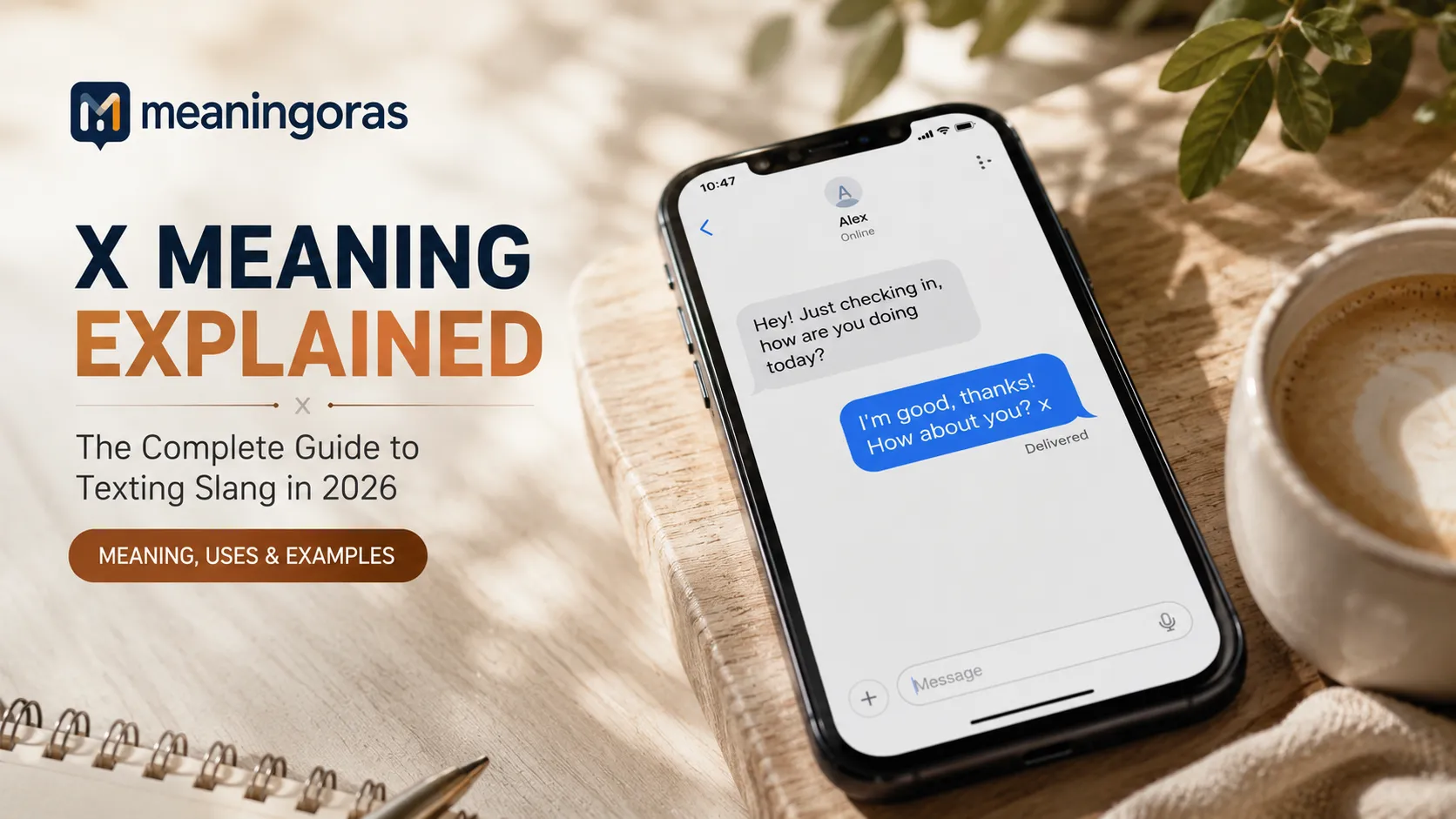
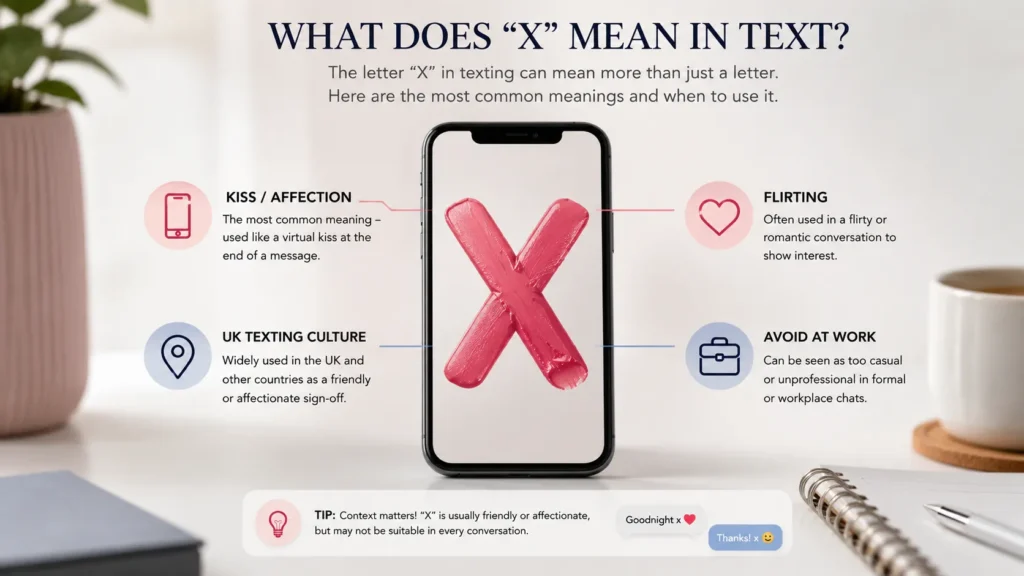
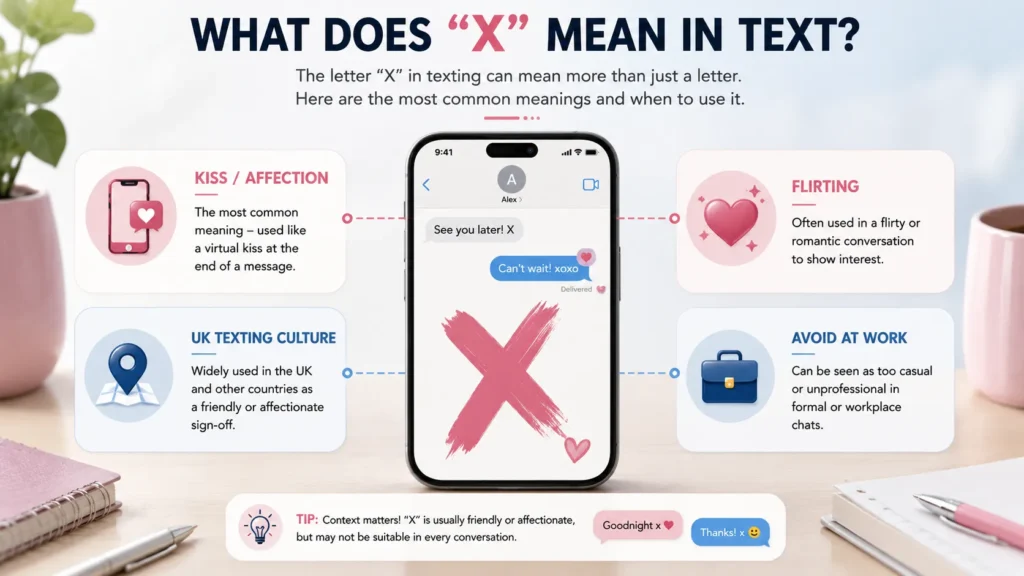
When “x” appears at the end of a message, it almost always means a kiss — a written stand-in for affection, warmth, or friendliness. It works the same way “sincerely,” “love,” or a kissy emoji (😘) would at the end of an email or note.
- “Night x” → a warm, caring goodnight
- “Thanks x” → an appreciative, friendly sign-off
- “See you soon xx” → warmer or more affectionate than a single x
- “Sorry to hear that x” → sympathy softened with warmth
- “Can’t wait x” → excitement paired with affection
Most people encounter this meaning long before they ever consciously think about it — it shows up in texts from parents, friends, partners, and coworkers alike, which is exactly why it can feel confusing. The letter itself carries no fixed emotional weight;
it borrows its meaning entirely from the relationship and the sentence around it.
But context changes everything, and where “x” sits in a sentence — not just what it looks like — determines what it means. Let’s break down where that “kiss” meaning actually comes from, then work through every other situation you might run into it.
Where the “X = Kiss” Tradition Comes From
This isn’t a texting-era invention. The habit goes back centuries, long before phones existed.
In medieval Europe, many people couldn’t read or write, so they signed legal documents with an “X” instead of a signature. To show sincerity, the signer would often kiss the X they’d drawn — a gesture meant to seal the document the way a wax seal or oath would. Over time, the X itself became shorthand for the kiss, independent of the signature it started as.
By the time letter-writing became widespread, people were signing off personal letters with a row of X’s the way we’d sign off “with love” today.
This is also where the tradition of pairing “X” with “O” — as in XOXO — is thought to have taken shape, with the O representing an embrace to go alongside the X’s kiss, even though the exact origin of the “O” is less documented than the “X.”
Handwritten letters in the 19th and early 20th centuries frequently closed with rows of X’s between family members, friends, and romantic partners alike, well before there was any technology involved at all.
That’s an important detail, because it shows the gesture was never inherently romantic — it was a general marker of warmth and sincerity that people simply reached for depending on who they were writing to.
Why “X” Is Still So Common in Texting Today
Despite decades of new slang, emoji, and GIFs taking over digital conversation, “x” has never really gone away — and it’s worth understanding why it’s stuck around instead of being replaced.
Unlike an emoji, “x” is fast to type, doesn’t render differently across devices or apps, and carries almost no risk of looking sarcastic or over-the-top the way a string of emoji sometimes can.
That combination of speed, neutrality, and familiarity is exactly why it’s kept its place in everyday texting even as the rest of digital communication has changed dramatically around it.
There’s also a generational continuity to it. Unlike slang terms that cycle in and out within a few years, “x” has been passed down through multiple generations of communication technology — letters, postcards, SMS, and now DMs and chat apps — without needing to be “reintroduced” each time.
That long, unbroken usage history is part of why it still feels natural rather than dated, even to younger texters who’ve never written a physical letter in their life.
It also survives because it’s low-commitment. Adding “x” to a message doesn’t require the sender to say anything explicit about how they feel, which makes it a comfortable middle ground for people who want to convey warmth without a bigger emotional statement.
How Many X’s Should You Use? (x vs. xx vs. xxx)
This is where most people actually get tripped up — not on what x means, but on how much it means. There’s no official rulebook, but there’s a pretty consistent informal scale most English speakers intuitively use:
| Sign-off | General reading |
| x | Casual warmth — friendly, polite, low-key affection |
| xx | A step warmer — common between close friends, family, or early-stage romantic interest |
| xxx | Noticeably affectionate or flirty — usually reserved for a partner or someone you’re clearly interested in |
| xxxx+ | Strong affection, often used specifically between partners or very close family (e.g., a parent to a child) |
A few important caveats:
This scale isn’t universal. Some people always sign off with “xx” regardless of who they’re texting — it’s just their personal texting style, not a signal about the relationship.
Consistency matters more than quantity. If someone always sends “x” and suddenly stops, that’s usually a more meaningful signal than the number of x’s they use on any single message.
It’s not a countdown to romance. Reading “xxx” as a confession of feelings is a common overinterpretation — tone of the rest of the conversation matters far more than the x-count alone.
A quick worked example: if a friend who normally texts “see you tomorrow x” suddenly sends “can’t wait to see you tomorrow xxx,” that jump is worth noticing — not because three x’s are inherently romantic, but because it’s a change from their normal pattern. The same “xxx” from someone who always signs off that way, regardless of who they’re texting, tells you far less.
Does “X” Mean Flirting?
Sometimes — but not by default. “X” sits in a gray zone that can mean either friendly warmth or romantic interest, and the letter itself doesn’t disambiguate that. What actually tells you the difference:
The relationship context. An x from a close friend, sibling, or coworker you get along with is very unlikely to be flirtatious.
The rest of the message. X’s paired with compliments, extra effort in the conversation, or a shift toward more personal topics point toward flirting. X’s tacked onto a purely logistical text (“running 5 min late x”) usually don’t.
Frequency and consistency. A one-off x after good news is different from someone who adds x to every single message, which is often just their habitual sign-off style.
Regional norms. This matters more than most guides admit — covered in more detail below.
A useful way to test it: imagine the same “x” removed from the message entirely. If the text would read exactly the same without it — same warmth, same intent — the x is probably just stylistic. If removing it would make the message feel noticeably colder or more distant, that’s a sign the x is doing real emotional work, which often points toward genuine affection rather than habit.
X Meaning in Text From a Guy
“X” doesn’t have a different dictionary meaning depending on who sends it — it means the same thing (affection or warmth) regardless of gender. What differs is usage frequency and social norms.
Because “x” is coded as a slightly softer, more traditionally feminine texting habit in some cultures (especially in the US), a guy who uses it — particularly outside a romantic relationship — is often doing something intentional. It can read as a deliberate, if understated, sign of affection or comfort with vulnerability, rather than a throwaway habit.
That said, this varies a lot by upbringing and social circle. A guy raised in a family or friend group where “x” is a normal, everyday sign-off will use it far more casually than one for whom it’s genuinely unusual. Common situations where guys tend to use it: ending a goodnight text, checking in after something stressful, or replying to a partner’s message with something brief but caring — “sounds good, love you x.”
X Meaning in Text From a Girl
It’s especially common between female friends as a sign-off in group chats, birthday messages, and casual check-ins — “hope the interview goes well x” or “miss you, let’s catch up soon x” — without any romantic undertone at all. That widespread platonic use is exactly why decoding an “x” from a girl usually depends far more on the relationship it’s coming from than on the letter itself.
In both cases, the same rule applies: look at the full pattern of the conversation, not the letter in isolation. A single x from someone who’s otherwise being warm and engaged means something different than a single x tacked onto a curt, one-word reply.
Regional and Cultural Differences: UK vs. US vs. Elsewhere
This is one of the most-searched but least-explained parts of this topic, and it matters a lot in practice.
United Kingdom and Ireland: Signing off texts, and even some emails, with “x” is extremely common and largely gender-neutral. It’s used between friends, family members, and casual acquaintances without any romantic implication — to the point that leaving it off can occasionally read as slightly cold or curt in close relationships.
Australia and other English-speaking regions: Usage tends to sit somewhere in between, often influenced by exposure to UK texting norms.
This regional gap is one of the biggest sources of real cross-cultural miscommunication around “x.” An American texting a UK-based coworker, client, or new friend might read a casual “thanks, speak soon x” as unexpectedly personal, when in that context it’s roughly equivalent to signing off “cheers” or “best.” The reverse also happens — someone from the UK visiting or working with Americans may notice their own habitual “x” landing more heavily than intended, simply because the local convention is different.
If you’re texting internationally, this is genuinely useful context — an “x” from a UK contact that would raise eyebrows from an American one is often just standard local texting etiquette. When in doubt in a new cross-cultural relationship, it’s reasonable to simply ask, or to mirror the other person’s usage rather than guessing.
Should You Use “X” in Professional or Work Messages?
Generally, no — with some nuance. In most workplace cultures, especially in the US, adding “x” to an email or a work text can come across as unprofessional or overly familiar, even when it’s not meant that way. There’s a well-documented example of a UK politician being publicly criticized by a judge for signing off a constituent email with an “x,” which shows the norm holds even in places where “x” is common in personal texting.
A safer approach for professional contexts:
- Stick to standard sign-offs like “Thanks,” “Best,” or “Regards”
- If you’re texting a work contact you’re also genuinely friendly with outside work, read the room — mirror what they do rather than introducing it yourself
- When in doubt, leave it out; it’s much easier to add warmth with wording than to walk back an overly familiar sign-off
There’s also a useful distinction between a work email and a work text. Text messages tend to carry a slightly more relaxed tone by default, so a quick “running 5 minutes late x” to a manager you’re on friendly, informal terms with may land fine, even where the same sign-off in a formal email would not. The safest general habit is to let the more senior or more distant party set the tone, rather than introducing extra warmth yourself.
X Meaning on Social Media (Instagram, Snapchat, Discord, X/Twitter)
The meaning stays consistent across platforms, but the context shifts slightly on each one:
- Instagram DMs and comments: Used the same way as texting — a friendly or flirty sign-off, often paired with emoji.
- Snapchat: Common in streak chats and casual back-and-forth conversations as a quick, low-effort way to add warmth.
- Discord: Less common conversationally, but occasionally used humorously or ironically rather than sincerely.
- X (formerly Twitter): A capital “X” here almost always refers to the platform itself, not the kiss sign-off — a good example of how capitalization and context change the meaning entirely.
- Facebook and Messenger: Similar to texting — often used at the end of comments or private messages between friends and family, especially among older users who carried the habit over from SMS.
- Reddit and other forum-style platforms: Rarely used as a sign-off at all, since the format skews more toward anonymous or topic-based discussion rather than personal messaging.
Capitalization is a genuinely useful signal here: a lowercase “x” is almost always the kiss sign-off, while a capital “X” in the middle of a sentence is more likely referring to the platform, a variable, or a rating.
Other Meanings of “X” in Text and Online (Not Just a Kiss)
“X meaning in text” doesn’t always refer to the kiss sign-off. Depending on where you encounter it, “x” or “X” can mean something completely different:
- “Ex” — In casual chat and social media captions, “x” is sometimes shorthand for “ex,” as in a former partner (“ran into my x at the store”).
- The platform X (formerly Twitter) — Since the 2023 rebrand, “X” in a sentence like “I saw it on X” refers to the social media platform, not a kiss or a variable.
- X-rated — Shorthand for adult or explicit content, used as a prefix (“that movie was pretty X”).
- Multiplication — In quick math or measurements typed in a chat (“2×4,” “3x the price”), “x” simply means “times.”
- Roman numeral ten — Occasionally used stylistically (event names, dates) rather than conversationally.
- “X marks the spot” / crossing something out — Used to indicate a location, or to mark something as done, cancelled, or eliminated (“just x that off the list”).
Knowing these alternate uses matters because context — not the letter itself — is what tells you which meaning applies. A good rule of thumb: kiss-meaning “x” almost always sits at the very end of a sentence or message on its own, while the other meanings almost always sit inside a sentence, attached to a noun or number (“2x,” “my x,” “on X,” “X-rated”). That single positioning cue resolves the vast majority of ambiguous cases without needing any other context at all.
Quick Reference: How to Read “X” by Context
| Where you see it | Likely meaning |
| End of a casual text (“see you later x”) | Affection, warmth, kiss |
| End of a text from a UK/Irish contact | Standard sign-off, not necessarily romantic |
| Repeated heavily (xxx, xxxx) | Stronger affection or flirtation |
| In a work email or message to a boss/client | Generally avoid — reads as too casual |
| “My x” or “his x” | Refers to an ex-partner |
| “I saw it on X” | Refers to the social media platform |
| “❌” or a lone x on a list/poll | Marking something wrong, rejected, or unwanted |
| “2x,” “3x” | Multiplication or repetition (“three times”) |
Common Misunderstandings About “X” in Texting
- “More x’s always means more feelings.” Not necessarily — some people just have a habitual sign-off style that doesn’t scale with emotion the way it seems to.
- “No x means something is wrong.” Often it just means someone’s typing quickly, texting from a work context, or simply doesn’t use x as part of their normal style.
- “X always means romantic interest.” In much of the UK and Ireland especially, it’s a default, gender-neutral sign-off with no romantic weight at all
- “X means the same thing everywhere online.” A capital “X” on the platform formerly known as Twitter, or an “x” used to mark something wrong on a poll, has nothing to do with affection at all.
People Also Ask
No. It’s one of the least reliable signals to read alone — plenty of people use “x” as a default, habitual sign-off with everyone, platonic or not. Look At The Overall pattern of the conversation instead of the letter in isolation.
It can mean several things — they’re being more formal, texting in a rush, or feeling more distant — but it’s rarely meaningful on its own. Consider it alongside everything else about how the conversation has changed.
Not inherently — it’s common in the UK and among close friends regardless of gender. In other contexts it can carry a bit more weight, since it’s a less automatic habit for many men.
Yes. In much of the UK, Ireland, and among many friend groups globally, “x” is a completely platonic, everyday sign-off.
“Xoxo” spells out “hugs and kisses” (X for kiss, O for hug) and is a more explicit, slightly old-fashioned version of the same sentiment a single “x” conveys more casually.
Conclusion
“X” is one of the most context-dependent characters in modern texting — the same single keystroke can mean affection, a former partner, a math operation, or a social media platform, depending entirely on where it lands in a sentence. Most of the time, at the end of a casual message, it’s simply a small, low-effort way of saying “I Care About you” — nothing more, nothing less.. When in doubt, read the sentence around it rather than trying to decode the letter in isolation.