Introduction
If you’ve ever traveled to Scandinavia, exchanged foreign currency, or seen prices listed as kr, you may have wondered: what does “kroner” mean?
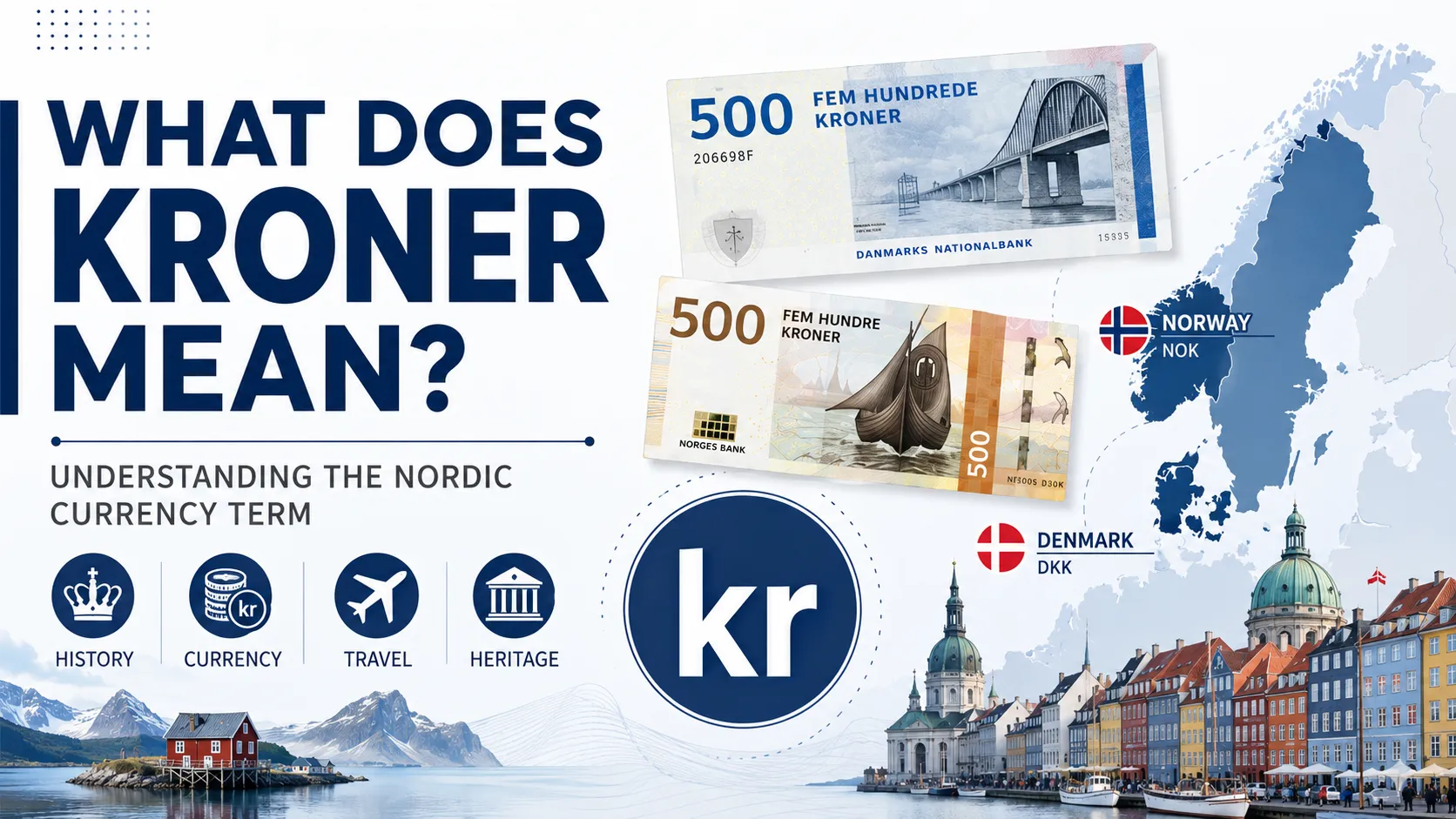
Simply put, kroner is the plural form of krone, a currency unit used primarily in Scandinavian countries such as Denmark and Norway. The word itself translates to “crown”, reflecting the historical influence of European monarchies on currency naming traditions.
However, the meaning of kroner goes beyond a simple dictionary definition. Many people confuse krone, kroner, krona, and kronor, while others wonder whether kroner is a real currency, a slang term, or even related to the euro.
This comprehensive guide explains everything you need to know about the meaning of kroner, including its history, pronunciation, countries that use it, currency symbols, practical examples, travel tips, and common misconceptions.
What Does Kroner Mean?
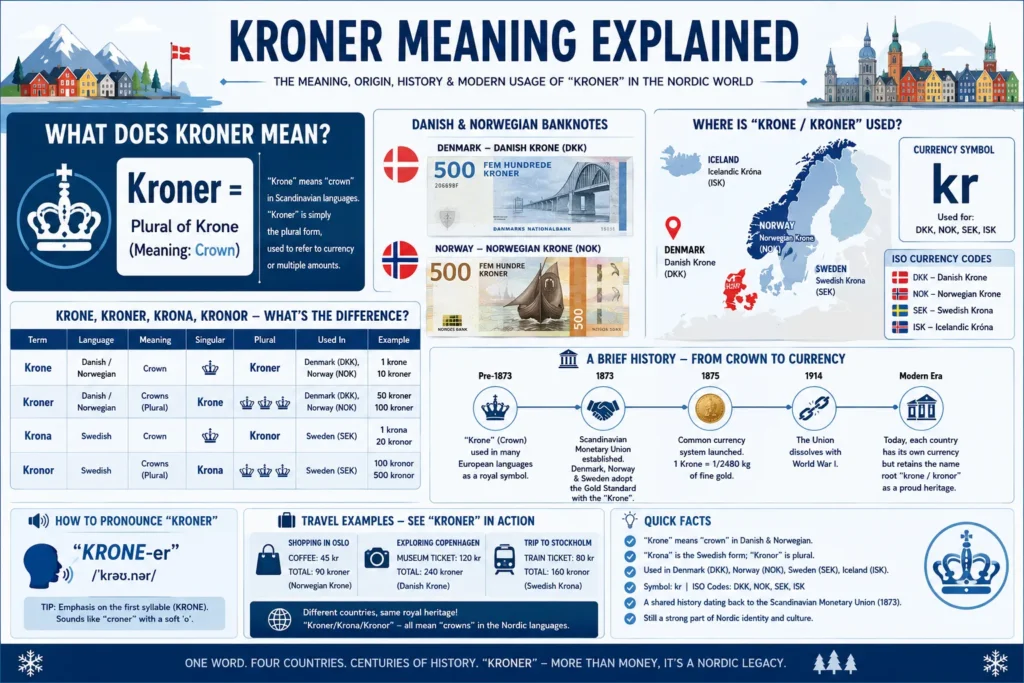
Kroner means “crowns” and is the plural form of the Scandinavian currency unit called “krone.” It is primarily used in Denmark and Norway and originates from the Old Norse and Latin words for “crown.”
In everyday English, when someone says:
“This meal costs 200 kroner.”
They mean:
“This meal costs 200 units of the local Scandinavian currency.”
The exact value depends on whether they are referring to:
- Danish kroner (DKK)
- Norwegian kroner (NOK)
Quick Meaning Summary
| Term | Meaning |
| Krone | Singular currency unit |
| Kroner | Plural form of krone |
| Literal Meaning | Crown |
| Main Countries | Denmark and Norway |
| Currency Symbol | kr |
| Currency Codes | DKK, NOK |
| Currency Family | Scandinavian currencies |
What Is a Krone?
A krone is the singular name of the currency unit.
Examples:
- 1 krone
- 10 kroner
- 100 kroner
Just as English uses:
- one dollar
- two dollars
Scandinavian languages use:
- one krone
- several kroner
The word kroner itself is simply the plural form.
Origin of the Word Kroner
The word kroner has a fascinating historical background.
Meaning of Crown
The term comes from the word:
Crown
Many European countries historically named their currencies after royal crowns because monarchies controlled the minting of coins.
Latin Origins
The ultimate origin traces back to the Latin word:
Corona
which means:
Crown or garland.
Scandinavian Development
Over centuries, the word evolved into:
| Language | Word |
| Danish | Krone |
| Norwegian | Krone |
| Swedish | Krona |
| Icelandic | Króna |
Their plural forms then became:
- Kroner
- Kronor
- Krónur
Why Is It Called Kroner?
The name reflects the historical importance of monarchies in Northern Europe.
During the nineteenth century, Scandinavian nations adopted currency systems that emphasized royal authority and national identity. The crown symbol became associated with state power, stability, and sovereignty.
This is why many European currencies historically used names meaning:
- Crown
- Crown coin
- Royal currency
- Denmark
Denmark uses the Danish krone.
- Currency code: DKK
- Symbol: kr
Norway
Norway uses the Norwegian krone.
- Currency code: NOK
- Symbol: kr
Greenland
Greenland primarily uses the Danish krone.
Faroe Islands
The Faroe Islands use a Local version of the Danish kron
Krone vs Kroner vs Krona vs Kronor
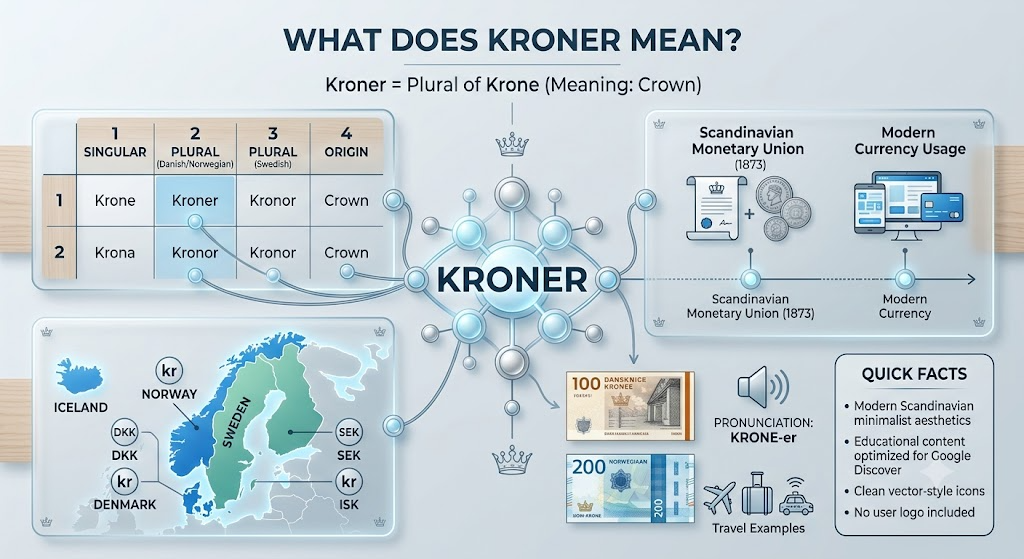
| Term | Country | Meaning |
| Krone | Denmark, Norway | Singular |
| Kroner | Denmark, Norway | Plural |
| Krona | Sweden | Singular |
| Kronor | Sweden | Plural |
| Króna | Iceland | Singular |
| Krónur | Iceland | Plural |
The currencies are related linguistically but are separate national currencies.
How to Pronounce Kroner
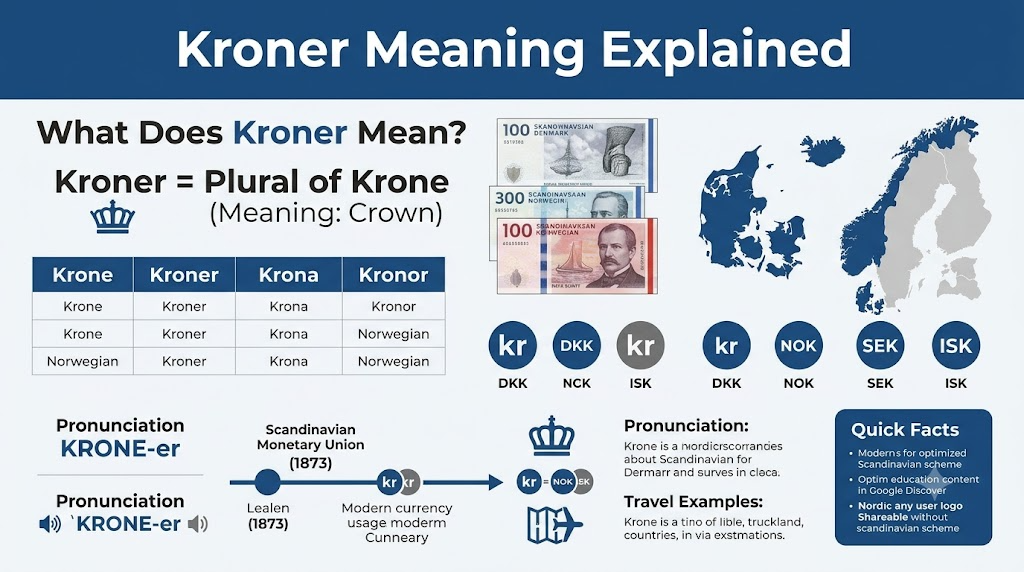
Pronunciation:
KRONE-er
IPA:
/ˈkroʊnər/
Examples:
- “The hotel costs 900 kroner.”
- “I exchanged dollars for Norwegian kroner.”
Common pronunciation mistakes include:
- “croner”
- “kron-air”
- “krowner”
Currency Symbols and Codes
| Currency | Symbol | ISO Code |
| Danish Krone | kr | DKK |
| Norwegian Krone | kr | NOK |
| Swedish Krona | kr | SEK |
| Icelandic Króna | kr | ISK |
Examples of Using Kroner
Travel
“The train ticket costs 250 Danish kroner.”
Restaurants
“Dinner was about 450 Norwegian kroner.”
Shopping
“This jacket costs 1,200 kroner.”
Banking
“The exchange office converts euros into kroner.”
How Much Is Kroner Worth?
The value of the kroner changes constantly due to foreign exchange markets.
Several factors affect its value:
- Interest rates
- Inflation
- Economic growth
- Oil prices (especially in Norway)
- International trade
- Central bank policies
Therefore, there is no single fixed value for “kroner.”
History of the Krone Currency
Scandinavian Monetary Union
In 1873, several Scandinavian countries created the Scandinavian Monetary Union, which standardized their currencies around the concept of the “crown.”
The union included:
- Denmark
- Sweden
- Norway
Although the union later dissolved, each country retained its own version of the currency.
Modern Currency Systems
Today:
- Denmark continues using the Danish krone.
- Norway continues using the Norwegian krone.
- Sweden uses the Swedish krona.
- Iceland uses the Icelandic króna.
Interesting Facts About Kroner
- The word literally means “crowns.”
- Denmark and Norway share the same currency name but not the same currency.
- Sweden uses krona, not kroner.
- Iceland uses a different spelling and pluralization.
- None of these countries uses the euro as their primary national currency.
Travel Tips for Using Kroner
When visiting Scandinavian countries:
- Use credit and debit cards whenever possible.
- Carry a small amount of cash.
- Check current exchange rates before traveling.
- Avoid airport currency exchanges when possible.
- Verify whether prices are listed in DKK or NOK.
People Also Ask
Kroner means “Crowns” and is the plural form of the Scandinavian currency unit called krone.
Kroner is plural. The singular form is krone.
Denmark and Norway primarily use kroner, while related versions exist in other Nordic countries.
No. Krone is singular, while kroner is plural.
Yes. Krona and kronor are used in Sweden, while krone and kroner are used in Denmark and Norway.
The value varies depending on exchange rates and economic conditions.
Generally no. Norway uses the Norwegian kroner, which is a separate currency.
The name comes from historical European monarchies, where crowns symbolized royal authority.
Conclusion
Understanding the Meaning Of Kroner is easier once you know that it simply means “crowns” and serves as the plural form of krone, the official currency unit used in Denmark and Norway. Its origins trace back centuries to European monarchies, and today it remains one of the most recognizable currency names in Scandinavia.
Whether you’re planning a trip, studying world currencies, exchanging money, or simply curious about language and history, understanding the difference between krone, kroner, krona, and kronor helps you navigate Scandinavian currencies with confidence.