
Introduction
If you’ve searched for “Katz Meaning,” you’ve probably encountered conflicting explanations. Some sources claim it’s a Jewish surname tied to ancient priestly families, while others suggest it has German roots or even modern internet slang meanings.
The truth is that Katz has multiple origins, and understanding its meaning depends entirely on historical, cultural, and family context.
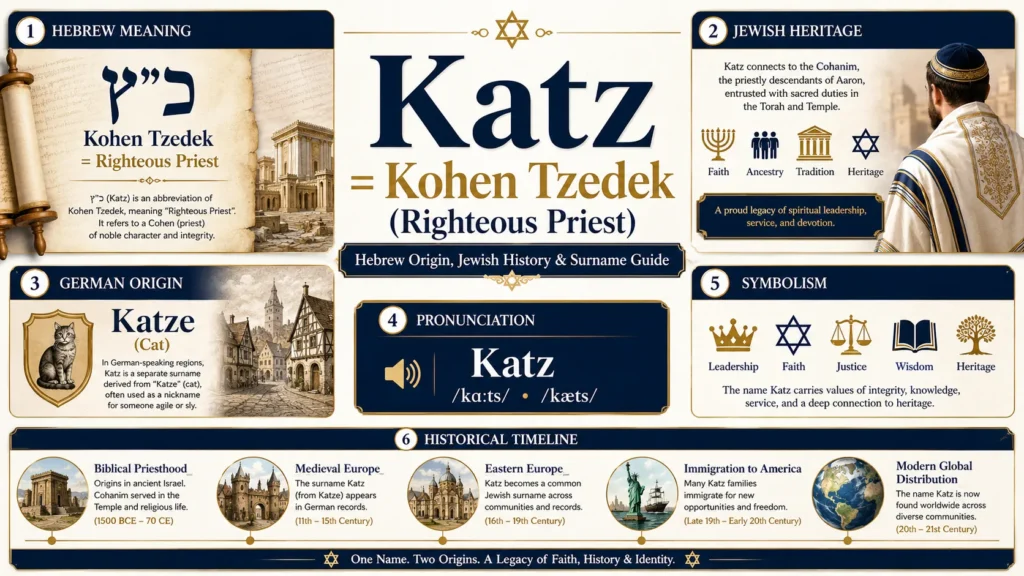
For many Jewish families, Katz (כ״ץ) is one of the most historically significant surnames in Ashkenazi Jewish history. It is traditionally understood as an abbreviation of “Kohen Tzedek” (כֹּהֵן צֶדֶק), meaning “Righteous Priest,” connecting the surname to the ancient priestly class known as the Cohanim.
However, some Katz families derive their surname independently from German linguistic roots, where Katze means “cat.” In modern culture, Katz may also appear as a username, business name, or stylized online identity.
This comprehensive guide explores every major interpretation of the Katz surname, including its Hebrew origins, Jewish history, German etymology, pronunciation, symbolism, genealogy, and contemporary usage.
What Does Katz Mean?
Featured Snippet Answer
Katz is primarily a Jewish surname derived from the Hebrew abbreviation כ״ץ (Katz), which stands for “Kohen Tzedek,” meaning “Righteous Priest.” The surname traditionally indicates association with the Jewish priestly class known as the Cohanim. Some Katz families, however, have independent German origins derived from the word “Katze,” meaning “cat.”
Quick Meaning Summary
| Aspect | Meaning |
| Primary Origin | Hebrew |
| Hebrew Meaning | Kohen Tzedek (Righteous Priest) |
| Religious Association | Cohanim priestly lineage |
| Secondary Origin | German |
| German Meaning | Derived from Katze (cat) |
| Usage | Primarily surname |
| Biblical Connection | Indirect priestly heritage |
| Modern Usage | Family name, brand, usernames |
Katz Meaning in Hebrew
The most recognized meaning of Katz comes from the Hebrew abbreviation:
כ״ץ
This abbreviation traditionally stands for:
כֹּהֵן צֶדֶק (Kohen Tzedek)
“Righteous Priest”
Historically, Jewish families bearing the Katz surname often identified themselves as descendants of the Cohanim, the hereditary priestly class originating from the biblical lineage of Aaron.
Why Was the Abbreviation Used?
During medieval Europe, Jewish communities frequently abbreviated prestigious family titles and religious affiliations into surnames. Katz became one of the most recognizable examples of this practice.
The surname served several purposes:
- Preserving priestly identity
- Distinguishing family heritage
- Maintaining religious status
- Recording ancestral lineage
Is Katz a Jewish Surname?
Yes, Katz is widely recognized as a Jewish surname, particularly among Ashkenazi Jewish communities.
However, an important historical nuance exists:
Although many Katz families have priestly associations, not every person with the surname Katz necessarily descends directly from the ancient priestly line.
Several factors contributed to surname adoption over centuries:
- Migration
- Regional naming practices
- Administrative registration
- Family tradition
- Cultural assimilation
Katz Meaning in German
Not all Katz families share Jewish ancestry.
In German-speaking regions, the surname sometimes developed independently from:
Katze
= “Cat”
This type of surname was common during the medieval period and may have originated as:
- A nickname
- An occupational reference
- A personality descriptor
- An animal-associated family identifier
Therefore, some Katz families have entirely German, rather than Jewish, origins.
Katz Name Origin Timeline
| Period | Development |
| Biblical Era | Origins of the priestly Cohanim |
| Medieval Europe | Emergence of Katz abbreviation |
| 1400–1700 | Expansion among Ashkenazi communities |
| 1700–1900 | Migration throughout Eastern Europe |
| Late 1800s | Immigration to America |
| Modern Era | Global distribution of Katz families |
How Do You Pronounce Katz?
Standard Pronunciation
Katz
IPA:
/kɑːts/
/kæts/
Pronunciation Guide
- “Kahts“
- Rhymes approximately with “lots” (depending on accent)
Is Katz a Biblical Name?
Technically, Katz itself does not appear in the Bible.
However, the surname’s religious significance comes from its connection to:
- The priestly descendants of Aaron
- Ancient Israelite worship traditions
- Jewish hereditary priesthood
- Temple service lineage
Thus, Katz has a strong biblical association, even though it is not directly mentioned in scripture.
Katz Symbolism
The surname Katz is often associated with symbolic meanings such as:
Leadership
Connection to priestly service and community guidance.
Faith
Strong ties to Jewish religious traditions.
Justice
Reflected through the phrase “Kohen Tzedek” (Righteous Priest).
Wisdom
Association with scholarship and religious learning.
Heritage
Representation of ancestral identity and family continuit
Is Katz Used as Slang?
Despite some websites claiming otherwise, there is no universally accepted internet slang meaning for “Katz.”
In modern online culture, Katz may appear as:
- A username
- A gaming handle
- A stylized spelling of “cats”
- A community nickname
- A brand identity
Its meaning depends heavily on context rather than serving as a standard internet abbreviation.
Katz vs Cohen
| Feature | Katz | Cohen |
| Origin | Hebrew abbreviation or German surname | Hebrew surname |
| Meaning | Often linked to Kohen Tzedek | Priest |
| Heritage | Often Ashkenazi | Priestly families |
| Usage | Surname | Surname |
| Religious Association | Frequently priestly | Explicitly priestly |
Famous People With the Surname Katz
Notable individuals with the Katz surname include:
- Jon Katz
- Steven T. Katz
- Leo Katz
- David S. Katz
People Also Ask
Katz usually refers to the Hebrew abbreviation for Kohen Tzedek, meaning “Righteous Priest,” although some families have German origins.
Yes. Katz is widely recognized as an Ashkenazi Jewish surname with historical priestly associations.
In Hebrew, Katz represents the abbreviation כ״ץ, traditionally interpreted as Kohen Tzedek.
Some Katz families have German ancestry, deriving the surname from Katze, meaning “cat.”
The surname itself is not biblical, but it has strong biblical associations through the priestly lineage of the Cohanim.
Kohen Tzedek translates to “Righteous Priest” and serves as the traditional explanation for the Jewish surname Katz.
Katz is relatively common among Ashkenazi Jewish families and appears worldwide due to historical migration patterns.
Katz often symbolizes faith, heritage, leadership, justice, and ancestral continuity.
Conclusion
The Katz meaning is far richer than most online definitions suggest. For many families, it represents a profound connection to Jewish history, priestly heritage, and the ancient tradition of the Cohanim through the Hebrew phrase Kohen Tzedek. At the same time, some Katz families have independent German origins unrelated to Jewish ancestry.
Understanding the surname requires examining historical context, religious heritage, family genealogy, and regional naming traditions. Rather than having one universal meaning, Katz is a surname whose significance depends heavily on ancestry and cultural context, making it one of the most fascinating family names in Jewish and European history.