Introduction
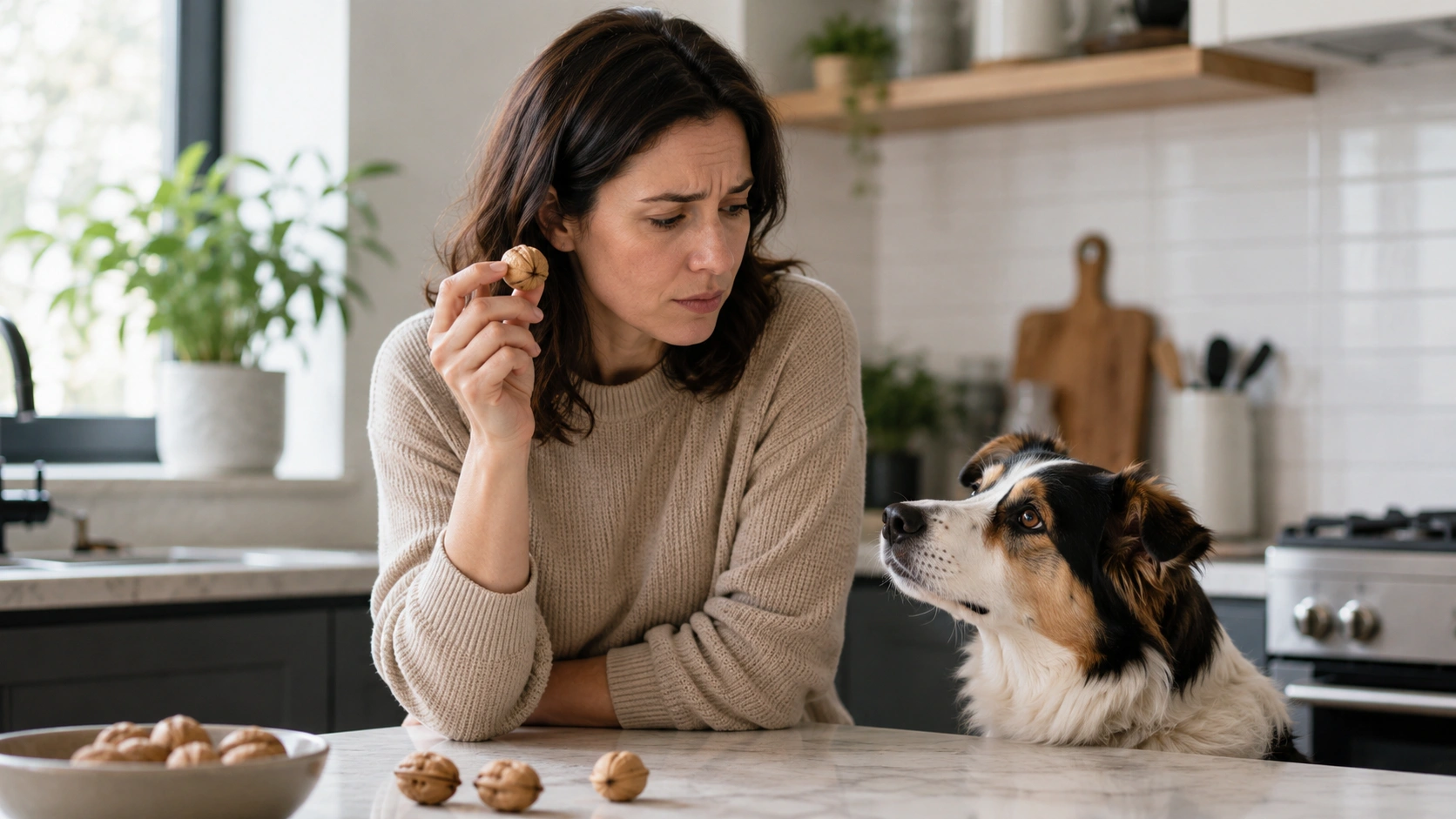
If you have ever dropped a walnut on the floor and watched your dog sprint toward it, you already know why this question matters. Dog owners want a simple answer, but walnut safety is not as straightforward as it looks. Some pages make English walnuts sound only mildly risky, while others warn about black walnuts, mold, choking, blockage, and pancreatitis. The problem is that all of those risks can be true at the same time.
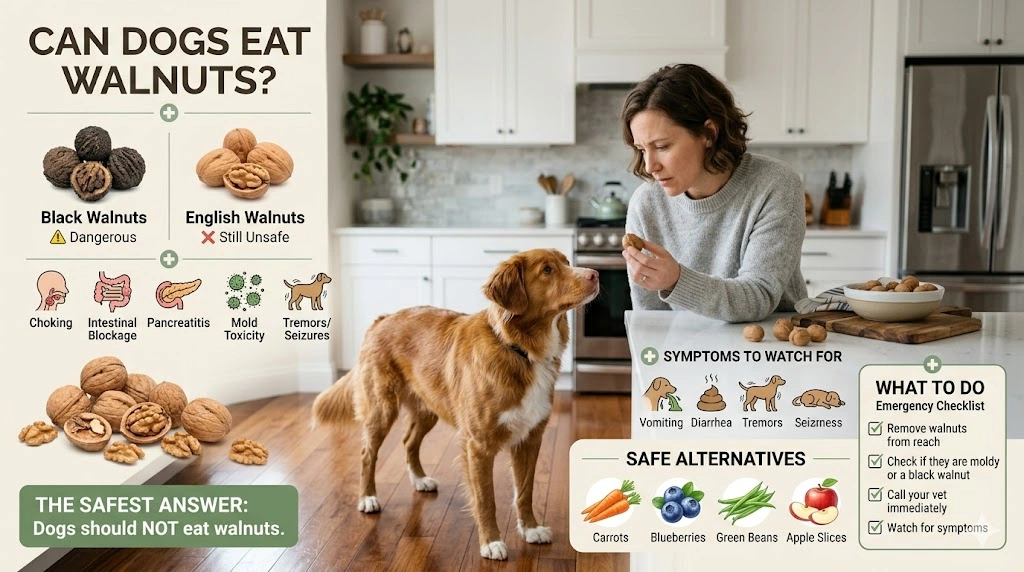
The safest practical answer is this: dogs should not eat walnuts on purpose. Black walnuts are toxic, moldy walnuts can expose dogs to dangerous mycotoxins, and even plain English walnuts can still cause choking, stomach upset, or intestinal blockage. That is why a good dog-care article should not stop at “it depends”; it should help owners decide what to do in the next five minutes.
This guide gives you that decision path. You will get a direct answer, the real differences between walnut types, the symptoms to watch for, the urgent steps to take if your dog already ate one, and safer treat ideas that fit everyday dog life in the US, UK, and Europe.
Snippet-ready answer
Can dogs eat walnuts? No, dogs should not eat walnuts. Black walnuts are toxic, moldy walnuts can cause tremors or seizures, and even English walnuts can create choking, blockage, and digestive risks.
Why walnuts can be dangerous for dogs
Walnuts are risky for dogs for three different reasons at once. First, they are high in fat, which can upset the stomach and may contribute to pancreatitis when eaten in larger amounts. Second, they are a physical hazard because whole nuts and shells can choke a dog or get stuck in the digestive tract. Third, walnuts can carry mold, and moldy foods may contain tremorgenic mycotoxins that can trigger vomiting, incoordination, tremors, seizures, and elevated body temperature.
That is why the best safety approach is not “How many walnuts can I safely give?” but “Why give walnuts at all when safer treats exist?” AKC and ASPCA both warn that nuts are high in fat and can cause gastrointestinal problems, blockages, or pancreatitis, while Pet Poison Helpline notes that moldy nuts and compost exposure can produce serious neurologic signs.
Black walnuts vs. English walnuts
This distinction matters because not all walnuts carry the same level of risk. PetMD explains that black walnuts are toxic to dogs, while English walnuts are sometimes described as lower risk in very small amounts. ASPCA lists black walnut as toxic to dogs and says moldy nuts or hulls can cause tremors and seizures, and Vets Now notes that cooking walnuts are usually English walnuts, while black walnuts are the species that cause concern outdoors.
The problem is that the “English walnut is okay in tiny pieces” idea is easy to overread. That is a narrow exception, not a feeding recommendation. Purina UK still warns that a whole walnut in the shell can lead to abdominal obstruction, and Purina US says walnuts can be difficult to digest, can cause internal blockages, and may carry mold that breeds tremorgenic mycotoxins.
Moldy walnuts and mycotoxins
This is the hidden danger many Can Dogs Eat Walnuts owners miss. Walnuts can mold, and moldy foods can contain tremorgenic mycotoxins. Pet Poison Helpline says those toxins may be found in moldy nuts and compost and can cause vomiting, agitation, incoordination, tremors, seizures, and elevated body temperature. Merck Veterinary Manual also notes that moldy foods, such as walnuts, may be part of the exposure history in tremorgenic neuromycotoxicosis.
This risk is especially important for walnuts found outside, in compost, under trees, or forgotten in a pantry. Those are the walnuts most likely to be old, damp, moldy, or contaminated. That is why “it looked fine” is not a reliable safety test.
Choking, blockage, and pancreatitis
Even if a walnut is not toxic, it can still hurt your dog. AKC warns that walnuts can be a choking hazard and can contribute to pancreatitis when eaten in large quantities. PetMD also mentions choking and intestinal blockage, while Purina UK says a whole walnut inside the shell can cause abdominal obstruction and should prompt a call to the vet straight away.
Small dogs face a bigger mechanical risk because their airways and intestines are smaller, and AKC specifically notes that blockage risk is higher in small breeds. That makes whole nuts, shells, and shell fragments especially poor choices for toy breeds and puppies.
Walnut risk comparison table
| Walnut type or form | Risk level for dogs | Why it matters | Best action |
| Black Walnut | High | ASPCA lists it as toxic to dogs; moldy nuts/hulls can cause tremors and seizures. | Do not feed; call your vet if eaten. |
| English walnut | Moderate to high | Some sources allow tiny amounts, but it still carries choking, blockage, and fat-related risks. | Avoid as a routine treat. |
| Whole walnut in shell | High | Can cause abdominal obstruction and choking. | Contact your vet. |
| Moldy walnut | Very high | Moldy foods may contain tremorgenic mycotoxins, causing tremors, seizures, and more. | Treat as an emergency risk. |
| Walnut shell or hull | High | Physical blockage and possible neurologic risk in black walnut exposure. | Keep away immediately. |
Symptoms of walnut poisoning in dogs
The signs can vary based on whether the problem is choking, blockage, stomach upset, black walnut toxicity, or mold exposure. The most commonly reported red flags include vomiting, diarrhea, excessive salivation, fatigue, abdominal pain, tremors, seizures, fever, incoordination, and weakness. Purina US specifically lists salivation, fatigue, vomiting, tremors, fever, seizures, abdominal pain, jaundice, and liver damage as walnut-poisoning signs. Pet Poison Helpline and Merck also emphasize agitation, incoordination, hyperthermia, and seizures with mycotoxin exposure.
Symptom table
| Symptom | What it may mean | How urgent it is |
| Vomiting or diarrhea | Stomach upset, mold exposure, or fat intolerance | Same-day vet advice if repeated |
| Drooling or salivation | Nausea, oral irritation, or toxin exposure | Call the vet for guidance |
| Tremors or twitching | Possible mycotoxin reaction or neurologic toxicity | Emergency |
| Seizures | Serious neurologic toxicity | Emergency |
| Wobbliness or incoordination | Possible black walnut or mold-related neurologic effect | Emergency |
| Abdominal pain or bloating | Blockage, pancreatitis, or GI irritation | Urgent vet visit |
| Jaundice or yellow gums/eyes | Possible liver involvement | Emergency |
ASPCA, Pet Poison Helpline, and Merck all support a low threshold for emergency action when tremors, seizures, or incoordination appear after moldy food or black walnut exposure.
What to do if your dog ate a walnut
Do not guess your way through this. Use an emergency-first decision path.
- Remove the walnuts immediately so your dog cannot eat more.
- Check what kind of walnut it was, if you can safely do that: black walnut, English walnut, shell, hull, or possibly moldy.
- Call your vet right away if the walnut was black, moldy, in the shell, outdoors, or if your dog is showing any symptoms. Purina UK specifically says a whole walnut in the shell can cause obstruction and needs vet contact straight away.
- Treat tremors, seizures, wobbliness, vomiting, or collapse as urgent. Those are not “wait and see” signs.
- Follow veterinary instructions quickly and exactly. Moldy food exposure can progress, and toxin-related signs may appear within hours.
Are walnuts ever safe for dogs?
The honest answer is that walnuts are not a smart dog treat, even if a few sources describe tiny amounts of English walnuts as lower risk. PetMD says English walnuts may be tolerated in very small portions, Vets Now says cooking walnuts are usually English walnuts, and Purina UK says English walnuts can be a rare treat in moderation. But the broader veterinary safety consensus still leans the other way because walnuts are high in fat, can choke dogs, can block the intestines, and can hide mold.
That means the practical answer for real-life dog owners is simple: do not make walnuts part of your dog’s diet or training routine. When a treat creates too many avoidable risks, the safest choice is to skip it entirely. AKC specifically recommends choosing safer fruits, vegetables, or vet-approved treats instead of nuts.
Europe and UK-specific practical advice
For European dog owners, walnuts show up in two common places: outdoor spaces and holiday food tables. Vets Now notes that black walnuts are more likely to be encountered outdoors under trees, especially in the south of the UK, while RSPCA’s Christmas safety guidance includes walnuts and mouldy food among foods pets should avoid.
That matters in real city and apartment life. Dogs in apartments often walk through communal gardens, parks, shared courtyards, and autumn leaf litter, where dropped nuts can hide in grass or under benches. In winter, walnut bowls, snack trays, and leftover baking ingredients can sit low on coffee tables and sideboards where curious dogs can reach them. The fix is boring but effective: keep nuts sealed, clean up dropped pieces fast, and assume your dog will find anything left at nose height. This is especially important around Christmas, when walnuts and mouldy leftovers become more common hazards.
For UK and European owners, another practical point is species confusion. If a dog picks up a walnut outside and you are not sure whether it is an English walnut or a black walnut, Vets Now advises calling your vet, especially if any illness appears. That is a good rule anywhere black walnuts may be present.
Apartment living, urban walks, and cold-weather tips
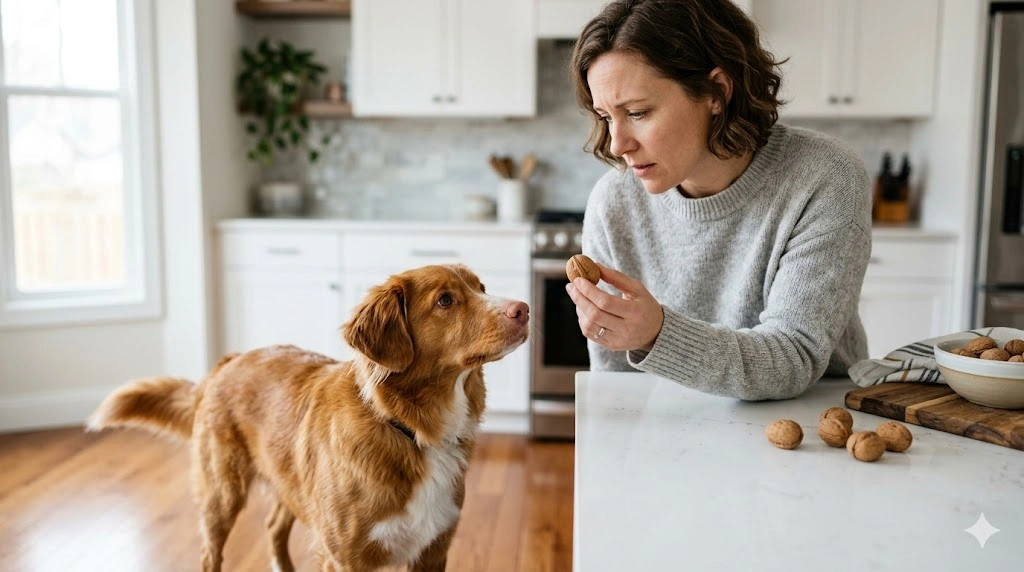
Walnuts are not just a countryside problem. Urban dogs can find them in park grass, outside cafés, under benches, in shared gardens, or near squirrel feeding spots. In apartments, the biggest danger is usually human food storage: mixed nuts on counters, holiday baking trays, and dropped shell fragments on the floor. A quick floor sweep after snack time prevents a lot of mistakes.
Cold weather creates another pattern. Dogs spend more time near indoor snacks, and families often bring richer foods, baked treats, and festive nuts into the home. RSPCA warns that mouldy food can cause vomiting, tremors, convulsions, and seizures, so winter is a good time to stay extra strict about what gets left out.
Common mistakes dog owners make
The most common walnut mistakes are easy to avoid once you know them:
- Thinking “English walnut” means “dog safe.” It may be lower risk than black walnut, but it is still not a great treat.
- Giving whole walnuts or shells because “it was just one.” Whole nuts can obstruct the gut or choke a dog.
- Ignoring moldy or outdoor walnuts because they look normal from a distance. Mold can produce tremorgenic toxins.
- Waiting for symptoms to “pass.” Seizures, tremors, and incoordination are emergency signs.
- Sharing walnuts from seasoned snacks or baked goods that may contain salt, onion, garlic, or other unsafe ingredients. AKC warns that salted or seasoned nuts can be toxic or harmful.
Expert tips for safer dog feeding
- Keep a small note on your phone with the nearest emergency vet and poison helpline numbers.
- Check your yard and walk routes for fallen nuts in autumn.
- Store mixed nuts in sealed containers above counter level.
- Choose one or two consistent dog-safe treats and use them instead of human snacks.
- For dogs with sensitive stomachs or a history of pancreatitis, be even stricter with fatty foods. AKC notes that high-fat nuts can contribute to pancreatic issues.
Pros and cons of walnuts for dogs
| Pros | Cons |
| Walnuts do contain nutrients that are useful for humans. Pawlicy notes they are rich in fatty acids, vitamins, minerals, and antioxidants. | Dogs do not benefit enough to justify the risks. |
| A tiny amount of English walnut may be tolerated by some dogs. | Walnuts can cause choking, blockage, pancreatitis, mold exposure, vomiting, tremors, and seizures. |
Better dog-safe alternatives
If your goal is simply to give your dog a safe, crunchy, or festive snack, there are better options. RSPCA lists plain carrots, green beans, peas, broccoli, cauliflower, mashed or boiled potatoes, plain salmon, and small amounts of skinless, boneless turkey or chicken as safer seasonal options. AKC also recommends safe fruits and vegetables or vet-approved treats instead of nuts.
People also ask
It is better not to offer one at all. Some sources say a tiny amount of English walnut may not cause immediate harm, but the safer recommendation is still to avoid walnuts because the risks are not worth it.
Yes. Black walnuts are specifically listed as toxic to dogs, and moldy nuts or hulls can cause tremors and seizures.
Yes. Moldy nuts can contain tremorgenic mycotoxins that may cause vomiting, incoordination, tremors, seizures, and elevated body temperature.
Treat it as a blockage risk. Whole walnuts in shells can cause abdominal obstruction, and shells can also create choking problems.
Mold-related neurologic signs can appear within hours, and the exact timing depends on the amount eaten, the dog’s size, and the type of exposure.
Not if the walnut was black, moldy, in a shell, or eaten in quantity. Early veterinary advice is the safer choice because signs can develop later.
Final takeaway
Can Dogs Eat Walnuts? Can Dogs Eat Walnuts? Eating walnuts can trigger serious poisoning, and even English walnuts can still cause choking, blockage, or stomach upset. If your dog ate a walnut, the best response is to identify the type, check whether it was moldy or in a shell, and call your vet quickly if there is any doubt.
For everyday feeding, the cleaner choice is simple: skip the walnut and use dog-safe treats instead. That keeps your dog safer, reduces emergency risk, and makes life easier for you, too. If this guide helped, bookmark it and share it with another dog owner who might need a fast answer the next time a walnut lands on the floor.Disclaimer: This content is for educational and informational purposes only and does not replace professional veterinary advice. Always consult a licensed veterinarian for medical concerns regarding your dog.