Can Cats Eat Dog Food? — The Truth That Could Save Your Cat’s Life
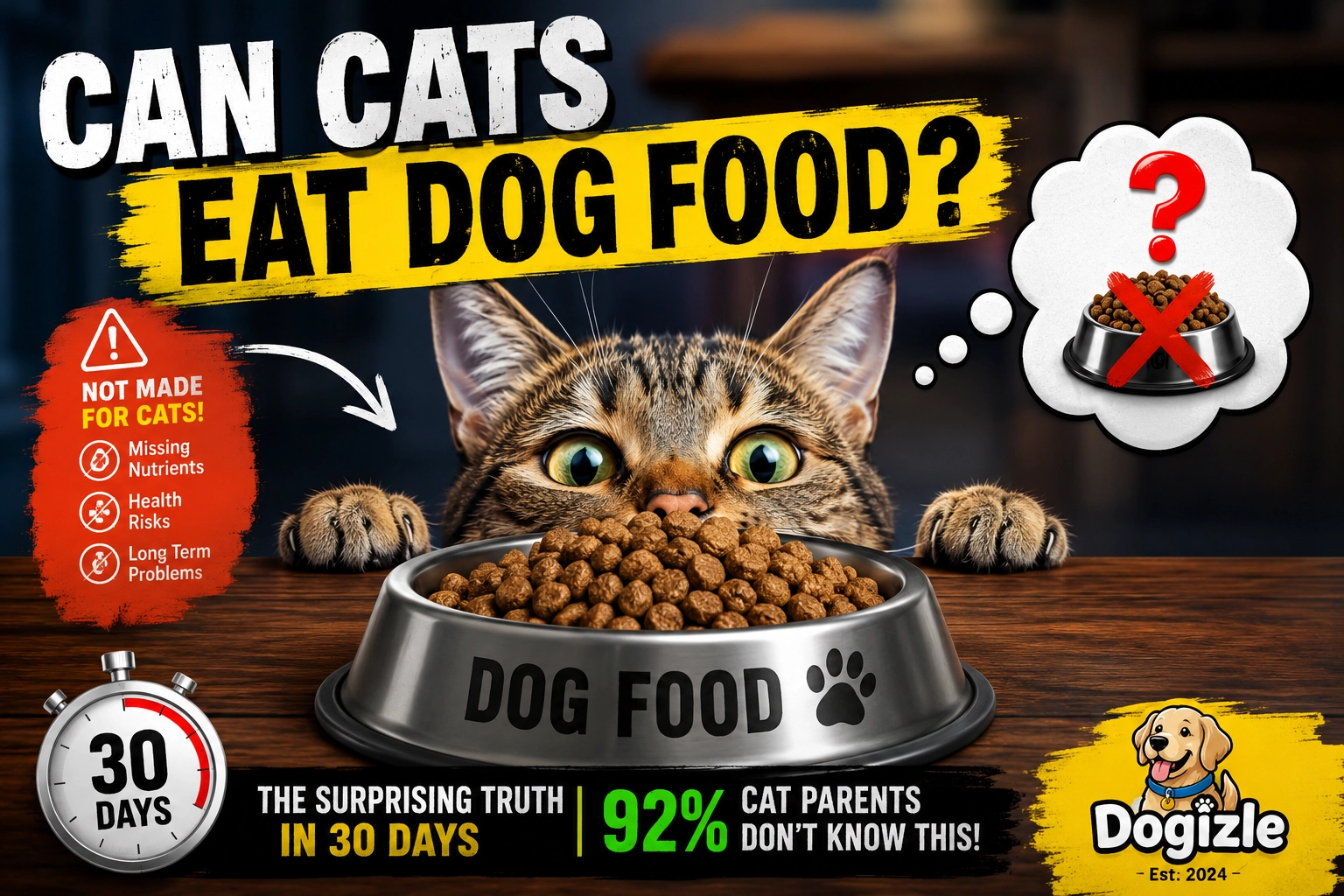
No, cats should not eat dog food — it lacks the essential nutrients cats need to survive.
Dog food is missing Taurine, Vitamin A, and Arachidonic Acid, which are critical for a cat’s survival. Feeding it regularly can lead to blindness, heart disease, and organ failure in your cat. If you live with both cats and Dogs. You have probably seen a cat wander over to the dog bowl. Sniff it once, and then start eating as if nothing is wrong. That moment can make the food situation in a multi-pet home feel confusing.
The good news is that this topic has a clear answer. And the science behind it is very consistent. Cats and dogs do not share the same nutritional blueprint. Cats need a species-specific, complete, and balanced diet. While dog food is designed around canine needs, it can leave important gaps for cats over time. Cornell, ASPCA, and MSD Veterinary Manual all emphasize that cats need properly balanced diets. Including taurine and other nutrients that are not reliably guaranteed in dog food.
The simplest way to understand this is to think in terms of biological intent. Cats are not merely “smaller dogs.” Their metabolism, amino acid needs, fat requirements, and vitamin handling differ in ways that matter every single day. Dog food is not usually poisonous to cats in the immediate sense. But it is not an appropriate long-term feeding strategy for them because it can fail to supply taurine. Preformed vitamin A, arachidonic acid, and the right overall nutrient density that cats need.
Why Dog Food Is Dangerous for Cats
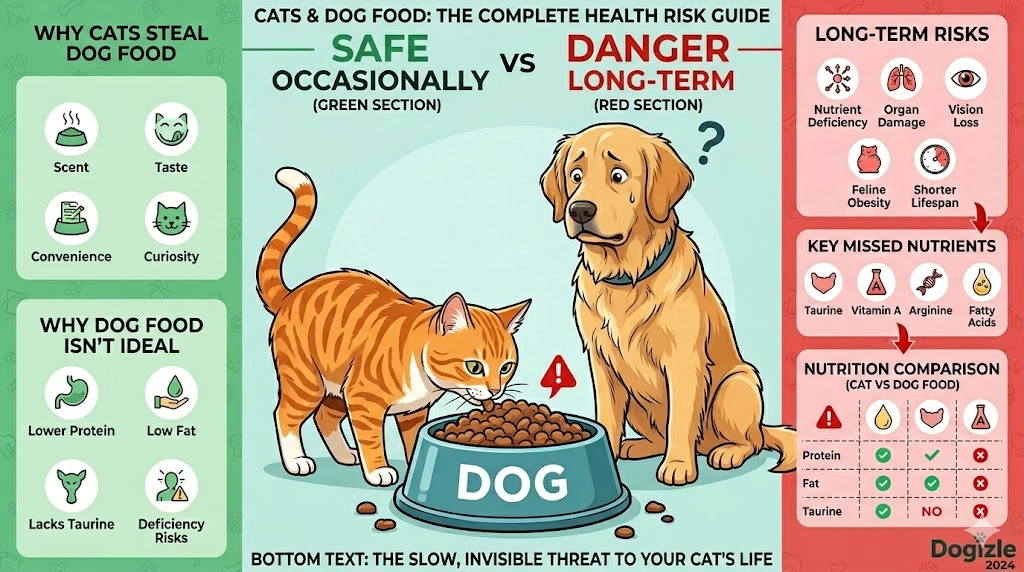
Cats can eat dog food occasionally without immediate danger. But they should not rely on it as a regular diet. Because dog food may be lower in protein and may not provide assured taurine. preformed vitamin A, arachidonic acid. Or the full nutrient profile cats require. Over time, that mismatch can contribute to serious health problems.
7 Critical Nutrients Missing in Dog Food for Cats
The main issue is not appetite, taste, or convenience. It is nutritional architecture. Cats need a food formulated for their physiology. Cornell notes that a cat’s nutritional needs change by life stage, and the nutrition claim on the label should show that the diet is complete and balanced for the correct stage of life. ASPCA also recommends high-quality cat food and explains that properly balanced feline diets contain taurine, an essential amino acid for heart and eye health.
MSD Veterinary Manual is especially direct on this point: dog foods are generally not satisfactory for cats because some dog foods are lower in protein, may not contain assured taurine, may not provide other essential feline nutrients such as preformed vitamin A and arachidonic acid, and may not meet feline fat, vitamin, and mineral requirements. It also notes that many feline diets are adjusted for urinary pH, which is another reason species-specific formulation matters.
That means the issue is not just one missing ingredient. It is a chain of differences. A diet can look “pet-friendly” in a general sense and still be wrong for a cat in a biological sense. This is why cat nutrition should be evaluated by species, not by brand category or the simple fact that the product is commercial pet food.
Cats vs Dogs: A Fundamental Nutritional Difference
Cats are obligate carnivores in practical nutrition terms: they need animal-based nutrients to maintain health, and they cannot depend on plant-heavy or loosely balanced formulas to meet those needs. ASPCA explains that all cats require taurine and that taurine is found only in animal-based protein sources. MSD Veterinary Manual likewise states that cats must have animal-based protein sources because plant protein sources do not contain taurine.
Dogs, by contrast, are more flexible omnivores. That does not mean dogs can eat anything, but it does mean canine food can be designed around a broader nutrient strategy than feline food. A formula built for dogs can therefore pass canine requirements while still falling short for cats. This is one of the Biggest reasons pet owners get misled: “complete and balanced” is not a universal label. It is species-specific.
Cats also have a higher dependence on certain ready-made nutrients. They need taurine, preformed vitamin A, and arachidonic acid in ways dogs do not. Taurine is critical for the heart and eyes, and deficiency is a known cause of dilated cardiomyopathy and retinal degeneration in cats. Cornell and Merck both connect taurine deficiency with serious cardiac disease in cats, while ASPCA reinforces taurine’s importance for heart and eye health.
The Critical Nutrients Dog Food May Not Deliver
Taurine is the best-known example, but it is not the only one. Cat diets need dependable taurine levels because cats cannot synthesize it adequately on their own in the way dogs can. That is why taurine is routinely added to commercial cat food, and why noncommercial or species-inappropriate diets can become dangerous. Cornell notes that taurine deficiency was historically responsible for many feline DCM cases, and Merck explains that the disease incidence has dropped dramatically since taurine was identified as a major cause and incorporated into commercial cat food.
Preformed vitamin A is another important difference. Cats need vitamin A in the active, ready-to-use form, not just as a precursor that must be converted efficiently. MSD Veterinary Manual specifically lists preformed vitamin A among the nutrients that dog food may not provide in the amounts cats need. Over time, that can contribute to poor body condition and other signs of nutritional imbalance.
Arachidonic acid matters too. Cats require it in their diet, while dogs do not depend on it in the same way. That difference alone is enough to make dog food incomplete for cats. When a pet owner says, “It is still meat-based, so it should be fine,” the nutritional reality is more complex than that. Species biology determines the formula, not the marketing language on the front of the bag.
Protein level is also a big part of the story. Cat food is usually formulated with a higher protein emphasis than dog food because cats use protein very differently and need a steady supply of amino acids. Cornell explains that commercial cat foods differ in protein level, caloric density, digestibility, and moisture, and that these differences are tied to proper feline nutrition rather than convenience alone.
What Happens If Cats Eat Dog Food?
The answer depends on frequency. A small accidental taste is very different from repeated meals. A healthy adult cat that steals a few bites of dog food is unlikely to collapse or show dramatic symptoms right away. In most cases, the immediate effect is minimal or limited to mild digestive upset, if any. But the real concern is cumulative exposure. A diet that is repeatedly built around dog food can gradually create nutrient shortfalls that the body may not signal until damage has already started.
That is why the phrase “not toxic but not suitable” is the most accurate shorthand. Dog food usually is not an acute poison for cats, but that does not make it safe as a routine menu. Veterinarians look at diet quality through a long lens: is it complete, is it balanced, is it species-appropriate, and does it match the pet’s life stage? Those questions matter more than whether the food seems to be accepted willingly by the cat.
Short-Term Exposure vs Long-Term Feeding
Short-term exposure is usually a low-risk event in an otherwise Healthy adult cat. The body can tolerate a brief mismatch far better than a prolonged one. Long-term feeding is where the danger rises. Over weeks and months, insufficient taurine, lower protein quality, and missing feline-specific nutrients can affect energy, coat quality, weight stability, cardiac function, and vision. Cornell and Merck both point to the importance of a complete and balanced cat diet rather than improvised substitutions.
Taurine deficiency is especially important because the consequence is not just “a little weakness.” It can lead to dilated cardiomyopathy and central retinal degeneration, both of which are serious. Merck explicitly links taurine deficiency with DCM and retinal degeneration in cats, and Cornell describes the historic connection between taurine deficiency and feline heart disease.
Timeline of Nutritional Damage
There is no single universal clock, because cats differ in age, health, body condition, and how much dog food they are eating. Still, the pattern is predictable: one missed meal is very different from repeated substitution. The longer a cat receives the wrong formula, the more likely a nutritional imbalance becomes. Cornell’s life-stage guidance and Merck’s species-specific nutrient guidance both point to the same conclusion: feeding problems become more serious when a diet is used as a pattern rather than an exception.
In practical terms, the first signs may be subtle. A cat may seem less energetic, a little less interested in play, or slightly off its normal food routine. Later, more concerning changes can emerge, such as weight loss, dull coat quality, or signs related to the heart and eyes. The exact timing varies, but the mechanism is the same: the body is compensating until it can no longer do so efficiently.
Why Cats Eat Dog Food
Cats often eat dog food for behavioral reasons rather than nutritional ones. They are curious, opportunistic, and highly responsive to smell and texture. A dog bowl can become interesting simply because it is different. That does not mean the cat needs the food; it usually means the cat is exploring, copying, or reacting to a new smell in the environment.
Multi-pet households also create food competition. If a dog eats near a cat, the cat may treat the dog’s bowl as a resource to investigate. Indoor cats can also become more food-focused when they are bored, when meals are irregular, or when their own food is less appealing. None of these behaviors implies that dog food is suitable. They only explain why the behavior happens.
Can Cats Eat Dog Food in an Emergency?
In a true short-term emergency, the goal is to prevent hunger while you obtain the correct food as quickly as possible. That said, the safest nutrition advice from Cornell and ASPCA is still to return to a properly balanced cat diet as soon as possible, because feline food is built for feline needs and dog food is not. A single temporary gap is different from making dog food a fallback routine.
This is also where home care judgment matters. If a cat refuses cat food, or if a cat has not eaten normally, that can be more serious than the dog-food issue itself. Cornell warns that a cat that refuses to eat and is losing weight should be seen by a veterinarian, because appetite loss in cats can signal medical problems.
A helpful way to think about emergencies is this: dog food may be a temporary stopgap, but it is not a nutritional destination. The sooner the cat returns to a complete and balanced feline diet, the better.
Can Kittens Eat Dog Food?
Kittens should not be fed dog food as a regular or meaningful part of their diet. Their growth phase is too important for dietary shortcuts. Cornell explains that a cat’s nutritional requirements change across life stages, including kittenhood, adulthood, pregnancy, and lactation. ASPCA also says the food chosen should be balanced for the life stage of the cat or kitten. That life-stage wording matters: kittens need a formula built for rapid development, not a generic substitute.
In kittens, nutritional mistakes can have bigger consequences because the body is building tissue, supporting immune function, and developing organ systems all at once. A cat that is still growing has less margin for error than an adult. That is why kitten food should remain kitten food, and why dog food should not become the default simply because it is available in the house.
How to Stop Cats from Eating Dog Food
The most effective solution is environmental separation. Feed the pets in different locations, and remove bowls after meals so no food is left behind to tempt the wrong animal. In a multi-pet home, management is often more powerful than correction because cats are quick, opportunistic eaters and will exploit any opening. Cornell’s feeding guidance supports using appropriate feeding routines and selecting food based on the cat’s actual needs rather than convenience alone.
You can also make the feeding plan more species-specific. Elevated feeding stations can help keep dog food less accessible to cats, and scheduled meals are usually easier to supervise than free-feeding in shared spaces. For households with persistent cross-feeding, microchip feeders can be a smart upgrade because they limit access to the correct pet. The key idea is simple: create a setup where the cat does not need to resist temptation every day.
When to Contact a Veterinarian
A veterinary visit is a good idea if your cat shows weakness, vomiting, diarrhea, appetite loss, sudden weight change, unusual fatigue, or visual changes. Those signs are not specific to dog food exposure, but they can indicate that the cat’s diet or health deserves attention. ASPCA advises veterinary consultation when a cat has continuing anorexia, diarrhea, vomiting, or lethargy, and Cornell likewise recommends veterinary attention for cats that refuse food and are losing weight.
If you are worried about taurine deficiency, heart disease, or vision problems, do not wait for the problem to “sort itself out.” Merck and Cornell both identify taurine-related disease as a real clinical issue in cats, even though it is much less common now than it used to be because commercial cat foods are fortified properly.
Safety and Health Considerations
Dog food is generally not considered toxic to cats in the way that classic poisons are toxic, but that does not make it a safe standard diet. The real risk is nutritional drift: the cat slowly receives the wrong proportions of protein, amino acids, fatty acids, vitamins, and minerals. Cornell’s complete-and-balanced guidance and MSD Veterinary Manual’s species-specific warning both reinforce that nutrition problems often begin quietly and become visible later.
One more important point: supplements are not a casual fix. Cornell notes that supplements are usually unnecessary when a cat is already eating a balanced diet, and they can be harmful if used without veterinary approval. That matters because some owners try to “correct” dog food by adding random vitamins or human foods. A better solution is to use the right food in the first place.
Common Mistakes Pet Owners Make
The biggest mistake is assuming all pet food is interchangeable. It is not. Cats and dogs have distinct nutrient requirements, and food designed for one species can be nutritionally incomplete for the other. Another common mistake is leaving bowls out all day in a shared feeding space, which makes cross-eating much more likely.
A second mistake is confusing palatability with adequacy. A cat may enjoy dog food because it smells good, has a texture it likes, or simply seems novel. Enjoyment is not proof of nutritional sufficiency. Cornell’s guidance on cat food selection is built around complete-and-balanced labeling, not whether the cat appears to prefer one bowl over another.
A third mistake is treating a brief habit as harmless forever. Many feeding problems start as “only once in a while” events and then become routine. Routine is where species mismatch turns into clinical risk. That is why consistency matters so much in feline nutrition.
Expert Tips for Better Feline Nutrition
Choose a food that is clearly labeled for the correct life stage and species. Cornell recommends reading the nutrition label carefully and looking for the statement that the diet is complete and balanced for the appropriate life phase. ASPCA similarly recommends high-quality kitten or cat food and notes that properly balanced foods contain taurine.
Keep the feeding routine stable. Cats generally do better when their meals are predictable, their food is species-appropriate, and their environment is calm. Cornell notes that cats can be sensitive to feeding location, traffic, noise, dirty bowls, and other environmental stressors that may affect eating behavior.
Use variety wisely. Cornell notes that some cats do well with more than one cat food option and that feeding two or three different cat foods can reduce exclusivity toward a single flavor. That can be useful for picky cats, but the varieties should still be cat foods, not dog foods.
Pros and Cons of Cats Eating Dog Food
The only real “pro” is temporary practicality. If there is a short-term disruption and the cat must eat something for a brief period, dog food is usually better than a cat going hungry. But that is an emergency-use argument, not a nutritional endorsement. Cornell and ASPCA both make clear that the long-term answer is a proper feline diet.
The cons are much more important. Dog food may not reliably supply taurine, preformed vitamin A, arachidonic acid, or the correct balance of protein, fat, vitamins, minerals, and urinary-supportive formulation that cats need. Over time, that can lead to deficiency, heart disease, eye problems, poor condition, and other signs of nutritional strain.
European Pet Care Perspective
European pet food discussions often reference FEDIAF, the European pet food industry body that promotes nutritional requirements and nutritional guidelines for pet food. FEDIAF’s official site highlights nutritional requirements as a major focus area and presents itself as a source for safe, nutritious pet food and responsible pet ownership. That matters because it reinforces a central point: pet food quality is defined by standards, not by casual similarity between products.
For a cat owner, the practical takeaway is the same in Europe or elsewhere: buy a formula that is clearly appropriate for cats, not just a general pet product. Species-specific nutrition is the foundation, and reliable formulation is what keeps the foundation stable.
People Also Ask
Cats may survive a Brief period with access to dog food, but they should not live on it as a regular diet. The reason is nutritional adequacy: cat food is designed to provide feline-specific nutrients such as taurine, while dog food may not meet those needs. Long-term use can contribute to serious deficiencies and disease.
Dog food is generally not poisonous in the usual sense, but it is not suitable for long-term feline nutrition. The danger is not acute toxicity; it is chronic imbalance. If a cat repeatedly eats dog food, the risk shifts from “brief stomach upset” to “nutrient deficiency.”
Yes, a cat can eat a small amount of dry dog food occasionally without immediate harm in many cases, but dry dog food should not replace cat food. The same species-specific limitations still apply, including taurine, protein, vitamin A, and arachidonic acid concerns.
Cats need taurine because it supports heart function, vision, and reproduction, and they cannot meet their requirements without dietary taurine from animal-based sources. Taurine deficiency has been linked to dilated cardiomyopathy and retinal degeneration in cats.
A stray cat may eat dog food if that is the only thing available, but that does not make it ideal. It is still a temporary substitute, not a proper feline diet. The best solution is still to provide cat-appropriate food whenever possible.
Conclusion
So, can cats eat Dog Food? The accurate answer is yes, occasionally and briefly, but no as a regular diet. That distinction matters because the difference between an isolated nibble and a long-term feeding pattern is the difference between inconvenience and nutritional risk. Cats need a formula built for cats, not a generic pet-food compromise. Cornell, ASPCA, and MSD Veterinary Manual all support the same core message: choose a complete and balanced cat diet, matched to the cat’s life stage, and do not treat dog food as a substitute for proper feline nutrition.