Feed or Fear? The Bean Secret Vets Don’t Ignore
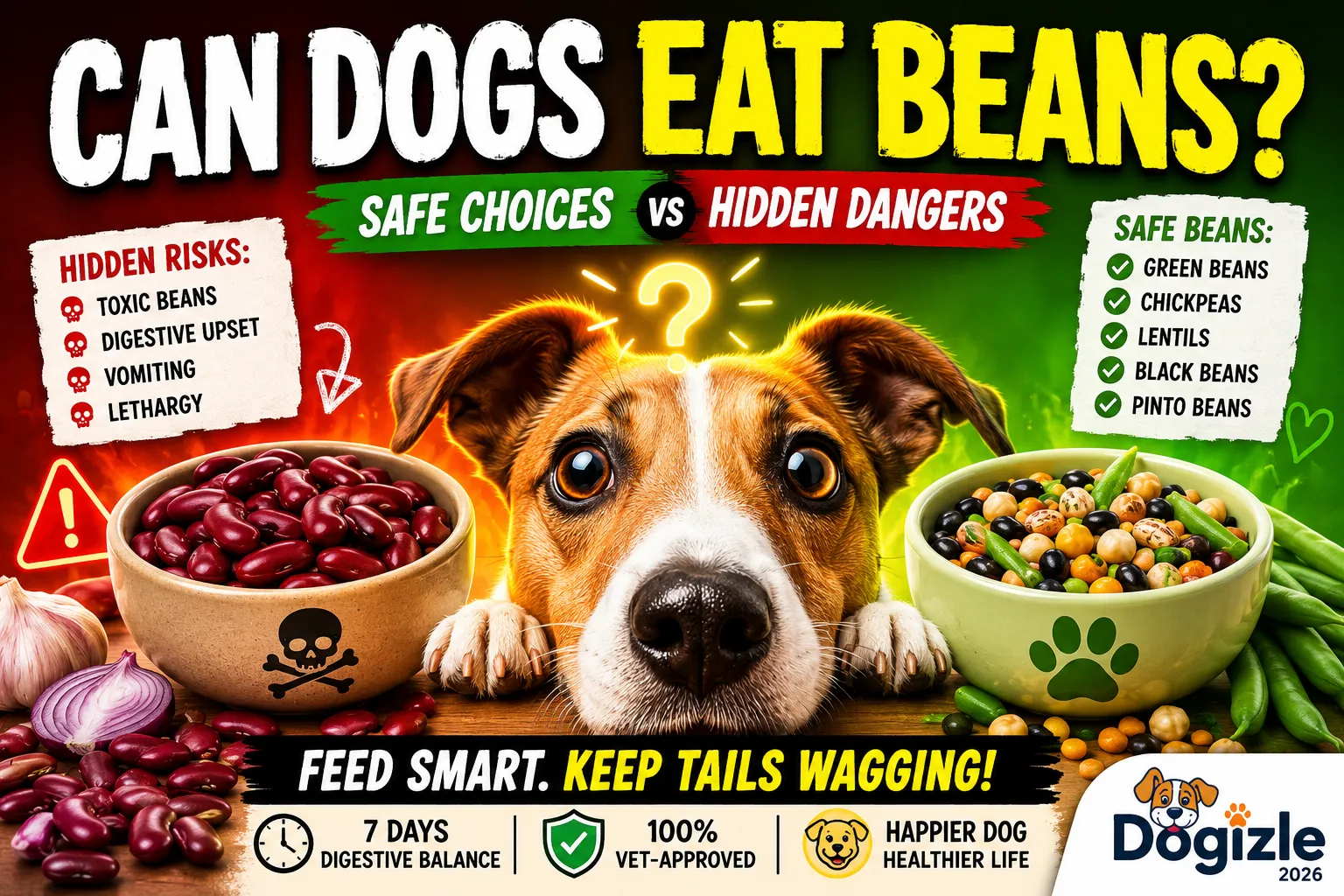
Yes, dogs can eat some beans in moderation. But not all beans are safe, and the wrong kind can cause stomach upset or worse. In this guide, you’ll learn which beans are safe.Which to avoid, and how to feed them the smart. Vet-approved way without risking your dog’s health. If you share your home with a Dog. You have probably looked at a bowl of beans at some. Point and wondered whether it is a harmless. Snack or a problem waiting to happen.
That question is more important than it sounds. Because beans can be nutritious in the right form. But they can also cause stomach upset or serious illness when they are raw. Over-seasoned, canned, or mixed with toxic ingredients. Veterinary nutrition guidance consistently emphasizes that dogs do best on complete and balanced diets. With human foods limited to small, safe extras rather than becoming a major part of the menu.
The simple answer is yes. Dogs can eat some beans, but not all beans are appropriate. And preparation matters a great deal. Plain, thoroughly cooked beans can be a useful occasional treat for many dogs. While dishes containing garlic, onions, heavy salt, sugar, or fat should be avoided. Green beans are especially popular as a low-calorie snack. And chickpeas are also commonly used in dog food and treats when they are cooked properly.
This guide breaks the topic into plain English so you can make a confident decision for your own dog. You will learn which beans are generally safe. Which bean dishes are risky, how much to offer, what to do about canned beans. And when beans should stay far away from your dog’s bowl.
Quick Answer – Can Dogs Eat Beans Safely?
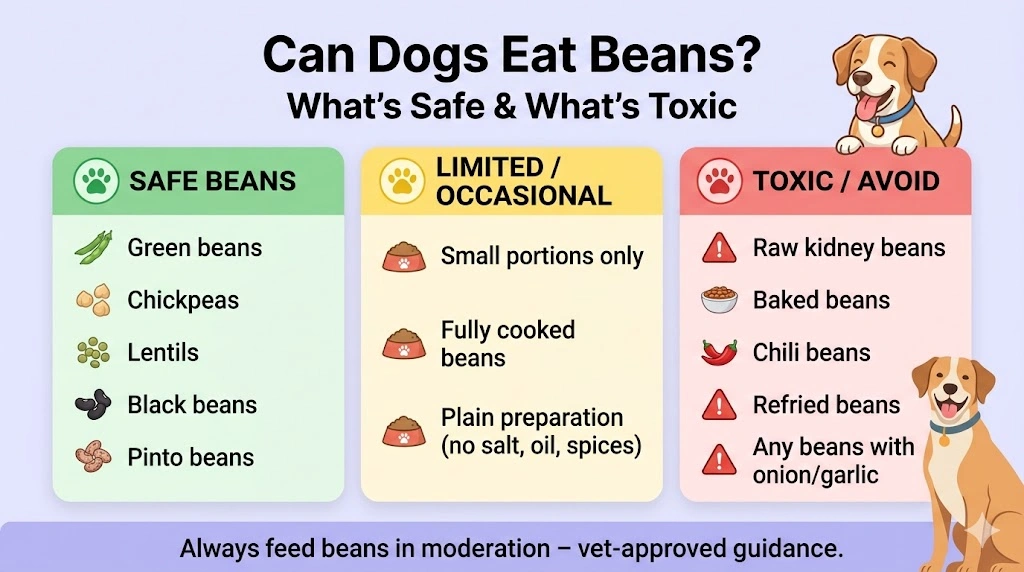
Yes, dogs can eat beans safely only under the right conditions. The safest approach is simple: serve beans only when they are fully cooked. Plain, and offered in very small amounts as an occasional treat. Dogs should never be given raw beans. Heavily seasoned beans, or bean dishes that contain ingredients known to be unsafe for them. Such as onion, garlic, or excessive salt. Beans can cause gas and other digestive upset when eaten in large quantities. So moderation is not optional; it is the rule.
A useful way to think about beans is this: they are a side dish, not a core diet. Veterinary nutrition guidance stresses that treats. Should remain a small part of daily intake. while the main diet should still supply complete. And balanced nutrition suited to the dog’s age, size, and health status. For green beans in particular. PetMD recommends keeping them as an occasional treat that does not make up more than 10% of the diet.
Nutritional Value of Beans for Dogs
Beans can contribute useful nutrients when they are prepared correctly. They are known for their fiber, plant protein, and. A range of vitamins and minerals, and plain cooked beans are often low in fat. Chickpeas, for example, contain protein, folate. Potassium, fiber, vitamins A and B, and magnesium, while green beans. Are praised as a low-calorie treat that still provides nutrients and can help dogs feel satisfied.
That said, dogs are not built to rely on beans as a main source of nutrition. Veterinary nutrition authorities emphasize that. Pets need complete and balanced diets that match their life stage, body condition, and individual health needs. Human foods can be useful in small amounts. But even safe foods can add extra calories and disrupt a diet if they are overused. In other words, beans may be helpful as a topper or training treat. But they are not a substitute for proper dog food.
A practical way to understand the role of beans is to view. Them as a supportive ingredient rather than a foundation. Their fiber can help with satiety. And their protein may contribute a small nutritional boost. But dogs still need animal-based nutrients and a carefully formulated diet to stay healthy over time. PetMD notes that chickpeas can add to a dog’s nutrition only when they are fed alongside. A well-balanced commercial dog food, not instead of it.
Safe Beans Dogs Can Eat
Not every bean belongs in the “no” category. Several bean types can be safe for dogs when they are fully cooked, plain, and served in small portions. The key phrase is plain and cooked. If the beans are soft, simple, and free from harmful add-ins, they are much more likely to be tolerated well.
1. Green Beans
Green beans are one of the best choices for dogs. They are low in calories, easy to portion, and commonly recommended as a healthy snack for dogs that need a lighter treat. They can be served raw or cooked, but cooked green beans are often easier to digest. PetMD also notes that green beans can be used as an occasional treat, and that treats like green beans should stay below 10% of daily intake.
Green beans are especially attractive for weight-conscious dogs because they provide volume without a large calorie load. They are also simple to prepare: wash them, remove any tough ends or strings, and serve them plain. Frozen green beans can be used as a snack, too, but they should be cut appropriately and handled carefully because frozen pieces can become a choking hazard in some dogs.
2. Chickpeas
Chickpeas, also called garbanzo beans, are another dog-friendly option when they are freshly prepared and thoroughly cooked. PetMD describes them as a safe and nutritious treat for dogs and points out that they are commonly used in dog foods and treats. They contain protein and several useful micronutrients, which makes them a reasonable occasional topper when used correctly.
The biggest caution with chickpeas is the same one that applies to other legumes: keep the seasoning out of the picture. Canned chickpeas may contain a lot of sodium, and dried chickpeas should not be fed until they are fully cooked and soft enough to mash. Dry, hard chickpeas can be difficult to digest and may pose a choking risk.
3. Black Beans
Black beans are generally treated as a safe bean option when they are cooked plain and offered in moderation. PetMD’s bean guidance states that most beans are fine for dogs when they are served without unsafe ingredients, and black beans are specifically noted in PetMD’s bean coverage as a good source of fiber, potassium, magnesium, and antioxidants when prepared properly.
For dogs, black beans should be soft, unseasoned, and given in small bites rather than in large scoops. Their value lies in being a small addition, not a bulk ingredient. That makes them useful in a topper, mixed into a homemade meal approved by your vet, or offered as a tiny taste during training, but not as a daily filler.
4. Pinto Beans
Pinto beans are also commonly included in the “safe in moderation” category when they are prepared correctly. PetMD’s bean article explains that many bean varieties can be acceptable for dogs if they are cooked plain and free from toxic seasonings, and pinto beans fit that overall pattern as long as they are soft, simple, and served sparingly.
A pinto bean serving should never be salty, spicy, oily, or mixed into a rich human recipe. Dogs do not need those extras, and their digestive systems often respond poorly to them. The bean itself may be tolerable; the recipe around it is usually the real problem.
5. Lentils
Lentils can be a reasonable occasional addition when they are fully cooked and plain. WSAVA nutrition guidance stresses that food should be tailored to the individual dog, and PetMD lists lentils among common carbohydrate sources used in some dog foods. That does not make lentils a necessity, but it does place them within the broader group of ingredients that can appear in canine diets when properly formulated.
One important caution is that legume-heavy diets have been discussed in relation to diet-associated dilated cardiomyopathy in dogs, especially when legumes are used as major ingredients in grain-free or boutique diets. That concern is about long-term diet formulation, not about a tiny serving of cooked lentils as an occasional treat. The safe takeaway is simple: small amounts are one thing, but making lentils or other legumes the backbone of a dog’s diet is not a good idea unless a veterinarian or board-certified nutrition professional has designed the diet.
6. Peas and Other Similar Legumes
Peas are commonly treated as safe in small amounts when they are plain and properly prepared, though they should still be offered in moderation. PetMD explains that peas are a nutritious treat when free from butter, salt, and spices, and AKC notes that small amounts of certain peas are not harmful. As with beans, the issue is not simply whether the food is a legume; the issue is how much is given and what else is mixed in.
The broader lesson is useful: many plain legumes can be okay in small quantities, but they should remain supplements, not staples. If a legume-rich pattern becomes the primary structure of the diet, the conversation shifts from “Can My Dog Have This?” to “Is the whole diet balanced?” That is a very different question, and the one your veterinarian should help answer.
Dangerous & Toxic Beans for Dogs
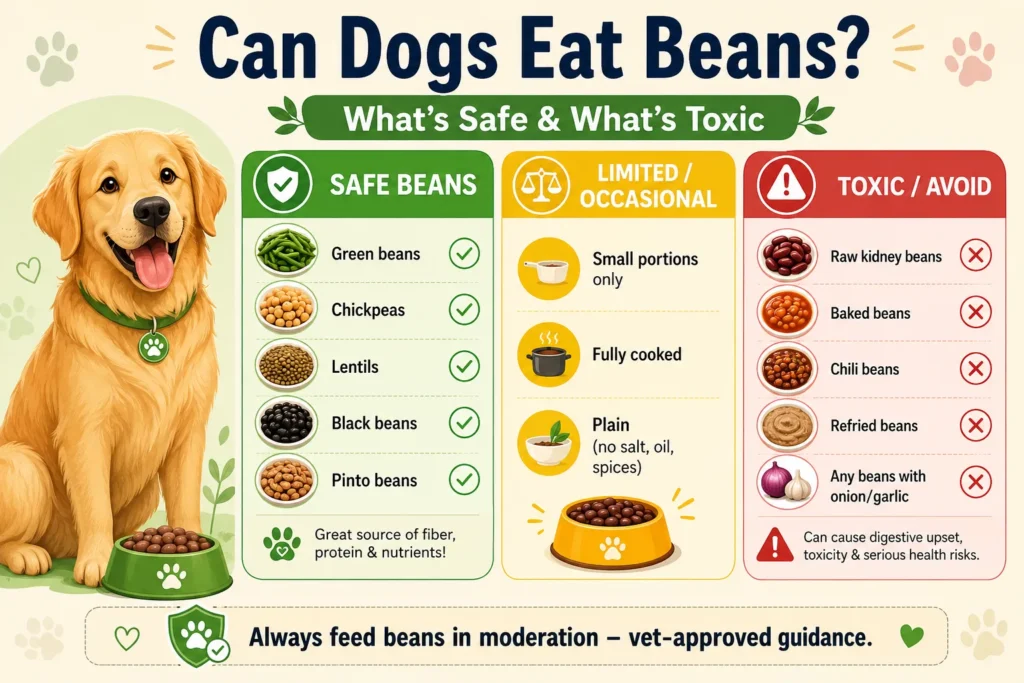
Some bean dishes are not just unhelpful; they can be dangerous. The problem is usually not the bean alone, but the ingredients, the method of preparation, or the fact that the bean is raw or undercooked. When you see a bean dish with a long ingredient list, that is often your cue to put it out of reach.
1. Raw Kidney Beans
Raw kidney beans are a serious no. Raw or undercooked beans can cause stomach upset, and raw kidney beans are specifically identified as toxic to dogs by PetMD. In food safety guidance from the FDA, raw or undercooked kidney beans contain phytohaemagglutinin, a natural lectin that can trigger nausea, vomiting, and diarrhea. That is why kidney beans must be thoroughly cooked before they are even considered for dogs, and why raw versions should never be offered.
The safer mental shortcut is simple: if a bean is hard, dry, raw, or only partially cooked, it is not ready for your dog. Cooking changes the bean from a digestive problem into something much more manageable, but incomplete cooking leaves the hazard in place.
2. Fava Beans
Fava beans are not usually the first bean people think about, but they deserve caution. Large amounts can be difficult on the digestive system, and any bean that is not fully cooked or is part of a rich, seasoned dish can become a problem. Because dogs vary in sensitivity, a bean that seems harmless in theory may still upset an individual dog’s stomach in practice.
3. Baked Beans
Baked beans should generally be avoided. PetMD specifically warns that baked beans can be unsafe because they commonly contain extra ingredients that can make dogs sick, and green bean casserole or similar side dishes often include onion and garlic. Baked beans are also frequently sweetened and heavily seasoned, which makes them a poor choice for dogs, even before you factor in the additional flavorings.
4. Refried Beans
Refried beans are another bad fit for dogs. They are usually richer and heavier than plain cooked beans, and that higher fat content can be hard on a dog’s digestive tract. PetMD warns that refried beans should be avoided because they contain ingredients such as garlic, onion, spices, and extra fat that can upset a dog’s stomach or make them sick.
5. Chili Beans
Chili beans should be kept off the menu entirely. So Chili recipes almost always contain seasonings that are unsafe for dogs, especially onion, garlic, and spicy ingredients. The bean itself is not the issue; the entire chili mixture is. VCA explains that onion, garlic, chives, and leeks can cause vomiting, diarrhea, abdominal pain, and even red blood cell damage in dogs, and Merck notes that these Allium ingredients can lead to hemolysis and more serious illness.
Can Dogs Eat Cooked Beans?
Yes, dogs can eat cooked beans, but only if the beans are prepared correctly. “Correctly” means fully cooked, soft, plain, and completely free from salt, garlic, onion, butter, oil, and spice blends. PetMD’s guidance on beans is clear that plain cooked beans can be a good source of protein and fiber, but only when unsafe add-ins are left out.
Cooking matters because it changes digestibility. PetMD notes that cooked green beans are more easily digestible than raw ones, and raw or undercooked beans in general can cause digestive upset. The same idea applies broadly: the softer and simpler the bean, the less likely it is to cause trouble.
A good home-preparation rule is to boil or steam the beans until they are tender, then let them cool and serve only a few pieces at first. If you are making a bean dish for yourself and want to share with your dog, it is better to set aside a dog-safe portion before adding your seasonings rather than trying to “wash off” unsafe ingredients later. Once onion, garlic, or excess salt has been added, the dish is no longer a dog-safe snack.
Can Dogs Eat Canned Beans?
Canned beans are not the best choice for dogs. The main concern is sodium. PetMD warns that canned beans are often laden with sodium, and that too much sodium over time is not healthy for dogs. For green beans and chickpeas, low-sodium canned versions are better than regular canned versions, but plain home-cooked beans remain the cleaner option.
Even rinsing canned beans does not turn them into a perfect dog snack. It may reduce some surface salt, but it does not change the fact that canned products are usually more heavily processed and can still contain more sodium than you want in a pet treat. That is why veterinarians and pet nutrition sources generally prefer fresh or home-cooked beans over canned ones.
If canned beans are the only option, choose a no-salt-added variety, rinse them well, and keep the portion tiny. That is a compromise, not an ideal. The best case is still a plain pot of beans cooked at home without additives.
Can Puppies Eat Beans?
Puppies can eat beans only in very small amounts, and even then, caution is important. Their digestive systems are still developing, and foods that are tolerated by adult dogs can sometimes cause more noticeable stomach upset in younger dogs. PetMD notes that green beans can be safe even for puppies, but puppy stomachs are more sensitive, and too much fiber can cause discomfort.
That means beans should never crowd out the food a puppy actually needs. Puppies require a Growth-appropriate, complete, and balanced puppy diet, and WSAVA nutrition guidance makes it clear that nutrition needs change with age and must be tailored over time. Beans can be a tiny sample or training reward, but they should not become a routine filler in a puppy’s bowl.
When introducing beans to a puppy, start with a very small amount and watch closely for gas, loose stool, bloating, or reduced appetite. If the puppy is already dealing with a sensitive stomach, it is usually wiser to skip the experiment and stick with the regular diet.
How Many Beans Can Dogs Eat?
Portion size depends on the dog’s size, overall diet, and how their stomach handles new foods. A sensible starting point is always “less than you think.” PetMD recommends keeping treats like green beans under 10% of daily intake, with the other 90% coming from a well-balanced dog food diet. That same principle is a smart way to think about other bean types, too.
Here is a practical feeding range you can use as a rough guide:
For small dogs, begin with one to two teaspoons of plain cooked beans. So medium dogs, one to two tablespoons is enough to test tolerance. For large dogs, up to about a quarter cup may be reasonable, but only if the beans are fully cooked, plain, and well tolerated. These are not rules carved in stone; they are cautious starting points.
The safest habit is to give a small first serving and wait at least 24 hours to see how the dog responds. If the dog develops gas, soft stool, vomiting, or unusual discomfort, the amount was probably too high or the bean type was not a good match. A dog that does well with a small serving does not automatically do well with a bigger one.
What Happens If a Dog Eats Too Many Beans?
Too many beans can create more trouble than benefit. The most common problems are gas, bloating, diarrhea, and vomiting. PetMD explicitly warns that beans can trigger digestive issues when eaten in large quantities, and the higher the serving, the greater the chance that the dog’s gut will protest.
The reason is simple: Beans are fiber-rich and can be difficult for some dogs to process in large amounts. A dog may look fine after a small taste and then develop symptoms later if they were fed too much. That is one reason veterinary nutrition guidance favors small, measured portions and steady monitoring instead of free-feeding human foods.
In more serious situations, especially when a dog has eaten a bean dish that is rich, greasy, or toxicly seasoned with toxic ingredients, the problem can escalate beyond simple gas. That is when concerns such as pancreatitis, dehydration, or toxin exposure enter the picture, and professional veterinary care becomes important. VCA and Merck both highlight how dangerous onion- and garlic-containing foods can be, while PetMD warns against refried and baked bean dishes for exactly those sorts of reasons.
Breed & Age Considerations
Not all dogs handle beans the same way. Small dogs usually have less room for error because even a modest serving can be a large amount relative to body size. That means a teaspoon of beans may be fine for one dog and too much for another. Sensitivity is often about relative dose, not just the bean itself.
Medium and large dogs may tolerate beans a little better, but “better” does not mean “unlimited.” Their digestive systems still react to excess fiber, sodium, fat, and seasoning. Puppies and seniors generally require extra caution because they are either still developing or may have slower digestion and more fragile tolerance. WSAVA specifically notes that nutritional needs vary by age, breed, body condition, and health status.
Some breeds can also be more sensitive to certain toxins. VCA notes that dogs of Japanese descent, such as Akitas and Shiba Inu, may have a higher risk for onion toxicity. That does not change bean advice in general, but it does reinforce the bigger message: if a bean dish includes Allium ingredients, the risk is not equal for every dog.
Real-Life Feeding in Everyday Homes
In practical terms, many owners use beans in one of two ways: as a small training reward or as a low-calorie topper. That can work well when the beans are plain, and the serving is modest. Green beans are especially common in this role because they are filling, light, and easy to portion.
Some owners also use chickpeas or other plain beans in homemade treats. That can be fine as long as the recipe stays dog-safe and the beans are cooked to a softness. A homemade treat still counts as part of the Dog’s total calorie intake, though, so “healthy” does not automatically mean “unlimited.” WSAVA reminds caregivers that even safe human foods can contribute to extra calories and obesity.
If you are trying to manage a dog’s weight, green beans are usually the easiest bean-related option to work with. They are low in calories, simple to prepare, and widely accepted as a snack in moderation. PetMD specifically recommends that they stay under 10% of the diet, which makes them a supporting player rather than a meal replacement.
Vet Safety Tips
The safest bean strategy is straightforward. Cook the beans fully. Leave out salt, oil, butter, garlic, onion, chives, and seasonings. Start with a tiny amount. Watch your dog for digestive upset. Keep beans as an occasional addition, not an everyday habit. These recommendations line up with veterinary nutrition guidance that emphasizes complete and balanced diets and careful portion control.
Another important habit is to keep human leftovers out of reach. Bean dishes from the dinner table often contain ingredients that are unsafe for dogs, especially onion and garlic. VCA explains that those ingredients can lead to vomiting, diarrhea, anemia, weakness, and even severe illness. Merck adds that the toxic mechanism can damage red blood cells and may show delayed effects, which means a dog can look fine at first and still become sick later.
It is also wise to think beyond the bean itself and focus on the whole pattern. A food can be “safe” in isolation but still be a poor choice if it replaces balanced nutrition, adds too many calories, or becomes a routine part of an unbalanced homemade diet. WSAVA’s guidance is clear that ideal feeding should be individualized and reviewed over time with veterinary input.
Common Mistakes Dog Owners Make
One of the biggest mistakes is assuming that any bean dish is automatically dog-safe. Baked beans, chili beans, and refried beans are common examples of foods that sound harmless but often contain harmful or heavy ingredients. PetMD specifically flags baked beans and refried beans as foods to avoid.
Another common error is using beans as a “healthy” replacement for proper dog food. That sounds virtuous, but it can create nutritional imbalance, particularly if beans start displacing the protein and nutrient profile the dog actually needs. Veterinary nutrition guidance repeatedly stresses that even safe human foods should remain a small part of the diet.
A third mistake is ignoring portion size. Dogs are not small humans, and what looks like a tiny scoop to us can be a significant serving for a small dog. Beans are best introduced slowly and in measured amounts so you can see whether the dog gets gas, diarrhea, or vomiting.
Finally, many owners forget about canned beans. The convenience is tempting, but sodium is the silent problem. PetMD warns that canned beans are often too salty, and canned chickpeas and green beans should only be used carefully, ideally in no-salt-added forms.
Expert Vet Advice
The best expert advice is not complicated: keep beans small, plain, and occasional. Treat them as a bonus food, not a base ingredient. Green beans are one of the safest and simplest choices, while chickpeas, plain cooked black beans, pinto beans, and lentils can be reasonable in moderation if they are prepared properly and tolerated well by the individual dog.
Veterinary nutrition guidance also reminds us that every dog is different. Age, breed, weight, health status, and the rest of the diet all influence whether a food is a smart choice. That is why “vet-approved” in practice means “appropriate for this dog, in this amount, in this form.” A food can be safe in one household and a bad idea in another, depending on the dog’s needs.
There is also an important boundary between an occasional bean snack and a grain-free, legume-heavy diet. Long-term diets that rely heavily on peas, lentils, beans, or potatoes have been part of the discussion around diet-associated DCM, so it is wise to avoid turning legumes into the central pillar of your dog’s food plan unless a qualified veterinary professional has designed that diet.
People Also Ask
No. Beans should only be offered occasionally, not every day. Even safe beans can add extra fiber and calories, and treats should remain a small part of the total diet. PetMD recommends that green beans stay under 10% of daily intake.
Yes, green beans are one of the safest bean options for dogs. They can be served raw or cooked, but plain cooked green beans are often easier to digest. They are best used as a treat rather than a meal replacement.
No, baked beans should not be given to dogs. They often contain sugar, salt, spices, and other ingredients that are not dog-friendly, and PetMD specifically warns against them.
Only if they are thoroughly cooked and served plain, and even then only in small amounts. Raw kidney beans are toxic to dogs, and raw or undercooked kidney beans contain phytohaemagglutinin, which can cause vomiting and diarrhea.
In small amounts, yes, beans may support digestion because of their fiber content. Too many beans, however, can have the opposite effect and lead to gas, bloating, diarrhea, or vomiting.
Yes, plain cooked beans and plain cooked rice can be served together in small amounts, but the mixture should stay simple and free from seasoning. The safety issue is always the same: no onion, no garlic, no heavy salt, and no rich sauces.
Conclusion
Yes, Dogs can eat beans, but only when the beans are chosen carefully and prepared the right way. Plain, fully cooked, unseasoned beans can be a small and sometimes useful treat. Green beans are especially well tolerated, chickpeas can also be safe when cooked properly, and other plain bean varieties may be acceptable in limited amounts, depending on the individual dog.
The real danger is not the bean family itself; it is the way humans often cook and serve beans. Salt, onion, garlic, fat, sugar, and sauces change a simple food into a risky one. Raw kidney beans are another clear hazard and should never be fed to dogs.
The safest rule is easy to remember: beans can be an occasional supplement, not a substitute for dog food. Keep the portion small, the recipe plain, and your dog’s overall diet complete and balanced. That is the most reliable way to use beans without creating unnecessary risk.