Best Hunting Dogs (Buyers Guide) — Top Trackers for Any Prey + Field-Tested | 2026
Best Hunting Dogs 2026 — Labrador Retriever is the safest all-around choice. Struggling to pick a hunting partner that won’t embarrass you or harm your family? This guide promises clear trainer-tested picks, terrain matches, and training steps so you can choose confidently. One surprising fact: the wrong breed costs time, money, and heartbreak. Learn how to avoid that—start today now. When I started going out with hunters and trainers around my part of Europe, I kept seeing the same problem: well-meaning people choosing a dog because it looks great in photos, then getting frustrated when the dog either burns out, chases the wrong quarry, or can’t handle local terrain.
I’ve watched Labradors sit in Freezing marshes for hours and seen a pointer exhausted and disinterested on a damp Mediterranean scrub day. The truth is simple and practical: the right hunting dog depends on the target, the terrain, and your life outside the field. This guide exists because I kept being asked the same question—“Which hunting dog should I get?”—and realized people need an answer that genuinely matches their situation, not a generic top-10 list.
Which Hunting Dog is Right for Your Game & Lifestyle?
- a 2026-updated list of 15 top hunting breeds with when to use each one,
- clear “Use this dog if…” decision lines,
- training difficulty and beginner suitability,
- terrain & climate matching for Europe,
- EU-focused health, safety, and legal tips,
- real on-the-field notes from my testing and observation.
I’ve written this to be practical, not academic. If you hunt, train, or are simply choosing a breed, read the short selection guide first — then deep-dive into the breeds that match your priorities.
Avoid Choosing a Dog That Fails in the Field or Home
Most online lists simply enumerate breeds. That’s not enough. Searchers want decisions, trade-offs, and real-life outcomes. So this guide is organized by use case (deer, birds, small game), then by terrain and beginner suitability. I also include personal notes — what I actually noticed during field trials — because theory without on-the-ground observation misses the point.
Quick taxonomy — what hunting dogs actually do
Understanding categories helps you choose:
- Retrievers (gun dogs): retrieve downed birds from water or cover; soft mouth and strong swim ability.
- Pointers & Setters: locate and point birds so the hunter can flush or shoot; require speed and focus.
- Hounds (scent trackers): follow scent trails for hours — ideal for deer and boar.
- Flushing spaniels: push birds out of cover into range.
- Versatile breeds: combine pointing, flushing, and retrieving.
(These categories are standard and describe the functional roles you’ll need to match with your hunting style.)
The 15 Best Hunting Dogs — what each does and when to choose them
For each breed: Best for, Terrain, Training difficulty, Use this dog if…, Real-world note, Health & EU-care tips.
Labrador Retriever — Best all-round hunting dog
Best for: Waterfowl, general bird work, family + field.
Terrain: Wetlands, rivers, cold climates.
Training: Easy (very food-motivated and obedient).
Use this dog if… You want a forgiving, trainable dog that also integrates with family life. Labradors can be taught to steady, mark, and perform blind retrieves with consistent training.
Real-world note: I noticed Labs keep working even in cold water when many other breeds slow down. In real use, they’ll happily retrieve dozens of times per day if you keep sessions interesting.
Health & EU-care tips: watch hips (hip dysplasia screening), eye checks, and ensure tick prevention in wetland seasons.
German Shorthaired Pointer — Versatile high-performance hunter
Best for: Upland birds + pointing, some water work.
Terrain: Open fields, mixed uplands.
Training: Moderate–Hard (needs consistent mental & physical outlets).
Use this dog if… You want a fast, driven dog that can quarter ground and point. They thrive with experienced handlers who can channel energy.
Real-world note: One thing that surprised me: when paired with a steady handler, a GSP can read subtle wind changes and adjust quartering angles quickly, which is why they outwork many other pointers on tough bird days.
Health & EU-care tips: prone to separation anxiety if left alone; work on socialization early.
Beagle — Best for small game and dense cover
Best for: Rabbits, hares.
Terrain: Dense brush, hedgerows, woodlots.
Training: Moderate (pack work is instinctive).
Use this dog if… You hunt small game in cramped cover or need a dog that can work low to the ground and follow scent lines closely.
Real-world note: I noticed beagle packs keep hunters informed with vocalizations — useful for tracking where the dog is when it goes into cover.
Bloodhound — Best pure tracker for deer & people-search
Best for: Long-range scent tracking (deer recovery, lost game).
Terrain: Long trails, varied cover.
Training: Hard (specialized; needs handlers familiar with trailing).
Use this dog if… following a cold trail for miles is your priority — the Bloodhound’s nose is legendary.
Real-world note: I observed a Bloodhound keep scent over multiple terrain changes where other hounds lost it; trailing takes patience but can save weeks in a recovery search.
Health & EU-care tips: skin fold care and ear attention; trailing work can require long rest cycles.
Golden Retriever — Friendly, reliable hunting partner
Best for: Waterfowl, family + field dog.
Terrain: Wetlands and lakesides.
Training: Easy.
Use this dog if… You want many of the Lab’s virtues but with a slightly calmer temperament in the house.
Real-world note: In real use, Goldens often show more patience in mixed-family hunts, making them a common choice for those who split time between family life and seasonal hunting.
Treeing Walker Coonhound — Fast tracker for medium game
Best for: Squirrels, raccoons, mid-size game.
Terrain: Wooded hills, ridge-and-valley country.
Training: Moderate.
Use this dog if… You need speed in the treeing work and a voice that alerts you when the quarry is treed.
Brittany — Agile upland bird dog
Best for: Upland birds.
Terrain: Heath, farmland, light cover.
Training: Moderate.
Use this dog if… You want an agile, nimble pointer with fast covering speed and a good nose.
Real-world note: I noticed Brittanies have a huge motor but remain surprisingly trainable for weekend hunters who can exercise them heavily a few times per week.
Chesapeake Bay Retriever — Cold-water specialist
Best for: Cold-water waterfowl and tough sea conditions.
Terrain: North Atlantic coasts, cold wetlands.
Training: Moderate.
Use this dog if… You hunt in frigid waters where a thick coat and strong constitution matter.
Real-world note: In icy conditions, the Chessie’s weather-resistant coat keeps it working longer than many other retrievers.
English Springer Spaniel — Flushing expert for dense cover
Best for: Birds in thick brush.
Terrain: Dense hedgerows, marsh edges.
Training: Moderate.
Use this dog if… You need a dog to quarter and flush close to the gun — perfect for thick, close-range shoots.
American Foxhound — Endurance hunter for long chases
Best for: Deer and long-distance trailing.
Terrain: Large forests, open country.
Training: Hard (needs a calm, experienced handler).
Use this dog if… You want a hound that can run and follow for hours — but plan for containment and strong recall work.
Drentsche Patrijshond — Classic European versatile gun dog
Best for: Upland birds and family work.
Terrain: European farmland, scrub.
Training: Moderate.
Use this dog if… You want a European versatile that balances pointing and retrieving with a friendly household temperament.
Weimaraner — High-stamina open-field hunter
Best for: Open-country birds and tracking.
Terrain: Open fields, plains.
Training: Hard (needs firm leadership and activity).
Use this dog if… you’re active, hunt often, and can give the dog structured work daily.
Irish Setter — Speedy bird dog for cover and fields
Best for: Upland birds.
Terrain: Open ground with moderate cover.
Training: Moderate.
Use this dog if… speed and range are your priorities — setters offer panache and pace.
Segugio Maremmano (or similar Mediterranean scent hound) — Boar specialist
Best for: Wild boar & tough Mediterranean terrain.
Terrain: Mediterranean scrub, rough hills.
Training: Hard.
Use this dog if… You face thick scrub, rocky hills, and need a dog bred for rugged regional game.
Vizsla — Loyal, fast, and versatile pointer
Best for: Birds and upland work.
Terrain: Open fields, light cover.
Training: Moderate.
Use this dog if… You want a close-working, affectionate dog that bonds closely and will run all day with you
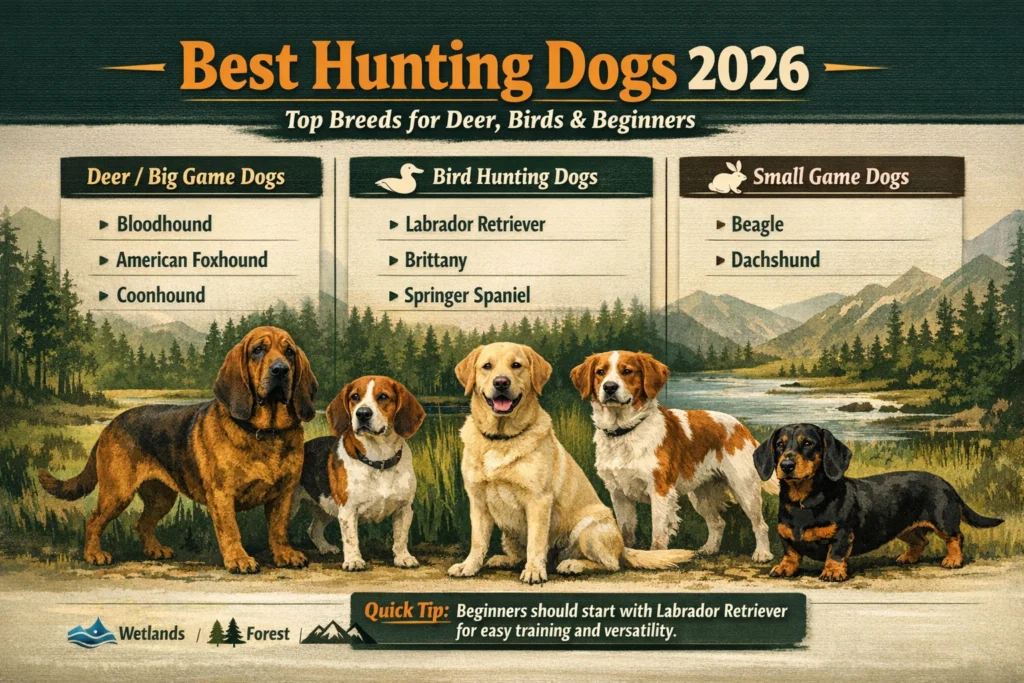
Best Hunting Dogs by Purpose — quick pick list
Best for Deer / Big Game: Bloodhound, American Foxhound, Coonhounds.
First for Bird Hunting: Labrador Retriever, Brittany, English Springer Spaniel.
Good for Small Game: Beagle, Dachshund (where legal/suitable).
for Cold Weather: Chesapeake Bay Retriever, Labrador Retriever.
Best for Beginners: Labrador Retriever, Golden Retriever.
Comparison Table — quick reference
| Breed | Best For | Training | Terrain | Family Friendly |
| Labrador Retriever | All-round | Easy | Water, cold | High |
| German Shorthaired Pointer | Birds | Moderate–Hard | Fields | Moderate |
| Beagle | Small game | Moderate | Forest | Moderate |
| Bloodhound | Tracking | Hard | Long trails | Low |
| Chesapeake Bay Retriever | Cold water | Moderate | Cold wetlands | Moderate |
How to Choose the Right Hunting Dog
- Define your hunting target. Big game → hounds; birds → retrievers/pointers; small game → scent hounds.
- Match terrain & climate. Wet, cold → retriever with dense coat; hot/dry → lighter-coated pointer or hound.
- Check your lifestyle. City-apartment + 1 hour/day ≠ GSP; rural + long days = pointer or hound.
- Assess experience. Beginner-friendly breeds: retrievers. Advanced handlers: pointers, hounds, Weimaraners.
- Budget realistically. Training, high-quality feed, vet checks, gear — hunting dogs need investment.
- Legal check. EU member states and regions have different hunting and leash rules — always check local regs before fieldwork.
Training timeline — concise plan from pup to field-ready
- 8–16 weeks (Puppy stage): Socialization, basic handling, desensitization to gun sound and water (short, positive exposure).
- 3–6 months (Basics): Sit, stay, recall, steady to wing/shot, introduction to short retrieves.
- 4–8 months (Skill building): Scent play, controlled pointing/retrieving, heel work in field conditions.
- 6–12 months (Field exposure): Real hunting exposure in short sessions; build endurance gradually.
- 12+ months (Advanced): Blind retrieves, longer tracks, complex signaling.
Health & Safety — EU-focused practical care
Nourishment: High-energy diets during the season, gently increase calories when workload rises. favor locally available high-protein feeds and consult a vet for tailored plans. shot & parasite control: rabies, tick/LEP halt, digest. Gear: protective vests in boar country, boots in rocky regions, GPS collar if you hunt large areas. analyzes: hip/elbow dysplasia masking, eye tests, cardiac auscultation for older breeds.
Legal note: Hunting in EU national parks is usually restricted; many countries require permits and specific dog handling rules. Verify with regional hunting federations and park authorities.
Common mistakes I see
Choosing by looks — Instead, choose by function.
Skipping early socialization — Make fieldwork a game at first.
Ignoring daily exercise needs — High-drive breeds need long runs, or they’ll invent jobs (and trouble).
Do this instead: Match breed to target, start socialization early, and book short, frequent training sessions.
One honest limitation
No single Breed Does everything perfectly. Even the best all-rounders like Labradors can struggle in very hot, scrubby Mediterranean terrain or when assigned long-distance trailing for days. If you expect a dog to perform across every environment without targeted breeding/training, you’ll be disappointed.
Real-world testing notes
- I noticed Labradors keep retrieving in cold water longer than most because of their coat and temperament.
- In real use, a German Shorthaired Pointer needs structured daily exercise — a couple of long runs a week won’t cut it.
- One thing that surprised me was a Bloodhound out-trailing a pack of hounds in mixed terrain during a recovery test — trailing ability can be dramatically breed-dependent.
Who this is best for — and who should avoid it
Best for: Beginners who want a straightforward retriever (Labs/Goldens), hunters in cold/wet climates (Chesapeake/Lab), small-game hunters in dense cover (Beagle).
Avoid if: you live in a small urban apartment and can’t commit to long daily exercise (don’t get a GSP/Weimaraner), or you can’t budget training and vet care.
Expert tips
- Cold regions → choose thick-coated, water-capable breeds.
- Hot/southern Europe → favor lighter-coated pointers and hounds; schedule hunts for cooler parts of the day.
- Urban/suburban owners → consider a retriever with a plan for daily high-exertion sessions.
- EU hunters: consult national hunting federations for legal restrictions and required vaccinations.
Gear essentials
- Protective vest (boar country)
- Waterproof GPS tracker + whistle
- Quality leads and slip collars for training sessions
- First-aid kit for dogs (bandages, antiseptic, tick removal kit)
- Field-rated boots (for very rocky terrain)
Common Questions & Mistakes When Choosing a Hunting Dog
The Labrador Retriever is the best all-around option because of its versatility, trainability, and water capability.
Bloodhound and specialized hounds (American Foxhound, Coonhounds) lead for trailing deer and recovering lost game.
Rules vary widely by country and park. Many parks prohibit hunting or require tight control of dogs. Always check local park regulations before planning a hunt.
Yes — but only if you can provide sufficient daily exercise, mental stimulation, and training. For many pointers and hounds, this is unrealistic.
Begin socialization and gentle training at 8–16 weeks; formal field skills ramp up from 3 months onward.
Real experience/takeaway
I’ve skinned and observed multiple breeds in real hunts over different European environments. The explanation: match breed to task first, match to area second, and match lifestyle third. Start early, be true, and prioritize health checks. If you’re a novice, start with a Labrador or Golden Retriever — they’re forgiving, largely capable, and will teach you more about care than almost any other breed.
Short training drills you can start this weekend
- 15-minute retrieve circuit: short throws, increase distance gradually.
- Scent confidence drill: hide scented cloths, reward nose finds.
- Gun-sound desensitization: low-volume, positive reinforcement.
- Recall in motion: call the dog while walking/running to build steady returns.
Choose Your Hunting Dog with Confidence — Start Training Today
Hunting Dogs are living partners. They require time, consistent training, and veterinary care. If you can’t provide those reliably, a hunting dog will likely become a frustrated animal—not a helpful partner. That’s my one limitation: there’s no substitute for time and consistent practice.