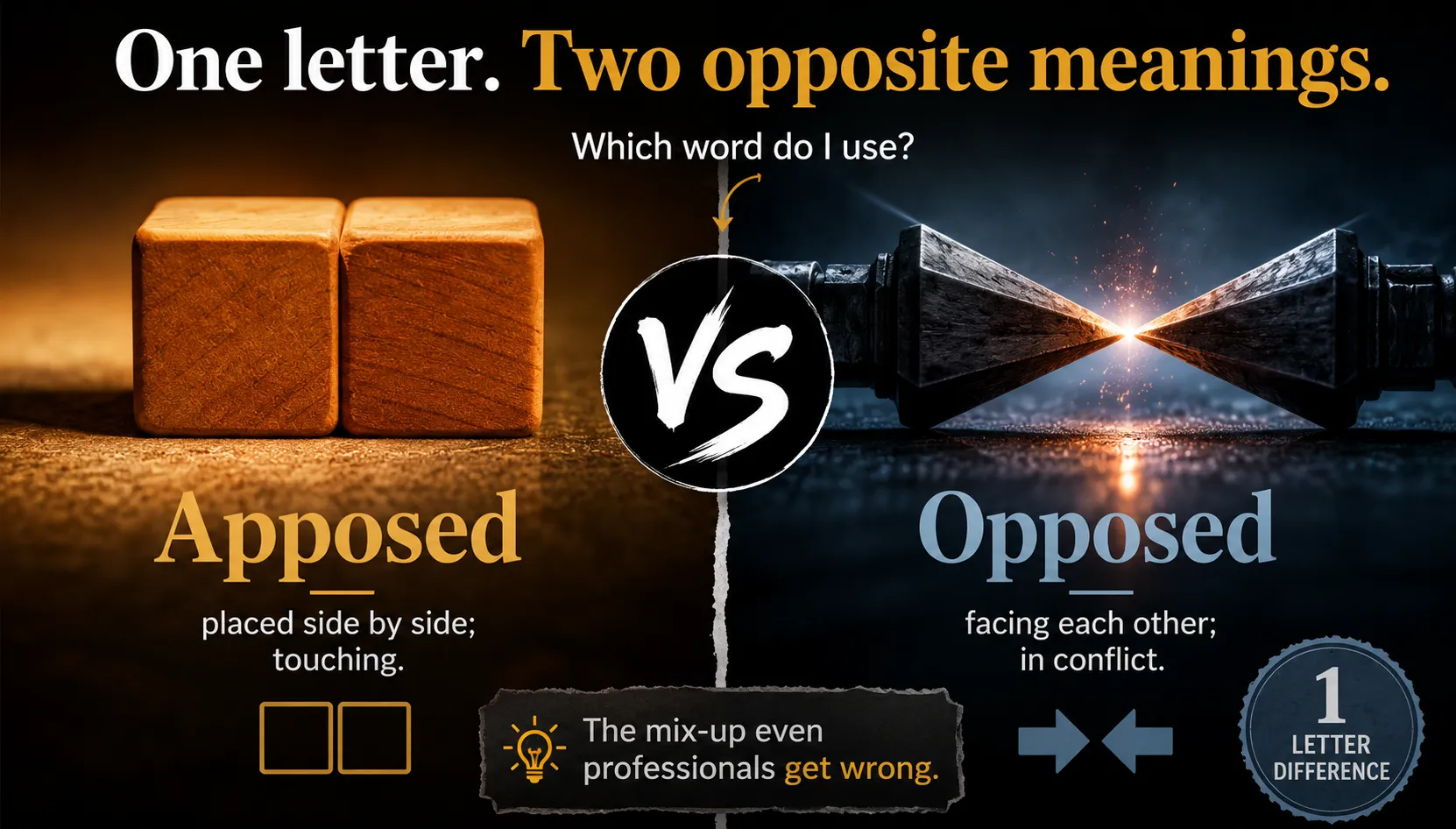
Apposed vs Opposed: What’s the Real Difference?
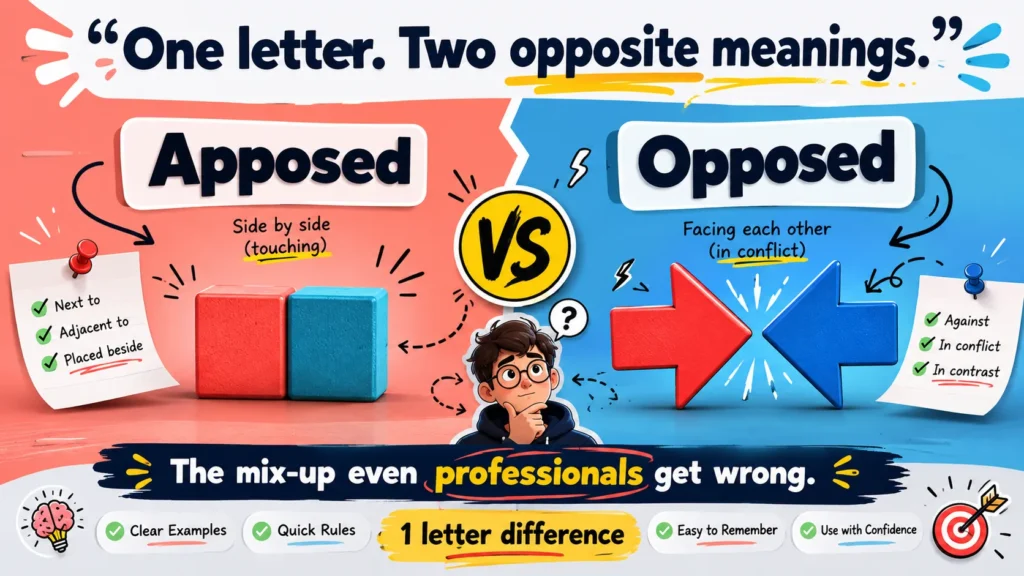
One letter separates apposed from opposed — but they mean almost opposite things. Opposed means against or in disagreement. Apposed means placed directly side by side or in contact, and it’s a specialized word you’ll mostly meet in medical and scientific writing. If you’ve typed one of these and paused, unsure whether it’s a typo, you’re not alone — apposed is real, correct, and rare enough that most readers have never consciously seen it before.
1. What Does “Opposed” Mean?
Opposed is the adjective/past-tense form of the verb oppose — it means against, resisting, or in disagreement with something. It’s one of the most common words in English and needs no special context to be correct.
- She opposed the new zoning law.
- He is opposed to raising taxes.
- The two candidates hold opposed views on healthcare.
If you’re unsure which word you need, opposed is almost always the safe answer.
2. What Does “Apposed” Mean?
Apposed means placed directly next to or in contact with something else, with no sense of conflict at all. It’s a formal, technical word used almost exclusively in medicine, biology, and anatomy.
- The surgeon carefully apposed the wound edges before suturing.
- The apposed cell membranes allowed for direct signaling.
- Apposition of the fracture fragments was confirmed on X-ray.
3. Apposed vs Opposed: Quick Comparison Table
| Apposed | Opposed | |
| Core meaning | Placed side by side / in contact | Against, in disagreement |
| Verb form | appose | oppose |
| Noun form | apposition | opposition |
| Pronunciation (IPA) | /əˈpoʊzd/ | /əˈpoʊzd/ — sounds identical, spelled differently |
| Latin root | apponere — “to place near” | opponere — “to place against” |
| Register | Formal, technical, scientific | Everyday, universal |
| Typical field | Medicine, anatomy, biology, printing | Politics, relationships, debate, general writing |
| Frequency | Rare | Extremely common |
| Example | “The stent struts were fully apposed to the vessel wall.” | “She was firmly opposed to the merger.” |
4. Origin and Etymology of Apposed and Opposed
Both words come from Latin verbs built on ponere (“to place”), split by opposite prefixes.
Opposed comes from opponere — ob- (“against”) + ponere (“to place”) — literally “to place against.” It entered English through Old French oposer and has stayed common ever since.
Apposed comes from apponere — ad- (“to/near”) + ponere (“to place”) — literally “to place near.” It stayed largely confined to Latin-derived scientific and medical vocabulary, which is why it never entered everyday conversation the way opposed did. Google’s Ngram Viewer shows apposed holding a near-flat, low-frequency line for over a century, while opposed has always been common.
5. Pronunciation: Apposed vs Opposed
Both words are pronounced almost identically: /əˈpoʊzd/ (uh-POHZD). This near-identical sound is a major reason the two get confused in speech and in writing — spelling, not pronunciation, is what carries the meaning here.
6. How to Use “Opposed” in a Sentence
- As a verb: Voters opposed the referendum.
- As an adjective with “to”: My parents are opposed to the idea of me moving abroad.
- Describing conflicting positions: The board was opposed to the acquisition.
- In sports/competition: The two teams were fiercely opposed in the final.
7. How to Use “Apposed” in a Sentence
- As a verb: The surgeon apposed the skin edges before suturing.
- As an adjective: The apposed membranes allowed for efficient signaling.
- Describing physical alignment: The labels were apposed to each section in the diagram.
- In printing/typography: The caption was apposed to the image, running flush along its edge.
8. Apposed in Medical and Scientific Writing
Apposed isn’t a vocabulary flourish — it’s standard professional terminology in several fields:
- Surgery: wound edges are “apposed” before suturing.
- Cardiology: stent struts are described as apposed or malapposed against the vessel wall on imaging.
- Valve anatomy: mitral valve leaflets must be properly apposed to prevent regurgitation.
- Gastroenterology: bowel walls may appear closely apposed in areas of stricture during colonoscopy.
- Cell biology: apposed membranes in a synapse allow efficient neurotransmitter diffusion.
9. Apposed vs Opposed vs Juxtaposed
A third word regularly gets tangled into this confusion: juxtaposed.
- Juxtaposed — placed side by side specifically to invite comparison or contrast (writing, art, design). The film juxtaposed scenes of wealth and poverty.
- Apposed — placed side by side in physical contact, no comparative intent (medical/anatomical). The tissue layers were apposed and sutured.
- Opposed — against or in conflict. The union opposed the new policy.
Juxtaposition is a rhetorical or visual device meant to highlight contrast. Apposition is a physical, often clinical description of contact with no comparative purpose.
10. “As Opposed To” — Meaning and Correct Usage
The idiom “as opposed to” means “rather than” or “in contrast to” — not “in disagreement with.”
- I’d take the 11 a.m. flight, as opposed to the 6 a.m. one.
- We’re focusing on retention, as opposed to acquisition, this quarter.
The idiom is fixed: it’s always “as opposed to,” never “as apposed to,” no matter how side-by-side the two options feel.
11. Apposition, Malapposed, and Unopposed Explained
- Apposition (noun) — the state of being placed side by side or in contact. Apposition of the bone fragments was achieved before casting.
- Malapposed / malapposition — a clinical term, especially in cardiology, for a structure (like a stent) that fails to sit flush against a surface.
- Unopposed — without resistance or a counterbalancing force. The bill passed unopposed. Built from oppose, not appose — there’s no standard “unapposed.”
12. Common Mistakes with Apposed and Opposed
- Using “apposed” as a fancier synonym for “opposed” — they aren’t interchangeable.
- Writing “as apposed to” — the idiom is always as opposed to.
- Auto-correcting “apposed” away in medical writing, assuming it’s a typo — this can change the meaning of a clinical note.
- Confusing apposed with juxtaposed when describing a rhetorical contrast rather than physical contact.
- Overusing “apposed” in general writing to sound sophisticated — most readers will read it as a mistake.
13. Memory Tricks to Never Mix Them Up Again
- Prefix trick: Ap- = “attach” → placed beside → apposed. Op- = “opponent” → placed against → opposed.
- Double-P visual: Apposed has its two P’s sitting right next to each other — just like the things it describes.
- Mnemonic: “Apposed things rest side by side. Opposed things collide.”
- Substitution test: Swap the word for “against.” If the sentence still works, use opposed. If “placed next to” fits instead, use apposed.
14. Apposed vs Opposed Self-Test (Quiz)
Fill in the blank with apposed or opposed:
- The senator was strongly ______ to the new tax bill.
- The surgeon carefully ______ the skin edges before closing the incision.
- On imaging, the stent struts appeared well ______ against the vessel wall.
- The two political parties remain ______ on nearly every major issue.
- I’d rather take the morning train, as ______ to the evening one.
Answers: 1. opposed 2. apposed 3. apposed 4. opposed 5. opposed
Explore More: https://dogizle.com/ctfu-meaning-in-text/
15. Related Terms and Similar Word Confusions
- Juxtaposed — placed together to highlight contrast
- Apposition — noun form of apposed; also a grammar term for a noun phrase renaming another noun (“my friend, the doctor”)
- Unopposed — without resistance or opposition
- Malapposed — failing to sit properly against a surface (clinical)
- Contrasted — a general synonym for placed in opposition for comparison
People Also Ask
No. Both are real, distinct words with different Latin roots and different meanings — apposed means placed beside/in Contact, Opposed Means against or in disagreement.
It’s pronounced /əˈpoʊzd/ (uh-POHZD) — phonetically almost identical to “opposed,” which is part of why the two get confused in speech.
Apposed describes physical contact, typically in medical or scientific contexts, with no comparative intent. Juxtaposed describes things placed side by side specifically to highlight contrast or comparison, usually in writing, art, or film.
No. The idiom meaning “rather than” is always spelled “as opposed to.”
Q5 VWhat does “malapposed” mean?
A clinical term, most common in cardiology, describing a structure (like a stent) that isn’t sitting flush against a surface as it should.
Rarely, but yes — it appears occasionally in printing, typography, and general descriptions of physical placement. Outside technical writing, it will usually read as unfamiliar or mistaken.
Conclusion
Apposed = placed side by side or in direct contact — a specialized medical/scientific term.
Juxtaposed = placed together specifically to invite comparison — a different word from both.
The idiom is always “As Opposed To,” never “as apposed to.”
When in doubt, opposed is almost always the safe, correct choice.