CTFU Meaning in Text: What It Really Means, Where It Came From, and How to Use It
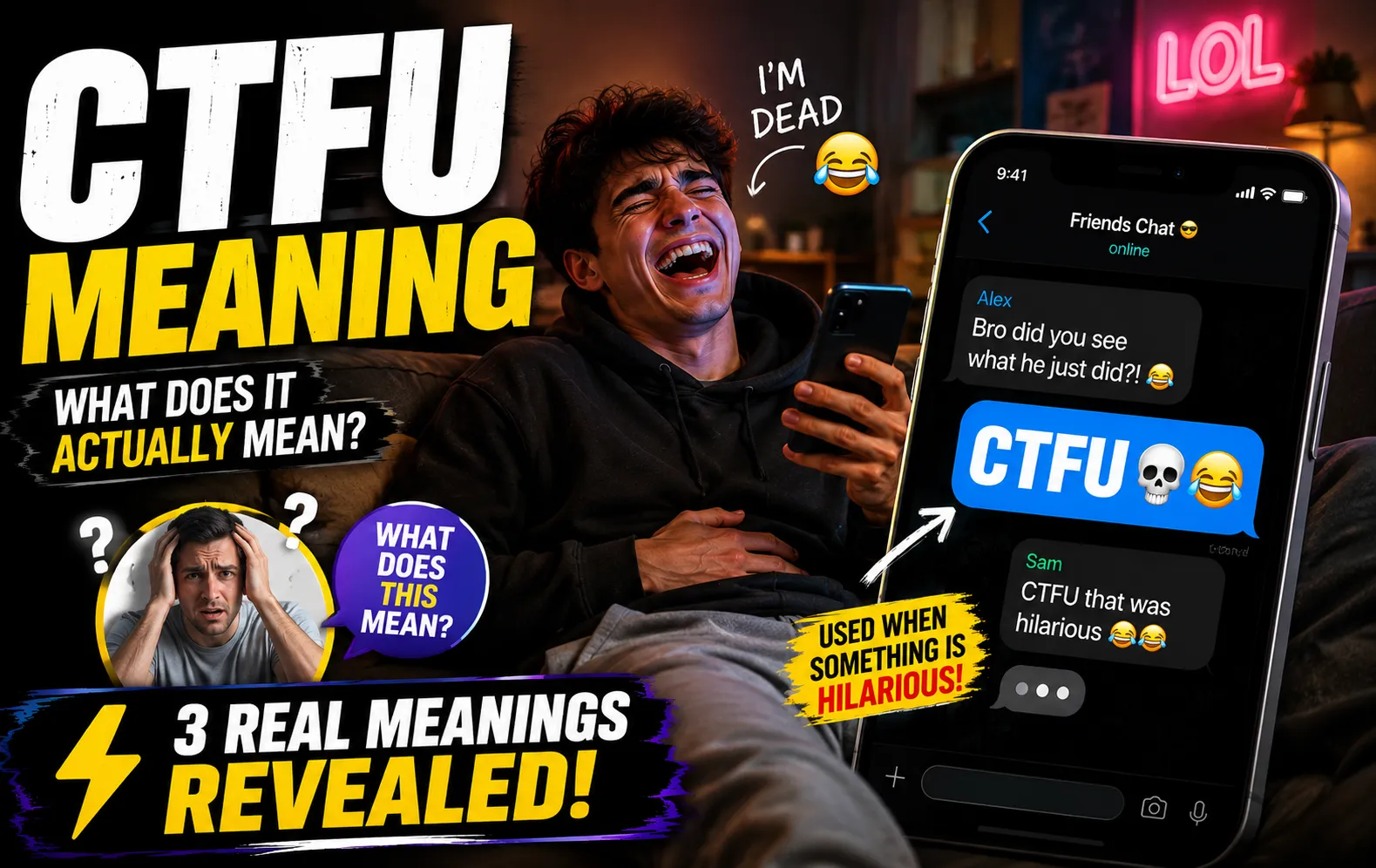
Quick answer: CTFU is internet slang that most commonly stands for “Cracking The F*** Up” — used to say you’re laughing uncontrollably at something funny. It’s a more intense version of LOL or LMAO. Less commonly, it can also mean “Cheer The F*** Up” (telling someone to lighten up) or, in New Orleans slang specifically, “Cut The F*** Up” (meaning to act a fool, dance, or let loose).
If you’ve seen CTFU pop up in a TikTok comment section, a group chat, or a meme caption and had no idea what it meant, you’re not alone. It looks aggressive at first glance but almost always means the opposite — someone is having a great time.
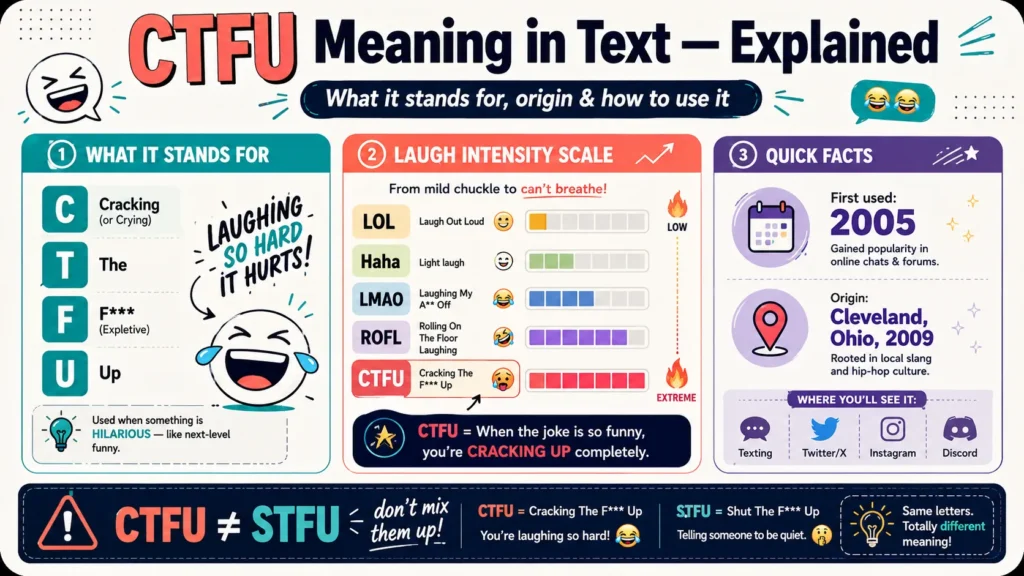
What Does CTFU Stand For?
| Letter | Stands For | Role |
| C | Cracking | The action — something “broke” your composure |
| T | The | Connector |
| F | F*** | Intensifier |
| U | Up | Completes the phrase — “cracking up” = laughing hard |
CTFU Actually Has 3 Different Meanings
1. Cracking The F*** Up — the primary, everyday meaning. Used 95% of the time to express intense laughter. “That prank video got me CTFU.”
2. Cheer The F*** Up — a less common usage, telling someone who’s being overly dramatic to lighten up. “It’s not that deep, CTFU.”
3. Cut The F*** Up — a New Orleans regional variant meaning to act a fool, dance, or let loose. “Everybody just started CTFU on the dance floor.”
Knowing all three helps explain why the word occasionally feels “off” from pure laughter, depending on who’s using it.
Where Did CTFU Come From? The Real Origin Story
CTFU has a documented history worth knowing:
- 2005 — first entered into Urban Dictionary.
- 2008 — made its debut on Twitter, helping it spread beyond niche forums.
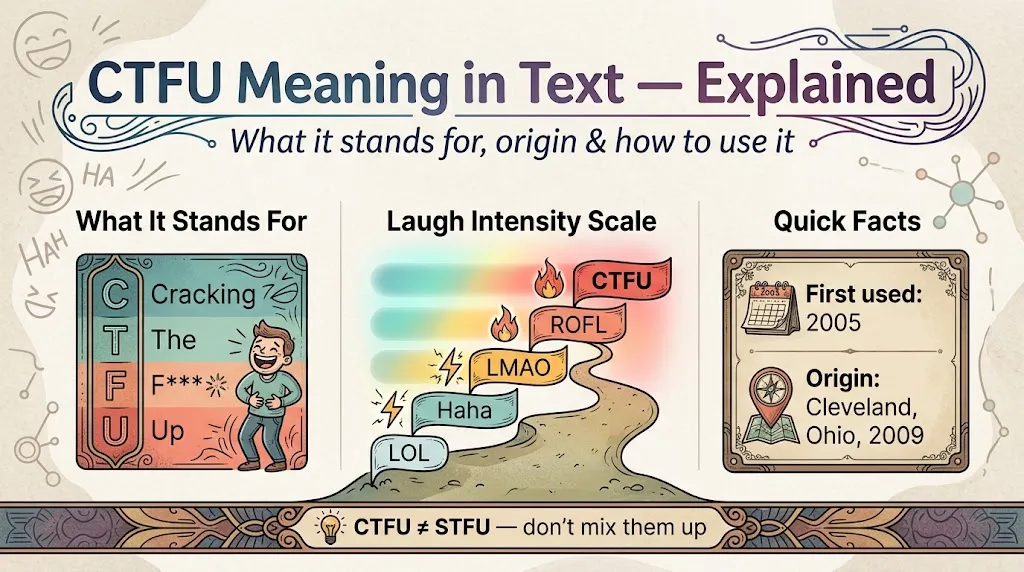
- 2009 — according to a 2014 linguistic study on geotagged slang usage, CTFU was most concentrated in Cleveland, Ohio, before expanding into Mid-Atlantic states.
- 2010s–present — spread nationally through meme culture and texting shorthand, becoming a fixture alongside LMAO and ROFL.
LMAO vs. ROFL vs. LMFAO
| Acronym | Meaning | Intensity | Best For |
| LOL | Laughing Out Loud | Mild | Polite, casual acknowledgment |
| Haha / Hahaha | Casual laughter | Mild–Moderate | Friendly, low-key replies |
| LMAO | Laughing My A** Off | Strong | Genuinely funny content |
| ROFL | Rolling On the Floor Laughing | Strong | Exaggerated physical reaction |
| CTFU | Cracking The F*** Up | Very Strong | Uncontrollable, can’t-breathe laughter |
| LMFAO | Laughing My F***ing A** Off | Very Strong | Peak intensity, explicit |
CTFU vs. STFU: Don’t Mix These Up
- STFU = “Shut the f*** up” → aggressive, telling someone to stop talking.
- CTFU = “Cracking the f*** up” → positive, expressing laughter.
How to Use CTFU in a Sentence
Reacting to something funny:
- “Bro your dog just fell off the couch trying to bark, CTFU 💀”
- “I watched this fail video ten times, CTFU”
In a group chat:
- Friend 1: “I accidentally called my teacher ‘mom'”
- Friend 2: “CTFU no you didn’t 😭”
As a caption:
- “POV: you tried the recipe and it exploded. CTFU.”
Telling someone to lighten up (less common usage):
- “It’s just a typo, CTFU, it’s not that serious.”
CTFU Meaning From a Girl vs. From a Guy
The meaning doesn’t change based on who’s typing it — but the context clues people read into it often do.
From a girl, CTFU (especially with 😂 or 💀) usually signals genuine amusement and comfort in the conversation — sometimes a sign she’s enjoying the back-and-forth, particularly in a flirty or dating context.
Where You’ll See CTFU Most Often
| Platform | How It’s Used |
| TikTok | Comment sections on funny/fail videos, captions |
| Reactions to reels and memes | |
| X (Twitter) | Reply to viral or absurd posts |
| Snapchat | Reactions between friends |
| Discord / gaming chats | Live reactions to funny in-game moments |
| Text messages | Casual laughter between friends |
CTFU on TikTok, Instagram & Snapchat
TikTok — appears constantly in comment sections under prank, fail, and relatable content; also used in captions by creators leaning into chaotic humor.
Instagram — shows up in reel comments and DMs, usually paired with 😂 or 💀 to react to memes and reposts.
Snapchat — used between close friends reacting to snaps, often shorthand for “I can’t stop laughing at this.”
Is CTFU Rude or Inappropriate?
CTFU isn’t inherently rude — it’s almost always positive — but it does contain censored profanity, which limits where it’s appropriate.
Fine to use: with friends who use similar slang, on meme-heavy platforms, in casual gaming or group chats.
Avoid using it: in work emails, academic writing, messages to clients or teachers, or first-time conversations with someone you don’t know well.
If you wouldn’t say the uncensored phrase out loud in that setting, don’t type CTFU either.
CTFU vs. CTFO: Don’t Confuse These Either
- CTFU = “Cracking the f*** up” — you’re laughing.
- CTFO = “Calm the f*** out” — telling someone to relax during a heated moment.
They show up in similar casual contexts but mean very different things — one’s about laughter, the other’s about de-escalating tension.
Clean Alternatives to CTFU
- “I’m dying 💀”
- “I can’t breathe”
- “I’m wheezing”
- “That cracked me up”
- “I’m crying, this is too much”
- “That’s hilarious”
These work well for mixed-age group chats, non-native English speakers, or semi-professional casual settings where CTFU might land wrong.
Common Misconceptions About CTFU
“It means someone is angry.” Wrong — that’s STFU. CTFU is almost always positive.
“It’s fine to use anywhere online.” Not quite — the censored profanity makes it a poor fit for formal or professional spaces.
“It only means laughing.” Not always — the New Orleans and “cheer up” variants show it can carry other meanings depending on context.
“It’s a brand-new term.” It’s actually been around since 2005, predating most current slang trends by well over a decade.
Related Slang Terms and Similar Meanings
- LMAO — Laughing My A** Off
- LMFAO — Laughing My F***ing A** Off
- ROFL — Rolling On the Floor Laughing
- STFU — Shut The F*** Up
- CTFO — Calm The F*** Out
- IJBOL — I Just Burst Out Laughing
- 💀 (skull emoji) — “I’m dead,” used the same way as extreme laughter acronyms
When to Avoid Using CTFU Entirely
- Talking to a mixed-age or multigenerational group
- Messaging non-native English speakers who may not know the slang
- Writing content meant for a broad, general audience
- Serious, sensitive, or emotional conversations
- First interactions with someone you don’t know
Explore More : https://dogizle.com/rfn-meaning-in-text/
People Also Ask
CTFU most commonly means “Cracking The F*** Up,” used to express intense, uncontrollable laughter in response to something funny.
No. STFU means “Shut the f*** up” (aggressive), while CTFU means “Cracking the f*** up” (laughing). They look similar but mean very different things.
Not inherently — it’s usually a positive, laughter-based reaction.However, because CTFU contains censored profanity, people should use it in casual conversations rather than professional or formal settings.
Both express strong laughter, but people generally use CTFU to show more intense laughter—closer to “I completely lost it” than a strong chuckle.
Usually, yes — but in New Orleans slang it can mean “cut the f*** up” (to act a fool or let loose), and occasionally it’s used to mean “cheer the f*** up.” Context tells you which one applies.
Conclusion
CTFU is a high-intensity way to say you’re laughing hard — one of the strongest laughter acronyms in casual digital slang, right up there with LMAO and LMFAO. It’s built for casual, friendly conversations, not your inbox at work. Know your audience, watch for the STFU mix-up, and you’ll never misread it again.