THO Meaning in Text: What It Really Means (And How to Use It)
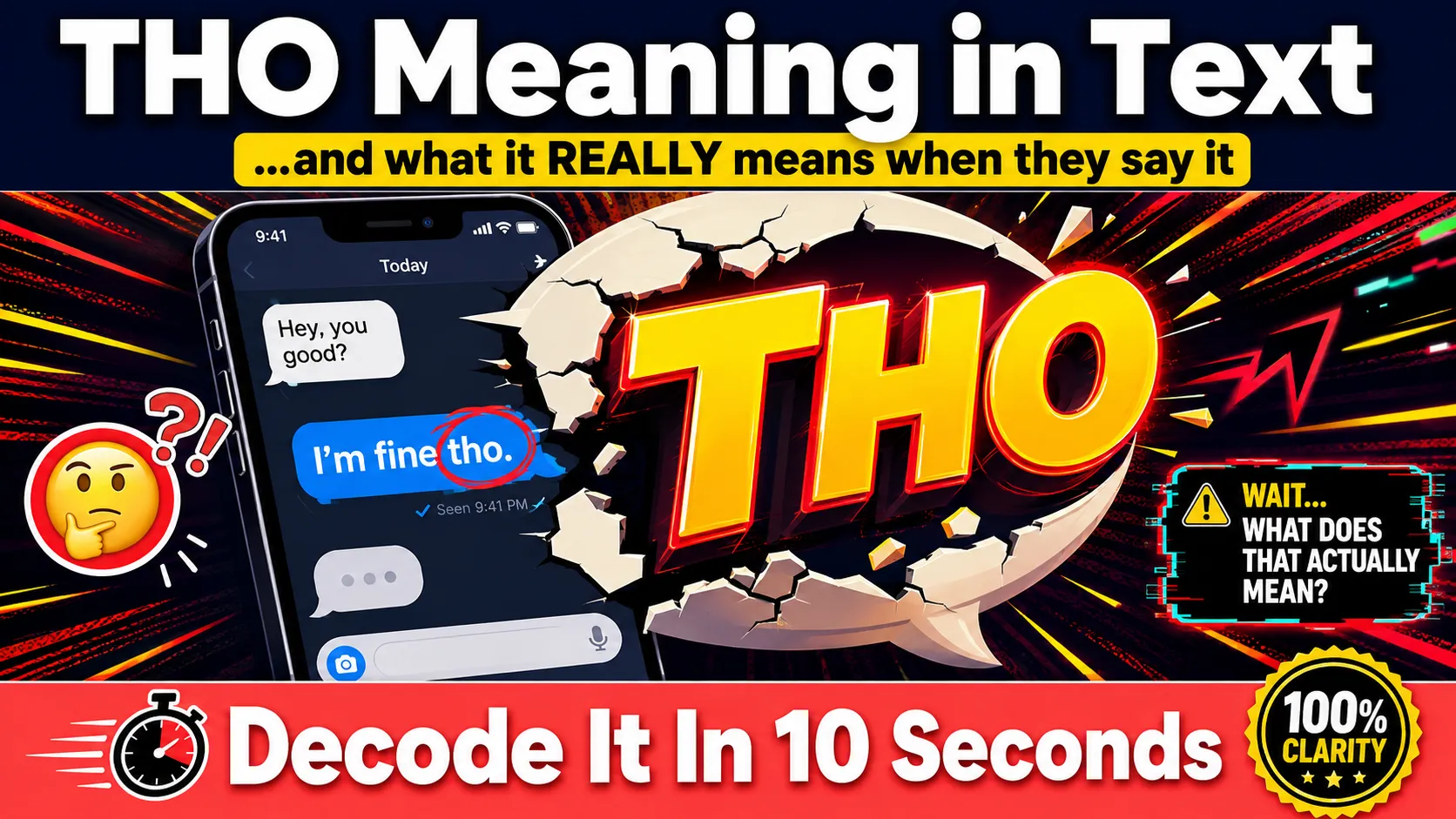
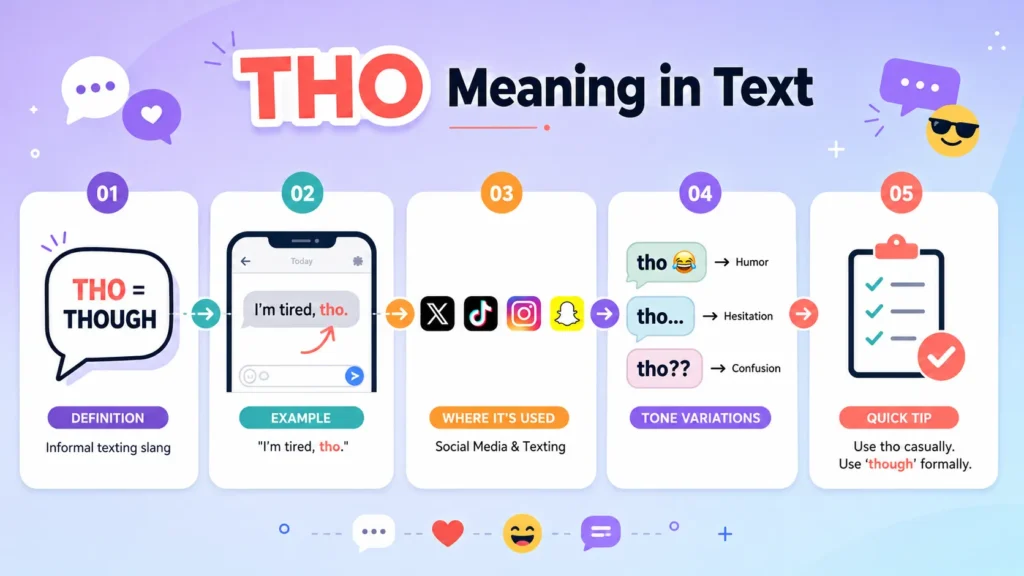
“Tho” is the informal, shortened spelling of “though.” It’s used in texting, DMs, and social media to add contrast, emphasis, or a casual tone to a sentence — almost always placed at the end. Example: “I’m tired, tho.” When capitalized as THO, it can also stand for unrelated terms like Thoracic (medical shorthand) or Take-Home Oxygen — context decides which meaning applies.
People search “tho meaning in text” for one simple reason: someone sent it, and the reader wants to know if it changes the tone of the message. It usually does — “tho” softens, questions, or lightly contradicts whatever came before it, and catching that nuance is the difference between reading a text correctly and misreading it entirely.
What Does “Tho” Mean?
“Tho” is a casual spelling of the conjunction “though.” It does the same grammatical job as “though” — introducing contrast, an exception, or a qualifying thought — just with a shorter, more relaxed feel that matches how people type.
Compare:
Formal: “I don’t really like the movie, even though the acting was great.” Texting: “Don’t really like the movie. Acting was great tho.”
The meaning is identical. What changes is tone: “tho” reads faster and mimics spoken rhythm, which is exactly why it dominates texting and comment sections.
Quick Meaning Summary
| Attribute | Detail |
| Full form | Though |
| Part of speech | Conjunction/discourse marker |
| Typical placement | End of sentence (most common), also start or mid-sentence |
| Register | Informal, conversational |
| Common platforms | Texting, Twitter/X, TikTok, Instagram, Snapchat, dating apps |
| Primary function | Contrast, emphasis, or tone-softening |
| Formal alternative | Though, however, still, yet |
The Core Function of “Tho”
“Tho” generally does one of three jobs in a sentence:
- Introduces contrast — “The food was cold, tho.”
- Softens a statement — “You’re kinda annoying tho 😂” (playful, not harsh)
- Adds pure emphasis or reaction — “This song tho.” (no contrast at all)
That third use trips people up because it doesn’t involve any contrast — it functions almost like an exclamation, similar to saying “wow, this song.”
Is “Tho” a Real Word?
Yes. “Tho” isn’t internet-invented slang — it’s a recognized variant spelling of “though” that appears in major dictionaries, with documented use in print going back decades, well before texting existed.
That said, it’s still classified as informal/non-standard. Use “though” in essays, professional emails, or reports. Save “tho” for texting, captions, and casual chat.
Origin and History of “Tho”
- Middle English roots: “Though” descends from the Old English “þēah.” Shortened forms like “tho'” (with an apostrophe) appear in English literature centuries before texting.
- Early 2000s SMS boom: Character limits and typing speed pushed people to trim common words — “though” → “tho,” alongside similar cuts like “thru” and “nite.”
- Social media acceleration (2010s–today): Twitter’s character limits, then TikTok and Instagram captions, turned “tho” into a stylistic choice rather than just a space-saver — people use it even with plenty of characters left, because it sounds more casual.
How to Use “Tho” in a Sentence
1. End of Sentence (Most Common)
- “I’m not mad, tho.”
- “That test was hard tho.”
- “Kinda miss him tho.”
2. Start of Sentence
- “Tho I get it, I still disagree.”
- “Tho she said no, I asked again anyway.”
3. Mid-Sentence
- “It’s a good phone, tho a bit pricey.”
“Tho” vs. Similar Words
| Word | Formality | Typical Position | Vibe |
| Though | Standard/formal | Anywhere | Neutral, correct in all writing |
| Tho | Informal/slang | Usually end of sentence | Casual, texting-native |
| But | Standard | Start/middle | Direct, blunt contrast |
| Still | Standard | Usually end | Persistent contrast |
| However | Formal | Start of sentence | Academic, professional |
| Thx | Informal | Anywhere | Unrelated — means “thanks,” not “though” |
Key distinction: “Tho” and “but” both signal contrast, but “tho” is softer and trails the sentence as an afterthought, while “but” front-loads the contrast and feels more assertive.
“Tho” on Social Media and Texting Apps
- Twitter/X: Frequently used for emphasis-only reactions with no real contrast — “This tweet tho.”
- TikTok & Instagram captions: Adds a knowing, self-aware, or sarcastic tone — “Adulting is hard tho.”
- Snapchat & iMessage: A quick tone-softener after something that could sound harsh — “You left me on read tho 💀”
- Dating apps: A low-pressure way to flirt or push back gently — “Not sure about that outfit tho 👀”
- Reddit & Discord: Used to add a casual caveat to an opinion inside a longer comment thread.
Tone Variations: How Punctuation Changes “Tho”
| Style | Meaning | Example |
| tho | Neutral contrast/emphasis | “That’s crazy tho.” |
| tho 😂 | Humor, sarcasm | “You really said that tho 😂” |
| tho… | Hesitation, trailing thought | “I kinda like it tho…” |
| tho?? | Confusion or disbelief | “Why would you do that tho??” |
| tho fr | Emphasizes sincerity (“for real”) | “That was good tho fr” |
| THO (caps) | Strong emphasis or exasperation | “I SAID NO THO.” |
THO Meaning From a Girl (or Guy) — Does It Change?
“Tho” itself isn’t gendered — it means the same thing no matter who sends it. But context around it shapes how it reads:
- “Miss you tho” → often a light, semi-flirty admission of feeling.
- “You’re annoying tho 😂” → playful teasing, not an insult.
- “That’s kinda sus tho” → adds a note of genuine suspicion.
The tone comes from the surrounding words, punctuation, and emojis — not from “tho” on its own.
THO as an Acronym: Other Meanings
When capitalized, THO can mean something entirely different from the texting slang — context decides:
- Thoracic — medical shorthand referring to the chest region, used in clinical notes.
- Take-Home Oxygen — used in aeromedical and patient-care documentation.
- Gamer tags/clan names — a common three-letter tag for gaming clans and esports teams.
- Organization initialisms — shorthand for company or team names in specific industries.
If “THO” appears in a medical chart, aviation log, or gaming lobby, it’s almost certainly not the texting slang.
How to Respond to “Tho” in a Text
Since “tho” usually signals a soft contrast or unspoken feeling, the best replies acknowledge what’s underneath the word.
- They say: “I’m fine tho.” → You could reply: “You sure? ‘Tho’ feels like there’s more 👀”
- They say: “Miss you tho.” → You could reply: “Miss you more tho 😊”
- They say: “This movie was mid tho.” → You could reply: “Real, the ending saved it tho.”
Rule of thumb: “tho” is an invitation to dig a little deeper, not just a grammar tag.
Common Misunderstandings About “Tho”
- Myth: It’s just short for “though,” nothing more. Fact: True in spelling, but “tho” carries tonal nuance — humor, softness, or emphasis — that “though” doesn’t always convey.
- Myth: It always means “however.” Fact: It can also mean “still,” “yet,” or express pure emphasis with no contrast at all.
- Myth: It’s rude or dismissive. Fact: Tone depends entirely on context; playful use often sounds friendly, not curt.
- Myth: It’s a typo. Fact: It’s an accepted informal spelling, not a spelling error.
When You Should NOT Use “Tho”
Avoid it in:
- Professional emails or workplace chat with clients
- Resumes, cover letters, academic writing
- Formal reports or business documents
- Legal or medical documentation (unless correctly using the acronym meaning)
Use the full word “though” in all of these settings.
Real Text Conversation Examples
Casual catch-up
A: “How was the exam?” B: “Rough. Passed tho 😮💨”
Light complaint
A: “You’re late again.” B: “I brought snacks tho.”
Playful flirting
A: “Don’t text me at 2 am.” B: “You replied tho 👀”
Related Terms and Similar Slang
- Though — the formal parent word
- Still / Yet — neutral contrast alternatives
- However — formal academic substitute
- Fr (for real) — often paired with “tho” for sincerity: “tho fr”
- Thx — unrelated; means “thanks,” commonly confused with “tho”
People Also Ask
“Tho” is short for “though.” It adds contrast, emphasis, or a casual tone, most often at the end of a sentence.
It’s an accepted informal spelling listed as a variant of “though” in major dictionaries, but it’s not suited for formal or academic writing.
The word means the same thing regardless of who sends it — tone comes from the surrounding message and emojis, not the word itself.
No. It sometimes adds pure emphasis with no contrast at all, like “This song tho.”
They mean the same thing. “Though” is the standard spelling for formal writing; “tho” is the informal, texting-friendly version.
Q6 Can THO mean something other than “though”?
Yes — in capitalized form it can stand for “Thoracic” in medical contexts, “Take-Home Oxygen” in aeromedical settings, or serve as a gaming clan tag.
Conclusion
“Tho” is simply “though,” dressed down for the speed and tone of digital conversation. It softens statements, adds emphasis, and mirrors how people actually talk — which is why it’s taken over texts, captions, and comments everywhere. Use it freely in casual chats, skip it in formal writing, and remember: capitalized as THO, it might not be slang at all — check the context.