Introduction
Aging is inevitable. Discomfort is not.
As Dogs mature into their golden years, their physiology evolves gradually. Stamina declines. Mobility becomes restricted. Metabolism decelerates. Digestion turns delicate. Fat accumulates more easily. Vision may blur. Hearing can weaken. And often — the same diet that sustained them for years no longer provides optimal support.
That is precisely why selecting the best dog food for senior dogs europe is one of the most influential health decisions a responsible dog guardian can make.
Senior canine nutrition is not about purchasing a package labeled “Senior” in oversized typography. It is about comprehending:
- How aging alters canine biology
- Which nutrients genuinely preserve vitality
- What European regulatory bodies require
- How environmental temperature affects joints and metabolism
- How to proactively reduce arthritis, obesity, and renal decline
From start to finish, this guide sets out clear steps based on research to help you feed your older pet well – grounded in facts, built for real-life choices.
Let us begin with the foundation — understanding aging itself.
Understanding Senior Dog Nutrition (The Biology of Canine Aging)
Before modifying your dog’s diet, it is crucial to define what “senior” truly signifies in veterinary science.
Dogs do not age uniformly. Lifespan varies dramatically depending on size, genetics, and breed classification.
When Is a Dog Considered Senior?
| Breed Size | Senior Age Range |
| Small Breeds | 8–10+ years |
| Medium Breeds | 7–9+ years |
| Large Breeds | 5–7+ years |
| Giant Breeds | 5–6+ years |
A 6-year-old Great Dane may already display geriatric characteristics.
A 9-year-old Toy Poodle may remain playful and alert.
Breed size shapes how cells age. Faster biological decline shows up in bigger dogs, tied to higher oxidative stress and greater joint strain.
What Changes Inside an Aging Dog’s Body?
With advancing age, multiple biological systems shift:
- Basal metabolic rate decreases
- Lean muscle tissue diminishes (sarcopenia)
- Adipose tissue accumulates more easily
- Cartilage thins and synovial fluid decreases
- Digestive enzyme output declines
- Renal filtration efficiency weakens
- Immune surveillance becomes less robust
Therefore, senior dogs require nutrient-dense yet calorie-controlled diets.
Not reduced nourishment.
Refined nourishment.
Key Nutrients in the Best Dog Food for Senior Dogs
Dogs get older; their needs shift. On the continent, picking pet food starts with weighing macronutrients – protein, carbohydrates, fat. At the same time, tiny nutrients including vitamins and minerals matter just as much. This detail makes it easier to choose the right fit.
High-Quality Protein (Adequate, Not Restricted)
Outdated beliefs suggested older dogs require low protein intake. Contemporary veterinary research contradicts this for healthy seniors.
Protein is essential to:
- Preserve lean muscle mass
- Maintain immune resilience
- Sustain structural integrity
- Support tissue repair
Look for:
- Named animal protein sources (chicken, salmon, lamb)
- 20–28% protein (adjusted to activity level)
- Transparent ingredient labeling
Avoid:
- Generic “meat derivatives”
- Excessive plant-based fillers
Cold months in the North can slow down dogs like Labradors, German Shepherds, or Golden Retrievers, leaving their strength feeling flat. As temperatures drop, getting around feels heavier, adding pressure on the bones and ligaments that hold them up.
Protein quality directly influences functional longevity.
Omega-3 Fatty Acids (EPA & DHA)
Omega-3 fatty acids exert anti-inflammatory effects that are particularly beneficial for aging joints.
Benefits include:
- Reduction of joint inflammation
- Enhanced cognitive support
- Cardiovascular protection
- Skin barrier maintenance
In lands like Germany, Sweden, and Switzerland, where winters bite hard, canines sometimes feel stiffer because of the cold. Because of this, some pet feeds add more EPA and DHA – not by choice, but because body responses shift with lower temperatures.
Glucosamine & Chondroitin
These structural compounds assist in:
- Cartilage regeneration
- Joint lubrication
- Reduced stiffness
Vital for:
- Large breed seniors
- Overweight dogs
- Mobility-compromised pets
Breeds like the Rottweiler and Boxer frequently require additional orthopedic support.
Controlled Calories & Moderate Fat
Reduced activity increases obesity risk.
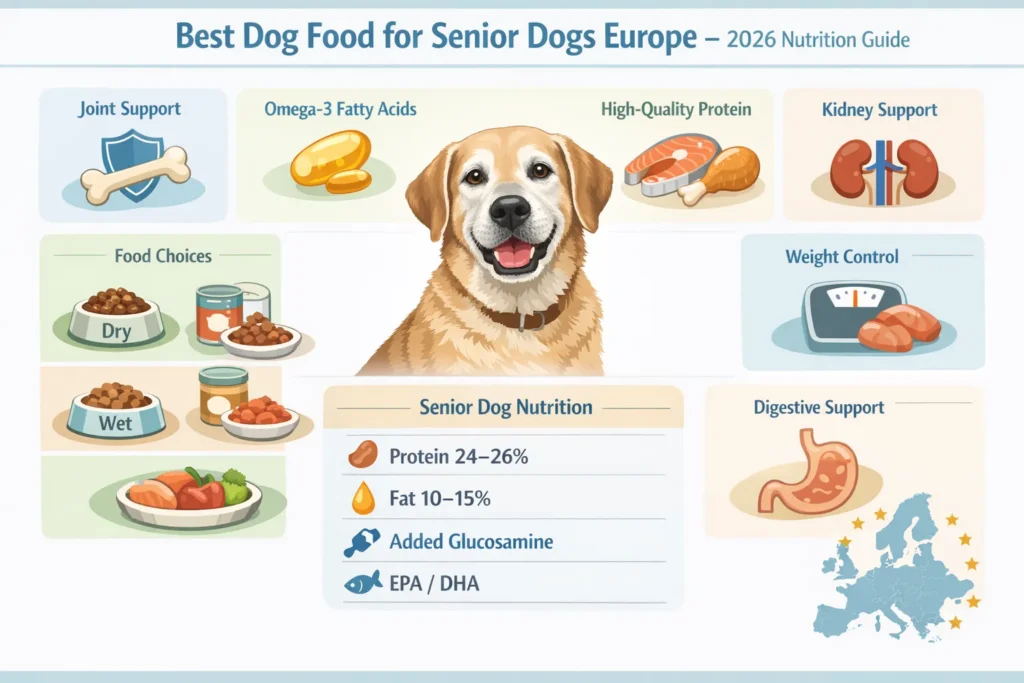
Ideal fat range: 10–15%
Calorie density: Balanced, not excessive
Inclusion of L-carnitine assists in lipid metabolism and weight regulation.
Obesity remains one of Europe’s most prevalent senior canine health concerns.
Fiber & Prebiotics (Digestive Optimization)
Aging gastrointestinal systems often become sensitive.
Look for:
- Beet pulp
- Pumpkin
- Inulin
- Fructooligosaccharides
Useful especially where pets like Dachshunds or French Bulldogs tend to experience stomach issues.
Reduced Phosphorus & Sodium
Crucial for:
- Renal preservation
- Cardiovascular stability
Especially relevant for dogs above 10 years of age.
Types of Senior Dog Food – Evaluating Format Options
Not all senior Dogs benefit from identical food structures.
| Food Type | Advantages | Drawbacks | Ideal For |
| Dry (Kibble) | Cost-effective, dental abrasion benefit | Lower moisture | Healthy seniors |
| Wet (Canned) | Hydrating, softer texture | Higher cost | Dental limitations |
| Fresh | Highly digestible | Requires refrigeration | Selective eaters |
| Semi-Moist | Palatable texture | May lack complete balance | Appetite stimulation |
Best Dog Food for Senior Dogs (Category Guidance for Europe)
Rather than random brand lists, focus on nutritional classification.
Best Overall Senior Dry Food
Criteria:
- 24–26% protein
- Added joint nutrients
- Omega-3 fortification
- Compliance with European standards
Price range: €50–€75 / 12kg
Balanced formulas suitable for stable, active seniors.
Best for Joint Support
Ideal features:
- Elevated EPA/DHA
- MSM inclusion
- Weight-controlled energy density
Beneficial for orthopedic discomfort and mobility issues.
Best Soft Dog Food for Senior Dogs
Recommended for:
- Tooth loss
- Jaw weakness
- Appetite decline
High meat concentration and absence of artificial dyes are essential.
Best for Sensitive Stomach
Look for:
- Limited ingredient diets
- Single protein sources
- Prebiotic fibers
Supports gastrointestinal stability.
Best for Small Breed Senior Dogs
Small breeds maintain relatively higher metabolic rates.
Seek:
- Smaller kibble dimensions
- Slightly elevated protein
- Dental-supportive textures
Best for Large Breed Seniors
Priorities include:
- Lower calorie density
- Substantial joint reinforcement
- Controlled mineral balance
Large skeletal frames demand specialized formulation.
Senior Dog Food Comparison Table
| Category | Protein % | Joint Support | Digestive Support | Best For |
| Standard Senior Dry | 24–26% | Moderate | Moderate | Healthy seniors |
| Joint-Focused Formula | 22–25% | High | Moderate | Arthritic dogs |
| Sensitive Stomach | 23–27% | Low | High | Digestive concerns |
| Wet Senior Food | 8–12% (wet basis) | Moderate | High moisture | Dental challenges |
How to Choose the Right Senior Dog Food (Step-by-Step)
Selecting the best dog food for senior dogs Europe requires structured evaluation.
Step 1: Evaluate Age & Breed
Large breeds transition earlier.
Small breeds transition later.
Chronological age alone should not dictate change — physiological signs matter more.
Step 2: Assess Health Conditions
| Condition | Nutritional Priority |
| Arthritis | Omega-3 + Glucosamine |
| Weight Gain | Reduced fat + calorie control |
| Kidney Issues | Lower phosphorus |
| Dental Problems | Wet or softened food |
Step 3: Check EU Compliance
Look for adherence to:
- FEDIAF
- British Veterinary Association
- Federation of Veterinarians of Europe
- World Small Animal Veterinary Association
These bodies provide science-based nutritional frameworks and regulatory benchmarks.
How to Transition to Senior Dog Food Safely
Sudden dietary modification can cause gastrointestinal upset.
10-Day Transition Plan
| Day | Old Food | New Food |
| 1–3 | 75% | 25% |
| 4–6 | 50% | 50% |
| 7–9 | 25% | 75% |
| 10 | 0% | 100% |
Monitor:
- Stool firmness
- Appetite
- Behavior
- Energy levels
Gradual integration reduces digestive stress.
Safety & Health Considerations
Consult a veterinarian if:
- Kidney disease is suspected
- Heart murmur is detected
- Sudden weight loss occurs
Avoid raw feeding for immune-compromised seniors.
Farther overseas – especially in Spain and Italy – drinking enough fluid isn’t often talked about yet it holds real weight. Combining wet dog meals with drier versions can quietly increase daily intake levels.
In colder climates, modest winter calorie adjustments may assist thermoregulation.
Common Mistakes European Dog Owners Make
- Switching to unnecessarily low-protein formulas
- Overfeeding sedentary seniors
- Ignoring periodontal disease
- Failing to adjust intake seasonally
- Assuming grain-free automatically equals superior
Grain-free diets are only beneficial in confirmed allergy cases.
Expert-Level Feeding Tips
- Add warm water to enhance aroma
- Weigh your dog monthly
- Feed Smaller, more frequent meals
- Monitor body condition score
- Introduce joint supplements if needed
Preventing obesity significantly extends lifespan and comfort.
Real-Life European Feeding Scenarios
Apartment Living (Paris, London, Berlin)
Lower daily activity → controlled calorie intake
Combination wet/dry feeding works effectively
Cold Climate (Sweden, Switzerland)
Higher omega-3 inclusion
Enhanced joint nutrients
Mediterranean Climate (Italy, Spain)
Hydration monitoring
Adjust feeding during summer heat
Frequently Asked Questions
- Do senior dogs really need special dog food?
- Best age to switch?
- Is wet or dry better?
- Can adult food work for seniors?
- How much should I feed?
- What ingredients should I avoid?
Pros & Cons of Senior Dog Food
Pros
- Supports joint integrity
- Encourages weight stability
- Improves digestibility
- Tailored micronutrient profile
Cons
- Higher price point
- Not required for every Dog
- Some brands reduce protein excessively
Final Thoughts – Helping Your Senior Dog Thrive
Picking top picks for older pups in Europe? This isn’t about shiny labels or pretty boxes. It’s knowing science behind ingredients, reading labels clearly, then tailoring choices just right.
If you:
✔ Monitor body weight
✔ Prioritize premium protein
✔ Introduce joint support proactively
✔ Transition gradually
Your companion can experience extended vitality, mobility, and comfort.
Aging is biological.
Suffering is preventable.
When choices are thoughtful and checks happen often, older dogs thrive through old age – full of energy, respect, and warmth.