Ugh Meaning in Text: What It Really Means (And How to Reply)
You’re mid-conversation, everything seems normal, and then it lands: “ugh.”
No explanation. No emoji. Just three letters sitting in the chat, and now you’re trying to figure out if the other person is annoyed at their day, annoyed at you, joking around, or just tired. That single word carries an unusual amount of ambiguity for something so short — which is exactly why “ugh meaning in text” is one of the most-searched slang questions online.
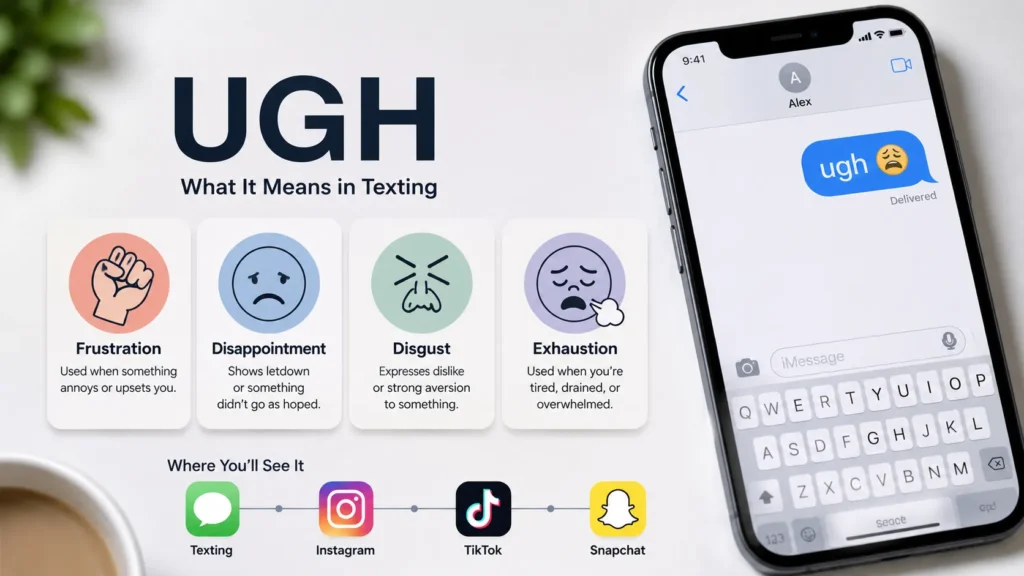
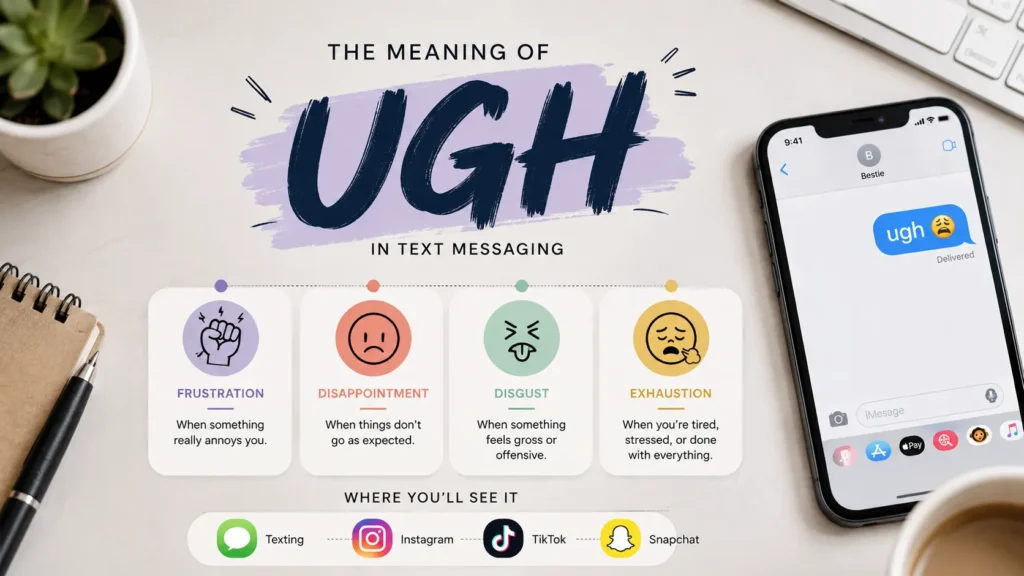
The short answer: “ugh” is a written interjection used to express frustration, disappointment, disgust, or exhaustion. It’s not an acronym and it doesn’t stand for anything — it’s the text version of a groan or a sigh. But the real answer is more layered, because “ugh” changes meaning depending on where it’s used, how it’s punctuated, whether it’s paired with an emoji, and what came before it in the conversation.
This guide breaks that down platform by platform and tone by tone, so you never have to guess again.
1. What Does “Ugh” Mean in Text?
Ugh is an interjection — a word that exists purely to express emotion rather than to describe or explain anything. It represents a sound of disgust, discomfort, or a grunt-like reaction to something unpleasant.
In plain terms, “ugh” means:
- “I’m annoyed.”
- “This is frustrating.”
- “That’s gross/unpleasant.”
- “I’m exhausted/overwhelmed.”
It’s the written equivalent of a groan. You’re not meant to analyze it grammatically — you’re meant to feel the reaction behind it.
2. Quick Meaning Summary
| Attribute | Detail |
| Meaning | Frustration, disappointment, disgust, or exhaustion |
| Part of speech | Interjection (not an acronym or abbreviation) |
| Tone | Negative to neutral; occasionally playful/flirty in casual contexts |
| Common platforms | Texting, Instagram, TikTok, Snapchat, Discord, dating apps |
| Formality | Informal only — avoid in professional or academic writing |
| First associated use | Written imitation of a disgust/frustration grunt, predating digital messaging by over a century |
3. Is “Ugh” an Acronym or Abbreviation?
No. It doesn’t stand for anything, unlike “smh” or “idk.” Linguists call this kind of word a non-lexical interjection — built to imitate a sound rather than carry a dictionary definition. It sits in the same family as “ow,” “oof,” “meh,” and “shh.”
4. Origin and History of “Ugh”
“Ugh” isn’t an internet invention — it predates texting by a long way. Its origins trace to the written imitation of a guttural, grunt-like exhale people naturally make when disgusted or frustrated, and it has appeared in English writing for well over a century, including in 19th- and 20th-century literature and stage directions, long before it ever showed up in a text message.
What changed with texting and social media isn’t the meaning — it’s the frequency and versatility. “Ugh” became one of the most efficient words in digital communication because it delivers raw emotional tone in one syllable, with no risk of sounding overly dramatic and no need for further explanation.
5. Why Is “Ugh” So Popular in Texting and Social Media?
Because it does something a full sentence can’t: it communicates mood instantly, with zero typing effort, and it works whether the feeling is minor (“ugh, traffic”) or major (“ugh, I can’t do this anymore”). It also carries almost no risk — it’s vague enough that it rarely commits the sender to a specific complaint, which makes it easy to send even when they’re not ready to explain.
6. Ugh Meaning by Platform: Texting, Instagram, TikTok, Snapchat & Discord
Where “ugh” shows up changes how it should be read.
Texting (SMS/iMessage/WhatsApp): Almost always personal and situational, usually opening a message that’s about to explain what’s wrong — “Ugh, my flight got delayed.” Sent alone with no follow-up, it’s a mood check. Asking what happened works better than guessing.
Instagram and Facebook: Shows up in captions and comments as a relatable, lighthearted complaint — Monday mornings, gym motivation, adulting. Less raw emotion, more performed exasperation for an audience.
TikTok: Leans into comedic exaggeration — “UGHHH” in captions and comments, signaling relatable frustration meant to drive engagement, not genuine distress.
Snapchat: More private and real-time, so “ugh” skews closer to an honest in-the-moment reaction — a bad grade, an awkward run-in — often followed by a snap showing the context.
Discord and gaming chats: Almost always about in-game frustration — a lost round, a bad teammate, lag, or a missed shot.
7. Ugh in Dating Apps and Flirty Texting
This is where people get tripped up most. In a dating or flirty exchange, “ugh” can shift meaning entirely — used affectionately or playfully, almost like mock-annoyance:
- “Ugh, you’re too cute, stop it.”
- “Ugh, why do you always make me laugh at bad jokes.”
Here, “ugh” isn’t rejection — it’s closer to “you’re getting to me (in a good way).” Context and the rest of the message are the only reliable way to tell annoyed-ugh from flirty-ugh apart.
8. Punctuation and Repetition: Ugh vs. Ughhh vs. UGH
The way “ugh” is typed changes its intensity — one of the most overlooked parts of reading tone in text:
| Version | What It Signals |
| ugh (lowercase, no punctuation) | Mild, casual annoyance |
| Ugh. (capitalized, period) | Flat, final, more serious — often “I don’t want to talk about it” |
| ughhh / ughhhh (stretched letters) | Exaggerated or dramatic frustration, often humorous |
| UGH (all caps) | Strong, immediate frustration or genuine anger |
| ugh 😩 / ugh 😭 | Softened, often self-deprecating or playful |
| ugh… (trailing dots) | Resigned, tired, or hinting there’s more they’re not saying |
A period after “ugh” often reads as more serious than an emoji after it — punctuation is doing real emotional work here.
9. What Emotion Does “Ugh” Actually Express?
“Ugh” is a flexible carrier for several related negative (and occasionally playful) emotions:
- Frustration — “Ugh, the WiFi went out again.”
- Disappointment — “Ugh, they cancelled on me.”
- Disgust — “Ugh, there’s mold on this.”
- Exhaustion/overwhelm — “Ugh, I have three deadlines this week.”
- Playful mock-frustration — often in flirty or joking contexts, signaling fondness rather than genuine annoyance.
10. Examples of “Ugh” in Real Conversations
- “Ugh, I woke up late again.” — frustration
- “Ugh, they cancelled on me.” — disappointment
- “Ugh, there’s mold on this.” — disgust
- “Ugh, I have three deadlines this week.” — exhaustion
- “Ugh, you’re too cute, stop it.” — flirty mock-annoyance
- “Ugh Monday again 😩” — relatable social-caption complaint
11. Is “Ugh” Rude or Inappropriate?
Generally, no — “ugh” is mild, informal slang and isn’t inherently rude. Context matters, though:
- Casual conversations, social media, friends: Completely normal, low-risk.
- Responding to someone sharing bad news: Can read as dismissive if it’s your entire response.
- Professional emails, academic writing: Avoid it entirely.
- Someone’s serious personal update: Pair it with something more substantive, or skip it.
Rule of thumb: fine for low-stakes venting, risky as your only reply to something that actually matters to the other person.
12. How to Reply When Someone Texts You Just “Ugh”
- If something’s genuinely wrong: “Ugh, what happened?” or “Uh oh, what’s going on?”
- If it’s probably minor: “Lol what now” or “Ugh same, rough day?”
- If it might be flirty: Mirror the tone — “Ugh what did I do 😏” rather than over-analyzing it.
- If you’re still unsure: A simple “You good?” invites clarification without assuming the worst.
The safest universal move is always to ask — “ugh” is intentionally vague, and guessing wrong can make you seem like you’re not paying attention.
13. “Ugh” vs. Similar Slang
| Term | Core Meaning | Typical Use | How It Differs From “Ugh” |
| Ugh | Frustration, disgust, exhaustion | Texts, captions, comments | Broadest of the group — covers multiple negative emotions |
| Meh | Indifference, lack of enthusiasm | Casual replies | Boredom, not annoyance |
| Oof | Sympathy, impact, secondhand embarrassment | Reacting to someone else’s situation | Reaction to something happening to someone else |
| Ew | Disgust specifically | Reacting to something gross | Narrower — always disgust, never fatigue |
| Yikes | Awkwardness, mild alarm | Reacting to a bad decision/situation | Signals concern/judgment, not personal frustration |
| Smh | Disapproval, disbelief | Reacting to someone’s actions | Directed at someone else’s behavior |
14. People Also Ask
It’s a written Expression Of Frustration, disappointment, disgust, or exhaustion — the text equivalent of a groan or sigh.
No. It doesn’t stand for anything — it’s an interjection that imitates a real vocal sound.
Not inherently. It’s casual and common, but can read as dismissive if it’s your only response to something serious.
It usually signals exaggerated or dramatic emotion, often used humorously.
Not necessarily — it’s often about something unrelated. Ask rather than ass
Yes, in casual or dating conversations, it can signal playful mock-annoyance instead of real frustration.
“Ugh” expresses frustration or discomfort; “meh” expresses indifferen
15. Conclusion
“Ugh” is small, but it’s doing a lot of work. At its core, it’s a stand-in for frustration, disappointment, disgust, or exhaustion — but the specific meaning always depends on where it shows up, how it’s punctuated, and what relationship it’s coming from. A bare “ugh” in a group chat about Monday means something different from a bare “ugh” from someone you’re dating, which means something different again from an “UGHHH” on a TikTok comment.
The one universal rule: when it’s ambiguous, ask. “Ugh” is built to be quick and open-ended — reading too much into it (or too little) is usually where the miscommunication starts.