DPWM Meaning: What It Really Stands For (And How to Use It) in 2026
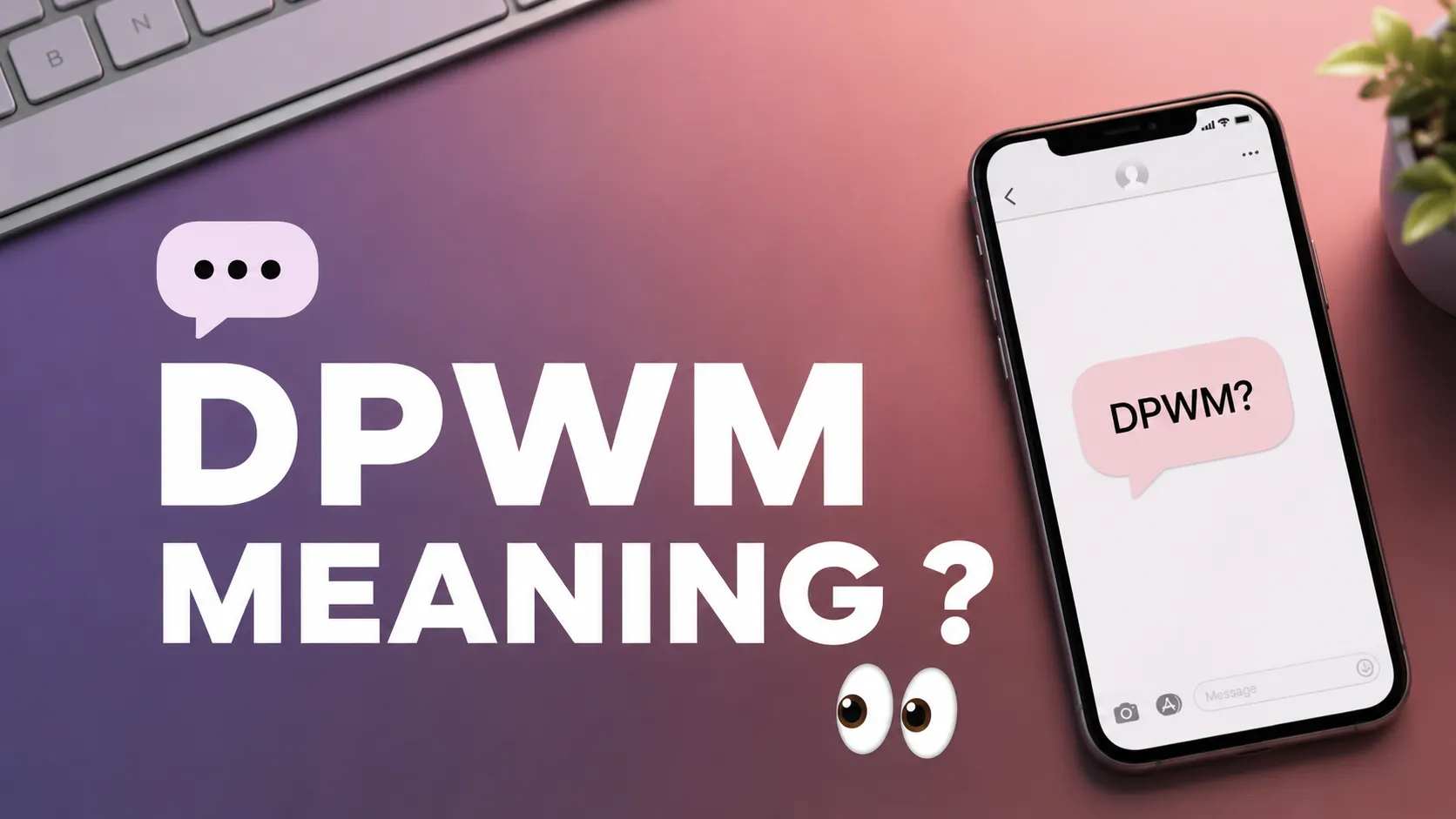
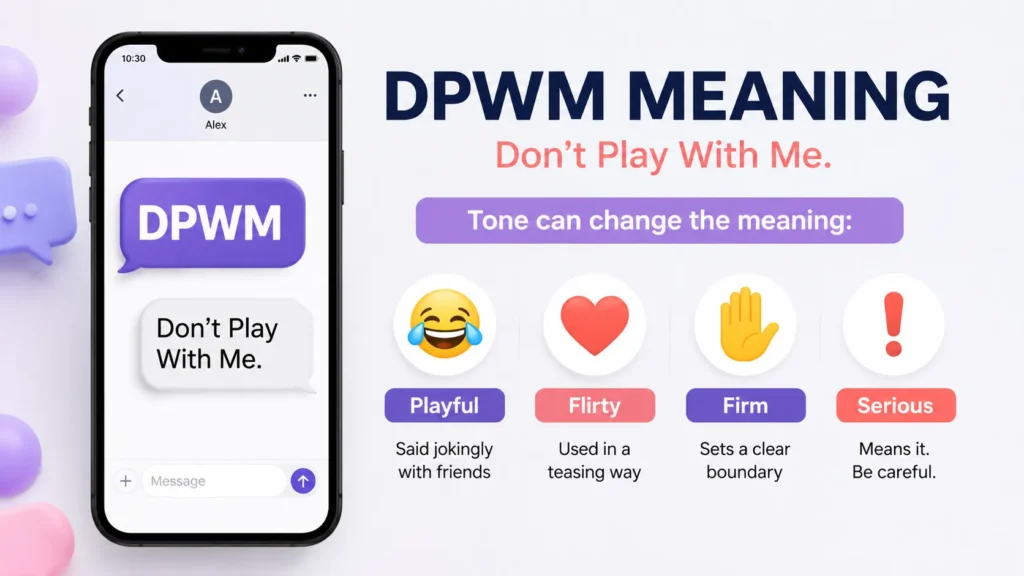
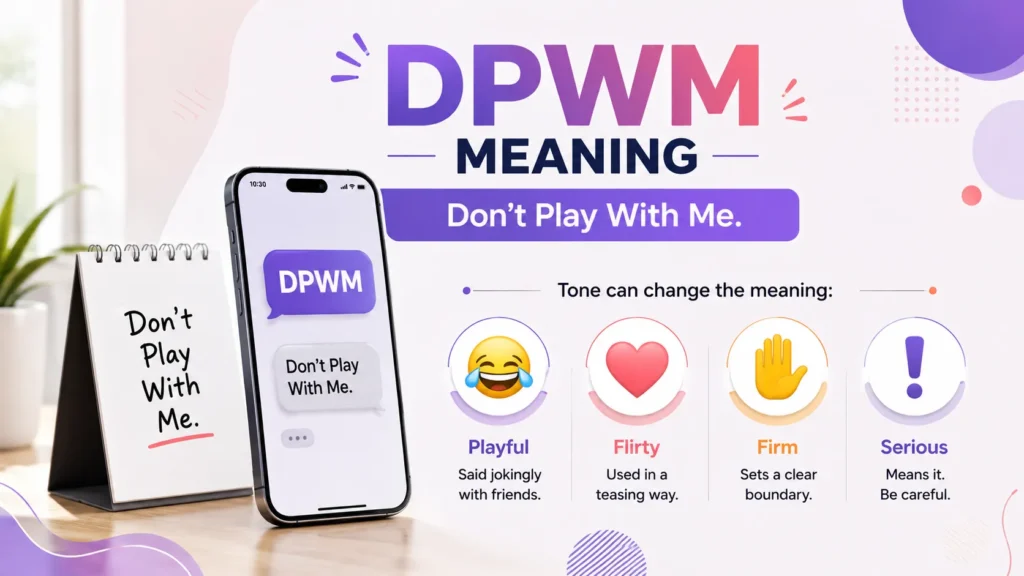
DPWM means “Don’t Play With Me.“ It’s texting and social media slang used to signal that someone is being serious, isn’t in the mood for jokes, or wants a boundary respected. You’ll see it most on TikTok, Snapchat, Instagram, and in everyday DMs — and its emotional tone can range from lighthearted teasing to a genuine warning, depending entirely on punctuation, emojis, and who’s sending it.
If you just got a “DPWM” text and aren’t sure how to take it, you’re not alone — it’s one of the more ambiguous pieces of Gen Z shorthand precisely because the same four letters can mean five different things depending on context. This guide breaks down exactly how to read it, where it came from, every major variant, and the handful of legitimate non-slang meanings that most guides gloss over.
What Does DPWM Mean?
DPWM stands for “Don’t Play With Me.” It’s a compressed way of saying: I mean what I just said — stop testing me, joking around, or pushing this further. It functions less like a fixed definition and more like a tone marker that tells the reader how to interpret the message around it.
Quick Meaning Summary
| Attribute | Detail |
| Full form | Don’t Play With Me |
| Category | Texting/social media slang (acronym) |
| Primary tone | Serious, warning, or boundary-setting |
| Common platforms | TikTok, Snapchat, Instagram, WhatsApp, Discord |
| Formality | Informal only |
| First popularized | Early 2020s, TikTok/Snapchat caption culture |
| Closest synonyms | “I’m not playing,” “on god,” “deadass,” “I mean it” |
Origin and History
DPWM belongs to the same family as other consonant-stacked texting abbreviations — IDC, ION, TF — that trace back to SMS character-limit habits and were later carried into app culture by Gen Z. Unlike LOL or BRB, DPWM has no single viral origin video or post; it built up gradually through TikTok and Snapchat caption culture in the early 2020s, where short, blunt reaction phrases spread fast because they’re quick to type and stack easily with emojis.
The phrase itself is much older than the abbreviation. “Don’t play with me” has long been used in everyday spoken English — particularly in African American Vernacular English (AAVE) and Southern U.S. dialects — to mean “be serious with me” or “don’t test my patience.” DPWM is simply the texting-era shorthand of that existing phrase, not a brand-new coinage.
Why Is DPWM Popular?
DPWM’s staying power comes down to efficiency and flexibility. It says in four letters what would otherwise take a full sentence, and because its tone isn’t fixed, it adapts to almost any conversation — teasing, flirting, warning, or competing. That flexibility is exactly why it keeps appearing across unrelated contexts: a TikTok comment, a Snapchat caption, and a heated 1:1 text can all use the same four letters to mean something slightly different.
The DPWM Tone Spectrum
Tone is the single biggest factor in how DPWM lands, and it’s the part most competing guides fail to map out clearly:
| Tone | What It Signals | Typical Formatting |
| Playful | Teasing, disbelief, mock offense | “dpwmmm 😭” or “DPWM 😂” |
| Flirty | Mock-serious warning between people who are into each other | “dpwm… I mean it 👀” |
| Firm/Assertive | Setting a real boundary, first warning | “DPWM.” (no emoji, period) |
| Angry/Confrontational | Escalated warning, often mid-argument | “DPWM!!” in all caps, sent alone |
When in doubt, default to reading it as firm-but-not-hostile unless the surrounding conversation clearly points elsewhere.
DPWM on Social Media
TikTok — Almost always reactive rather than confrontational, showing up in comments under surprising or funny videos, closer in meaning to “no way” than an actual threat.
Snapchat — Common in captions and chat replies. Leans playful in public Snaps but can turn genuinely firm in a private 1:1 chat, especially without emojis.
Instagram — Appears in comments and DMs, usually reacting to a post, transformation, or announcement — reaction over warning, similar to TikTok.
WhatsApp / iMessage / SMS — The context where DPWM is most likely to be a real, serious statement rather than a reaction, since these are typically 1:1 or small-group threads.
Discord / gaming chat — Competitive framing, used when someone’s trash-talking or underestimating a player — closer to “don’t underestimate me.”
X (Twitter) / Reddit — Less common than on visual platforms, but appears in reply threads with the same reactive, disbelief-driven usage seen on TikTok.
DPWM From a Girl vs. From a Guy {#gendered}
The base meaning doesn’t change with gender — “Don’t Play With Me” means the same thing regardless of who sends it. What shifts is likely intent:
- From a girl, flirty context — often mock-serious, implying “I like you, but don’t mess me around.”
- From a girl, conflict context — a direct signal she’s not joking and wants specific behavior to stop.
- From a guy — most often used in banter, competitive talk, or as a lighthearted warning among friends.
The quickest way to read it correctly either way: check whether the message right before it was affectionate/joking (→ likely playful) or a genuine complaint (→ likely a real boundary).
Examples of DPWM in Use
Playful/TikTok-style:
A: “bro said he’d pay me back next week 💀” B: “DPWMMM he’s said that for a month 😭”
Firm/1:1 text:
A: “I keep telling you I’m not comfortable with that joke.” B: “Okay, DPWM. I hear you.”
Flirty:
A: “you’re not actually gonna show up tomorrow are you” B: “dpwm… I’ll be there 😏”
Gaming/competitive:
A: “you’re not beating me in this lobby” B: “DPWM, watch.”
The meaning (“I’m serious”) stays constant across all four — what changes is the emotional register, carried entirely by punctuation and context.
DPWM Variants Explained
| Variant | Meaning | Notes |
| DPWM | Don’t Play With Me | The base phrase |
| DPWMRN | Don’t Play With Me Right Now | Adds urgency, usually mid-argument |
| DPWMP | Don’t Play With My [Person/Pet/etc.] | Context-dependent; can carry adult-slang meanings, so read carefully |
| DFPWM | Don’t F***ing Play With Me | Intensified, more vulgar; close-friend use only |
| DPWN | Don’t Play With Me (alternate spelling) | Functionally identical, less common |
| DPW | Don’t Play With [it/them] | Shorter, more general, less specific |
| DPWY | Don’t Play With Yourself / Don’t Play With You | Ambiguous — meaning depends entirely on context |
Rule of thumb: the longer the acronym, the more specific and often more intense the warning.
How to Respond to DPWM {#respond}
- Read the tone first — all-caps with no emoji signals seriousness; lowercase with emoji signals playfulness.
- If playful, mirror the energy with a laughing emoji or light tease.
- If firm or serious, acknowledge it plainly (“okay, got it”) rather than deflecting with a joke.
- If unsure, just ask — “wait are you being serious rn?” costs nothing and avoids misreading the room.
Common Misunderstandings {#misunderstandings}
- “DPWM always means someone’s angry.” False — it’s most often reactive or playful, especially on TikTok and Instagram.
- “DPWM is a new phrase.” False — the spoken phrase predates texting by decades; only the abbreviation is recent.
- “DPWM only has one meaning.” False — outside of slang, the same letters are used in electronics and a few organizational contexts (see below).
- “DPWM and DFPWM are interchangeable.” Not quite — DFPWM is a deliberately stronger, more vulgar escalation, not a casual substitute.
When Not to Use DPWM {#etiquette}
- Professional messaging — Slack, email, workplace chat. Reads as unprofessional regardless of intent.
- With people you don’t know well — its tone-dependent nature makes it easy to misread between strangers.
- In genuinely tense conflicts — slang can come across as dismissive; a direct sentence communicates more clearly.
- Formal writing — resumes, cover letters, customer-facing messages.
Non-Slang Meanings of DPWM {#nonslang}
DPWM isn’t exclusively internet slang. The same letters appear as a real acronym in several technical and organizational contexts that deserve a full explanation rather than a one-line mention:
Digital Pulse Width Modulation — In electronics and embedded systems, a digital signal-control technique that regulates power delivered to a device (motors, LEDs, audio circuits) by rapidly switching a signal on and off and varying the on/off ratio. It’s a digitally controlled variant of standard PWM, common in microcontroller and power-electronics design.
Discontinuous Pulse Width Modulation — A specific PWM switching strategy in motor drives and power inverters where one phase leg is held fixed during part of the switching cycle, used to reduce switching losses compared to continuous PWM. It appears in power-electronics and electric-drive engineering literature.
Department of Parks and Wildlife Management — Shorthand used by some regional or state government bodies overseeing parks, conservation, and wildlife regulation. Naming conventions vary by state or country.
Digital Personal Wealth Management — Informal shorthand occasionally used for apps or platforms that help individuals track investments and personal finance digitally; not a standardized industry term.
Data Processing Workflow Management — Informal shorthand within some tech and software teams for a system that manages how data moves through processing stages.
Context makes the intended meaning obvious almost immediately — none of these technical uses overlap with the texting-slang meaning.
Related Terms and Similar Meanings {#related}
| Term | Meaning |
| IDC | I Don’t Care |
| ION | I Don’t |
| TF | The F*** |
| On God | I’m being completely honest |
| Deadass | Seriously, not joking |
| I’m not playing | Full-sentence equivalent of DPWM |
People Also Ask
DPWM means “Don’t Play With Me.” It signals seriousness, sets a boundary, or reacts with mock disbelief, depending on tone.
It carries the same base meaning as always, but in a flirty exchange it often functions as a lighter, boundary-setting statement rather than a literal warning
“Don’t Play With Me Right Now” — the same core meaning as DPWM with added urgency, typically used mid-conversation when tension is already present.
DFPWM is an intensified, more vulgar version of the same phrase, generally reserved for close friends or high-emotion moments.
Yes — in electronics, it can stand for Digital Pulse Width Modulation or Discontinuous Pulse Width Modulation, and it’s used informally in some government, finance, and tech contexts too.
Conclusion
DPWM is a small phrase carrying a lot of tonal weight. At its core it always means “Don’t Play With Me,” but whether that lands as a joke, a flirt, or a genuine warning depends on punctuation, platform, and the relationship between the people using it. Read the context before you react — and if you’re ever unsure, it’s always fine to just ask.