Acquitted Meaning: The Complete Guide to What “Acquitted” Really Means
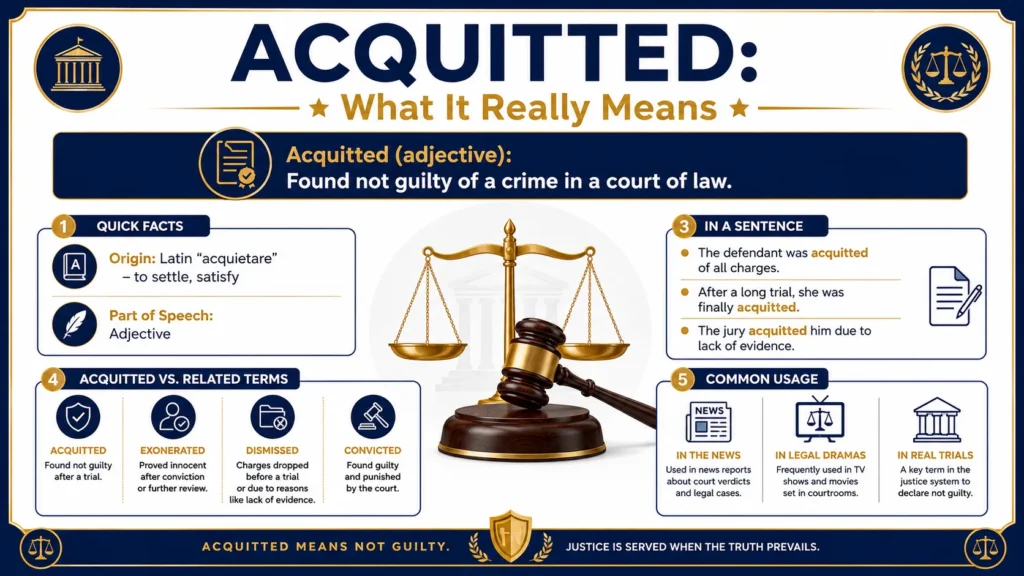
Acquitted means a court has officially cleared a person of a criminal charge — the judge or jury decided the prosecution did not prove guilt beyond a reasonable doubt.
That one-line answer covers the basics, but “acquitted” is one of those words that people search for right when it actually matters to them — a family member’s trial, a news headline, a legal drama, or a vocabulary test. So this guide goes further than a dictionary entry. Below, you’ll find the full legal meaning, the lesser-known everyday meaning, exactly how “acquitted” differs from “not guilty,” “dismissed,” “convicted,” and “exonerated,” what legally happens after someone is acquitted, and how to use the word correctly in a sentence.
Quick Meaning Summary
| Word | Acquitted |
| Part of speech | Verb (past tense/participle of “acquit”) |
| Core meaning | Formally found not guilty of a criminal charge |
| Who decides | A judge or jury, after hearing the evidence |
| Means innocent? | No — means the prosecution didn’t prove guilt |
| Second meaning | To conduct/perform yourself well (or poorly) under pressure |
| Opposite | Convicted |
| Key legal effect | Triggers double jeopardy protection against retrial |
What Does “Acquitted” Mean?
To be acquitted is to be formally released from a criminal accusation because the evidence wasn’t strong enough to convict. The word comes from the verb acquit, which means to clear someone of a charge or to discharge them from an obligation.
In a courtroom, an acquittal is a legal verdict — a final decision that ends the criminal case in the defendant’s favor.
A jury, after they deliberate and vote “not guilty,” or
A judge, either in a bench trial (a trial without a jury) or through a motion for judgment of acquittal, where the judge rules that the prosecution’s evidence was too weak to even let the case reach a jury.
Once someone is acquitted, the criminal case against them for that specific charge is over. They are released from custody or bail conditions tied to that charge, and — as explained further down — they generally cannot be tried again for the same offense.
Where Does the Word “Acquitted” Come From?
“Acquit” traces back to Old French and Anglo-French words meaning “to settle a debt” or “to release from an obligation,” which themselves developed from Medieval Latin roots connected to the idea of being “quit” or “free” of something owed. That original financial sense — clearing a debt — is why the legal meaning fits so naturally: being acquitted is, in effect, having your obligation to answer for a crime “paid off” and closed.
The Two Meanings of “Acquitted”
Most people only know the courtroom sense, but “acquitted” actually has two distinct meanings in English. Mixing them up is one of the most common vocabulary mistakes with this word.
| Meaning | Definition | Example |
| 1. Legal Sense (most common) | Formally found not guilty of a crime in court | “The jury acquitted him after two days of deliberation.” |
| 2. Behavioral sense (“acquit yourself”) | To conduct or perform yourself in a certain way, usually well, under pressure | “She acquitted herself admirably in the debate.” |
The second meaning has nothing to do with courts or crime — it’s about how well someone handles a difficult situation. We’ll cover it in more detail later in this guide, but it’s worth flagging early because it trips up even native speakers.
Does “Acquitted” Mean Innocent?
No — and this is the single most misunderstood part of the word. An acquittal is not a declaration of innocence. It’s a statement about the prosecution’s evidence, not about what actually happened.
Criminal trials require proof “beyond a reasonable doubt” — the highest burden of proof in the legal system. If the prosecution falls even slightly short of that extremely high bar, the result is an acquittal, regardless of whether the defendant actually committed the act. In other words, an acquittal means:
- The government failed to prove guilt to the required legal standard.
It does not mean:
- The court found the person innocent.
- The evidence proved the person didn’t do it.
- The person has no criminal record from the arrest (an acquittal doesn’t automatically erase an arrest record).
This distinction matters in real life. It’s the reason an acquitted person can still be sued in civil court over the same conduct — a civil case only requires proof “by a preponderance of the evidence” (essentially, more likely than not), a far lower bar than “beyond a reasonable doubt.” The best-known example is O. J. Simpson, who was acquitted of murder in his 1995 criminal trial but was later found liable for wrongful death in a separate civil lawsuit brought by the victims’ families, based on the same underlying facts.
How Does Someone Get Acquitted? The Legal Process
An acquittal can happen in a few different ways:
- Jury verdict. After hearing all the evidence, a jury votes unanimously (in most jurisdictions) that the prosecution did not prove its case.
- Bench trial ruling. When a defendant waives their right to a jury, a judge alone hears the case and can rule “not guilty,” resulting in an acquittal.
- Judgment of acquittal. A judge can acquit a defendant even before the case reaches a jury, by ruling that the prosecution’s evidence is legally insufficient to support a conviction. This can happen at the close of the prosecution’s case or after a guilty verdict is set aside.
- Appellate acquittal. In rare cases, an appeals court can determine that the evidence presented at trial was insufficient as a matter of law and order an acquittal rather than a new trial.
In every version, the underlying question is the same: did the government meet its burden of proof? If not, the law requires an acquittal — even if jurors personally suspect the defendant did something wrong.
Acquitted vs. Convicted
This is the most direct opposite pairing. A conviction happens when the judge or jury decides the prosecution did prove guilt beyond a reasonable doubt.
| Acquitted | Convicted | |
| Outcome | Not guilty | Guilty |
| Result | Defendant is released; case closed | Defendant faces sentencing/penalties |
| Appeal rights | Prosecution generally cannot appeal | Defendant can appeal |
| Retrial | Barred by double jeopardy | Not applicable (case already resolved against defendant) |
One nuance worth knowing: a defendant facing multiple charges can be partially acquitted — acquitted on some counts while convicted on others. For example, someone charged with both assault and a lesser related offense could be acquitted of the assault charge but convicted of the lesser one.
Acquitted vs. Not Guilty
These two terms are closely related but not perfectly interchangeable, and this is where most explanations online get vague.
- “Not guilty” is the verdict — the specific words a jury or judge uses to announce the outcome.
- “Acquitted” is the legal status that results from that verdict (or from certain other rulings, like a judgment of acquittal).
Every acquittal comes from a “not guilty” finding, but “not guilty” is also used more broadly. For instance, if a case is dismissed for lack of evidence before trial, the defendant is not technically “acquitted” in the strict sense — but they are still not guilty of the charge in the eyes of the law. In everyday and even news usage, though, “acquitted” and “found not guilty” are treated as synonyms, and that usage is accepted as correct.
Acquitted vs. Dismissed
This comparison catches people off guard because both sound like a legal win — but they are fundamentally different events.
| Acquittal | Dismissal | |
| When it happens | At or after a trial | Usually before or during a trial, before a verdict |
| Who decides | Judge or jury, based on the evidence at trial | Judge or prosecutor, often for procedural reasons |
| Can charges return? | No — double jeopardy applies | Sometimes — a case dismissed “without prejudice” can be refiled |
| Double jeopardy protection | Yes, full protection | Only if jeopardy had already “attached” (i.e., trial had started) |
In short: a dismissal ends a case without ever deciding guilt or innocence, often because of insufficient evidence at an early stage, a procedural error, or a violation of the defendant’s rights. That’s why an acquittal carries the much stronger, final protection of double jeopardy, while a dismissal (depending on the type) sometimes does not.
Acquitted vs. Exonerated
- Acquitted = found not guilty during a trial, because the prosecution didn’t meet its burden of proof. It says nothing definitive about actual innocence.
- Exonerated = officially cleared of a crime after a conviction, typically because new evidence (such as DNA evidence) affirmatively proves the person did not commit the offense. Exoneration is a much stronger, more specific declaration: the legal system is acknowledging it got it wrong.
Put simply: acquittal happens instead of a conviction; exoneration happens after one.
Full Comparison Table: Acquitted vs. Every Related Term
| Term | Meaning | Happens When | Implies Innocence? | Double Jeopardy Applies? |
| Acquitted | Formally found not guilty at trial | After evidence is tested at trial | No | Yes |
| Convicted | Formally found guilty | After evidence is tested at trial | N/A (opposite outcome) | N/A |
| Not guilty | The verdict itself | Announced at end of trial | No | Yes (once verdict is final) |
| Dismissed | Case ended without a verdict | Before or during trial, before it’s decided | No | Only if jeopardy had attached |
| Charges dropped | Prosecutor chooses not to pursue charges | Usually before trial | No | No — can potentially be refiled |
| Exonerated | Officially cleared after a prior conviction | After new evidence proves innocence | Yes | N/A (conviction already vacated) |
| Vacated | A prior guilty verdict is set aside by a court | After appeal or new evidence | Not necessarily | May allow retrial |
What Happens After Someone Is Acquitted?
Once an acquittal is final, several important legal consequences follow:
1. Protection from double jeopardy
The Fifth Amendment’s Double Jeopardy Clause (and equivalent protections in most legal systems worldwide) prevents the same government from prosecuting a person again for the same offense after an acquittal — no matter how new evidence, or how flawed the original trial seemed.
2. The record isn’t automatically erased
An acquittal ends the criminal case, but the arrest itself may still appear on background checks unless the person separately applies for expungement or record sealing, depending on their jurisdiction.
3. Civil liability can still apply
Because civil cases use a lower burden of proof, an acquitted person can still be sued privately over the same conduct. This is exactly what happened in the O. J. Simpson case: acquitted criminally, Later Held Liable Civilly.
4. Limited exceptions across borders and jurisdictions
Double jeopardy protection generally only applies within the same legal system. Under the “separate sovereigns” doctrine in the United States, an acquittal in state court doesn’t prevent federal prosecutors from charging the same person for the same conduct under a different federal law, and vice versa. Some other countries, such as England and Wales, have also carved out narrow exceptions allowing retrial after acquittal for very serious crimes if compelling new evidence emerges.
Can an Acquitted Person Be Tried Again?
In almost all cases: no. Once jeopardy has attached (typically when the jury is sworn in, or the first witness testifies in a bench trial) and a final acquittal is entered, retrial for the same offense by the same government is constitutionally barred — even if the acquittal later seems clearly wrong. This rule exists specifically to prevent the government from repeatedly prosecuting someone until it gets a conviction.
The narrow exceptions are: prosecution by a different sovereign (e.g., state vs. federal government in the U.S.), and, in a handful of countries, retrial for serious crimes when new and compelling evidence surfaces after reforms to traditional double jeopardy rules.
“Acquit Yourself”: The Other Meaning of Acquitted
Outside the courtroom, “acquit” and “acquitted” describe how someone performs or behaves, especially under pressure or scrutiny. This usage is common in writing about sports, public speaking, exams, and other high-stakes performances.
Examples:
- “The rookie quarterback acquitted himself well in his first start.”
- “Despite the tough questions, the candidate acquitted herself confidently at the press conference.”
- “He didn’t acquit himself particularly well during the negotiation.”
Notice the pattern: People almost always use the phrase with a reflexive pronoun (himself, herself, themselves, yourself) and usually pair it with an adverb that describes how well or poorly someone performed (well, admirably, poorly, confidently).This meaning has no connection to guilt or courts — it’s really about conducting oneself in a way that meets (or fails to meet) expectations.
How to Use “Acquitted” in a Sentence
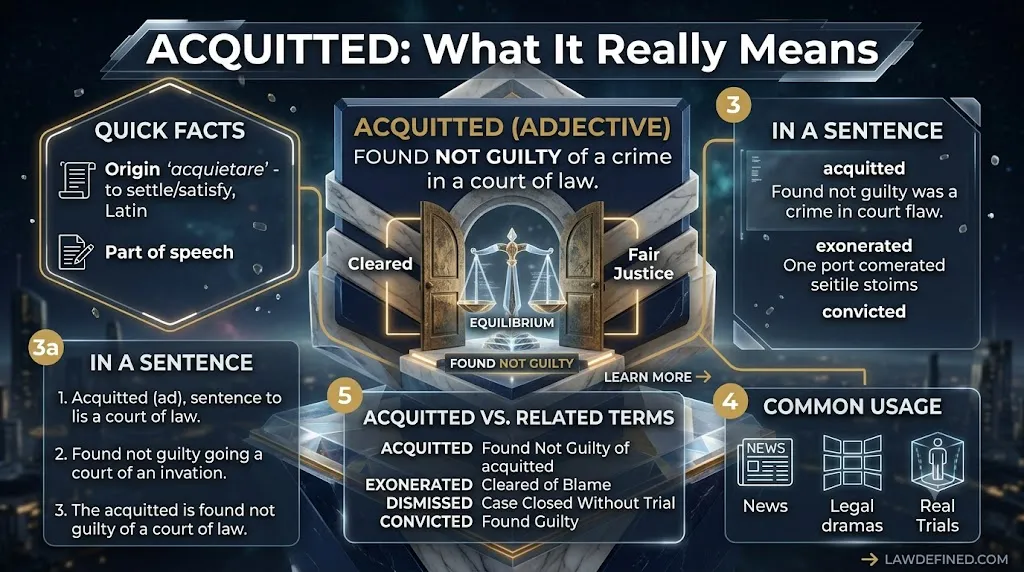
Legal sense:
- “After a two-week trial, the jury acquitted the defendant on all charges.”
- The court acquitted her of fraud after the prosecution’s key witness recanted.
- “The court acquitted him of the more serious charge but convicted him of a lesser one.
Behavioral sense:
- “The interns acquitted themselves impressively during the client pitch.”
- “I didn’t acquit myself well in that interview — I was too nervous.”
Synonyms and Antonyms of Acquitted
Synonyms (legal sense): cleared, exonerated (informally, though not technically identical — see above), absolved, discharged, vindicated, found not guilty
Antonyms: convicted, found guilty, condemned, sentenced
Synonyms (behavioral sense): performed, conducted oneself, behaved, comported oneself
People Also Ask
No. It means the prosecution failed to prove guilt beyond a reasonable doubt. The statement describes the evidence presented, not a legal finding of innocence.
Yes. Criminal acquittal only protects against further Criminal Prosecution for the same offense. A civil lawsuit over the same conduct can still proceed, since civil cases use a lower burden of proof.
The court announces a “not guilty” verdict.That verdict acquits the defendant and grants them legal acquittaln everyday use, people treat “not guilty” and “acquitted” as synonyms.
Generally no, due to double jeopardy protections. The main exceptions involve prosecution by a different sovereign government (such as state versus federal charges) or, in a few countries, retrial for serious offenses when compelling new evidence emerges under specific legal reforms.
Not automatically. An acquittal ends the case, but authorities may still keep the arrest record unless a court expunges or seals it under local law.
It means you performed or behaved well in a difficult or high-pressure situation — it has nothing to do with courts or crime.
No. Acquittal happens during a trial when evidence isn’t sufficient to convict. Exoneration happens after a conviction, when new evidence proves the person’s actual innocence.
Conclusion
Understanding what “acquitted” means goes beyond just knowing it’s the opposite of “convicted.”As we’ve explored, a court acquits someone when the prosecution fails to prove guilt beyond a reasonable doubt. An acquittal means the court has found the person not guilty, but it doesn’t necessarily prove the person’s innocence..
Whether you’re watching courtroom dramas, following breaking news, studying for a vocabulary test, or just trying to sound sharper in conversation, knowing the difference between Acquitted, Exonerated, Dismissed, and convicted helps you follow legal stories with real clarity — and use the word correctly yourself.