SOS Meaning: What It Really Stands For (And Why It’s Not What You Think)
Type “SOS” into a group chat, spot it on a prescription bottle, or hear it crackle over a ship’s radio, and you already know one thing: something needs attention, fast.
The short answer: SOS Doesn’t Stand For Anything. It’s not short for “save our souls” or “save our ship” — those are popular myths. SOS was designed purely as an easy-to-transmit Morse code pattern, and the letters were a happy byproduct of that pattern, not the reason for it.
People search for “SOS meaning” for very different reasons — some want the historical trivia, some just saw “SOS” appear on their phone’s signal bar and got worried, others are staring at a prescription label wondering what it means. This guide covers all of it: the real origin story, the Morse code behind it, and every modern context where the term shows up — texting, smartphones, medicine, and beyond.
Quick Meaning Summary
| Context | What SOS Means |
| Maritime & radio (original use) | A universal Morse code distress signal — not an acronym |
| Text message / social media | Informal shorthand for “I need help” or “this is urgent” |
| Phone signal bar | Emergency-calls-only network status, not an alert you triggered |
| iPhone / Android feature | Built-in tool to call emergency services and share your location |
| Prescription label | Latin si opus sit — “take only if needed” |
| Government writing | Abbreviation for Secretary of State |
| Teen chat slang | Occasionally “someone over shoulder” |
What Does SOS Actually Stand For?
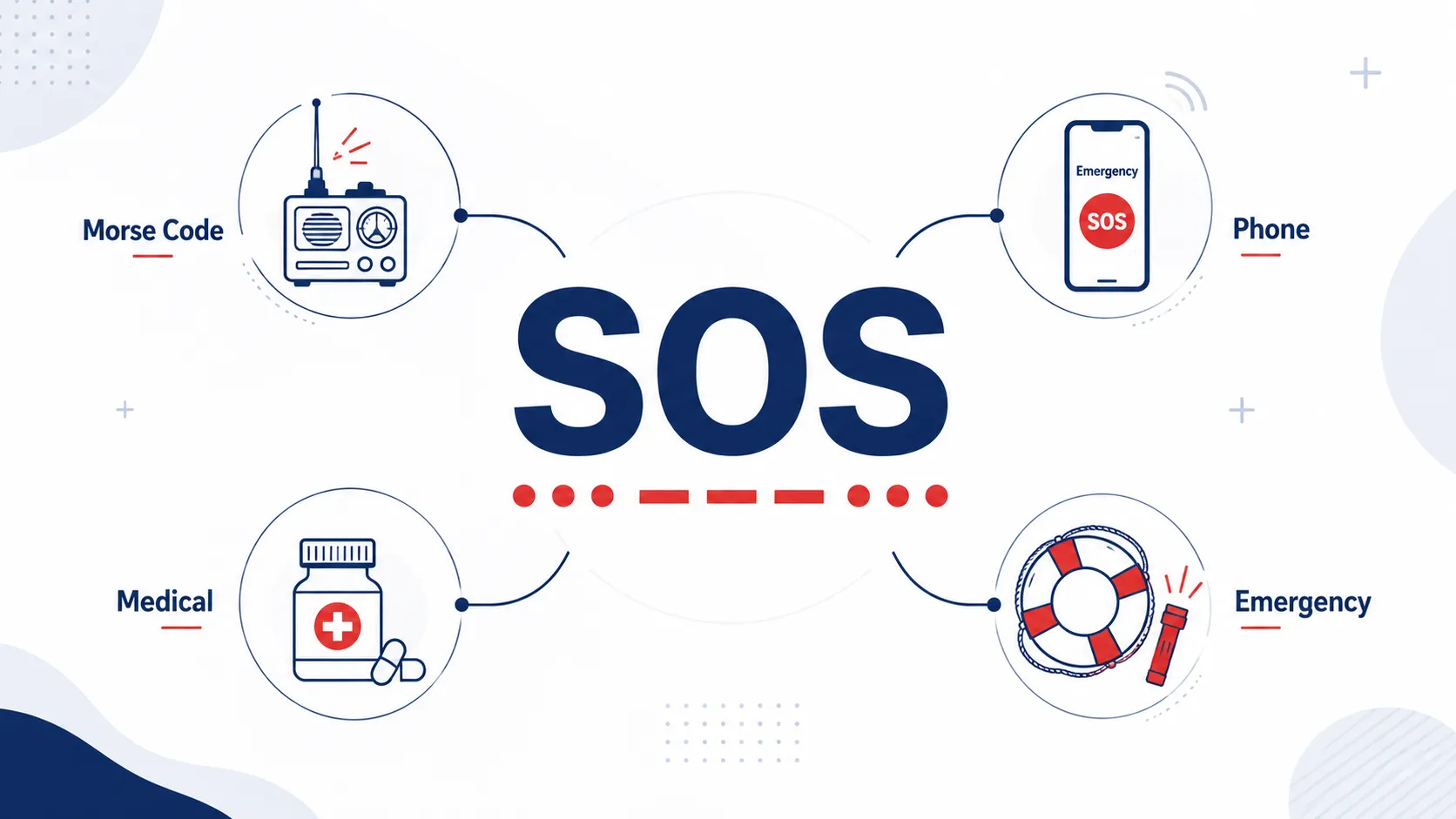
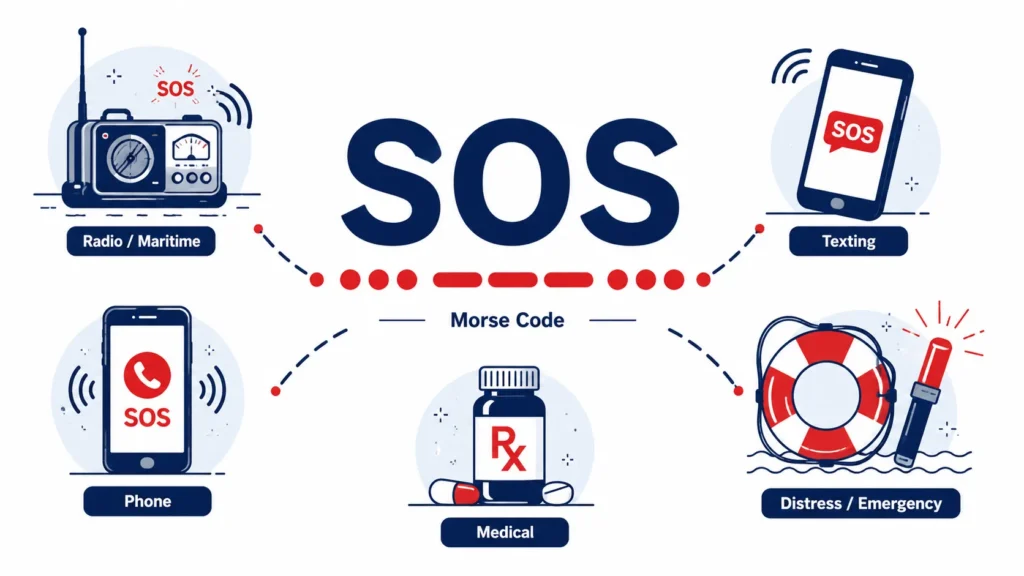
Nothing — and that’s the part that surprises most people. SOS is not an acronym or initialism. It was built as one continuous Morse code string: three dots, three dashes, three dots, sent without pauses between the “letters.”
The reason it looks like a word is coincidental: three dots happens to form the letter S in Morse code, and three dashes happens to form O. Pairing them gave radio operators an easy way to memorize a sequence, not a phrase to spell out.
“Save Our Souls” and “Save Our Ship”: Debunking the Myth
Both phrases are backronyms — words invented after the fact to explain letters that already existed, rather than the other way around. Maritime historians and the original regulatory documents that created SOS make no mention of either phrase; they describe only the dot-dash pattern itself.
The myth spread because people naturally want abbreviations to mean something. Once SOS became culturally famous, “save our souls” offered a dramatic, easy-to-remember story — and it simply outlived the boring truth.
Why Was SOS Chosen Over Other Distress Codes?
SOS wasn’t the first distress signal — it won out over competing systems for practical reasons:
- CQD, used by the Marconi Company, was harder to transmit cleanly and easy to confuse with routine “CQ” (all-stations) calls.
- National navies and telegraph companies each ran their own codes, meaning ships from different countries often couldn’t understand one another’s distress calls.
- SOS solved this by being short, rhythmically distinct, and unmistakable even over a weak or noisy signal.
There’s also a visual bonus: written out, “SOS” is a palindrome that reads the same forward, backward, and upside down — which is exactly why stranded survivors have long stamped it into snow or arranged it out of rocks and driftwood. It’s legible to a rescue plane no matter which direction it’s approaching from.
The alt text stays factual and keyword-inclusive (good for image search + accessibility) without being stuffed.
The caption is short and curiosity-driven to boost time-on-page/CTR from image search or social shares, while still stating the core fact from the article.
If you want, I can also generate 2-3 alt text/caption variants sized differently (e.g., a punchier caption vs. a more literal one) — just say the word.
Origin and History of SOS
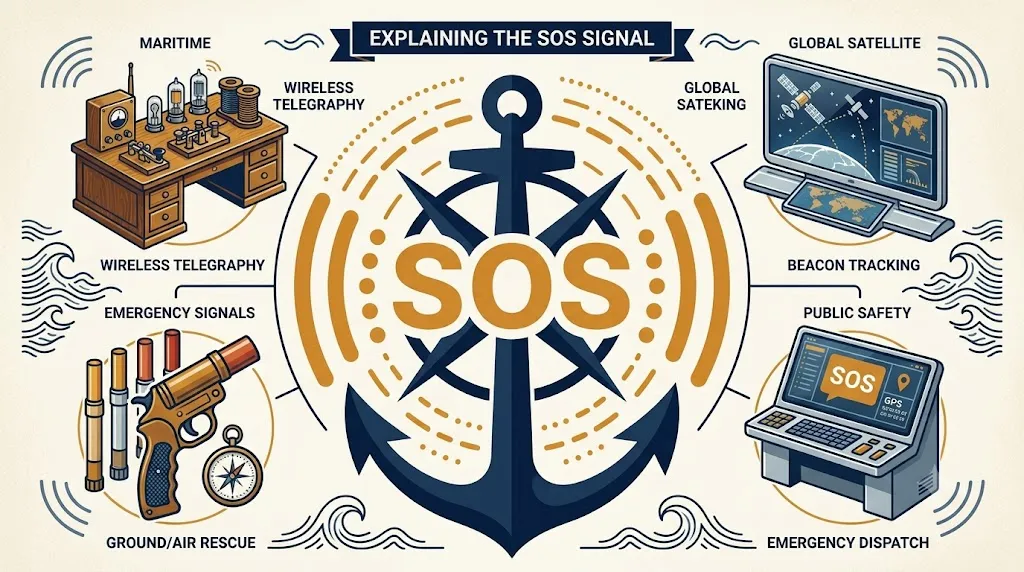
- 1905: Germany adopts the three-dot/three-dash/three-dot pattern as a national maritime distress signal.
- 1906: The International Radiotelegraph Convention in Berlin adopts the same pattern internationally, taking effect in 1908.
- 1909: Among the earliest recorded uses at sea, on the RMS Slavonia and SS Arapahoe.
- 1912: The Titanic disaster cements SOS in public memory. Operators initially transmitted the older CQD signal out of habit, then began mixing in the newer SOS as the emergency escalated — both codes went out that night.
- 1999: SOS is retired as the mandatory protocol at sea, replaced by the satellite-based Global Maritime Distress and Safety System (GMDSS). It’s still recognized worldwide as a manual backup.
SOS in Morse Code
| Letter | Pattern | Sound |
| S | · · · | dit-dit-dit |
| O | — — — | dah-dah-dah |
| S | · · · | dit-dit-dit |
Full unbroken signal: · · · — — — · · ·
Because it’s just a rhythm, SOS can be sent almost any way a signal can travel: three short and three long flashes of light, three short and three long horn blasts, or three short and three long taps against a wall when speaking or being seen isn’t an option.
How Is SOS Used Today? Context by Context
In Texting and on Social Media
Away from genuine emergencies, “SOS” has become casual shorthand for “help, now” — usually about something far less serious than a shipwreck. A text like “SOS, I left my keys inside” is a request for a quick favor, not a 911 call. Tone and punctuation usually make the intent obvious: heavy emoji use signals it’s lighthearted, while a flat, unadorned “SOS” out of nowhere is worth a real follow-up. In some group chats among younger users, SOS occasionally shows up as “Someone Over Shoulder” — a heads-up that the sender can’t speak freely.
On Your Phone
Modern smartphones have turned SOS from a word into a functioning tool:
- Emergency SOS (iPhone/Android): Rapidly pressing the side or power button places a call to local emergency services and can alert your saved emergency contacts with your location.
- “SOS” on the signal bar: This means normal carrier service is unavailable, but your phone can still reach emergency numbers only. It’s a status label, not something you’ve activated.
- Satellite SOS: Newer phones can send a distress message via satellite when there’s no cell or Wi-Fi signal at all — a genuine safety net for hikers and remote travelers.
In Medicine
On a prescription, SOS traces back to the Latin phrase si opus sit — “if there is need.” It tells you to take a medication only when your symptoms require it, not on a fixed schedule. It’s common on labels for as-needed pain relief, anxiety medication, or rescue inhalers. Always confirm dosing limits with your pharmacist rather than guessing from the label alone.
Other Meanings of SOS
- Music: “S.O.S.” is a well-known single by both ABBA (1975) and Rihanna (2006), each using the distress-call imagery to describe a relationship in crisis.
- Government: In political and administrative writing, SOS commonly abbreviates Secretary of State.
- Gaming: SOS is also a classic pencil-and-paper grid game where players race to complete the sequence S-O-S.
- Nonprofits: Groups like SOS Children’s Villages and Wildlife SOS use the term to signal their rescue-focused missions.
- Business: In some industries, “SOS” is shorthand for terms like “special order sale” — always check the surrounding context.
The alt text stays factual and keyword-inclusive (good for image search + accessibility) without being stuffed.
The caption is short and curiosity-driven to boost time-on-page/CTR from image search or social shares, while still stating the core fact from the article.
If you want, I can also generate 2-3 alt text/caption variants sized differently (e.g., a punchier caption vs. a more literal one) — just say the word.
Common Misunderstandings About SOS
- “It’s an acronym.” It isn’t — it’s a Morse code pattern that happens to spell letters.
- “It stands for save our souls.” A popular backronym, not the historical origin.
- “SOS on my phone means I sent a distress signal.” In most cases, it just means you’ve lost regular network service and can only dial emergency numbers.
- “SOS is no longer used.” It was replaced as the mandatory maritime protocol in 1999 but remains a recognized manual backup worldwide.
People Also Ask
Nothing. It’s a Morse code sequence — three dots, three dashes, three dots — chosen for how easy it is to send and Recognize, not for any words behind it.
Already in use; the original 1905–1908 regulations describe only the Morse pattern.
Because it’s a memorable, story-friendly explanation that spread through pop culture long after SOS was adopted — even though it isn’t historically accurate.
Usually “I need help” or “this is urgent,” though often with much less severity than an actual emergency. In some slang, it can also mean “someone over shoulder.”
It means you’ve lost regular carrier service but can still call emergency numbers. It’s a network status indicator, not something you’ve triggered yourself.
It comes from the Latin si opus sit, meaning “if there is need” — take the medication only when symptoms require it, not on a set schedule.
Yes, but not immediately — operators sent the older CQD signal first, then added SOS as the situation worsened, helping popularize the newer code.
Yes, as a globally recognized backup signal. It stopped being the mandatory maritime protocol in 1999 after GMDSS took over, but it still works without any electronics at all.
Conclusion
SOS proves that the simplest explanations are often the correct ones: three easy-to-send Morse code symbols, not a hidden phrase. From 1905 maritime law to the Titanic, to the “SOS” on your phone’s signal bar and the label on a prescription bottle, the term has picked up new contexts over more than a century — but the core idea has stayed the same: a fast, unmistakable call for help. Next time someone tells you it stands for “save our souls,” you’ll know the real story.