Ops Meaning Slang: The Complete Guide to Every Definition (2026)
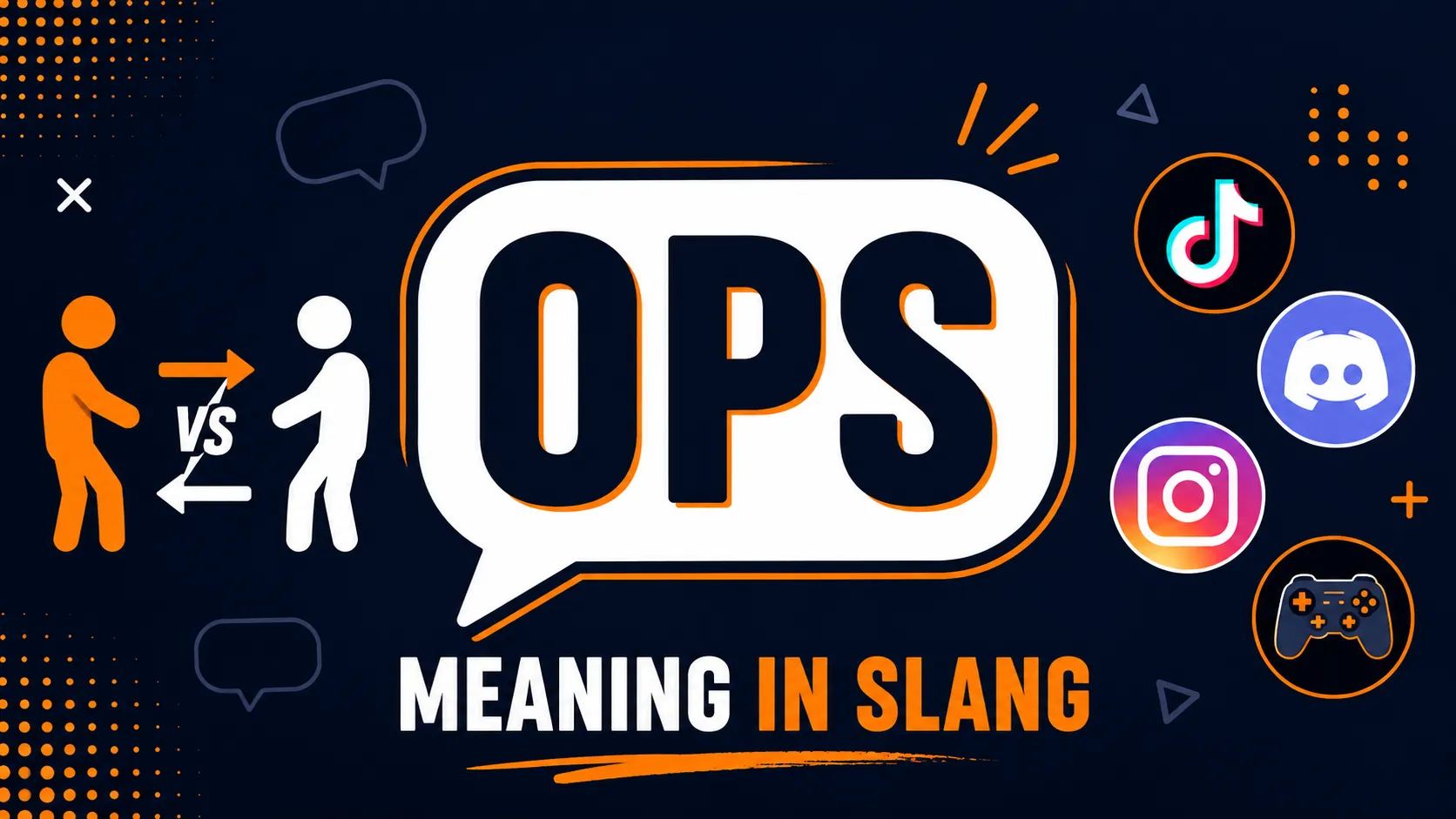
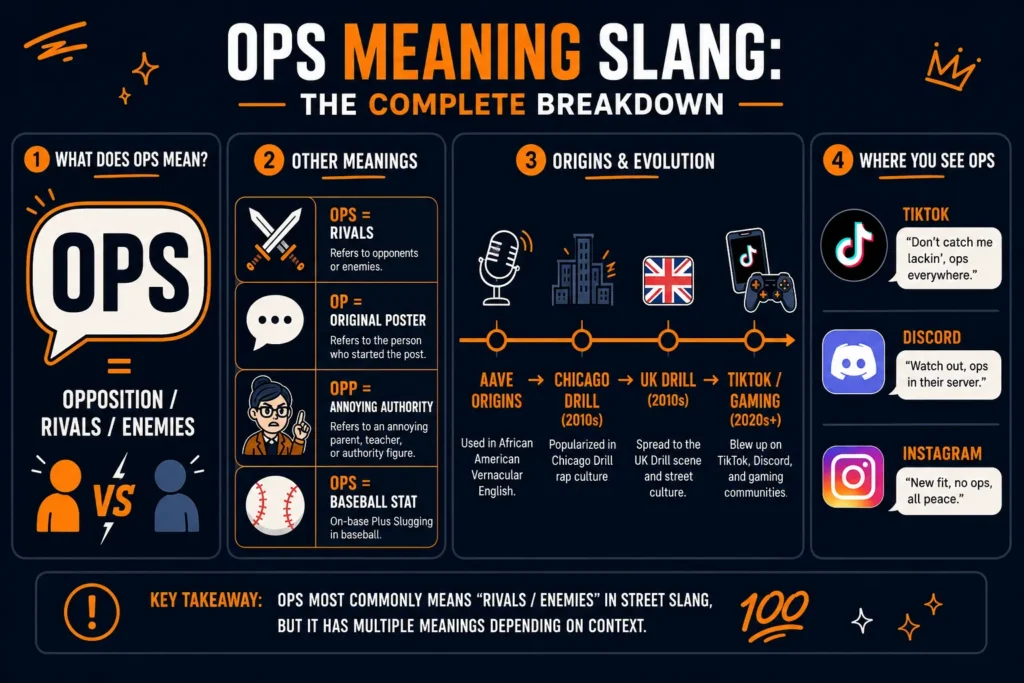
Quick answer: In slang, “Ops” Means Enemies, Rivals, Or Opposition — short for “opposition” or “opponents.” It comes from AAVE and Chicago drill music, where it referred to rival gang members, and has since spread into gaming, TikTok, Instagram, and everyday group-chat trash talk. OPS also has three completely unrelated meanings: a baseball stat (On-base Plus Slugging), a business/military term (Operations), and an internet typo for “oops.”
If you’ve seen “watch the ops,” “that’s my op,” or “ops stay lurking” and want the real answer — not a repetitive AI rewrite — this guide breaks down every meaning, where it came from, how to use it correctly, and how it’s different from “OP” and “OPP.”
What Does “Ops” Mean in Slang?
At its core, ops = opposition. It’s used to describe:
- Rival gang members or crews (“real” street usage)
- Online haters or people rooting against you
- Opposing players or teams in gaming
- Ex-friends, fake friends, or people talking behind your back
- Sometimes even law enforcement, in adversarial slang contexts
The word can be singular (“he’s an op”) or plural (“watch the ops”), and the spelling varies — ops, opps, and opp are all used interchangeably, though “opps” (double P) is the more traditional drill-slang spelling.
Example: “Don’t post your location, the ops are watching.”
The tone shifts a lot depending on who’s saying it. In street and drill contexts, it can carry real, serious weight. On TikTok or in a friend group, it’s often just a joking way to call out a hater, a nosy ex, or someone who beat you in a video game.
Ops vs. Opp vs. OP vs. OPP: What’s the Difference?
This is where most explainers get sloppy — these four terms look nearly identical but mean completely different things. Here’s the breakdown:
| Term | Meaning | Pronunciation | Where You’ll See It |
| Ops / Opps | Enemies, rivals, opposition | “ops” or “opps” | Drill lyrics, TikTok, gaming, group chats |
| OP | “Original Poster” — the person who started a thread or post | Spelled out: “Oh Pee” | Reddit, forums, Discord |
| OP (alt. meaning) | “Overpowered” — a character or player who’s too strong | Spelled out: “Oh Pee” | Gaming communities |
| OPP | Shorthand for “opposition,” used more casually by teens to describe someone being annoying (like a strict parent or teacher) | “Pop” without the First P | Gen Z/Gen Alpha slang, school/parent jokes |
| OPS (all caps, non-slang) | On-base Plus Slugging | “O-P-S,” spelled out | Baseball stats |
The confusion mostly comes down to context: if someone’s talking about rivals or enemies, it’s “ops.” If they’re referencing a forum post, it’s “OP.” If a teen is joking about their parent making them do chores, it’s “OPP.”
Where Does “Ops” Come From? (Origin & History)
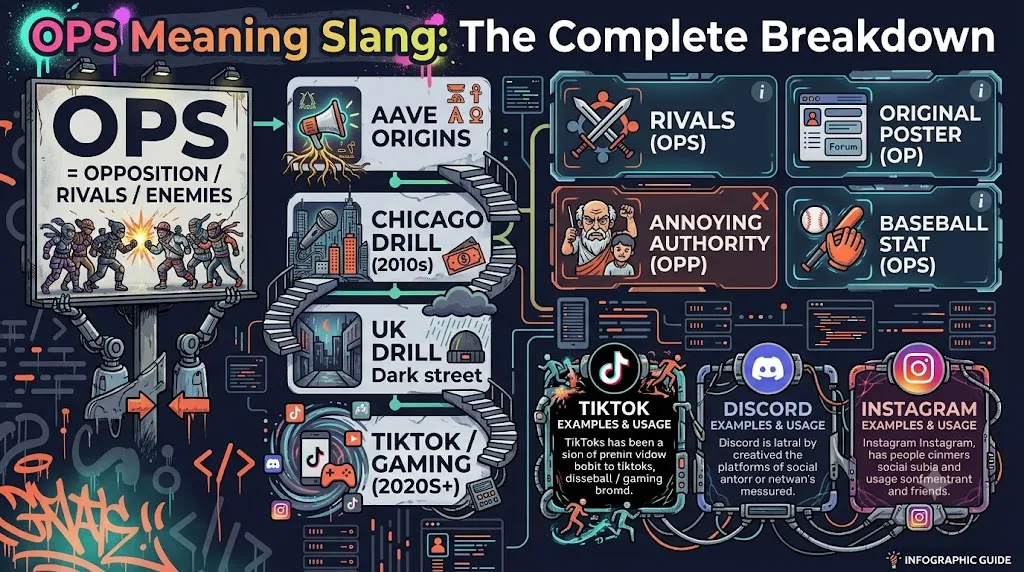
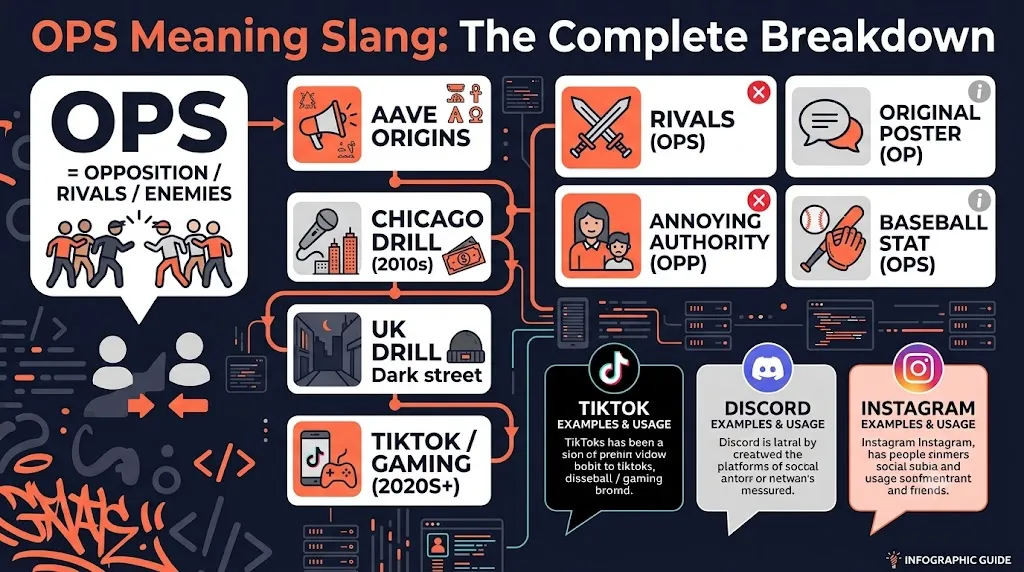
“Ops” originates from African American Vernacular English (AAVE) and street culture, where it was shorthand for “opposition” — referring to rival individuals or groups. The term was popularized through drill music, a hip-hop subgenre with lyrical roots in gangsta rap that began in Chicago in the early 2010s, where “opp” or “opps” was frequently used to refer to rival gang members.
From there, it spread in two directions:
- Into UK drill, where “opps” became one of the genre’s defining terms, referencing rival crews and postcode-based conflicts.
- Into mainstream internet culture, where TikTok, Instagram, and Discord adopted a much lower-stakes version of the word by the early 2020s — used for haters, exes, and rival gamers rather than literal gang rivals.
The legal controversy behind the word
This is the part almost no other “ops meaning” article covers, and it matters for understanding why the term carries weight: public debate has raged over drill rap’s real-world implications, with some UK and US authorities arguing the genre catalyzes violence, while others counter that it reflects — rather than causes — the realities its artists grew up in. Efforts to curb the genre have included removing music videos, blocking performances, and — controversially — using drill lyrics referencing “opps” as evidence in criminal court cases.
Academic critics have pushed back on that practice. A City University London sociologist has argued UK drill artists often exaggerate or fabricate violent content in their lyrics for effect, and that treating the music as literal evidence risks unfairly criminalizing the communities it comes from.
That context is worth knowing before assuming every use of “ops” in a song is a literal confession — most of the time, it isn’t.
How “Ops” Is Used Today, Platform by Platform
On TikTok
Usually the softest version of the word — used for haters, silent viewers, or people who don’t like your success. Think confidence-flexing captions like “my ops stay watching but never commenting.”
On Instagram
Similar to TikTok, but leans more dramatic — often implying someone is quietly monitoring your posts or stories out of jealousy.
On Discord and in gaming
The most neutral, low-stakes use of the word. “Ops” simply means the opposing team or player — no hostility implied, just competitive shorthand. You’ll hear it constantly in battle royale games, FPS lobbies, and strategy games.
In group chats and among friends
Often purely a joke. Calling a friend an “op” for beating you at a game or not replying to a text is playful, not serious.
In street and drill contexts
This is where the word retains its original, higher-stakes meaning — referring to real rivals or adversaries, not jokes.
The Rule of Thumb: the more casual the platform, the more likely “ops” is being used playfully rather than seriously.
Other Meanings of OPS (Not Slang)
Because “OPS” is only three letters, it gets reused across totally unrelated fields. Here’s what else it can mean:
1. OPS in baseball: On-base Plus Slugging
In baseball, OPS stands for “On-base Plus Slugging,” a statistic used to measure a hitter’s overall offensive performance. It’s calculated by adding two numbers together:
- OBP (On-Base Percentage): how often a batter reaches base — (Hits + Walks + Hit-by-Pitch) ÷ (At-Bats + Walks + Hit-by-Pitch + Sacrifice Flies)
- SLG (Slugging Percentage): how much power a hitter shows — Total Bases ÷ At-Bats
A higher OPS generally means a more productive hitter. This meaning has nothing to do with the slang usage above — context (a sports conversation vs. a social media caption) makes it obvious which one is meant.
2. OPS as “Operations”
In business, military, and IT contexts, “ops” is simply short for operations — the day-to-day functions that keep an organization running (e.g., “the ops team,” “DevOps,” “special ops”). This is a longstanding abbreviation, unrelated to the street-slang meaning.
3. “Ops” as a typo for “Oops”
Less common, but it does show up in casual texting as a fat-fingered version of “oops,” usually after a small mistake. Context makes this one obvious too — nobody confuses “ops, wrong chat” with a reference to rivals.
Ops in Music: Drill and Hip-Hop
“Ops” is deeply tied to drill and trap music, where artists reference real or perceived rivals in their lyrics. Artists commonly associated with popularizing the term include Chicago drill pioneers of the early 2010s and later Brooklyn and Atlanta artists who brought the word into mainstream hip-hop. The term originated in hip-hop lyrics, initially describing people in potentially serious, real-world conflict, and has since broadened into general use to refer to a wider range of rivals and antagonists.
Because of that broadening, hearing “opps” in a song today doesn’t necessarily signal an active, literal threat — it can just as easily be genre convention, bravado, or storytelling.
How to Use “Ops” in a Sentence
| Context | Example Sentence |
| Gaming | “Same ops from yesterday’s match — let’s run it back.” |
| Social media flex | “My ops thought I’d fail, but look at me now.” |
| Playful friend-group jab | “Bro thought you were moving like an op after you didn’t text back.” |
| Serious/street usage | “Watch out — that’s one of the ops.” |
| Business (non-slang) | “Loop in the ops team before we launch.” |
| Baseball (non-slang) | “His OPS jumped 80 points this season.” |
Related Slang Terms Worth Knowing
| Term | Meaning |
| Opp / Opps | Singular or plural version of “ops” |
| Snake | A disloyal or two-faced friend |
| Fed | Someone acting like an informant or authority figure |
| Cap / No cap | A lie / “I’m not lying” |
| NPC | Someone acting basic, scripted, or without independent thought |
| Ratio | When a reply gets more engagement than the original post |
| Cooked | In trouble, defeated, or exposed |
Is It Okay to Use “Ops”? A Note for Parents and Newcomers
For most Gen Z and Gen Alpha users, “ops” is casual slang with no real hostility behind it — closer to calling someone a “hater” than an actual threat. If you see your kid or a friend use it in a joking context (“she’s such an op for taking my fries”), it’s almost always harmless.
Context matters more than the word itself. Pay attention to:
- Tone: playful captions vs. aggressive or coded language
- Company: who’s using the word and in what community
- Surrounding language: references to real conflict, locations, or threats are a different situation than a joke about a video game loss
If the usage feels serious rather than playful, it’s worth a direct conversation rather than assuming it’s “just slang.”
People Also Ask
It usually means enemies, rivals, or people working against you — short for “opposition.” Tone (Serious Vs. Joking) depends on context.
No. “Ops” means rivals/enemies. “OP” usually means “original poster” (forums) or “overpowered” (gaming).
They’re used interchangeably — “opp” is singular, “ops” is often plural, though both get used loosely for one or many rivals.
It originated in African American Vernacular English and was popularized through Chicago and UK drill music in the early-to-mid 2010s.
Yes — in baseball, OPS stands for On-base Plus Slugging, a hitting statistic, completely unrelated to the slang meaning.
It can be, depending on tone. Among friends, it’s often a joke; in serious contexts it implies real hostility.
Yes — it remains common across TikTok, Discord, gaming lobbies, and everyday Gen Z conversation
Conclusion
At the end of the day, “ops” is one word doing a lot of jobs. It started as serious, weighted slang in AAVE and drill music, describing real rivals and real conflict. Today, it lives a double life — still carrying that original edge in street and drill contexts, while functioning as harmless, joking shorthand for haters, rivals, and friendly competition everywhere from Discord lobbies to TikTok captions.
The trick to reading it correctly isn’t memorizing a single definition — it’s reading the room. Who’s saying it, where, and in what tone tells you almost everything. And if you’re ever unsure whether someone means “opposition,” “original poster,” or “On-base Plus Slugging,” the surrounding conversation will almost always make it obvious.
If this cleared things up, the related terms table above is a good next stop — “cap,” “NPC,” and “ratio” all travel in the same circles as “ops” and are just as easy to get wrong without the right context.