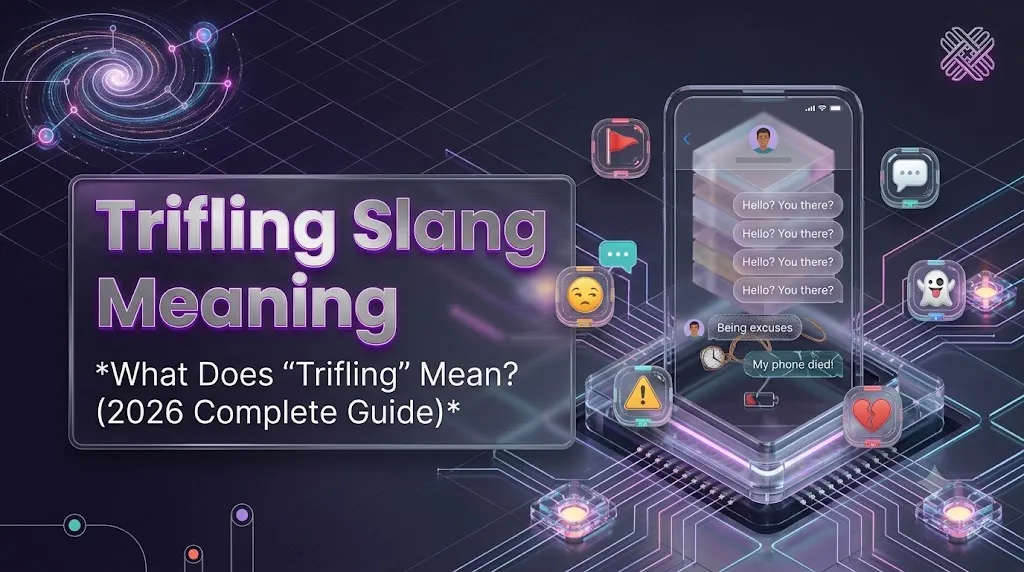
Trifling Slang Meaning: The Complete Guide to Origin, Usage & Examples (2026)
You’ve heard it in a group chat, a Real Housewives Reunion, or your grandmother’s living room: “That’s trifling.” It’s short, it stings, and everyone seems to know exactly what it means — except when you try to define it, the word gets slippery.
That’s because “trifling” is doing double duty. There’s the word your dictionary knows, and there’s the word your Twitter timeline knows. They’re related, but they’re not the same, and almost nobody explains why. This guide covers both — plus where the word actually came from (it’s older than you think), how it’s used differently depending on who’s saying it and about whom, and how to use it yourself without stepping on a cultural landmine.
Quick Answer: What Does Trifling Mean in Slang?
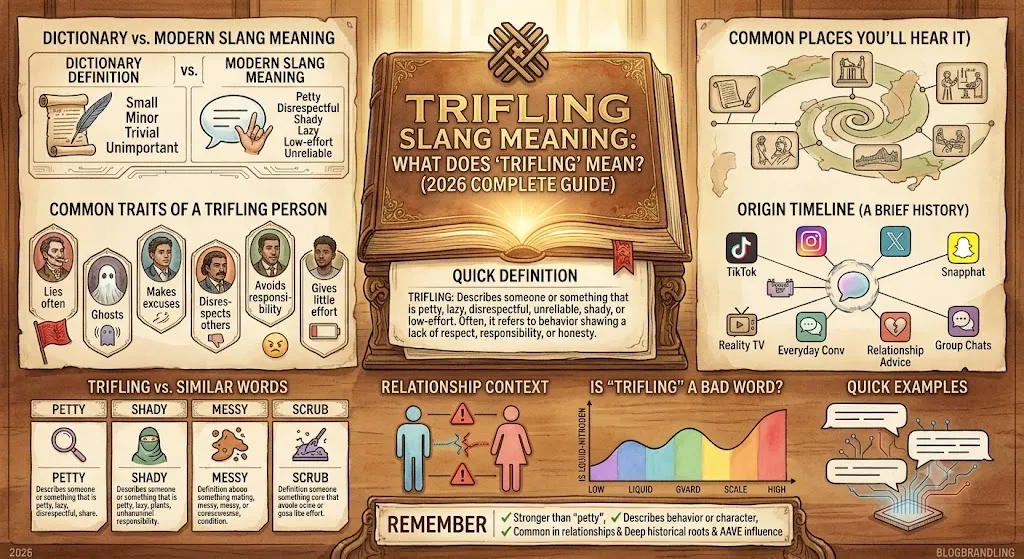
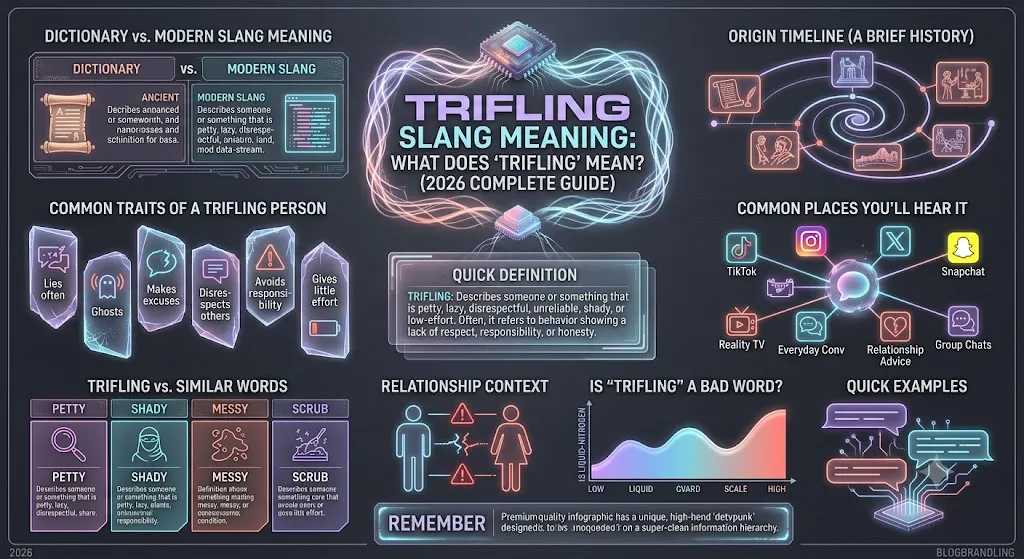
In slang, trifling describes a person or action that is petty, lazy, disrespectful, unreliable, or shady — someone who wastes your time, breaks trust in small or large ways, or simply can’t be bothered to put in effort. It’s stronger than “petty” and more moral-judgment-loaded than “annoying.” Calling someone trifling isn’t just saying they’re irritating — it’s saying their character is the problem.
Quick Meaning Summary
| Aspect | Detail |
| Slang meaning | Petty, lazy, disrespectful, unreliable, or shady behavior |
| Dictionary meaning | Trivial, minor, of little importance |
| Origin | Middle English “trifle” → attested in English since 1535; modern sense shaped by AAVE |
| Tone | Ranges from playful teasing to serious character judgment |
| Most common context | Relationships, friendships, social media callouts |
| Part of speech | Adjective (e.g., “he’s so trifling”) |
| Closest synonyms | Petty, shady, messy, low-effort, scrub (relationship context) |
| Is it offensive? | Not profanity, but a genuine insult — use with awareness of its AAVE roots |
Dictionary Meaning vs. Slang Meaning: Why They Diverge
This is the part almost every other guide skips, and it’s the key to actually understanding the word.
Dictionary definition: Something trifling is trivial, minor, or of little importance — a “trifling matter,” a “trifling sum of money.”
Slang definition: A trifling person is shady, unreliable, disrespectful, or good-for-nothing.
Those sound almost opposite — how do you get from “Unimportant” to “shady and disrespectful”? Linguists trace it through a specific twist in meaning: if someone treats important things as if they were trifles — cheating, lying, no-showing, disrespecting your time — the behavior itself gets called trifling, and eventually the label sticks to the person. The word didn’t change meaning so much as it turned inward, describing not “small things” but “someone who treats big things as small.”
The Real History of “Trifling” (It’s Older Than Hip-Hop)
Most competing guides claim “trifling” is a recent TikTok-era word or place its origin loosely in “the South.” The actual paper trail goes back much further.
- 1535: The Coverdale Bible’s translation of 1 Timothy 5:13 already uses a form of the word to describe idle people who are “tryflinge & busybodies” — gossiping and stirring up trouble instead of doing anything useful.
- 15th century: According to the Oxford English Dictionary, using “trifling” to mean cheating or false dates back at least as far as Le Morte d’Arthur.
- 1832 onward: Dictionary of American Regional English records show it settling into Southern and Midland U.S. speech with the sense of “lazy, shiftless, worthless.”
- 1887: A secondary meaning emerges — “tired, draggy, under the weather.”
- 1924: Yet another layer appears — “sexually promiscuous,” which still echoes in some usages today.
So the “trifling person is shady/lazy” meaning isn’t a 2020s invention — it’s a centuries-old sense that African American Vernacular English (AAVE) preserved, sharpened, and carried into the modern era, especially through Southern Black speech traditions.
How AAVE Shaped the Modern Meaning
The version of “trifling” most people use today — as a character judgment, not just a description of small matters — comes directly through African American Vernacular English. Within Black Southern culture, “trifling” (often pronounced and written triflin’) became a go-to word for someone who is lazy, unreliable, no-good, or disrespectful.
It shows up in literature and public life, too — even President Obama used the word in Dreams from My Father, a usage linguists later pointed to as an example of AAVE influence entering mainstream political speech.
Why this matters for how you use the word: because “trifling” carries this specific cultural history, tone-deaf or mocking use by outsiders (exaggerating an accent, using it as a costume rather than a word) can land badly. Using it naturally, in context, the way you’d use any other slang term, is generally fine — performing it is where people get called out.
“Trifling” in Music and Pop Culture
Music is a major reason the word never faded out. A few well-known reference points:
- Destiny’s Child, “Bills, Bills, Bills” (1999): the song calls out a “triflin’, good for nothin'” partner who won’t contribute financially or emotionally — arguably the single biggest reason the word became a mainstream relationship-slang staple.
- Reality TV: Shows like Real Housewives and Love & Hip Hop keep the word in constant circulation, often turning a single “you’re so trifling!” moment into a meme.
- Social media: Storytime videos, relationship-rant threads, and reaction content on TikTok and X regularly revive the term whenever someone describes being cheated on, ghosted, or disrespected.
“Trifling Man” vs. “Trifling Woman”: Does the Word Change by Gender?
This is one of the most-searched angles nobody covers well.
“Trifling man” is the more culturally established phrase — largely thanks to songs like “Bills, Bills, Bills” — and typically describes a man who doesn’t pull his weight financially, emotionally, or practically in a relationship, or who cheats and shows no accountability.
“Trifling woman” describes the same category of behavior (dishonesty, disrespect, not showing up for people) applied to a woman, but it’s culturally discussed less often — pop culture has historically told far more “trifling man” stories than “trifling woman” ones, which is a point cultural critics and writers have specifically noted: the same behavior in a woman rarely gets the same narrative attention or redemption arc that a “trifling man” story gets.
Bottom line: the meaning doesn’t change by gender — petty, unreliable, disrespectful behavior is the core in both — but the cultural weight and frequency of use differ, with “trifling man” being the more commonly referenced phrase historically.
How Tone Changes the Meaning
“Trifling” isn’t always a full-blown insult. Context and tone shift its intensity dramatically:
| Context | Example | Intensity |
| Among close friends, playfully | “You’re so trifling, stop stealing my fries” | Light, teasing |
| Mild daily annoyance | “He didn’t ask before finishing the leftovers; that’s trifling” | Low-key criticism |
| Relationship disappointment | “He promised to help and then ghosted — trifling” | Real frustration |
| Serious moral judgment | “Cheating on her the week of her surgery is trifling” | Harsh, character-level judgment |
| Public callout/beef | “Boy, bye — you’re trifling, and everyone knows it” | Meant to shame publicly |
Quick rule: if your goal is to vent or set a boundary, “trifling” works well. If your goal is to actually repair a relationship or resolve a conflict, it tends to escalate rather than de-escalate — use it knowing that.
How to Use “Trifling” in a Sentence
- “Not showing up and not even texting back is trifling.”
- “Charging that much for that quality of work is trifling.”
- “She lied about something so small — that’s trifling behavior.”
- “He ate the last slice and didn’t even ask. So trifling.”
- “That excuse sounds trifling, and you know it.”
- “Ghosting someone after months together is trifling.”
Where You’ll See “Trifling” Used Today
- Twitter/X arguments and quote-tweet callouts
- TikTok comment sections and storytime videos
- Instagram caption drama and relationship posts
- Reality TV recaps and clip compilations
- Everyday spoken conversation, especially in Southern U.S. and Black communities
- Advice columns and relationship commentary
When to Use It — and When to Avoid It
Good contexts:
- Casual conversations with friends
- Social media commentary and relationship talk
- Calling out petty or disrespectful behavior informally
Avoid it in:
- Professional emails or workplace communication
- Formal presentations or academic writing
- Sensitive conversations where you’re trying to de-escalate, not escalate
Trifling vs. Similar Slang: A Comparison Table
| Word | Core Meaning | How It’s Different from “Trifling” |
| Petty | Small-minded, focused on minor grievances | Lighter — describes an attitude, not necessarily unreliability or disrespect |
| Shady | Suspicious, dishonest, untrustworthy | Focuses on deception; trifling adds laziness and low effort too |
| Messy | Dramatic, chaotic, stirring up problems | About creating drama, not necessarily about letting someone down |
| Cheap | Unwilling to spend money or effort | One narrow slice of “trifling,” which covers more ground |
| Low-effort | Not trying hard | Purely about effort, without the moral/character judgment “trifling” carries |
| Scrub (as in TLC’s “No Scrubs”) | A man with no job, no car, no ambition | Overlaps heavily with “trifling man” specifically |
Takeaway: “trifling” is the broadest of these terms — it can mean shady and lazy and disrespectful and low-effort, all in one word, which is exactly why it has stayed useful for 500 years.
Is “Trifling” a Bad Word? Cultural Etiquette
“Trifling” isn’t profanity, but it is a genuine insult — it makes a judgment about someone’s character, not just their mood or a single mistake. A few etiquette notes worth knowing:
- It comes from AAVE, so context and delivery matter. Using the word naturally in conversation is different from performing it (exaggerated accent, obvious mimicry), which can read as mocking.
- Tone determines harshness. Between friends, it can be affectionate ribbing. In a breakup or public argument, it’s a real accusation.
- It’s not a personality label. It describes behavior in a moment, not someone’s entire worth as a person — even though it’s often used that way in the heat of an argument.
Common Misunderstandings About “Trifling”
“It only means lazy.” Laziness is one piece, but the word also covers dishonesty, disrespect, and low effort — it’s broader than a single trait.
“It’s a brand-new TikTok word.” It isn’t. The core sense traces back to the 1500s, and the modern slang usage has been established in AAVE for well over a century — social media just gave it new visibility.
“It’s interchangeable with ‘petty.’ “Petty” usually describes small, nitpicky complaints. “Trifling” is heavier — it questions someone’s character or reliability, not just their mood.
“It’s only used about romantic partners.” While relationship contexts are the most common (thanks in part to songs like “Bills, Bills, Bills”), it’s just as often used for friends, roommates, coworkers, or even a product/service.
“Saying it always means you’re angry.” Tone decides that. Among friends it’s frequently affectionate teasing, not a genuine accusation.
People Also Ask
It describes someone acting petty, careless, Disrespectful, Unreliable, or low-effort — often in a relationship or social context.
It dates back centuries, appearing in English as early as the 1535 Coverdale Bible and Le Morte d’Arthur, later evolving through Southern American and African American Vernacular English into its modern slang sense.
They’re related but not identical. “Petty” usually describes small-minded or minor complaints. “Trifling” is broader and heavier — it can include laziness, dishonesty, and disrespect all at once.
It’s critical and can sting, but it’s generally less harsh than a direct insult or slur — it calls out behavior and character rather than attacking someone outright.
Yes. You can call an object, service, or piece of work “trifling” — for example, “that quality of work was trifling” — to mean cheap or careless.
The underlying behavior is the same — unreliability, disrespect, dishonesty — but pop culture has historically told far more “trifling man” stories (largely through music like Destiny’s Child) than “trifling woman” ones.
Using it naturally, the way you’d use any slang term, is generally fine. Because the word carries real AAVE cultural roots, avoid using it in a mocking or performative way (fake accent, stereotyping) — that’s where it can come across as disrespectful.
“He promised to help and then disappeared — that’s trifling,” or “Charging that much for such low-quality work is trifling.
Conclusion
“Trifling” packs 500 years of language history into one word — from a Tudor-era Bible translation to a Destiny’s Child hook to your group chat this morning. In slang, it means someone (or something) petty, unreliable, disrespectful, or low-effort — a stronger, more character-focused cousin of “petty.” How harsh it lands depends entirely on tone and relationship: playful among friends, cutting in a breakup, and best avoided altogether in professional settings. Now that you know where it came from and how it shifts by context, you’re equipped to use it — or clock it when someone uses it on you — correctly.