What Vegetables Can Dogs Eat? Safe, Unsafe, and How to Serve Them
If you are asking What Vegetables Can Dogs Eat, the short answer is that many plain vegetables are safe in small amounts, including carrots, green beans, peas, cucumber, zucchini, broccoli, cauliflower, celery, pumpkin, and sweet potato. The key is to serve them plain, bite-sized, and in moderation. Dogs do not need vegetables as a core nutritional requirement, but they can work well as low-calorie treats when used correctly.
The bigger question is not just “safe or unsafe.” It is also how the vegetable is prepared, how much is served, and whether your dog has any health conditions. Some vegetables are easy on the stomach, some can cause gas, and a few are genuinely dangerous. That is why the best pages on this topic should not stop at a list. They should help you choose the right vegetable, in the right form, for the right dog.
Quick Answer: What Vegetables Can Dogs Eat?
Here is the fastest practical answer:
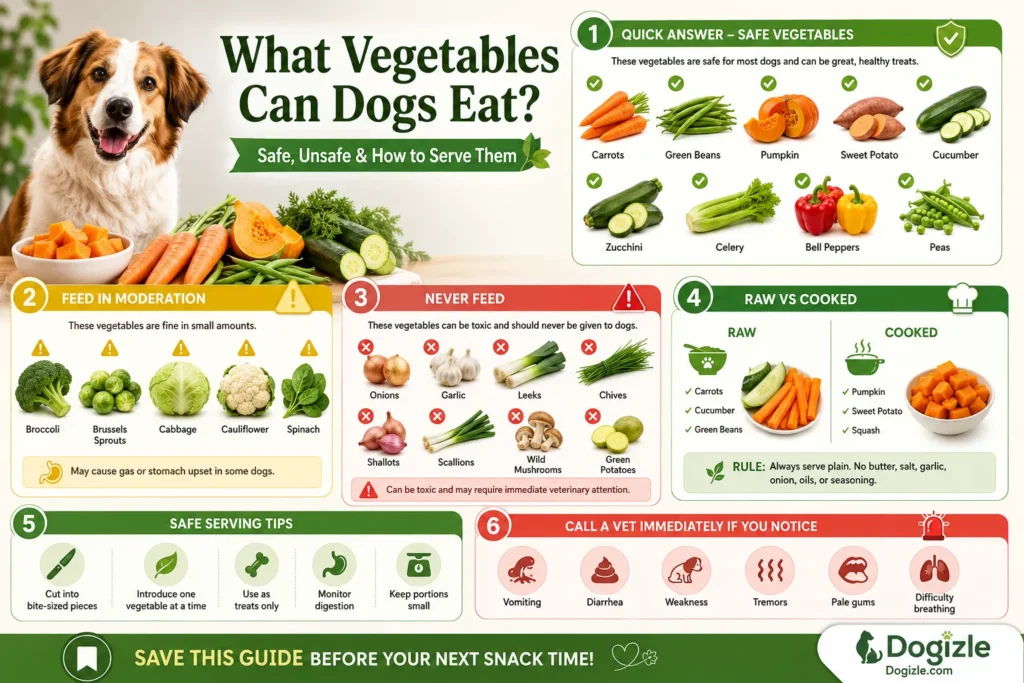
Dogs can usually eat carrots, green beans, peas, cucumber, zucchini, broccoli, cauliflower, celery, bell peppers, pumpkin, sweet potato, and small amounts of spinach, cabbage, and Brussels sprouts if they are served plain and in small portions. Avoid onions, garlic, leeks, chives, shallots, scallions, wild mushrooms, and raw or green potatoes. Tomatoes are a special case: the ripe fruit is treated differently from the leaves, stems, and green parts.
Safe Vegetables at a Glance
| Vegetable | Usual status | Best way to serve | Main note |
| Carrots | Safe | Raw or cooked, bite-sized | Low-calorie treat; crunchy and popular |
| Green beans | Safe | Plain, cooked, raw, or frozen | Great treat option; keep unseasoned |
| Peas | Safe in moderation | Fresh or frozen, plain | Good snack, but do not overfeed |
| Cucumber | Safe | Raw, chopped small | Hydrating, low-calorie treat |
| Zucchini | Safe | Raw or cooked, plain | Easier to digest when cooked |
| Broccoli | Safe in small amounts | Raw or cooked, tiny portions | Can cause gas or stomach upset if too much is eaten |
| Cauliflower | Safe in moderation | Small florets, plain | Can be a choking risk if not cut well |
| Celery | Safe in moderation | Small pieces | Stringy pieces can be hard to chew or digest |
| Pumpkin | Safe when plain | Cooked, plain, no pie filling | Better as a simple, soft food than a spiced dessert |
| Sweet potato | Safe when cooked | Boiled, steamed, or baked plain | Avoid seasoning and rich toppings |
Best Vegetables for Dogs
Some vegetables are especially practical because they are easy to serve, widely available, and usually well tolerated. Carrots, green beans, cucumber, and zucchini are among the simplest options for most dogs. They are easy to portion, easy to buy, and easy to keep plain. AKC, VCA, PDSA, and the Royal Kennel Club all point to these vegetables as useful treat choices when they are prepared without seasoning, oil, butter, or salt.
Carrots are a strong choice for many households because they are low in calories and easy to cut into small pieces. Green beans are another favorite because dogs often enjoy the texture, and both AKC and VCA describe them as safe, plain treat options. Cucumber and zucchini are useful for dogs that need a lighter snack, especially in warm weather or after exercise.
Why these vegetables work well
- They are usually easy to find in Europe, the UK, North America, and Australia.
- They can be served plain without much effort.
- They work well as a low-calorie training reward.
- They are easy to batch prep for busy dog owners.
- They fit apartment life, travel days, and family routines better than messy snacks.
Mini summary
If you need a simple rotation, start with carrots, green beans, cucumber, and zucchini. These are among the most practical “everyday” choices because they are easy to prepare and easy to portion.
Vegetables Dogs Can Eat in Moderation
Some vegetables are safe, but they are better treated as occasional foods rather than daily staples. This is usually because they may cause gas, stomach upset, or a choking risk when given in larger portions. Broccoli, Brussels sprouts, cabbage, cauliflower, spinach, and asparagus fall into this category for many dogs.
Broccoli is safe in very small amounts, but too much can irritate the stomach. AKC specifically notes that broccoli should be given in very small quantities because the florets contain compounds that may cause gastric irritation. Blue Cross also notes that green beans can be more digestible when cooked, and that broccoli, Brussels sprouts, and cabbage are known gas-producing foods for some dogs.
Spinach is another food that belongs in the “small amounts only” category. MasterClass and other current sources say dogs can eat spinach in moderation, but too much may lead to digestive upset, and some guidance also warns about kidney-related concerns. That makes spinach a “use carefully” vegetable, not a main treat.
Asparagus appears on several safe-food lists, but it is not usually the strongest choice for a pillar article because it is less practical, can be tough, and may not be as easy to digest. That is why a high-quality dog article should not just repeat every “technically safe” vegetable. It should guide readers toward the foods that are genuinely useful at home.
Moderation table
| Vegetable | Why limit it | Practical note |
| Broccoli | Can cause gas or gastric irritation | Tiny portions only |
| Brussels sprouts | Can cause flatulence | Offer sparingly |
| Cabbage | Can be gassy | Small servings only |
| Spinach | Small-amount food | Not a daily staple for most dogs |
| Cauliflower | Choking / gas risk | Cut small and serve plain |
| Celery | Stringy texture | Chop very small |
Mini summary
The safest strategy is to treat these vegetables as occasional add-ons, not everyday snacks. If your dog already has a sensitive stomach, start with easier options like carrots, cucumber, or green beans instead.
Vegetables Dogs Should Never Eat
The most important vegetables to avoid are the Allium family: onions, garlic, leeks, chives, shallots, and scallions. These can damage red blood cells and may cause anemia. ASPCA, VCA, PDSA, the Royal Kennel Club, and other veterinary sources all warn against them. Even cooked, dried, or powdered forms can be dangerous.
Wild mushrooms should also be treated as dangerous because they can be very hard to tell safe species from poisonous ones. PetMD explains that mushroom poisoning can cause vomiting, diarrhea, tremors, seizures, and even liver or kidney failure. Grocery store mushrooms are different from wild ones, but anything wild should be treated with caution.
Raw potatoes, green potatoes, and tomato leaves or stems are also unsafe. Blue Cross notes that young green tomatoes and the leaves and stems are the risky parts, not the ripe fruit itself. That distinction matters because many dog owners mistakenly assume all tomato parts are the same.
Avoid list table
| Vegetable/plant part | Why is it unsafe | What to do |
| Onion | Can damage red blood cells | Keep out of reach and call a vet if eaten |
| Garlic | Can cause anemia | Do not rely on “small amounts” advice |
| Leeks | Toxic Allium vegetable | Seek vet guidance quickly |
| Chives | Toxic Allium vegetable | Treat as an emergency food exposure |
| Shallots/scallions | Toxic Allium vegetables | Do not feed in any form |
| Wild mushrooms | Can be deadly | Contact a vet right away |
| Raw/green potatoes | Unsafe plant parts | Avoid completely |
| Tomato leaves/stems / green fruit | Solanine risk | Do not let dogs chew the plant |
Mini summary
The highest-risk vegetables are usually the onion family, wild mushrooms, and unsafe potato or tomato plant parts. These are not “moderation” foods. They avoid certain foods completely.
Raw vs. Cooked Vegetables for Dogs
Many vegetables can be served raw or cooked, but the best choice depends on the vegetable and your dog’s stomach. VCA says many fresh vegetables can be offered raw or cooked, as long as they are plain and free from seasoning, butter, or oil. AKC also notes that vegetables like broccoli can be safe raw or cooked, while pumpkin, squash, and sweet potato are generally better cooked.
Cooking helps soften tougher vegetables and may make them easier to digest. That is especially helpful for sweet potato, pumpkin, squash, and sometimes green beans or zucchini. PDSA and Blue Cross both emphasize plain preparation and small bite-size pieces.
Raw vegetables can be fine when they are chopped small, and the dog chews well. That said, raw hard vegetables can be a choking risk for small dogs, puppies, or dogs that swallow food too quickly. MasterClass and the Royal Kennel Club both emphasize cutting vegetables into very small pieces and serving them in moderation.
Best rule of thumb
- Raw works best for crunchy, easy-to-chop items like carrots, cucumber, and some green beans. Cooking works best for starchy or tougher vegetables like sweet potato, pumpkin, and squash.
- Always keep it plain.
- Never add onion, garlic, butter, salt, sauces, or spices.
How Much Vegetable Can a Dog Eat?
Vegetables should be treated as treats, not as a replacement for complete dog food. VCA advises keeping treats to a very small share of daily calories, while Forbes notes a 10% ceiling for vegetables in the diet. A conservative,e practical approach is to keep vegetables occasional and small, especially if your dog is new to them.
A good starting point is to offer only a few tiny pieces the first time. If your dog does well, you can slowly increase within reason. Too much too soon can trigger vomiting, diarrhea, bloating, or gas. That warning is consistent across the veterinary and charity sources reviewed here.
Practical serving guide
| Dog type | Starting amount | Notes |
| Toy / small dog | 1–2 small pieces | Watch for choking and loose stool |
| Medium dog | A few bite-sized pieces | Start slowly, especially with broccoli or cabbage |
| Large dog | Small handful at most | Treat, not a bowlful |
| Puppy | Tiny pieces only | Use extra caution with chewing and digestion |
| Senior dog | Soft, easy-to-chew pieces | Cooked may be easier than raw |
This table is a practical editorial guide, not a medical prescription. Dogs with diabetes, kidney disease, pancreatitis, chronic diarrhea, or food allergies may need different advice from their veterinarian.
Mini summary
The easiest mistake is thinking “vegetable” automatically means “healthy in any amount.” In reality, the safest plan is small, plain, occasional, and dog-specific.
Can Puppies Eat Vegetables?
Yes, puppies can usually eat dog-safe vegetables in tiny amounts, but the pieces should be very small and easy to chew. Puppies have smaller airways, more sensitive stomachs, and less experience with chewing unfamiliar food. That means their vegetable snacks should be simpler and more controlled than an adult dog’s.
For puppies, the safest starting choices are often cooked pumpkin, tiny carrot pieces, or small bits of green bean. Avoid hard chunks, stringy celery, and anything difficult to chew. Also, avoid giving puppies any vegetables that are known to be dangerous, even in small amounts, especially Alliums and wild mushrooms.
Puppy-friendly rule
Keep the first serving so small that it feels almost boring. That is exactly what you want. The goal is to test tolerance, not to make vegetables a major part of the puppy’s diet.
Dog Types That Need Extra Care
Sensitive stomachs
If your dog gets gas or loose stool easily, keep to the gentlest vegetables and stay away from gas-producing ones like broccoli, Brussels sprouts, cabbage, and large amounts of peas. Blue Cross and AKC both flag gas and digestive upset as common issues with these vegetables.
Overweight dogs
Vegetables can be useful for dogs that need lighter treat options because they are often lower in calories than many commercial snacks. VCA explicitly suggests water-based vegetables such as green beans, broccoli, and zucchini as treat alternatives. That makes them helpful in a weight-control plan when used in moderation.
Senior dogs
Older dogs may do better with softer vegetables that are easier to chew and digest. Cooked green beans, steamed pumpkin, and soft zucchini are often easier than raw, crunchy pieces. The main idea is to keep the snack easy, plain, and small.
Dogs with kidney or bladder issues
Some vegetables are more appropriate than others if your dog has kidney, bladder, or dietary restrictions. MasterClass specifically warns that spinach may not be ideal for every dog, and some vegetables are better introduced only after veterinary advice. This is where the “safe for most dogs” label is not enough.
What to Do If Your Dog Ate the Wrong Vegetable
If your dog ate onion, garlic, leek, chive, shallot, scallion, or a wild mushroom, treat it seriously and contact your veterinarian promptly. VCA, ASPCA, PDSA, and PetMD all warn that onion-family foods can damage red blood cells and that wild mushroom exposure can cause severe gastrointestinal and neurological signs.
Emergency warning signs
Call a vet immediately if you notice:
- repeated vomiting
- diarrhea that does not settle
- weakness or collapse
- pale gums
- discolored urine
- tremors or seizures
- severe lethargy
- trouble breathing
PDSA and the Royal Kennel Club note that onion poisoning signs may take days to appear, and VCA also warns that toxic plant exposures should not be ignored even if symptoms are not immediate.
What not to do
Do not try to “balance it out” with another food. Do not wait to see if it passes. So do not assume that cooked onion, onion powder, or leftover gravy is harmless. Veterinary and charity sources repeatedly warn that these exposures can still be dangerous.
Europe-Specific Practical Advice
For European and UK dog owners, the biggest everyday risk is often not the vegetables in your fridge. It is the vegetables in leftovers, sauces, and garden access. Onion-heavy dishes, soups, stuffing, gravy, bhaji, and similar foods are common household risks because onion, garlic, leeks, and chives are all part of the toxic Allium family.
The Royal Kennel Club also advises keeping dogs on paths and away from crops, including fields of fruit and vegetables, when walking in the countryside. That matters for farm edges, pick-your-own areas, allotments, and any place where dogs might find dropped produce or dig into crops.
European household habits that help
A simple “no leftovers from the pan” rule solves many accidents. If it came from a tray, gravy boat, wok, or takeaway box, check the ingredients first. That single habit prevents many unnecessary vet calls. This is especially important in apartment homes where dogs are close to kitchen counters and table scraps.
Apartment Living Scenarios
Apartment dogs often benefit from vegetables because they can be used as low-calorie treats without adding too much mess. A few tiny cucumber pieces, green beans, or carrot slices are easy to store in a container and hand out during training or enrichment. That makes vegetables useful for city homes, small kitchens, and busy schedules.
For indoor dogs, frozen green beans or chilled cucumber can also be a practical warm-weather snack. MasterClass specifically notes frozen green beans as a summer option, and VCA describes frozen vegetables as crunchy and appealing for many dogs.
Good apartment use cases
- training treats during recall practice
- a light snack for weight management
- enrichment in a lick mat or puzzle feeder, if your dog tolerates it
- a cooling snack in warm weather
- a simple substitute when you do not want to use calorie-heavy treats
Pros & Cons of Feeding Vegetables to Dogs
Pros
- low-calorie treat option
- easy to prepare plain
- useful for weight-control routines
- can add variety and enrichment
Cons
- Some vegetables cause gas or diarrhea
- choking risk if pieces are too large
- Toxic vegetables are common in kitchens and gardens
- not a replacement for balanced dog food
Common Mistakes Dog Owners Make
- Serving vegetables with seasoning, oil, or butter. Plain is safer.
- Giving too much too soon. Even safe vegetables can upset the stomach in large amounts.
- Assuming all Green Foods are safe. Onion-family vegetables are a major exception.
- Forgetting the choking risk. Small dogs and puppies need tiny pieces.
- Using vegetables as a meal replacement. Treats should remain treats.
Expert Tips
- Start with one new vegetable at a time so you can spot reactions.
- Keep a few “default safe snacks” in the fridge: carrots, green beans, cucumber, and zucchini.
- Steam or boil harder vegetables when your dog has a sensitive stomach.
- Use vegetables as a training reward only when your dog already tolerates them well.
- Treat any onion-family exposure as a real safety issue, not a harmless bite.
People Also Ask
Yes, many dogs can eat raw vegetables such as carrots, cucumbers, and some green beans, as long as they are plain and cut into small pieces. Some vegetables, like pumpkin and sweet potato, are usually better cooked first.
Yes, but only if they are plain and unsalted. Adding sodium, seasoning, butter, or sauces can change the safety profile quickly.
Broccoli, Brussels sprouts, cabbage, peas, and cauliflower are common gas-producing vegetables. Small amounts are usually better tolerated than large servings.
They can eat small amounts of safe vegetables often, but vegetables should stay in the treat category and not replace complete dog food.
Plain pumpkin is commonly listed as a safe vegetable, especially when cooked and served without seasoning. Keep it simple and do not use pie filling.
Cooked plain potatoes can be treated differently from raw or green potatoes, but the raw or green parts should be avoided. Blue Cross specifically warns against the unsafe plant parts.
Broccoli itself is commonly listed as safe in very small amounts, but the best approach is to serve tiny pieces and avoid giving too much of the fibrous parts. That reduces gas and choking risk.
Conclusion
Many vegetables are safe for dogs when they are served plain, cut small, and given in Moderation. The most practical choices are usually carrots, green beans, cucumber, and zucchini, while broccoli, Brussels sprouts, cabbage, spinach, and cauliflower are better used in smaller amounts. Onions, garlic, leeks, chives, shallots, scallions, wild mushrooms, and unsafe potato or tomato plant parts should be avoided completely.
The strongest pillar page is not the one that repeats the longest list. It is the one that helps owners make the right decision quickly: what is safe, what is limited, what is dangerous, how to serve it, and when to call the vet. That is the kind of content dog owners bookmark, trust, and share.