Introduction
Dachshunds are small dogs with a big appetite for life, but their long backs and short legs make food choice more important than many owners realize. Extra weight puts more strain on the spine and joints, and both AKC and PetMD warn that overweight Dachshunds face higher risk of back problems and other health issues. That is why the best dog food for dachshunds is not just “cute breed packaging.” It is a food that is complete and balanced, appropriate for the dog’s life stage, easy to portion, and practical to maintain over time.
The goal is simple: keep your Dachshund lean, comfortable, and well-fed without turning every meal into guesswork. WSAVA recommends a tailored nutrition plan based on the individual pet, and AAFCO explains that complete and balanced foods should match the intended life stage and include feeding directions on the label. That gives owners a much better framework than chasing trends or marketing claims alone.
Snippet Answer: What Is the Best Dog Food for Dachshunds?
The best dog food for Dachshunds is a complete and balanced diet with controlled calories, digestible protein, and feeding directions that match the dog’s age, body condition, and activity level. For many Dachshunds, that means a small-breed or breed-appropriate formula with measured portions and careful weight control.
What Makes Dachshunds Different Nutritionally?
Dachshunds are not “hard to feed,” but they are easy to overfeed. Their long frame makes extra weight more dangerous than it would be in many other breeds, and obesity can worsen orthopedic and spinal issues in dogs generally. AKC specifically highlights Dachshunds as a breed where staying lean matters for preventing disc damage.
In practical terms, the best food for this breed usually has five things going for it:
- controlled calories
- quality animal protein
- good digestibility
- useful fat, not excess fat
- a kibble size that is easy for a small mouth to pick up and chew
Royal Canin’s Dachshund formulas show how brand-specific nutrition often tries to address these exact needs with breed-focused kibble, weight support, and digestibility. That does not mean brand-specific food is the only option, but it does show what matters most for the breed.
Quick Summary
If a food helps your Dachshund stay lean, supports digestion, and fits the dog’s age and size, it is closer to the right answer than any “best dog food” headline alone.
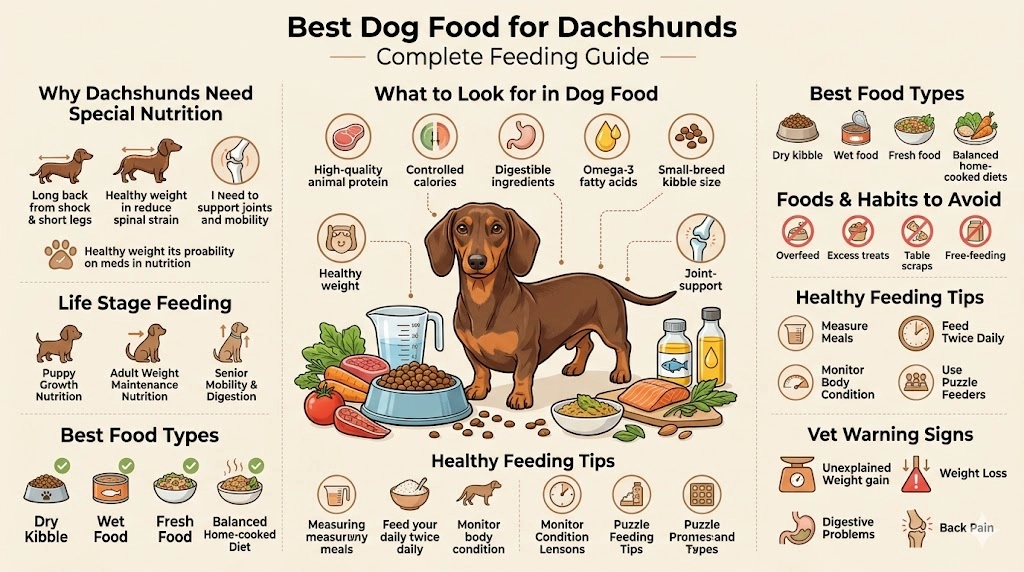
What to Look for in the Best Dog Food for Dachshunds
Start with the label, not the marketing. AAFCO says pet food should be complete and balanced for a recognized life stage, such as growth, maintenance, or all life stages. It also says complete-and-balanced foods need feeding directions on the label, which is useful because small dogs can gain weight quickly when portions are guessed instead of measured.
Look for these basics:
- a clear AAFCO nutritional adequacy statement
- the correct life stage
- a named animal protein source
- moderate calorie density
- feeding directions you can actually follow
- a company that explains how the diet is formulated and tested
WSAVA recommends asking who formulates the diet, what credentials they have, and how quality control is handled. That is a more trustworthy way to judge a dog food than simply trusting “premium,” “fresh,” or “human-grade” language.
Food Type Comparison Table
| Food type | Best for | Main benefit | Main caution |
| Dry kibble | Most adult Dachshunds | Easy to measure and budget-friendly | Watch portion size and calorie density |
| Wet food | Picky eaters, hydration support | Palatability and moisture | Calories can add up fast |
| Fresh food | Owners who want highly palatable meals | Often appealing for fussy dogs | Must still be complete and balanced |
| Home-cooked | Highly customized feeding | Can be tailored with veterinary help | Nutrient imbalance risk if not formulated properly |
This is where many competitor pages stay vague. They mention “healthy weight” or “better digestion,” but they do not explain how to compare formats in real life. Your article should make it easy to choose based on calories, life stage, and practical feeding habits. WSAVA’s nutrition guidance supports that individualized approach.
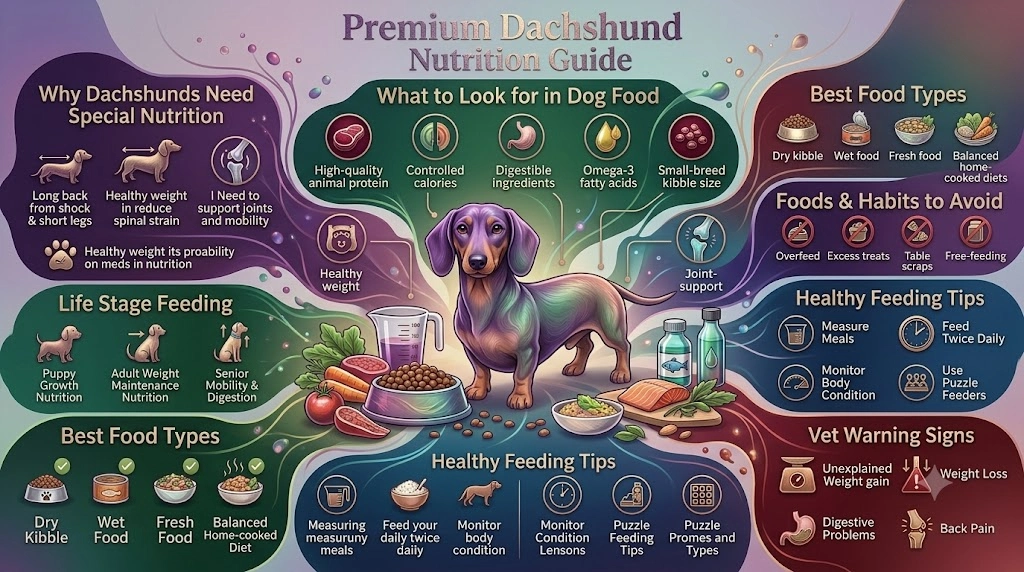
Best Food Types for Dachshunds: Kibble, Fresh, Wet, and Home-Cooked
1) Dry kibble
Dry food is often the easiest option for Dachshund owners who want consistent portions and predictable calories. For many dogs, this is the simplest way to keep meals measured and routine-based. Royal Canin’s breed pages also show how kibble shape and texture can be used to support breed-specific feeding.
2) Fresh food
Fresh food can work well for Dachshunds that are picky eaters or owners who prefer a more palatable plan. The important part is not the freshness claim itself; it is whether the food is complete, balanced, and correctly portioned. Spot & Tango and The Honest Kitchen both position fresh or minimally processed food around digestion, body composition, and wellness, but those claims still need to be checked against the label and feeding plan.
3) Wet food
Wet food can help with appetite and hydration, especially in older dogs or dogs that are hard to please. Royal Canin even offers a wet Dachshund formula for adult dogs over 10 months old, which shows how wet food can fit into a breed-aware plan. Just remember that wet food still needs to fit inside the total daily calorie budget.
4) Home-cooked food
Home-cooked meals may sound healthy, but they are the easiest way to create an unbalanced diet if they are not properly formulated. If a Dachshund needs home-cooked food for a medical reason, that plan should come from a veterinarian or veterinary nutrition specialist. WSAVA’s nutrition guidance strongly supports professional formulation rather than guesswork.
Mini Summary
The best format is the one you can feed correctly every day. A perfect food is useless if the portions are wrong or the dog refuses to eat it.
Best Dog Food for Dachshund Puppies
Puppies need growth nutrition, not adult maintenance food. AAFCO separates growth from maintenance because puppies have different nutrient needs during development. That matters for Dachshunds because overfeeding during growth can create long-term weight problems, while underfeeding or poor-quality food can compromise development.
For a Dachshund puppy, focus on:
- a growth or all-life-stages formula
- clear feeding directions by age and weight
- digestible protein
- controlled calories
- small, easy-to-chew kibble
Spot & Tango’s puppy guidance also reinforces a key point many owners miss: eating more is not always better, even in a growing puppy. Portion control matters early.
Puppy Feeding Table
| Puppy stage | Main goal | What to prioritize |
| 8 weeks to 6 months | Healthy growth | Growth formula, frequent meals, measured portions |
| 6 to 10 months | Steady development | Monitor body condition, avoid overfeeding |
| 10+ months | Transition toward adult food | Switch gradually if vet-approved |
Practical Puppy Advice
Use the food label as a starting point, then adjust based on body condition, stool quality, and your vet’s guidance. Puppies should look lean, not round. For Dachshunds, staying too heavy too early is a mistake that can follow them into adulthood.
Best Dog Food for Adult Dachshunds
Adult Dachshunds do best on a food that helps them stay lean without leaving them constantly hungry. This is the stage where most owners need the clearest feeding system, because small overages add up quickly. PetMD notes that how much you feed depends on the specific food, the dog’s health, and activity level, and that the bag instructions plus your veterinarian help determine the right amount.
For adults, your priorities should be:
- stable body weight
- good digestion
- decent satiety
- treat control
- consistent meal times
Many brand pages talk about weight management, but they rarely show readers what to do every day. That is your chance to win the keyword. Measured meals, body-condition checks, and treating treats as part of total calories are what actually keep a Dachshund in shape. AKC links excess weight in Dachshunds to back problems, and WSAVA recommends nutrition decisions based on the individual dog, not generic guesswork.
Adult Feeding Mistakes to Avoid
- free-feeding all day
- using too many treats
- changing food too often
- assuming “small dog” means “can handle extra snacks”
- ignoring slow weight gain until it becomes obvious
Quick Rule
If your Dachshund is gaining weight, do not wait for a dramatic change. Adjust portions early and get veterinary advice if the gain is unexplained.
Best Dog Food for Senior Dachshunds
Senior Dachshunds often need fewer calories, but they still need quality protein and easy digestion. Royal Canin’s Dachshund line specifically distinguishes adult and senior feeding, which is a useful reminder that the life stage matters just as much as the breed.
For seniors, prioritize:
- lean body condition
- digestibility
- mobility support
- easy chewing
- regular reassessment if appetite changes
A senior Dachshund that starts losing weight, eating less, or showing stiffness should not be managed with a random food switch alone. Appetite changes and weight changes can be signs of pain or disease, and PetMD also notes that unexplained weight loss or appetite change should raise concern in dogs.
Senior Summary
Older Dachshunds do not need “rich” food by default. They need the right calorie level, good protein, and a plan that protects both mobility and digestion.
How Much Should a Dachshund Eat?
There is no universal number. Feeding depends on body weight, age, neuter status, activity, and the calorie density of the food. PetMD says the feeding amount should be based on the specific food, the dog’s health, and activity level, with the veterinarian and the bag instructions helping guide the amount. AAFCO also requires feeding directions on complete-and-balanced foods, which makes the label a useful starting point.
Feeding Guide Table
| Situation | Feeding focus | What to do |
| Underweight Dachshund | Build body condition | Rule out illness, then increase calories carefully |
| Ideal weight | Maintain stability | Measure portions and keep a routine |
| Overweight Dachshund | Reduce calories | Cut treats, review portions, ask vet if needed |
| Very active dog | Support energy needs | Adjust feeding based on activity and body condition |
| Senior dog | Preserve lean mass | Avoid unnecessary calorie surplus |
The better rule
Feed by body condition, not by habit. If your Dachshund is too heavy, reduce calories. If your Dachshund is too thin, do not guess; rule out medical causes first. AKC specifically warns that weight gain is especially harmful in Dachshunds because of back problems.
Foods and Ingredients to Avoid
The biggest mistake is not one ingredient. It is buying a food that sounds good but does not clearly prove it is complete and balanced. AAFCO’s label guidance exists to help owners compare foods more objectively, while WSAVA advises asking practical questions about formulation and quality control.
Be careful with:
- foods without a clear nutritional adequacy statement
- vague “premium” claims with no real detail
- too many calorie-dense toppers
- frequent table scraps
- overuse of treats
Also avoid assuming that “grain-free” automatically means better, or that “fresh” automatically means safer. The real question is whether the diet is nutritionally complete, correctly formulated, and appropriate for your dog’s needs. WSAVA’s guidance makes that point very clearly.
Safety Note
If your Dachshund has repeated vomiting, chronic loose stools, itchy skin, recurring ear issues, or unexplained appetite changes, the issue may not be the brand at all. A vet exam is the smarter move.
How to Read a Dog Food Label for a Dachshund
This is one of the easiest ways to outrank weaker pages. Most pages mention nutrition, but they do not teach readers how to judge food. AAFCO and WSAVA give you the best framework here.
Label Checklist
- Find the AAFCO nutritional adequacy statement.
- Check whether the food is for growth, maintenance, or all life stages.
- Look at the feeding directions and compare them with your dog’s body condition.
- Review the ingredient list and guaranteed analysis.
- Confirm that the company can explain how the diet was formulated and tested.
What good label language tells you
A good label tells you the food is intended for the right life stage and gives you a usable feeding guide. It does not rely on vague wellness language alone. WSAVA also encourages asking about the formulator’s credentials and the manufacturer’s quality-control process.
Mini Summary
If the label cannot tell you clearly who the food is for and how to feed it, that is a warning sign.
Best Feeding Tips to Prevent Weight Gain and Back Stress
This is the section that can genuinely beat the competition because it turns nutrition into action.
Do this instead of guessing
- Measure meals with a kitchen scale or consistent measuring cup.
- Split food into two meals per day for easier control.
- Count treats as part of total calories.
- Use slow feeders or puzzle feeders for enrichment instead of extra snacks.
- Check body condition every month.
Royal Canin’s Dachshund formula and AKC’s Dachshund guidance both reinforce the importance of staying lean, while PetMD says feeding should be individualized rather than guessed.
Common mistakes dog owners make
- feeding too much because the dog “looks hungry”
- switching foods without a transition
- using too many toppers
- assuming exercise alone will fix weight gain
- ignoring gradual weight creep
Expert Tip
For small dogs, a few extra treats can matter more than owners expect. With Dachshunds, it is often the hidden calories, not the main meal, that push weight up.
Best Dog Food for Dachshunds with Sensitive Stomachs
Some Dachshunds do better on diets with simpler ingredient lists, easier digestibility, or a careful transition plan. The Honest Kitchen’s Dachshund content focuses on tummy-friendly recipes, while WSAVA’s nutrition framework reminds owners to judge the entire diet, not just one ingredient headline.
Watch for signs of intolerance
- frequent gas
- loose stools
- stomach upset after meals
- recurring ear or skin issues
- reluctance to eat
If these signs keep happening, the answer may be a better-formulated diet, a slower transition, or a veterinary workup. Do not keep changing foods at random.
Europe-Specific Practical Advice
For readers in the UK and Europe, it helps to think in terms of nutritional requirements, responsible pet ownership, and transparent manufacturer information. FEDIAF represents the European pet food industry and emphasizes nutritional requirements, responsible ownership, and pet wellbeing. That makes it a useful contextual reference point for European readers choosing dog food.
What European owners should check
- whether the food is complete and balanced for the correct life stage
- whether the feeding guide is clear and practical
- whether local veterinary advice aligns with the dog’s body condition and activity
- whether the food suits apartment life, seasonal activity changes, and travel routines
Seasonal and climate considerations
In colder months, many Dachshunds get less exercise, which means calorie control becomes even more important. The warm weather, hydration and activity timing matter more. In both cases, the food itself is only part of the solution; the routine around the food matters just as much. WSAVA’s guidance supports a personalized approach rather than a one-size-fits-all one.
Apartment Living, Urban Life, and Small-Space Feeding
Dachshunds can fit very well into apartment and city living, but small-space life often means fewer natural activity opportunities. That makes measured feeding, treat control, and daily walk structure more important. For urban owners, food choice should support lean body condition, easy digestion, and predictable routines.
Apartment-friendly feeding habits
- feed at fixed times
- avoid constant snacking
- keep water easy to access
- use short training sessions with tiny treats
- combine feeding with daily movement routines
Why this matters
The more sedentary the lifestyle, the more important calorie precision becomes. In small dogs, “just a little extra” can become a real problem over time.
Pros and Cons of Breed-Specific Dachshund Food
| Pros | Cons |
| Often designed for small mouths and breed needs | Usually more expensive |
| May support weight control and digestibility | Can be more marketing-driven than necessary |
| Convenient for owners who want a simple choice | Not the only valid option |
| Can make feeding easier for picky dogs | Still needs portion control and label checking |
Royal Canin’s breed line shows the upside of breed-focused nutrition, but WSAVA and AAFCO make it clear that the label, nutrient adequacy, and feeding plan matter more than the breed claim alone.
When to Ask Your Vet for Help
Ask your vet if your Dachshund has any of these:
- unexplained weight gain
- unexplained weight loss
- persistent gas or diarrhea
- recurring skin or ear problems
- back pain or reluctance to move
- sudden appetite changes
- difficulty maintaining a healthy body condition
AKC and PetMD both make it clear that Dachshunds are especially vulnerable to problems caused by excess weight, and PetMD notes that feeding should be adjusted to the dog’s health and activity level. If the dog’s body is changing despite careful feeding, a medical issue may be involved.
Danger signs that need prompt attention
If a Dachshund shows limping, dragging limbs, a hunched back, or sudden pain, get veterinary help quickly. AKC says those signs can be associated with IVDD and should not be ignored.
People Also Ask
The best choice is a complete-and-balanced food that fits your dog’s life stage, supports lean body condition, and includes clear feeding directions. For many Dachshunds, controlled calories and good digestibility matter most.
Breed-specific food can be helpful, especially if it supports kibble size, weight control, or digestion. It is not required, though. The real test is whether the diet is complete, balanced, and appropriate for the dog’s stage of life.
Fresh food can work well if it is nutritionally complete and correctly portioned. It is not automatically better than kibble or wet food; the deciding factors are calories, digestibility, cost, and how well you can feed it consistently.
Measure meals, limit treats, avoid free-feeding, and check body condition regularly. Weight gain is especially risky in Dachshunds because it can worsen back strain and spinal problems.
Yes. Puppies need growth-appropriate nutrition, not adult maintenance food. Choose a food with clear feeding directions and gradual weight gain rather than overfeeding for the sake of growth.
Conclusion
The Best Dog Food for Dachshunds is the food that keeps them lean, nourished, and comfortable for the long term. That means choosing a complete-and-balanced diet, matching the life stage, reading the label properly, and managing portions with discipline. For Dachshunds, weight control is not cosmetic; it is part of protecting the back and joints. The strongest pages on this topic will not be the loudest sales pages. They will be the ones that teach owners how to make a safe, confident, repeatable feeding decision.
Use this guide as your foundation, keep the advice practical, and always adjust based on your dog’s body condition and your veterinarian’s guidance. Bookmark it, share it with other Dachshund owners, and explore more Dogizle.com guides to build a better everyday routine for your dog.
This content is for educational and informational purposes only and does not replace professional veterinary advice. Always consult a licensed veterinarian for medical concerns regarding your dog.