Introduction
Choosing the Best Dog Food for Diabetic Dogs is not about chasing the trendiest bag on the shelf. It is about helping your dog stay stable, eat consistently, and avoid dangerous blood sugar swings. Veterinary guidance keeps coming back to the same fundamentals: timed meals, insulin coordination, controlled starch, enough fiber, healthy body weight, and a food your dog will reliably eat every day.
That matters because diabetic dogs do best when food and insulin work together, not against each other. Cornell warns against free-feeding and says meals 10–12 hours apart work best for most dogs, while Merck says most dogs require two insulin doses a day with two equal-calorie meals given immediately before insulin. Purina and PetMD both emphasize that diet changes and feeding inconsistency can destabilize glucose control.
In this guide, you will get more than a brand list. You will get a practical buying framework, label-reading tips, special-case advice for overweight and underweight dogs, Europe-friendly guidance, and a simple way to decide what actually fits your dog’s diabetes plan.
What makes the best dog food for diabetic dogs?
The best food for a diabetic dog is usually one that helps reduce post-meal glucose spikes, supports a healthy body condition, and fits the dog’s insulin routine. AAHA says dogs with diabetes can do well on any complete and balanced diet that is fed at consistent times in consistent amounts and is palatable enough to produce predictable intake. Cornell and Purina Institute both emphasize the same core idea: consistency is a major part of control.
From a nutrition standpoint, the big levers are starch, fiber, protein, calories, and fat. Purina Institute notes that starch content strongly influences post-meal glucose and insulin response, while increased soluble and insoluble fiber can reduce postprandial hyperglycemia. PetMD explains that fiber slows absorption, and protein helps support muscle and body condition.
That is why “best” is not always the same as “lowest carb at any cost.” Some dogs need a weight-loss approach, some need more calories, some need pancreatitis-safe fat limits, and some need the most palatable food possible so they actually eat. The right answer depends on the dog, not just the label.
Mini takeaway: the best diabetic dog food is the one that keeps eating predictable, meals timed, glucose steadier, and body weight appropriate.
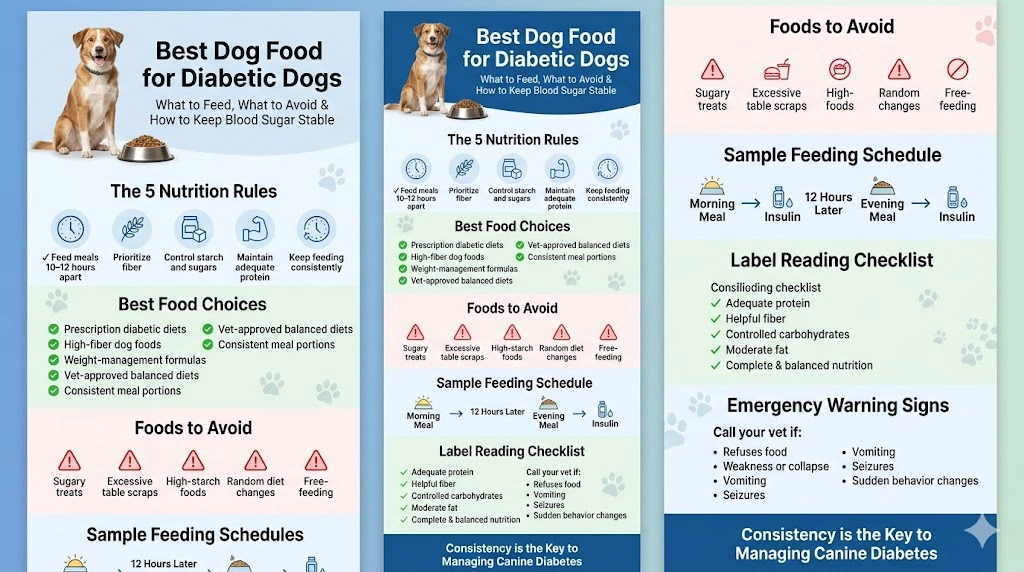
The 5 nutrition rules that matter most
1) Feed on a strict schedule
Cornell says diabetic dogs need correctly timed meals instead of free-feeding, and meals 10–12 hours apart work best for most dogs. Merck says most dogs require two doses of insulin per day, with two equal-calorie meals given immediately before insulin. This is one of the biggest reasons diabetic dog feeding is more about routine than variety.
2) Prioritize fiber
Purina says diabetic dogs may benefit from dietary fiber because it can help lower blood sugar and prevent glucose spikes. Cornell explains that insoluble fiber can help dogs feel full without excess calories, while soluble fiber slows digestion; both can matter, but the balance should fit the dog’s body condition.
3) Keep starch and simple sugars under control
Purina Institute states that starch is a key driver of post-meal glucose and insulin response in dogs. Cornell warns that highly digestible diets are often high in sugars and can cause glucose spikes followed by drops. Chewy’s vet-quoted benchmark puts ideal around 20%–25% carb matter on a dry matter basis, with anything above 30% considered high-carb for many diabetic dogs. That is a useful shopping reference, not a universal prescription.
4) Keep protein adequate
PetMD explains that protein helps maintain muscle and body weight, which matters because many diabetic dogs need stable lean mass to stay healthy. Purina Institute also lists maintaining healthy muscle mass as a dietary goal.
5) Match the diet to the dog’s body condition and medical risks
AAHA recommends a diet that corrects obesity, optimizes body weight, and minimizes postprandial hyperglycemia. Purina Institute adds that overweight dogs often need weight-loss support, while underweight dogs may need more calories with moderate fiber. Cornell adds that prescription diets may also help limit fat to reduce pancreatitis complications.
Mini takeaway: the food should support glucose control, but also the dog’s weight, appetite, and medical history.
Best dog food types for diabetic dogs
| Food type | Best for | Why it helps | Watch-outs |
| Prescription diabetic diet | Most newly diagnosed dogs, or dogs that need a structured plan | Built for glucose control, consistency, and predictable intake | Often vet-authorized only; still needs the right portioning and schedule |
| High-fiber complete diet | Dogs that do well with more fiber and steady meals | Fiber can reduce glucose spikes and improve satiety | Too much or the wrong fiber balance may not suit every dog |
| Weight-management diet | Overweight or obese diabetic dogs | Helps correct body condition and may improve insulin sensitivity | Weight loss should be monitored, not rushed |
| Palatable maintenance diet | Picky eaters or dogs that refuse prescriptions | AAHA says dogs can do well on complete and balanced diets if intake is consistent | Must still fit the glucose-control plan |
| Carefully Formulated Wet Food | Dogs that eat better on wet food or need stronger palatability | Can improve meal compliance if it fits the diet goals | Format matters less than nutrient profile and consistency |
The simple rule behind the table
If your dog is newly diagnosed, a veterinarian-recommended prescription diet is often the safest starting point because it is designed for predictable glucose control. PetMD lists common prescription examples such as Royal Canin Veterinary Diet Adult Glycobalance Dry Dog Food and Hill’s Prescription Diet w/d Multi-Benefit Dry Dog Food.
If your dog is stable, the final choice can be broader. AAHA says dogs with diabetes can do well on any complete and balanced food as long as meals are consistent and palatable. That means the right food is not always the fanciest one; it is the one your dog will actually eat on schedule.
Prescription diabetic dog food vs regular dog food
Prescription diet advantages
Diets are built with diabetic goals in mind. Cornell says they can help even out blood glucose levels and often limit fat to reduce pancreatitis risk. PetMD also notes that these veterinary diets are authorized by a veterinarian and usually contain the right balance of fiber, fat, protein, and carbohydrates for blood sugar support.
Regular dog food advantages
AAHA says many diabetic dogs can do well on a complete and balanced regular diet if the schedule, quantity, and palatability are right. That matters for dogs that refuse prescription food or do better on a food they already tolerate well.
The real-world decision
Use prescription food when you want the most structured starting point. Use regular food only when it still fits the glucose-control framework, and your veterinarian is comfortable with the choice. The food type is less important than the outcome: stable intake, lower spikes, and appropriate body condition.
Pros and Cons
Prescription diet pros
- Strongest structure for blood sugar management.
- Often easier to standardize long-term.
- May help with pancreatitis risk if fat is restricted.
Prescription diet cons
- Some dogs dislike the taste or texture.
- Usually requires vet guidance and sometimes prescription access.
Regular diet pros
- Easier to buy and sometimes better accepted.
- Can work well when complete, balanced, and consistent.
Regular diet cons
- Easier to choose the wrong carb/fiber/fat profile.
- Less targeted for diabetes unless carefully selected.
How to read the label before you buy
| Label check | What to look for | Why it matters |
| Guaranteed analysis | Protein, fat, fiber, moisture | Gives a quick nutrient snapshot, though not the full story |
| Ingredient order | Ingredients listed in descending order by weight | Helps you see what dominates the formula |
| Carbohydrate profile | Lower digestible starch, fewer sugar-heavy ingredients | Starch drives post-meal glucose response |
| Fiber sources | Look for practical fiber sources such as insoluble fiber support | Fiber can slow glucose spikes and help with satiety |
| Fat level | Especially important if pancreatitis is a concern | Cornell and Purina Institute both flag fat restriction for some diabetic dogs |
| Best-before date | Check freshness and shelf life | Helpful for food quality control and rotation |
Label-reading rules that save buyers from bad choices
First, do not judge a dog food by marketing language alone. AAHA and Cornell both care more about consistency, palatability, and body condition than flashy claims.
Second, remember that a lot of diabetic dogs do not need “grain-free” food. The important question is not whether grains exist, but whether the diet is complete, balanced, digestible in the right way, and stable for blood sugar control. The sources here consistently focus on starch load, fiber, fat, and consistency rather than marketing buzzwords.
Third, if you are shopping in Europe or the UK, ingredient order matters. UK Pet Food says ingredients must be listed in descending order by weight, and category names may be used under the regulations. FEDIAF says its nutrient guidelines are the reference document for pet nutrition in Europe and are reviewed by independent veterinary nutritionists.
Mini takeaway: the label should tell you whether the food is controlled, balanced, and consistent enough for diabetes—not just whether it sounds premium.
How to feed a diabetic dog on a schedule
| Time | What to do | Why it helps |
| Morning | Serve the first meal at the prescribed time and coordinate with insulin if your vet directs it | Keeps food and insulin aligned |
| Midday | Usually, no free-feeding or casual snacking unless your vet approves it | Prevents glucose spikes and schedule drift |
| Evening | Serve the second equal meal at the same time daily | Supports predictable blood sugar control |
| Before bedtime | Watch for appetite, water intake, and unusual behavior | Helps you catch control problems early |
Cornell says most dogs do best with meals 10–12 hours apart and warns not to give insulin if the dog skips a meal because of hypoglycemia risk. Purina says too much insulin can cause hypoglycemia, while too little can contribute to diabetic ketoacidosis. That is why feeding and insulin timing must stay consistent.
A simple routine for busy owners
- Feed the same food, in the same amount, at the same time.
- Keep treats minimal and consistent. Cornell warns that excessive treats or carb-heavy treats can disturb insulin regulation.
- Track appetite and body weight. AAHA and Purina Institute both emphasize body condition and muscle mass monitoring.
- If the dog refuses a meal, contact your vet before changing insulin decisions on your own. Cornell specifically warns that skipped meals can make insulin dangerous.
Foods and ingredients to avoid
Avoid these patterns
- Very sugary foods. Merck and Cornell both warn against foods that can promote dangerous glucose swings.
- Highly digestible, high-sugar formulas that spike blood glucose quickly. Cornell is very direct on this point.
- Random treat stacking and carb-heavy treats. Cornell says excess treats can throw off insulin regulation.
- Frequent diet switching. Purina says do not change insulin dosage or diet without veterinary approval.
Why “healthy-looking” food can still be wrong
A food can look premium and still be a bad fit for diabetic control if it is too starchy, too calorie-dense, or inconsistent enough to disrupt meal timing. Purina Institute says Best Dog Food for Diabetic Dogs starch source and amount alter glucose response, and AAHA says the best diet is the one that supports the pet’s body condition and predictable intake.
Dangerous myths to avoid
- “Grain-free automatically means better for diabetes.” Not necessarily; the real issue is digestible starch, calorie load, and consistency.
- “Any low-carb food is safe enough.” Not if the dog won’t eat it or if it breaks the insulin plan.
- “Skipping a meal is fine if the insulin is already planned,” Cornell warns the opposite: skipped meals can make insulin unsafe.
Best dog food choice by situation
| Situation | Best approach | Why |
| Overweight diabetic dog | Weight-management or prescription diabetic diet with calorie control | AAHA and Purina Institute emphasize body condition and weight loss when appropriate |
| Underweight diabetic dog | Higher-calorie complete diet with moderate fiber | Purina Institute notes that underweight dogs may need higher calories with moderate fiber |
| Pancreatitis risk | Lower-fat diet, often prescription-guided | Cornell and Purina Institute both flag fat restriction in relevant cases |
| Picky eater | Most palatable, complete, and balanced diet that still fits the plan | Cornell says the dog must eat regularly, or the medicine plan breaks down |
| Stable diabetic dog | Keep the diet consistent rather than “improving” it constantly | Cornell says even changing protein sources can influence blood glucose |
Apartment living and urban dog ownership tips
For apartment dogs, the biggest win is routine. Fixed meal times, controlled treats, and predictable walks make blood sugar management easier in small-space living. For city dogs with busy owners, the goal is not perfection; it is a schedule the household can truly keep every day. That aligns with Cornell’s and AAHA’s emphasis on consistency.
Cold weather and seasonal care
Cold weather can make routine harder, especially if walks get shortened or mealtimes drift. Keep the feeding schedule fixed, watch body weight, and avoid “extra treats to make up for a rough day,” because extra calories Best Dog Food for Diabetic Dogs can distort diabetic control. The consistent-intake guidance from Cornell, AAHA, and Purina Institute applies even more when the weather changes.
Europe-specific practical advice
Europe is a strong market for premium dog food, but label interpretation still matters. FEDIAF says its nutritional guidelines are the reference document for pet nutrition in Europe and are reviewed by independent veterinary nutritionists. UK Pet Food says ingredients on a label must appear in descending order by weight, which helps European buyers compare formulas more intelligently.
That means European shoppers should focus on the same diabetes priorities as everyone else—controlled starch, enough fiber, good palatability, and consistency—while also checking whether the brand clearly explains analytical constituents, ingredient order, and best-before date.
For Dogizle’s European audience, this is a strong angle: many buyers want “premium” food, but diabetic dogs need predictable nutrition more than luxury branding. That is exactly where a clinical, buyer-friendly guide wins trust.
How to transition to a new food safely
A food change should be gradual and planned. The core goal is not just a smooth stomach transition, but a stable glucose transition. Cornell warns that changing diet can affect blood glucose, and Purina says diet changes should not happen without vet approval.
Safe transition steps
- Ask your veterinarian whether the new food fits the insulin plan.
- Change gradually rather than all at once. This helps preserve appetite and routine. The consistency principle is central in AAHA and Cornell guidance.
- Watch stool quality, appetite, and energy. Purina Institute highlights monitoring appetite, water intake, urine output, body condition, and muscle mass.
- Recheck glucose control after the change, especially if the food profile is meaningfully different. Cornell notes that even a protein-source change can matter.
Common mistakes dog owners make
- Free-feeding a diabetic dog. Cornell says timed meals are better than free feeding.
- Skipping meals but giving insulin anyway. Cornell warns this can trigger hypoglycemia.
- Using too many treats. Cornell says excess treats and carb-heavy treats can disrupt insulin regulation.
- Switching foods repeatedly. Purina says not to change diet or insulin without veterinary approval.
- Chasing trendy buzzwords instead of stable nutrition. The veterinary sources focus on consistency, fiber, body condition, and palatability—not hype.
Expert tips
- For overweight dogs, monitor weight closely because weight loss can improve insulin sensitivity.
- For underweight dogs, do not force a weight-loss style food just because it says “diabetic.” Purina Institute says underweight diabetic dogs may need a higher-calorie diet with moderate fiber.
- For dogs that are hard to medicate, pairing feeding with insulin can build a positive routine. Cornell notes a treat after an insulin injection can help create a better association.
- If pancreatitis has ever been part of your dog’s history, fat level deserves special attention. Cornell and Purina Institute both flag that risk.
- A food that is “technically perfect” but constantly refused is not the best dog food. AAHA and Cornell both emphasize predictable intake.
Safety and health warnings
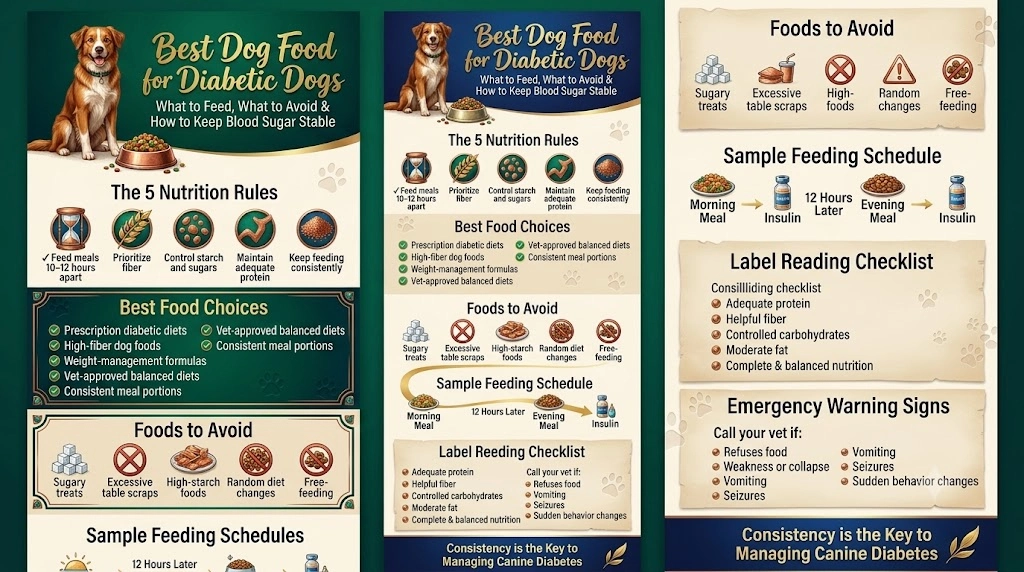
Contact your veterinarian promptly if your diabetic dog skips meals, becomes weak, collapses, has seizures, vomits repeatedly, stops eating, or shows unusual behavior. Cornell warns that skipped meals can make insulin risky, and Purina says hypoglycemia is an emergency and that insufficient insulin can lead to diabetic ketoacidosis. Merck notes that DKA is a critical condition requiring aggressive treatment.
The red flag list
- Weakness or collapse.
- Trembling or seizures.
- Not eating.
- Vomiting with poor appetite.
- Sudden worsening thirst, urination, or weight loss.
Takeaway: with diabetic dogs, the schedule is part of the treatment, not just a convenience.
People Also Ask
The best option is usually a complete, balanced food that keeps meals consistent, supports healthy body condition, and controls post-meal glucose spikes. Many dogs do well on prescription veterinary diets, but AAHA says some stable dogs can also do well on regular complete and balanced foods if feeding is consistent.
Yes, most dogs do best on two meals a day. Cornell says meals 10–12 hours apart work best for most dogs, and Merck says most dogs need two meals of equal calories given immediately before insulin.
Often, yes. Purina says fiber may help lower blood sugar and reduce spikes, while Cornell explains that insoluble fiber can help with satiety and calorie control. The right amount still depends on the dog’s weight and health history.
Sometimes. AAHA says dogs with diabetes can do well on any complete and balanced food if it is fed consistently and is palatable enough for predictable intake. The food still needs to fit the glucose-control plan.
Often yes, especially at the start. Cornell says prescription diets can help even out blood glucose and may limit fat to reduce pancreatitis risk. PetMD also notes that veterinary diets are commonly recommended for diabetic dogs.
Avoid foods that are very sugary, very starch-heavy, or so highly digestible that they spike glucose quickly. Cornell specifically warns about highly digestible diets and excessive carbohydrate-heavy treats.
Yes. AAHA and Purina Institute both stress body condition management. Overweight dogs often need a calorie-controlled weight-management approach, while underweight dogs may need more calories and a different fiber balance.
Do not assume the insulin routine is unchanged. Cornell warns that skipping a meal can make insulin dangerous and advises calling your veterinarian if the dog is not eating.
Conclusion
The Best Dog Food For Diabetic Dogs is the one that supports steady blood sugar, fits the insulin schedule, and keeps your dog eating reliably every day. The strongest veterinary guidance agrees on the essentials: timed meals, consistent portions, controlled starch, helpful fiber, adequate protein, and close attention to body condition. Prescription diets are often the safest starting point, but the real answer depends on your dog’s appetite, weight, and medical history.
If you remember only one thing, make it this: diabetes care is built on consistency. The best diet is not just nutritionally good on paper; it is the one your dog can eat reliably, day after day, without creating glucose chaos. That is the kind of practical guidance dog owners can trust, and the kind of content that earns repeat visits.
Bookmark this guide, share it with another dog owner who needs it, and explore more Dogizle nutrition and health content for smarter everyday care.
This content is for educational and informational purposes only and does not replace professional veterinary advice. Always consult a licensed veterinarian for medical concerns regarding your dog.