Best Harness for Small Dogs: Top Picks, Reviews & Expert Buying Tips
Walking a Small Dog should feel simple, safe, and pleasant. In reality, it can become a daily struggle when the harness is poorly fitted, too heavy, too loose, or designed for the wrong type of dog. A quality harness is not just a walking accessory. It is a control system, a comfort layer, and a safety tool all in one.
For tiny breeds such as Chihuahuas, Dachshunds, Pomeranians, Yorkies, Maltese, Toy Poodles, and French Bulldogs, the wrong walking gear can create real problems. The neck is delicate. The chest shape is often narrow or compact. Some breeds are more prone to slipping out. Others become anxious the moment you try to clip them in. According to the American Kennel Club, harnesses can reduce pressure on the neck compared with collars, and they can be especially useful for puppies, senior dogs, and brachycephalic breeds with broad heads and necks. AKC also notes that a properly fitted harness can help keep escape-prone dogs more secure.
That matters because many small dogs do not just “walk badly” by accident. Pulling, spinning, freezing, backing out, and refusing to move are often learned patterns or stress responses. Blue Cross explains that dogs usually learn to pull over time, so changing the behavior takes a fresh approach, calm repetition, and reward-based training. In other words, the harness and the training plan should work together, not against each other.
A good harness helps you distribute force across the chest instead of concentrating it around the neck. It should improve handling without restricting natural movement.This should feel light enough for a small body, but secure enough to prevent slips. It should also match your dog’s temperament. A nervous puppy, a city dog that walks on crowded pavements, and an escape artist all need slightly different design features. This guide is built around that reality.
What a Good Harness Actually Does
A well-designed harness should do five things at once.
First, it should distribute pressure more evenly across the chest and torso rather than loading the throat. That is one of the clearest reasons people choose a harness over a standard collar. Second, it should give the handler better steering control, especially when the dog suddenly darts, lunges, or freezes. Third, it should reduce the chance of choking or neck strain. Fourth, it should make daily walks less stressful for both dog and owner. Fifth, it should support training rather than sabotage it.
For small dogs, the details matter more than they do for larger breeds. A harness can be technically “secure” and still be wrong if it is too stiff, too bulky, too narrow across the chest, or too abrasive against sensitive skin. Small dogs often need soft edges, breathable fabric, adjustable straps, and lightweight construction. In hot weather, the fabric should let air move. In dark conditions, visibility features become important. The RSPCA recommends visible gear such as reflective collars or coats for safer visibility in the dark, and it also stresses that equipment should fit properly.
Quick Comparison: Top 10 Best Harnesses for Small Dogs
For a fast overview, here is how the most common small-dog harness categories break down:
Puppia Soft Harness is best for everyday comfort because it is soft, breathable, and gentle on the body. Rabbitgoo No-Pull Harness is best for pullers who need more control. Voyager Step-In is ideal for beginners who want quick on-and-off convenience. EcoBark is a budget-friendly comfort option. Gooby Escape Free is aimed at dogs who slip out of ordinary harnesses. Julius-K9 IDC Mini suits active dogs that need a sturdier build. Ruffwear Front Range is a premium option for outdoor owners who want more padding and durability. Curli Vest Harness works well for urban dogs who need a light, clean profile. PetSafe Easy Walk is geared toward training and front-clip steering. Truelove Mesh Harness is a balanced all-rounder with breathable and reflective elements.
These are not just product names. They represent different use cases. The best harness for your dog depends on body type, behavior, walk environment, and how much handling your dog tolerates.
How to Choose the Best Harness for Small Dogs
1. Fit is the first filter, not the last one
If the fit is wrong, the harness is wrong. A harness that is too loose can let a dog twist free. A harness that is too tight can cause rubbing, discomfort, restricted motion, or unnecessary pressure. The RSPCA emphasizes correct sizing and proper fitting, and AKC also highlights that a well-fitting harness is important for keeping dogs secure.
For most small dogs, the two-finger rule is a practical starting point: you should be able to slide two fingers under the strap without forcing them in. That gives you a functional fit without compressing the body. But fitting should never stop at the finger test. Watch the dog move. The harness should not ride up into the armpits, slide sideways, twist around the torso, or pinch the skin when your dog sits or turns. A harness should support movement, not interfere with it.
2. Decide between no-pull, back-clip, and dual-clip
A front-clip harness is useful for dogs that lunge forward or constantly pull because it redirects motion toward the handler. A back-clip harness is often more comfortable for calmer dogs because it places the leash attachment on the upper back. A dual-clip design gives you more flexibility, especially if you are still training and want to switch between control modes. Blue Cross recommends reward-based training for lead walking and points out that dogs often need a fresh approach when they have been pulling for a long time.
For a small dog that pulls hard, a no-pull harness can be a major upgrade. For a relaxed dog that simply walks beside you, an overbuilt control harness may be unnecessary. Matching the mechanism to the behavior is smarter than buying the most popular model. That is the difference between an efficient choice and an expensive mistake.
3. Material choice affects comfort more than most people realize
Small dogs are often sensitive to rough seams, stiff webbing, and heavy hardware. Breathable mesh is helpful in warm weather and for indoor-apartment dogs that only need short daily walks. Soft padding helps prevent friction on the chest and under the front legs. Lightweight construction matters because small dogs should not feel weighed down by their own gear.
Avoid stiff, industrial-style materials unless your dog truly needs a stronger build. Tactical-style harnesses may look rugged, but many small dogs do better with softer geometry, lower mass, and smoother contact surfaces. The goal is comfort with control, not armor. AKC’s guidance on harness choice supports the idea that the right material and structure depend on the dog’s body, age, and sensitivities.
4. Step-in vs overhead harnesses
Step-in harnesses are usually easier for nervous dogs, puppies, and owners who want a simple routine. The dog places its paws into the openings, and the harness closes around the body. Overhead harnesses usually offer a more secure wrap and are often preferred for active dogs or dogs that tend to wriggle out of simpler designs. AKC notes that step-in styles can work well for dogs that are sensitive around the head or are escape artists, especially when the fit is correct.
There is no universal winner here. A step-in harness may be the best onboarding tool for a new puppy, while an overhead vest may be better for a curious, fast-moving dog that needs more containment. The right choice depends on tolerance, security, and your own handling confidence.
5. Safety features should not be optional
Reflective trim, secure buckles, reinforced stitching, adjustable points, and escape-resistant construction are all worth paying attention to. If you walk in the evening, near traffic, or in low light, visibility becomes part of the safety equation. The RSPCA specifically recommends reflective visibility when walking in the dark, and it also reminds owners to keep dogs visible and properly controlled outdoors.
For small dogs, safety also means understanding how quickly a harness can be slipped out of if the chest, neck, or shoulder geometry is wrong. That is why fit and structure are inseparable. A strong buckle cannot compensate for poor sizing.
Best Harness by Dog Type
Best for small dogs that pull
If your dog pulls, you need structure that helps redirect movement rather than absorb it like a spring. A front-clip or dual-clip harness is usually the most useful starting point. The idea is simple: when the leash attachment sits at the chest, forward momentum gets redirected toward you rather than escalating into a tug-of-war. Blue Cross recommends calm, reward-based lead training and emphasizes that pulling is often a learned habit, which means the harness should support retraining rather than reward the old pattern.
Best for puppies
Puppies need softness, adjustability, and low weight. Their bodies are still developing, and they learn through repeated experience. A harness that is easy to put on, easy to adjust, and gentle against the skin is usually the best starting point. AKC notes that harnesses can be useful for puppies that are still growing.
Best for escape artists
Escape artists need a harness that hugs the body more securely without causing pressure points. Dogs with narrow waists, slim shoulders, or a habit of backing out need a design that limits slippage. AKC specifically points out that properly fitted step-in harnesses can work well for dogs that are difficult to keep contained.
Best for flat-faced breeds
Pugs, French Bulldogs, and similar breeds often benefit from a harness rather than a collar because the neck and airway need more consideration. AKC notes that harnesses can be helpful for brachycephalic dogs with a broad head and neck. In these breeds, the objective is to reduce neck pressure and make breathing and walking feel less strained.
Best for apartment dogs
Apartment dogs usually need lightweight, quick-to-use gear that is comfortable for short but frequent outings. Quiet buckles, easy fastening, and simple fit adjustment matter because the walk routine may happen multiple times a day. A bulky harness that takes too long to fit often becomes annoying for both dog and owner, especially when you are just stepping out for a fast potty break.
Detailed Product Reviews: Top Picks Explained
1. Puppia Soft Harness
Puppia Soft Harness is a classic comfort-first choice for small dogs. Its strongest appeal is tactile comfort. Soft mesh, lightweight construction, and gentle coverage make it ideal for dogs that dislike stiff or heavy gear. It works especially well for daily neighborhood walks, short urban strolls, and dogs that do not pull aggressively.
Its major advantage is that it feels unobtrusive. Small dogs can move without feeling like they are wearing a rigid frame. That makes it especially useful for dogs that are sensitive, timid, or new to harness training. The trade-off is control. If your dog pulls hard or tries to explode forward at every distraction, a soft comfort harness may not provide enough steering leverage. In that case, it is better as an everyday walker than a training tool. The AKC’s general guidance on choosing harnesses supports matching the design to the dog’s body and behavior rather than picking a one-size-fits-all solution.
2. Rabbitgoo No-Pull Harness
Rabbitgoo is the kind of harness many owners reach for when walks have become a power struggle. Its value lies in control. A dual-clip or front-clip layout gives you a practical way to redirect forward motion and reduce the dog’s ability to turn every walk into a drag race. That makes it especially useful for energetic small dogs, leash pullers, and owners who want a training-oriented option.
The main benefit is not brute force. It is directional guidance. Instead of concentrating pressure on the neck, the harness gives you a better geometry for steering. That lines up with Blue Cross Guidance that pulling should be addressed through training methods, positive reinforcement, and the right walking equipment. A harness like this is not a magic fix, but it can be a much better platform for behavior change.
3. Voyager Step-In Harness
Voyager Step-In is a strong choice for beginners because the wearing process is simple. For many owners, the hard part is not buying the harness. It is getting the dog into it without drama. A step-in design reduces the mental friction of harnessing, especially for dogs that dislike anything being pulled over the head.
AKC notes that step-in styles are useful for dogs who are sensitive around the head or ears, and that they can be especially practical for escape artists when the fit is correct. That makes this style a smart entry point for puppies, rescue dogs, and cautious small breeds. The limitation is that step-in designs may not be the best fit for high-energy pullers who need more structured control.
4. EcoBark Harness
EcoBark is the kind of harness owners choose when they want softness without overspending. It is a budget-conscious comfort option that usually appeals to casual walkers, first-time dog owners, and dogs that need a basic but gentle setup. Its appeal is simplicity. You are not paying for a complicated training system. You are paying for a serviceable, low-friction daily harness.
That said, budget designs often trade off some durability, structure, or refinement. For an adult dog with no major pulling issues, that may be completely acceptable. For a dog that is hard to control or has an escape tendency, you may need a more engineered model.
5. Gooby Escape Free Harness
Gooby Escape Free is designed for dogs that are highly likely to slip out of ordinary harnesses. That makes it especially relevant for tiny, narrow, or highly flexible dogs. The core benefit is a tighter, more secure fit structure that reduces the chance of backing out. AKC specifically mentions that certain well-fitting harness designs are harder for dogs to escape from if they fit properly.
This kind of harness is not about fashion. It is about containment geometry. The dog’s body should be held in a way that resists slipping without creating pinch zones or compressing the chest. Because escape-prone dogs often test the equipment at exactly the worst moment, a secure harness is often worth the extra time it takes to adjust.
6. Julius-K9 IDC Mini
Julius-K9 IDC Mini has a sturdier, more robust profile and works well for active dogs that need more durability than a soft mesh model can offer. It is a practical option for owners who want a harness that feels confident and structured during walks, especially in busier environments.
The advantage is stable handling. The downside is that some tiny dogs may find it more substantial than necessary. For very petite or sensitive dogs, a heavy-duty style may feel like overkill. This is why fit and body tolerance must remain the deciding factors.
7. Ruffwear Front Range
Ruffwear Front Range is a premium pick for owners who spend a lot of time outside and want a better finish, stronger padding, and higher overall refinement. It is often the kind of harness people choose when they want long-term quality rather than a temporary fix. For active small dogs that go on hikes, longer walks, or irregular terrain, this kind of harness can make sense.
Its strength is all-around performance. It balances comfort and structure well. The caveat is price. Premium gear should solve a real problem, not merely look premium. If your dog only needs short sidewalk walks, a simpler harness may serve you just as well.
8. Curli Vest Harness
Curli Vest Harness fits the urban lifestyle very well. It is typically light, clean, and easy to manage. For city dogs that need quick fastening and a low-bulk feel, this style can be extremely convenient. The vest-like shape also spreads contact more evenly than narrow strap-only designs.
That makes it a good compromise between comfort and control. It is often a stronger fit than a purely minimal harness but less complicated than a heavy no-pull trainer. If your dog walks daily but not aggressively, this can be a highly practical choice.
9. PetSafe Easy Walk
PetSafe Easy Walk is one of the most recognized training harness concepts because it focuses on discouraging forward pull. A front-clip setup is useful when the goal is to reduce the dog’s ability to lean into the leash. This design is best for training sessions, not just casual strolls.
Blue Cross emphasizes calm, reward-based lead work and notes that a fresh approach is often needed for dogs who have practiced pulling for a long time. A front-clip harness works best when paired with that mindset. It is most effective when you use it to teach new walking habits rather than relying on the harness alone to solve the problem.
10. Truelove Mesh Harness
Truelove Mesh Harness is a sensible all-rounder for owners who want breathable comfort and visibility in one package. That makes it attractive for everyday walking, mild training, and small dogs that need a lightweight but still reasonably secure option. Reflective accents are useful when you walk in early morning or evening conditions, and the RSPCA encourages visible gear for low-light safety.
This type of harness is often the safest “middle ground” choice. It is not the most specialized, but it covers many of the core needs that small dogs have: comfort, visibility, and moderate security.
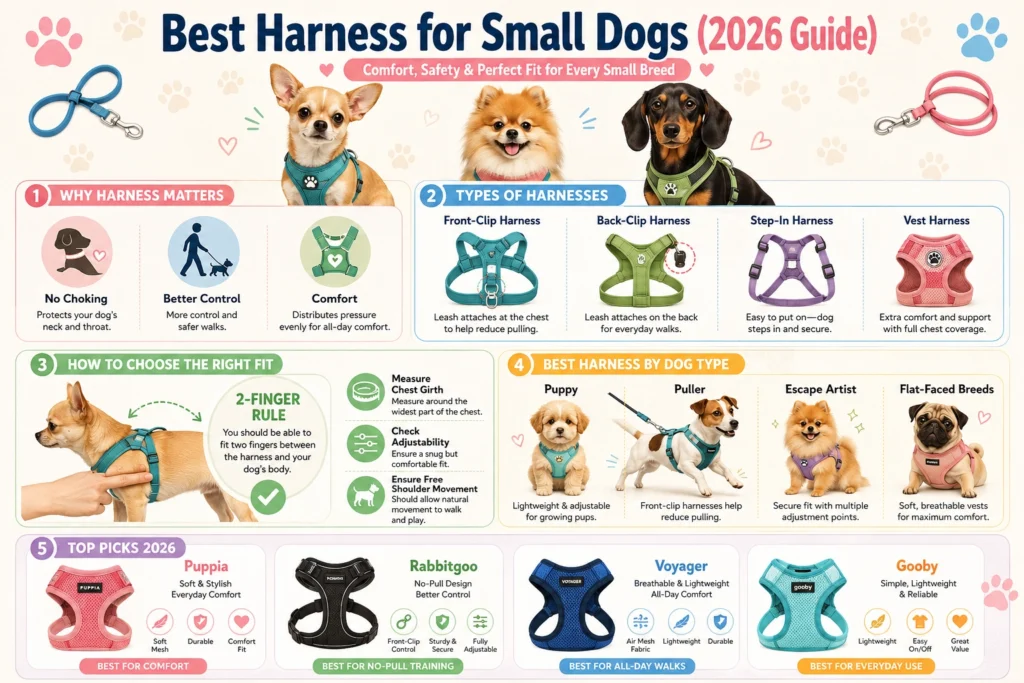
This quick visual guide breaks down the safest options, perfect fit tips, and top harness picks for 2026—so you can enjoy stress-free walks every day.
Step-In vs Vest Harness: Which One Is Better?
The answer depends on the problem you are solving.
A step-in harness is usually easier to put on, which is ideal for nervous dogs, squirmy puppies, and owners who want speed. A vest harness generally feels more secure and can distribute pressure more evenly across the body, which may be better for energetic or escape-prone dogs. AKC notes that different styles serve different dogs, and that step-in designs can help dogs that do not like things going over the head.
A practical rule is this: choose convenience when your dog is calm and cooperative; choose security when your dog is active, slippery, or unpredictable. For many small-dog homes, the best answer is to keep one harness for everyday use and one for more controlled walking.
Common Mistakes Dog Owners Make
1. Buying the wrong size and hoping it will “settle in.”
That rarely works. A harness does not become correct just because the dog gets used to it. If the straps are wrong, the dog may get chafing, difficulty moving, or a higher escape risk. The RSPCA stresses proper fit and sizing, and AKC similarly emphasizes the value of a well-fitting harness.
2. Expecting the harness to train the dog by itself
A harness can improve handling, but it is not a behavioral miracle. Blue Cross makes it clear that pulling develops as a learned pattern, which means the owner still needs training, patience, and reinforcement.
3. Forcing the harness on too quickly
If you rush the process, your dog may associate the harness with stress. Introduce it gradually. Let the dog sniff it. Reward calm behavior. Put it on for a few seconds at first. Build the habit slowly. Blue Cross recommends a positive introduction to walking equipment and reward-based handling.
4. Ignoring wear and tear
If the stitching loosens, the buckle weakens, or the straps lose their shape, the harness stops being trustworthy. Replace old equipment before it fails on a walk.
5. Forgetting visibility at night
The RSPCA recommends reflective visibility in darker conditions, and that advice matters even more for small dogs because they are harder to see at ground level.
Safety and Health Considerations
A harness should support safety, not create new risks. Do not leave it on all day. Check for skin irritation under the arms, around the chest, and along the back. Watch for overheating in warm weather. Make sure the straps do not rub while the dog moves. And always use visibility features if you walk in dim light. The RSPCA also reminds dog owners to keep gear fitted properly and to use visible equipment in the dark.
If you walk in the UK or Europe, there are additional real-world considerations around public walking, livestock, and legal compliance. The RSPCA advises keeping dogs on lead around livestock, staying visible, and ensuring dogs have an ID tag when out in public spaces. Those are not small details. They are part of responsible walking behavior.
Expert Tips for Better Harness Training
Introduce the harness in a calm room before using it outdoors. Pair it with treats so the dog forms a positive association. Keep the first sessions short. Check the fit weekly, especially for puppies or dogs that fluctuate in weight. Use the harness consistently if you are also working on leash manners. And reward the behavior you want, not just the absence of pulling. Blue Cross recommends reward-based lead training and reinforces the idea that calm, repeated practice matters.
It also helps to think in terms of context. A harness that is perfect for a neighborhood stroll may not be ideal for a crowded market, a muddy trail, or a winter coat over layers. Recalibrate the fit when the environment changes. That is how you keep the harness working as a tool rather than letting it become a source of friction.
Why Trust and Welfare Matter in This Topic
Harness selection is not just a consumer choice. It is part of responsible pet ownership. FEDIAF states that it promotes nutritious pet food, responsible pet ownership, and pet wellbeing, and its site also highlights that pet owners have a responsibility to help care for and protect their pets. FECAVA, meanwhile, positions itself as a major European veterinary federation focused on animal welfare, continuing education, and companion-animal veterinary care. Those are the kinds of source-level signals that reinforce why safe handling and humane equipment choices matter.
That is why this guide leans toward comfort, proper fit, and behavior-aware selection instead of hype. A good harness should reduce stress, not create it. It should improve mobility, not interfere with it. And it should help owners walk their dogs with more confidence and less anxiety.
People Also Ask
Yes. A harness is often better because it reduces neck pressure and gives you more control during walks. AKC specifically notes that harnesses apply less pressure to the neck than collars, and that they can be useful for puppies, senior dogs, and brachycephalic dogs.
The safest harness is usually the one that fits properly, distributes pressure well, and stays secure during movement. A padded, adjustable, escape-resistant design is the best starting point. The RSPCA stresses correct fitting, and AKC highlights the importance of well-fitting harnesses for secure walking.
No. Harnesses should generally be removed after walks or supervised activity. Leaving one on all day can lead to irritation, rubbing, and unnecessary discomfort.
A front-clip or dual-clip harness is usually best for pullers because it helps redirect forward motion. Blue Cross recommends a training-led approach with reward-based handling, which pairs well with no-pull designs.
Harnesses are generally used widely, but rules around dog walking can still vary by country, region, public land, and local regulations. In the UK, for example, the RSPCA advises keeping dogs on a lead in many situations and stresses legal ID requirements in public spaces.
Measure the chest girth first, then check neck circumference and overall body length if the brand asks for it. After sizing, confirm that the harness sits flat, does not twist, and allows natural movement. The RSPCA recommends correct sizing and proper fitting.
A padded harness worn over or with winter clothing is usually the best option. Make sure it still fits correctly after adding layers, and use reflective details for visibility. The RSPCA recommends reflective visibility in the dark and a proper fit for safety.
Pros and Cons of Dog Harnesses
Harnesses are often safer than collars because they reduce neck strain and improve handling. They can also reduce pulling and make escape harder when fit correctly. The downside is that they must be sized and adjusted properly. Some dogs resist them at first, and some designs can trap heat in warm weather. AKC and the RSPCA both support the core idea that fit and appropriate design are essential.
Conclusion:
Choosing the best harness for small dogs comes down to five things: fit, comfort, control, safety, and behavior match. The right harness should protect the neck, support walking manners, and feel easy enough that you will actually use it every day. AKC’s guidance supports the use of harnesses for small, growing, sensitive, and escape-prone dogs, while Blue Cross and the RSPCA reinforce the importance of positive training, proper fit, and visible, responsible walking habits.
Quick action plan
Measure your dog carefully. Identify the main behavior issue. Pick the harness style that matches the dog’s walking style. Introduce it gradually. Check the fit often. Then refine based on real-world use, not just product marketing.