The Four-Legged Workers Every European Farm Secretly Needs in 2026
Choosing the best farm dogs is not a lifestyle accessory choice; it is a working-system decision. Across Europe, livestock keepers continue to deal with large carnivores, including wolves, and the European Commission states that many EU member states fund preventive measures such as fencing, livestock guarding dogs, and shepherding to reduce damage to stock. That means the right dog can be a genuine part of a farm’s protection and management plan, not just an extra animal on the property.
The mistake many farms make is simple: they pick a dog for looks, popularity, or reputation rather than for function. But the best farm dog is the one that matches the job, the terrain, the livestock, and the handler’s experience. In FCI language, breed standards are built around health, temperament, behaviour, and utility, which is exactly the mindset farmers should use when selecting a working dog.
Why the right farm dog matters
A well-chosen farm dog can reduce stress on livestock, improve movement control, strengthen perimeter awareness, and make daily work more efficient. On a small holding, one dog may be enough to manage multiple routines. On a larger European farm, a two-dog setup often makes more sense: one dog for movement and control, another for deterrence and protection. That is not merely a preference; it follows the functional logic of herding breeds, guardian breeds, and terrier-type pest controllers as described in kennel and breed standards.
The goal is not to create a dog that does everything. The goal is to build a livestock system where each dog has a clear task. A calm guardian watching sheep is not the same job as a fast, responsive dog moving cattle through a field, and neither is it the same as a terrier clearing rats from feed storage. When that division is respected, the entire farm runs with more control and less conflict.
Understanding the three main farm dog roles
1) Herding dogs
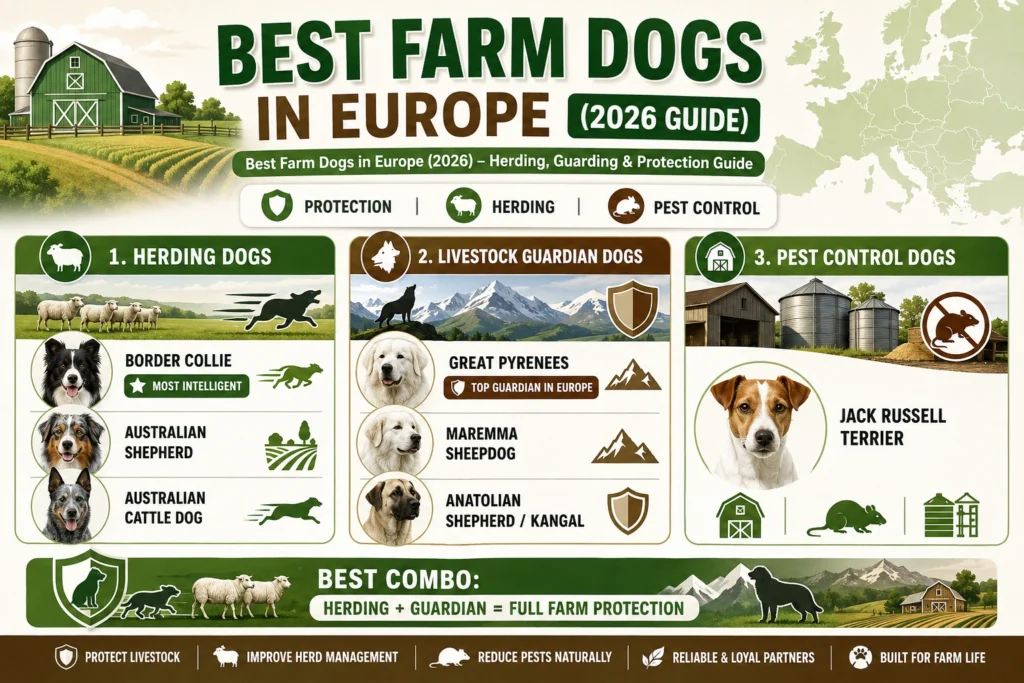
Herding dogs are livestock controllers. Their job is to move animals, regulate spacing, and respond quickly to direction. The FCI identifies Border Collie as a sheepdog with a working trial, while the AKC notes that herding breeds were developed to gather, herd, and protect livestock. In practical farm terms, these dogs are ideal when precision and obedience matter most.
2) Livestock guardian dogs
Livestock guardian dogs stay with the animals and deter threats. They are not built to chase stock around all day; they are built to remain steady, independent, and protective in the face of danger. The European Commission specifically lists livestock guarding dogs and shepherding among the preventive measures used against wolf damage, and FCI breed standards for guardian types such as the Great Pyrenees, the Abruzzese and Maremma Shepherd Dog, and the Kangal Shepherd Dog all reflect this purpose.
3) Utility and pest-control dogs
Some farm dogs are not there to move herds or confront predators. They are there to deal with vermin, burrowers, and barn pests. In the FCI standard, the Jack Russell Terrier is described as a working terrier with the ability to go to ground, which makes it well-suited to pest-control tasks around barns, feed rooms, and poultry areas. That is a small dog with a very specific role.
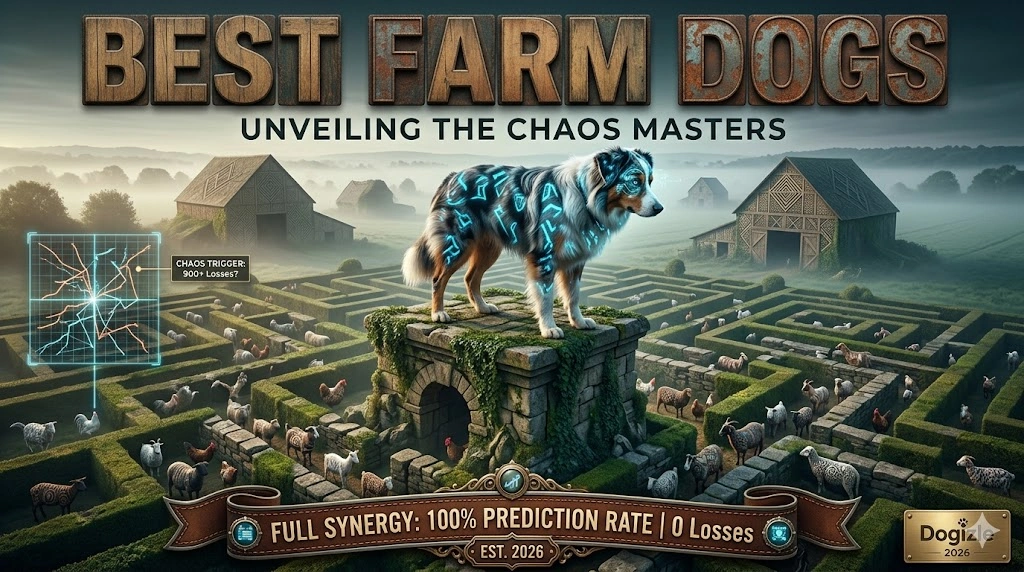
Best herding dogs for farms in 2026
Border Collie — the precision specialist
If your farm depends on accurate livestock movement, the Border Collie remains the benchmark. The FCI lists the breed as a sheepdog, and the AKC calls it the world’s premier sheep herding dog. It is intensely intelligent, quick on the draw, and deeply responsive to handler cues. That combination makes it especially useful for sheep farms, mixed flocks, and large open fields where control matters as much as speed.
What makes the Border Collie so effective is not just raw intelligence but functional focus. The breed is built to think, react, and adjust constantly. On a busy farm, that means the dog can read movement, anticipate a flock’s direction, and handle pressure without losing engagement. The downside is equally clear: a Border Collie that is underworked, understimulated, or inconsistently trained can become frustrated very quickly. This is a tool for active farms, not passive ownership.
Australian Shepherd — flexible herding power
The Australian Shepherd is one of the best choices for farms that need versatility rather than narrow specialisation. The FCI describes it as a farm and ranch shepherd dog, and the AKC’s breed standard calls it an intelligent working dog of strong herding and guarding instincts. That makes it especially attractive for mixed farms where the dog may need to move sheep in the morning, stay alert around buildings later, and generally remain adaptable throughout the day.
This breed works well when the farm has multiple small-to-medium tasks instead of one huge livestock operation. It tends to fit owners who want a responsive partner with energy, trainability, and practical utility. It is not a lazy dog, and it does not thrive on inactivity. But for a farm that needs a bright, alert, all-purpose herding helper, it is an excellent option.
Australian Cattle Dog — stamina and toughness
When the job is cattle movement, grit matters. The FCI says the Australian Cattle Dog was developed to assist with the cattle industry in early Australian conditions and needed to be strong, enduring, and capable of mustering and moving wild cattle. That makes it a logical fit for larger cattle systems, hotter environments, and operations that require endurance rather than finesse alone.
This breed is best for handlers who value resilience, persistence, and a dog that can keep working even when the day is long and the terrain is difficult. It is not a soft companion breed in a farm setting; it is a task-driven worker. If cattle are your primary livestock, and your operation depends on a dog that can keep pressure on stock without fading, this breed belongs on the shortlist.
Best livestock guardian dogs for farms in 2026
Great Pyrenees — the classic flock protector
The Great Pyrenees has one of the strongest reputations in the guardian category. FCI materials describe the breed as having been present in the Pyrenees from time immemorial and used as a guardian, while the AKC standard emphasises its size, majesty, and calm intelligence. For sheep farms in mountainous or predator-prone regions, that combination is hard to beat.
What makes the Great Pyrenees valuable is its steady temperament. It is not meant to be frantic or overly reactive. It is meant to observe, deter, and protect. That makes it especially suitable for farms that want a visible, calm presence around livestock rather than a dog that is constantly moving stock. In a guardian role, steadiness is an asset.
Abruzzes and Maremma Shepherd Dog — flock-bonding specialist
The FCI standard for the Abruzzes and Maremma Shepherd Dog says the breed is used mainly for the protection of flocks and the guarding of properties. That is exactly the kind of wording farm operators should look for when choosing a guardian breed: direct, practical, and task-specific. The breed is especially relevant for Mediterranean and Italian livestock systems where flock loyalty matters.
This is a dog built around proximity to the animals it protects. The most useful guardian dogs are often the ones that settle into the flock rather than chasing around it. That makes the Maremma type especially attractive in systems where the animals must be left in open pasture, semi-open mountain land, or isolated grazing fields.
Kangal Shepherd Dog — the heat-and-cold endurance guardian
For farms needing a highly capable guardian in harsh weather and rough terrain, the FCI’s Kangal Shepherd Dog standard is especially relevant. It describes the breed as a shepherd dog used for guarding sheep and notes its ability to endure extremes of heat and cold. That makes it a powerful candidate for remote or climatically demanding regions.
The Kangal is not a breed for casual handling. It is suited to farms that understand guardian-dog logic: independence, territorial awareness, and serious protective behaviour that must be managed with structure. For the right operation, however, it can be a formidable part of a livestock-defence system.
Best all-round farm dogs
German Shepherd — multi-purpose working partner
The German Shepherd remains one of the most adaptable working breeds in Europe and beyond. The FCI describes it as a versatile working, herding, and service dog, which explains why it still appears in so many farm discussions. It can guard, assist, patrol, and learn complex tasks quickly, making it a useful choice for mixed farming systems.
What sets the German Shepherd apart is not just intelligence but operational flexibility. On a farm, it can support boundary awareness, property protection, and livestock-related routines if trained well. It is a practical choice for owners who want a single dog that can cover multiple roles reasonably well, even if it is not the absolute best at any one specialist task.
Rottweiler — property security specialist
The Rottweiler is a strong option where farm security is a major concern. The FCI classifies it as a companion, service, and working dog and notes that its ancestors were herding or driving dogs. Historically, it has been connected with livestock movement and practical work, and in modern farm life, it often functions best as a property and perimeter dog.
For storage buildings, yard security, and farmhouses, a Rottweiler can be highly useful when properly socialised and trained. It is not a substitute for a true livestock guardian on a predator-heavy pasture, but it can be a strong layer of defence around the farm’s human and material assets.
Cane Corso Italiano — modern utility guardian
Some farms also consider the Cane Corso because the FCI describes it as a utility dog, polyvalent. That “polyvalent” quality matters: it signals a breed designed for more than one working purpose, including protection-oriented tasks. For farms that need a powerful, controlled guardian around buildings, machinery, and livestock areas, the Cane Corso can be a serious working candidate.
This breed is best suited to handlers with confidence, consistency, and a clear training plan. Its strengths are real, but so are the responsibilities that come with a large, protective working dog. The key is structure: clear rules, strong management, and early socialisation.
Best small farm and pest-control dogs
Jack Russell Terrier — compact farm hunter
For barns, feed stores, and poultry areas, the Jack Russell Terrier earns its place. The FCI standard calls it a good working terrier with the ability to go to ground. That makes it ideal for chasing and managing rodents in places where larger dogs are simply too big or too slow for the job.
This breed is energetic, fearless, and highly driven. On a farm, that translates into a dog that can help protect stored grain, reduce rat pressure, and keep nuisance pests under control. It is not a guardian breed and not a herding breed, but in the right setting, it can be one of the most practical little workers on the property.
Farm dog selection framework
A smart selection process starts with the farm’s core problem. If the main issue is moving sheep efficiently, the priority is a herding dog. That the main issue is wolves, foxes, or stray dog pressure, the priority is a guardian. If the main issue is rodents in storage and poultry zones, the priority is a terrier-type pest controller. The European Commission’s acknowledgement of fencing, livestock guarding dogs, and shepherding as preventive measures reinforces that the right dog should be matched to the actual threat.
A simple way to think about it is this: sheep farms often need a Border Collie plus a guardian; cattle farms often lean toward an Australian Cattle Dog or similar cattle worker; poultry farms benefit from a terrier for pests; mixed farms often do well with a German Shepherd as a flexible helper; and mountain farms often need a guardian with real endurance, such as a Great Pyrenees, Maremma, or Kangal-type dog. These recommendations follow the documented functional roles of the breeds rather than popularity or fashion.
Pros and cons of farm dogs
The advantages are obvious when the match is correct. A good farm dog can improve livestock control, reduce predator pressure, support security, and save labour. FCI and AKC materials both reflect the idea that working breeds exist for function, not ornament, and that breed standards exist to preserve the qualities that make those dogs useful.
The disadvantages appear when the match is wrong. A high-energy herding dog without a job can become destructive. A guardian dog without adequate livestock exposure can become overly territorial. A terrier without a clear pest-control role can dig, chase, and create trouble. In every case, training, structure, and purpose are non-negotiable.
Common mistakes farmers make
The first mistake is choosing a breed because it is famous rather than because it is suitable. A Beautiful Dog that cannot perform the farm task is not useful. The second mistake is mixing roles without thinking: herding dogs are not guardian dogs, and guardian dogs are not livestock drivers. The third mistake is underestimating how much early training and socialisation matter; AKC guidance stresses that early socialisation shapes adult behaviour, and simple training can begin as soon as puppies come home.
Another common error is ignoring the farm’s actual risk profile. Europe is not one single farming environment. Predator pressure, terrain, climate, flock size, and handling style all differ. That is why the right dog in northern pasture country may not be the right dog in an alpine valley or a poultry-heavy mixed holding. The function has to lead the decision.
Expert tips for choosing and raising a farm dog
Start by matching breed to job, not the other way around. Then look at the handler experience, because some dogs are easier to educate than others. FCI and AKC materials both emphasise that temperament, behaviour, and working function matter, so the best choice is the one you can actually shape into a reliable worker.
Begin socialisation and basic training early. AKC guidance says puppies are highly impressionable in the first months of life, and that short, positive training sessions can begin once they come home. For farm dogs, that early exposure should include livestock, machinery sounds, gates, vehicles, fences, and the day-to-day rhythm of the property.
Feed for work, not just for maintenance. FEDIAF’s role in Europe is to support nutritious pet food and responsible ownership, and working dogs on farms generally need diets that support energy output, recovery, and condition. Large, active breeds also need careful attention to body condition and joint health, especially when they are expected to work in rough ground and variable weather.
Real-life European farm scenarios
In wolf-affected regions, a guardian breed often makes sense alongside a herding breed. The European Commission specifically notes that livestock guarding dogs and shepherding are among the measures used to protect stock against wolves. In practical terms, that means a Border Collie plus a Great Pyrenees or Maremma-type guardian can be a highly functional pairing on many sheep farms.
For mixed farming systems, a German Shepherd or similarly versatile working breed can add flexibility when one dog needs to assist with more than one task. So cattle-focused farms, the Australian Cattle Dog and related herding dogs are especially relevant because their breed purpose centres on moving cattle efficiently over demanding land. For mountain farms, guardian breeds with a documented protective role are the strongest starting point.
Health and safety care for farm dogs
A farm dog’s health is a working issue, not just a welfare issue. Regular vaccines, parasite control, appropriate nutrition, and joint awareness all matter because a dog that is unwell cannot work reliably. The RVC’s veterinary research and dog-health resources underscore the importance of canine health management, while FEDIAF’s nutrition focus reinforces the value of feeding dogs according to their needs.
Working dogs also need mental stimulation. Herding breeds are built to think and act, which is why boredom can become a management problem. The better the dog’s daily job is defined, the fewer behavioural issues arise. On a farm, purpose is part of health.
Which dog fits which farm?
For a sheep farm, the strongest logic is a herding dog plus a guardian. For a cattle farm, a cattle dog or strong herding worker is usually the first consideration. So a poultry farm, pest control becomes more important, so a terrier-type worker can make sense. For a mixed farm, versatility matters most, which is why a German Shepherd or similar all-rounder can be useful. For a mountain or predator-heavy farm, guardian logic should lead the choice.
People Also Ask
For most farms, there is no single universal winner. The Border Collie is one of the best herding dogs, and the Great Pyrenees is one of the strongest guardian choices. The best answer depends on whether the farm needs movement control, livestock protection, or both.
Yes, farm dogs can live with other animals when they are introduced early and managed properly. AKC guidance on puppy socialisation emphasises that early, positive exposure shapes adult behaviour, which is especially important on farms where dogs must coexist with stock, poultry, and machinery.
No, not in the ordinary sense of the word. Proper guardian dogs are protective, steady, and territorial, but they should not be unstable or indiscriminately aggressive. Their job is to deter threats and stay with the flock, not to create chaos.
A German Shepherd or Australian Shepherd is often easier for beginners than a highly independent guardian breed. Both have strong working instincts and broad utility, and both are better suited to owners who want an adaptable dog with clear training responsiveness.
Yes. Every farm dog needs training, but the training style should match the role. Herding dogs need control and precision. Guardians need livestock bonding and calm boundaries. Terriers need channelled pest-control work and household rules. AKC guidance on early training and socialisation makes it clear that good working behaviour does not happen by accident.
Conclusion
The smartest way to choose farm dogs is to start with the farm’s actual needs. Herding dogs move livestock. Guardian dogs defend it. Terriers control pests. When those roles are matched correctly, the dog becomes part of the farm’s operating system rather than an extra burden. That is why the best answer is rarely “the most popular breed” and almost always “the breed whose function fits the job.”
For most European Farms, the strongest strategy is a dual system: one herding dog and one guardian dog. On some farms, a terrier can add a useful third layer for pest control. The exact combination depends on livestock type, land size, terrain, predator pressure, and how hands-on the handler is. Choose function first, train early, feed properly, and keep the dog working with purpose.