What Does NPC Really Mean? The Full Breakdown Across Gaming, Texting & Social Media
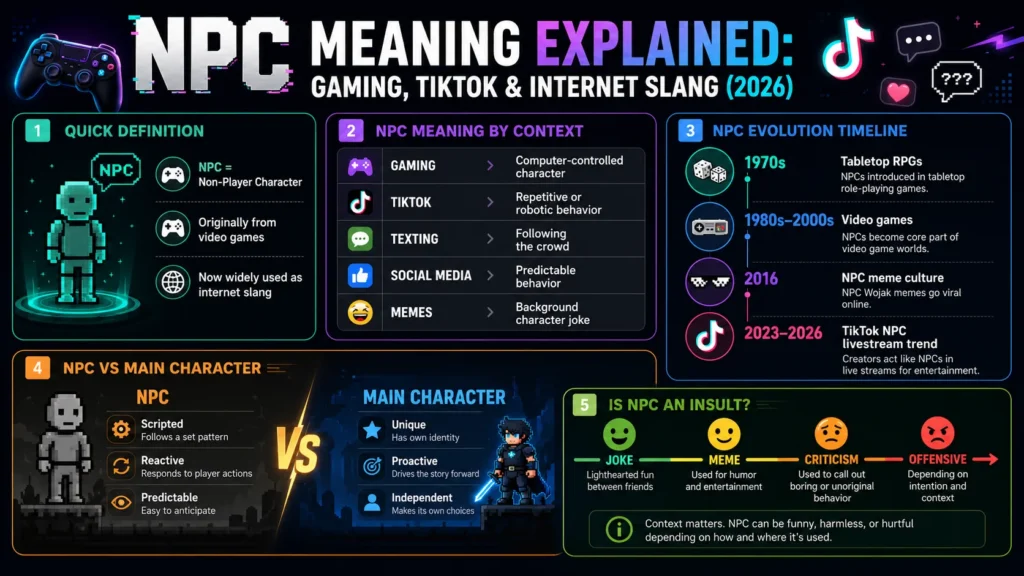
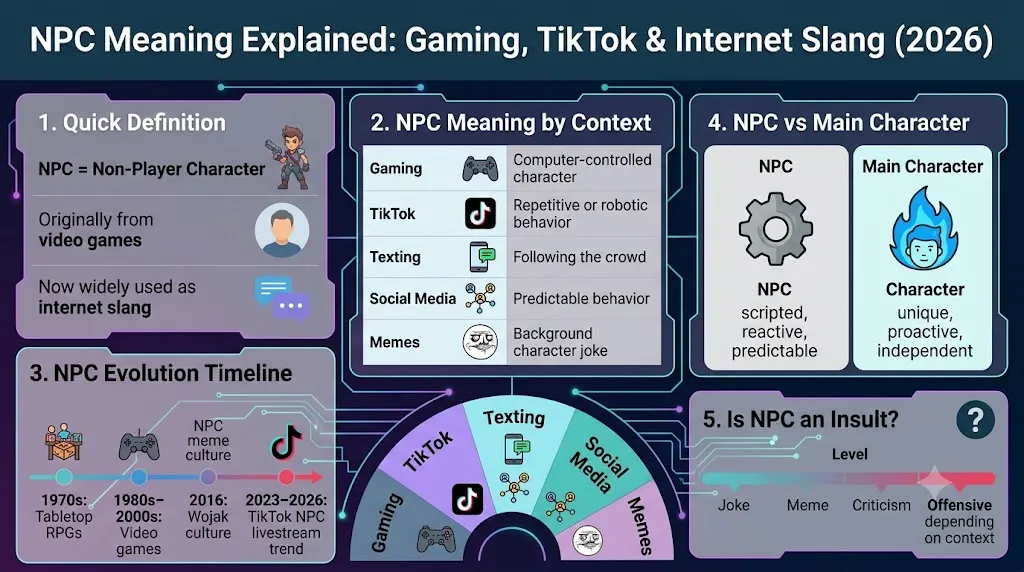
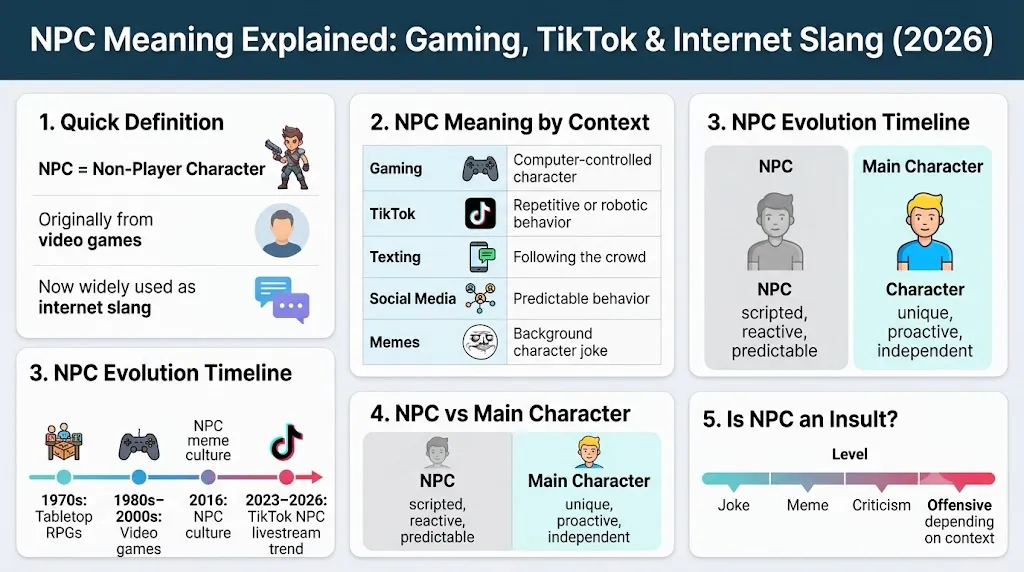
Originally, the term described computer-controlled characters in video games that players interact with but do not control. Today, NPC is also widely used as internet slang to describe someone perceived as acting predictably, following trends blindly, or behaving in a scripted or robotic way.
Depending on the context, calling someone an “NPC” can be humorous, sarcastic, or insulting.
NPC Meaning at a Glance
| Context | Meaning |
| Gaming | Computer-controlled character |
| TikTok | Person acting robotic or repetitive |
| Texting | Someone following the crowd |
| Social Media | Predictable behavior |
| Internet Memes | Background character joke |
| Gen Z Slang | Person lacking originality |
What Does NPC Mean?
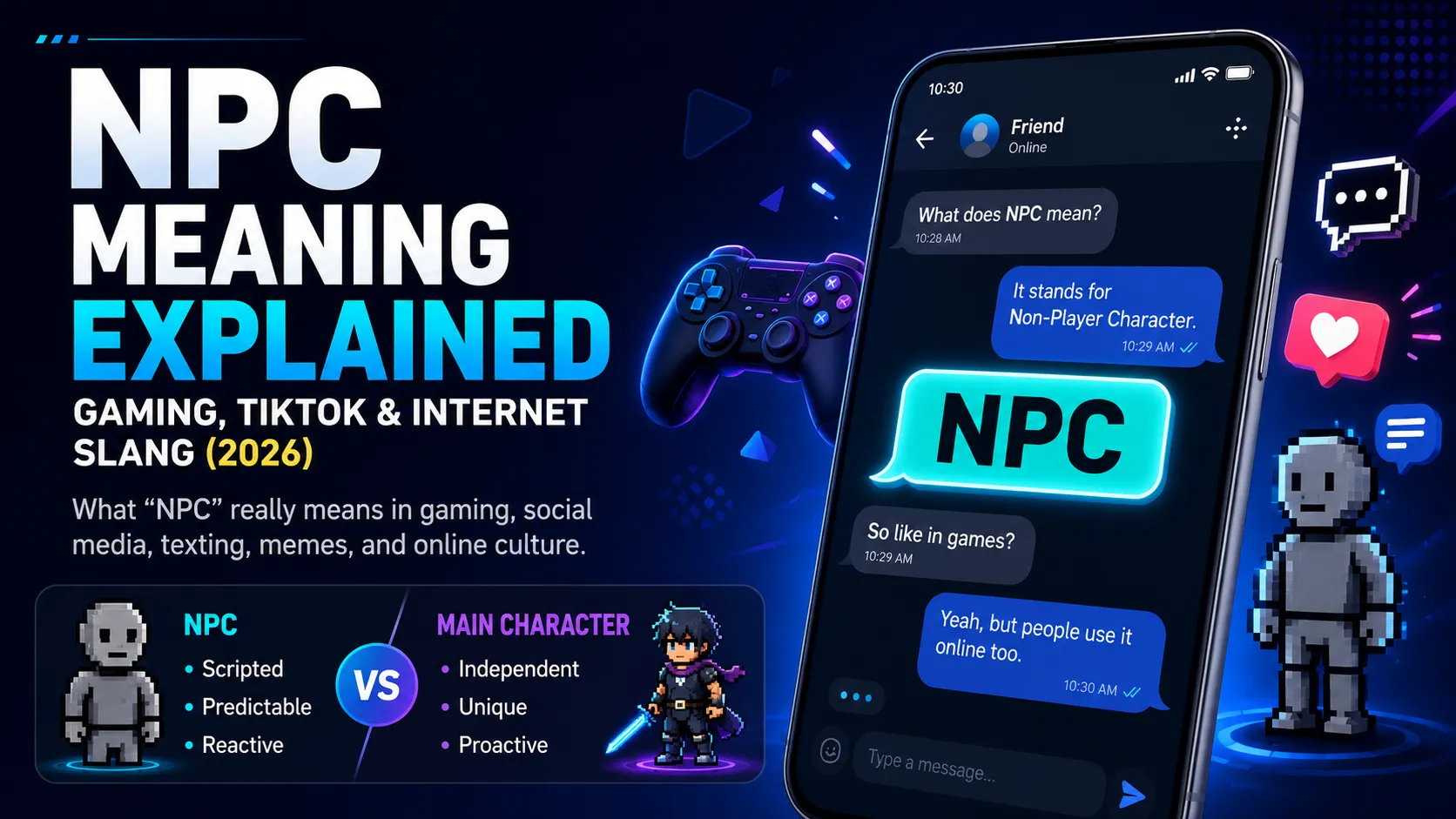
The acronym NPC stands for Non-Player Character.
In gaming, NPCs are characters controlled by the game’s software rather than by human players. They help create immersive worlds by acting as shopkeepers, quest givers, guards, villagers, enemies, and supporting characters.
Outside gaming, the meaning evolved into internet slang. Online communities began using “NPC” to describe people who appear to:
- Repeat popular opinions
- Follow trends without questioning them
- Act predictably
- Respond in scripted ways
- Show little originality
It’s important to understand that this slang usage is subjective and often intended as humor, criticism, or satire rather than a literal description.
NPC Full Form
NPC = Non-Player Character
The term originated in tabletop role-playing games before becoming a standard gaming term.
| Player Character (PC) | Non-Player Character (NPC) |
| Controlled by player | Controlled by game |
| Makes decisions | Follows programming |
| Drives the story | Supports the story |
| Has player agency | Has scripted behavior |
The Origin and History of NPC
The term NPC has existed for decades.
Tabletop RPG Era (1970s)
The earliest use appeared in tabletop role-playing games such as:
- Dungeons & Dragons
- Fantasy RPG systems
- Adventure campaigns
Game masters used NPCs to represent characters not controlled by players.
Video Game Era (1980s–2000s)
As video games evolved, NPCs became essential components of:
- RPGs
- MMORPGs
- Adventure games
- Open-world games
Examples included:
- Shopkeepers
- Villagers
- Guards
- Quest givers
- Enemies
Internet Meme Era (2016–Present)
The meaning expanded beyond gaming through:
- Meme culture
- Online forums
- Political discussions
- Social media platforms
- TikTok trends
Today, the slang meaning is often more widely recognized than the original gaming definition.
NPC Meaning in Video Games
In gaming, an NPC is simply a character controlled by artificial intelligence or game programming.
Common NPC examples include:
Shopkeepers
Sell weapons, armor, or supplies.
Quest Givers
Provide missions and objectives.
Guards
Protect cities or important locations.
Villagers
Populate game worlds.
Merchants
Enable economic systems.
Enemies
Challenge players during gameplay.
Without NPCs, most modern video games would feel empty and lifeless
NPC Meaning in Internet Slang
When used online, NPC usually refers to someone perceived as:
- Predictable
- Unoriginal
- Scripted
- Repetitive
- Following the crowd
Examples:
“Everyone copied the same trend like NPCs.”
“He’s just repeating what everyone else says.”
“That response sounds like NPC dialogue.”
This usage is subjective and often controversial because it can reduce complex human behavior to a stereotype.
Why Do People Call Someone an NPC?
People may use the term when they believe someone:
- Follows trends blindly
- Repeats popular opinions
- Gives robotic responses
- Displays little independent thinking
- Participates heavily in viral culture
The term often functions as:
- Humor
- Satire
- Insult
- Meme language
- Social criticism
Is Calling Someone an NPC Offensive?
Sometimes.
Whether “NPC” is offensive depends heavily on context.
| Usage | Perception |
| Among friends | Often humorous |
| Online debates | Often insulting |
| Workplace | Usually inappropriate |
| Social media memes | Often satirical |
| Personal attacks | Potentially offensive |
Many people consider the label dehumanizing because it implies someone lacks individuality or independent thought.
NPC Meaning on TikTok
NPC became enormously popular on TikTok through the viral NPC livestream trend.
Creators acted like video game characters by:
- Repeating phrases
- Making scripted movements
- Responding identically to gifts
- Performing repetitive actions
Common examples included phrases such as:
“Ice cream so good!”
“Gang gang!”
“Yes yes yes!”
The trend became one of the largest viral streaming phenomena on social media.
NPC Meaning in Text Messages
Examples include: “Everyone bought the same shoes.”
Friend 2: “NPC behavior
Step 1: “Stop following every trend
Friend 2: “Don’t be an NPC.”
NPC Meaning Across Social Media
| Platform | Common Usage |
| TikTok | Streaming trend and memes |
| Trend-following jokes | |
| Debate and internet culture | |
| Discord | Gaming slang |
| X | Political and social commentary |
| Snapchat | Casual slang |
| YouTube | Commentary and memes |
NPC Meme Explained
The NPC meme emerged from internet communities as a satirical illustration of perceived conformity.
The meme typically portrays:
- Expressionless faces
- Repetitive dialogue
- Uniform behavior
- Lack of individuality
The meme spread widely through:
- Forums
- Social media
- Political discussions
- Gaming communities
- TikTok culture
NPC v Main Character
| NPC | Main Character |
| Background role | Central role |
| Predictable | Individualistic |
| Reactive | Proactive |
| Follows scripts | Creates direction |
| Meme insult | Meme compliment |
NPC Bot
| NPC | Bot |
| Human insult/slang | Automated software |
| Meme expression | Technical term |
| Social commentary | Computer program |
| NPC | Sheep |
| Gaming-based insult | Social conformity insult |
| Internet slang | Older expression |
| Suggests scripted behavior | Suggests blind following |
Psychology Behind Calling Someone an NPC
Several psychological concepts help explain why the term became popular:
- Conformity
- Group identity
- Social stereotyping
- Online tribalism
- Humor and satire
- Social categorization
Research in social psychology suggests that humans naturally categorize groups and behaviors, which helps explain the popularity of labels like “NPC.”
When You Shouldn’t Use NPC
Avoid using the term:
- In professional settings
- In workplaces
- During serious discussions
- To harass others
- As a form of bullying
- When discussing sensitive topics
Respectful communication is generally more productive than labeling people.
Similar Internet Slang Terms
| Slang | Meaning |
| POV | Point of View |
| OP | Original Poster/Overpowered |
| AFK | Away From Keyboard |
| IRL | In Real Life |
| Sigma | Independent personality archetype |
| Delulu | Delusional |
| GOAT | Greatest Of All Time |
| Mid | Average |
| Sus | Suspicious |
| Rizz | Charisma |
| Aura | Personal vibe or presence |
| Main Character | Someone acting like the protagonist |
People Also Ask
NPC stands for Non-Player Character, a term originating in gaming.
It can be. Some people use it jokingly, While Others Use It as criticism or mockery.
On TikTok, NPC often refers to creators performing repetitive, game-like behaviors during livestreams.
NPC behavior refers to actions perceived as predictable, scripted, or trend-following.
Yes. Although it originated in gaming, Gen Z popularized its modern slang usage.
Usually to suggest someone is acting unoriginal, repetitive, or following the crowd.
Rarely. It’s usually neutral in gaming and negative or humorous in slang.
No. Today, it’s commonly used across social media, texting, and internet culture.
Conclusion
The meaning of NPC has evolved dramatically over the past several decades. What began as a simple gaming term for Non-Player Characters has transformed into one of the internet’s most recognizable slang expressions. Today, NPC can refer to video game characters, viral TikTok trends, online memes, and social commentary about conformity and behavior.
Understanding the context is crucial because the meaning changes depending on whether you’re discussing gaming, social media, texting, or internet culture.