ID Meaning in Text: What Does “id” Actually Mean?
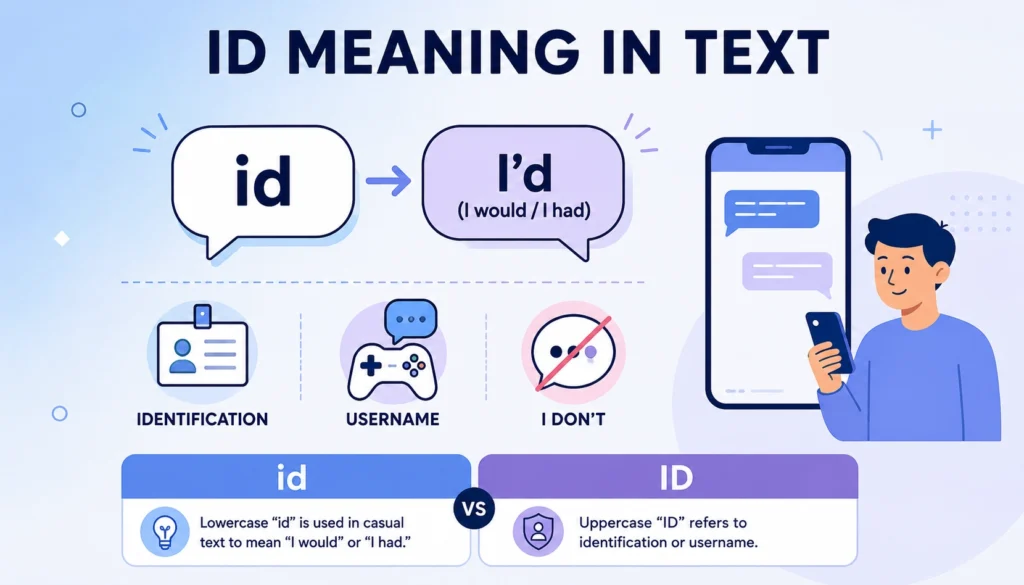
Quick answer: In most texts, lowercase “id” is just “I’d” (“I would” or “I had”) typed without the apostrophe. Capitalized “ID“ almost always means identification — a physical ID, a username, or an account number. Less often, “id” is a rushed version of “I don’t.” The way to tell them apart is capitalization plus the word that follows — both explained below.
If a friend, date, or coworker just texted you a bare “id” and you’re not sure what they mean, you’re not alone. Two letters, several completely different meanings — and the right one depends entirely on context. Here’s how to read it correctly, every time.
Quick Meaning Summary
| Form | Most Likely Meaning | Where You’ll See It |
| id (lowercase, mid-message) | I’d (I would / I had) | Texts, DMs, group chats |
| ID (all caps) | Identification | Work chats, bars, bookings, forms |
| id (fast typing) | I don’t | Casual, rushed messages |
| ID | Username/account ID | Gaming, apps, social platforms |
| ID | Intellectual disability | Healthcare, education, official docs |
| id | The id (Freud) | Rare — psychology or personality jokes |
Origin: Why “ID” Means Identification
The word “ID” as identification is short for identity/identification, and it traces back to the Latin idem, meaning “the same” — the same root idea behind verifying that a person is who they claim to be. This formal meaning predates texting by decades and is still the dominant meaning of “ID” outside casual chat.
The texting shorthand “id” for “I’d” is much newer and purely a product of mobile typing — dropping the apostrophe is faster, and autocorrect usually doesn’t flag it because “id” is already a real word.
Meaning 1: “id” = “I’d” (I Would / I Had)
This is the meaning you’ll run into most in everyday texting.
- “id go if you asked me” → I’d go if you asked me
- “id honestly love that” → I’d honestly love that
- “id already left by the time you called” → I had already left…
Tell: it sits right before a verb — go, love, say, have, honestly, probably. If a verb follows immediately, it’s standing in for “I’d.”
Meaning 2: “ID” = Identification
- “Bring your ID to the airport.”
- “They asked for ID at the door.”
- “Can you send a photo of your ID for verification?”
Tell: it’s capitalized, paired with a verb like bring, show, check, or send, and shows up in logistical or formal messages — work chats, bookings, bars, HR forms, deliveries.
Meaning 3: “id” = “I Don’t”
Less common, but real — usually from fast typers clipping words down further than autocorrect catches, functioning like a cousin of “idk.”
- “id know what you’re talking about” → I don’t know what you’re talking about
- “id care either way” → I don’t care either way
Tell: “I’d” makes the sentence nonsensical, but swapping in “I don’t” instantly makes it click — especially in a dismissive or uncertain tone.
Meaning 4: “ID” as a Username or Account Identifier
On apps, games, and social platforms, “ID” almost always means a unique identifier tied to an account, not a physical document.
- “What’s your Discord ID?”
- “Send me your Instagram ID.”
- “Enter your player ID to join the match.”
This usage is especially common in gaming and creator communities, where every account, item, or asset gets its own ID number or tag.
Meaning 5: “ID” in Medical, Clinical, or Official Contexts
In healthcare, education, and government paperwork, “ID” can stand for intellectual disability. This meaning basically never shows up in casual texting between friends — it’s confined to professional, clinical, or institutional writing, so context makes it obvious.
Meaning 6: “id” in Psychology (Freud)
Rarer in texting, but worth knowing: in Freud’s model of personality (id, ego, superego), the id represents our most basic, instinctual drives. A friend joking “it’s giving id behavior” means someone acted on pure impulse.
ID vs. IDK vs. IDC vs. IDEK
| Abbreviation | Meaning | Tone |
| ID | I’d / I don’t / identification (context-dependent) | Neutral to casual |
| IDK | I don’t know | Uncertain, non-committal |
| IDC | I don’t care | Dismissive, indifferent |
| IDEK | I don’t even know | Confused, exaggerated uncertainty |
“ID” is the odd one out here — IDK, IDC, and IDEK each point to one fixed meaning, while “ID” genuinely needs context to interpret.
Capitalization Rules: id vs. ID vs. Id
- Lowercase, mid-sentence (“…id go…”) → almost always “I’d”
- All caps (“ID”) → almost always identification, username, or account ID
- Capitalized only because it starts a sentence (“Id go…”) → still usually “I’d” — the capital is just autocorrect, not intent
When unsure, focus on the word right after it rather than the capital letter alone, since phones auto-capitalize sentence starters regardless of meaning.
ID Meaning on Social Media and Gaming Platforms
- Discord: “ID” usually means your Discord username or numeric user ID, used to add or verify contacts.
- Instagram/TikTok: “ID” typically refers to your handle or account, often requested to follow or collaborate.
- Reddit: “ID” can mean a Reddit username, though “id” as “I’d” is just as common in comment threads.
- Gaming (mobile/console): “player ID,” “friend ID,” or “game ID” are all account identifiers used to add friends or join matches.
Real Examples in Context
Friend group chat:
“id actually go to that concert ngl” (Translation: I’d actually go to that concert, not gonna lie.)
Work Slack/Teams message:
“Can you upload your ID before Friday’s onboarding?” (Translation: identification document.)
Gaming Discord:
“drop your ID so I can add you” (Translation: your account/player ID.)
Dating app:
“id love to hear more about that” (Translation: I’d love to hear more.)
Is It Rude to Text “id” Instead of “I’d”?
Not inherently — it depends on who you’re talking to. Among friends, “id” reads as normal, relaxed texting; nobody assumes disrespect. In formal settings (work, customer service, someone you don’t know well), skipping the apostrophe can come across as careless, so spelling out “I’d” is the safer call there.
Common Misunderstandings
- Assuming “id” always means “I’d.” It doesn’t — capitalized “ID” in a formal or transactional context is identification, not a contraction.
- Assuming “ID” is always a physical document. In gaming and app contexts, it’s almost always a username or account number.
- Reading “id” as a typo for “idk.” Sometimes it is, but often it’s a deliberate, faster way to write “I’d.”
How to Reply When You’re Not Sure What “id” Means
- Check what follows it. A verb right after (“id go,” “id love”) almost always signals “I’d.”
- Check the setting. Work chat or formal request → lean toward identification.
- Check the platform. Gaming or app context → lean toward username/account ID.
- Still unsure? Just ask. “Do you mean I’d or ID as in identification?” is a completely normal clarifying question.
Related Terms and Similar Meanings
- I’d — the full spelled-out contraction “id” often replaces
- IDK / IDC / IDEK — related “I don’t…” family of abbreviations
- Ego, Superego — the other two parts of Freud’s personality model alongside “id”
- Handle/Username — the broader term for what “ID” often means on social platforms
People Also Ask
It usually means “I’d” (I would/I had) regardless of who’s sending it. A verb following it and a casual tone confirm this reading.
No. It’s the most common meaning in casual, lowercase texting, but capitalized “ID” typically means identification, and in some cases lowercase “id” means “I don’t.”
No. IDK specifically means “I don’t know.” “ID” is more ambiguous and can mean “I’d,” “I don’t,” or identification depending on context.
Speed. Dropping the apostrophe is faster on a phone keyboard, and autocorrect usually leaves it alone since “id” is already a valid word.
On social and gaming platforms, “ID” typically refers to a unique username, account number, or player/item identifier — not a physical document.
Yes, but almost exclusively in professional, clinical, or educational writing — not in casual texting between friends, where the context makes the difference obvious.
Not always — context (capitalization, the following word, the platform, and the relationship) gets you most of the way, but asking directly is a normal fallback when it’s genuinely unclear.
Conclusion
“ID” in a text isn’t one fixed word — it’s a small abbreviation that shifts meaning based on capitalization and context. Lowercase “id” is almost always “I’d,” capital “ID” is almost always identification or a username, and both have rarer alternate meanings worth knowing. Once you get used to reading the clues — the word that follows, the setting, and the platform — you’ll never have to guess twice.