ASH Meaning in Text: The Complete 2026 Guide to Slang, Platforms, and Every Other Definition
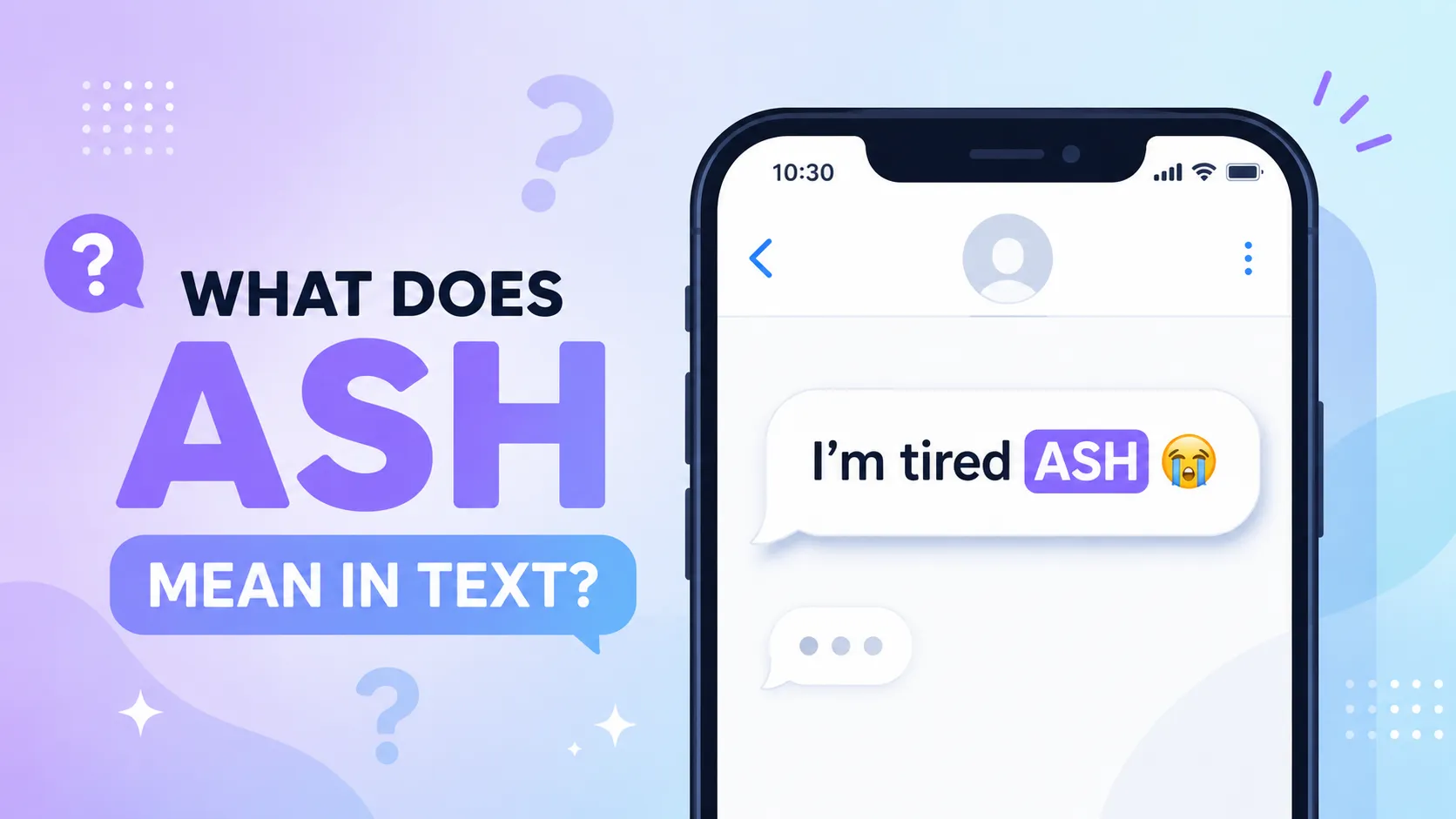
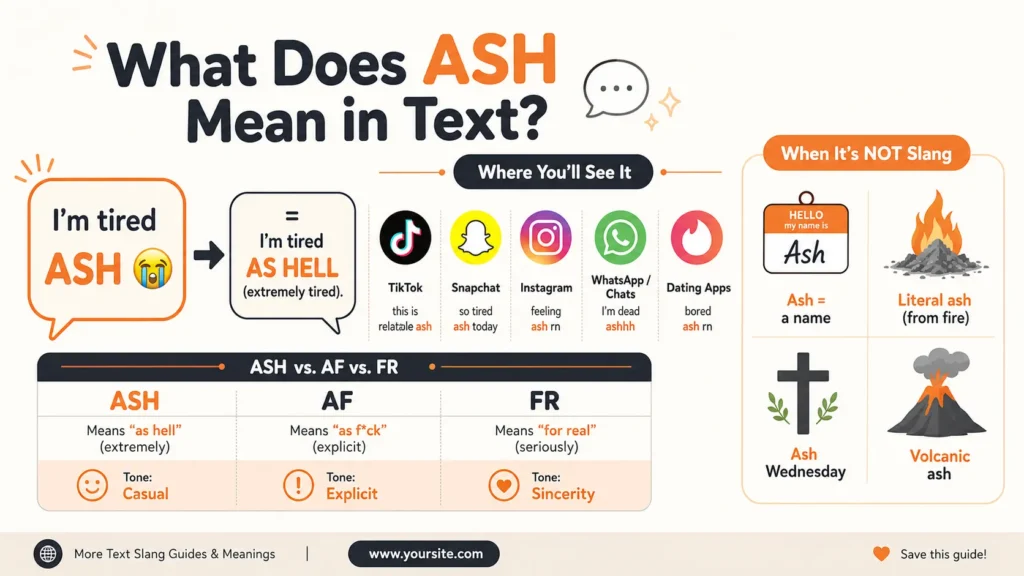
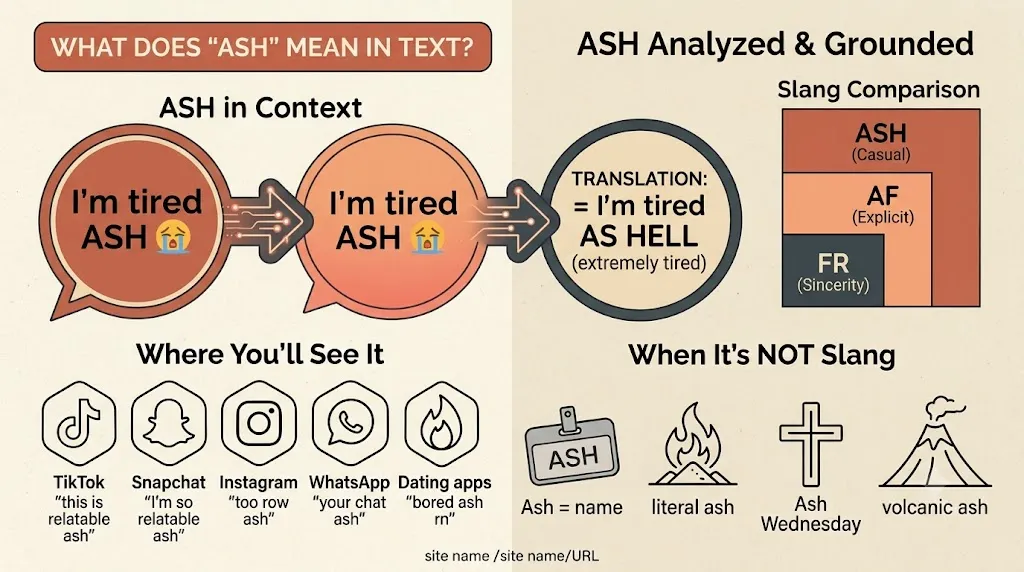
In texting, “Ash” Almost Always Means “As Hell” — a phonetic, typed-fast intensifier Gen Z and younger millennials use to amp up an adjective. “I’m tired ash” = “I’m tired as hell.” It’s one letter shorter than typing the whole phrase, and it reads softer than “AF.”
Outside of slang, “ash” can also mean: the powdery residue left after something burns, a first name (short for Ashley or Ashton, or the Pokémon protagonist), the religious symbol used on Ash Wednesday, or the technical term used in geology, chemistry, and volcanology.
The rest of this guide breaks down exactly how to tell which meaning you’re looking at — by platform, by sentence structure, and by capitalization — so you’re never left guessing again.
What Does ASH Mean in Text?
When you see “ash” tacked onto the end of a sentence, it’s doing one job: turning the volume up.
“ASH” = “as hell,” used as an intensifier right after an adjective or feeling.
- “I’m bored ash” → I’m bored as hell
- “That test was hard ash” → That test was hard as hell
- “She’s funny ash” → She’s funny as hell
Grammatically, it behaves the same way “af,” “really,” or “extremely” would — it just sits after the word it’s modifying instead of before it, because that’s how “as hell” works in spoken English (“tired as hell,” not “as hell tired”).
This is the meaning you’ll hit 90% of the time in a DM, a group chat, or a comment section. But “ash” is also a real English word and a common name, so context and capitalization matter — more on that below.
Where “ASH” Actually Came From
“Ash” isn’t an acronym in the traditional sense (it doesn’t stand for three separate words the way “LOL” or “BRB” do). It’s a phonetic contraction — a spelled-out version of how “as hell” sounds when someone says it quickly in casual speech.
The timeline roughly looks like this:
- Spoken origin: “As hell” has been used as a spoken intensifier in American English for decades (“hungry as hell,” “cold as hell”).
- Texting compression: As messaging culture pushed people toward shorter, faster typing, “as hell” got clipped the way it sounds when spoken fast — landing on “ash” because it still reads as a real, pronounceable word (unlike a string of consonants).
- Social media acceleration: Caption-driven platforms — Twitter/X, Instagram, and especially TikTok — rewarded short, punchy phrasing, which pushed “ash” from group-chat slang into mainstream comment sections and captions.
- Gen Z adoption: By the early 2020s, “ash” was firmly part of everyday Gen Z texting vocabulary, sitting alongside terms like “no cap,” “bet,” and “mid.”
Because it’s a living piece of slang rather than an official dictionary entry, its usage is still shifting — but the “as hell” meaning has stayed dominant and stable for years now, which is why it’s the safe default interpretation.
ASH Meaning by Platform
The core meaning of “ash” doesn’t change platform to platform — but how it shows up does. Here’s the breakdown.
ASH Meaning on TikTok
TikTok is arguably where “ash” gets the most exposure. It shows up constantly in captions and comment sections to exaggerate a reaction — “this is relatable ash” or “he’s cute ash 😭” — often paired with crying-laughing emojis or all-lowercase, no-punctuation formatting for extra casualness.
ASH Meaning on Snapchat
Snap captions and streak chats favor short, low-effort language, so “ash” fits naturally: “bored ash rn,” “school was long ash today.” Because Snapchat conversations are usually between close friends, the slang meaning is rarely ambiguous here.
ASH Meaning on Instagram
On Instagram, “ash” shows up most in comments and captions where someone wants to sound expressive without writing a full sentence — “this pic is fire ash” is a common comment-section pattern.
ASH Meaning on WhatsApp and iMessage
In one-on-one or group texting, “ash” behaves exactly like it does in speech — it’s used between people who already know each other’s tone, so it rarely confuses. “Work was long ash today” is a completely normal text between friends.
ASH Meaning in Gaming Chats (Discord, Twitch, Xbox/PlayStation Party Chat)
Gamers lean on “ash” for quick banter mid-match: “that clutch was clean ash,” “this lobby is sweaty ash.” Fast typing during live gameplay makes short intensifiers like “ash” more practical than typing “extremely.”
ASH Meaning on Dating Apps (Tinder, Hinge, Bumble)
This is where “ash” gets more interesting, because tone matters more when you’re talking to a stranger. A bio or opener like “bored ash at work, save me” signals a casual, low-pressure, Gen Z personality. It can land as playful and relatable — or read as a little too casual, depending on who’s on the other end. A safe rule: mirror the other person’s energy. If their profile is polished and formal, skip the slang. If they’re already texting casually, “ash” fits right in.
ASH vs. AF vs. ASF vs. FR
People often mix these up because they show up in similar spots in a sentence. Here’s how they actually differ:
| Term | Full Meaning | Function | Tone / Intensity | Example |
| ASH | “as hell” | Intensifier | Casual, softer, playful | “I’m tired ash” |
| AF | “as f***” | Intensifier | Stronger, more explicit | “I’m tired AF” |
| ASF | “as f***” (alt spelling of AF) | Intensifier | Same as AF, slightly more emphatic feel | “That’s funny asf” |
| FR | “for real” | Agreement/sincerity marker | Not about intensity — about honesty | “That movie was good, fr” |
| TBH | “to be honest” | Opinion marker | Neutral, used to preface a take | “TBH I didn’t like it” |
| ASL | “age, sex, location” | Information request (older chatroom slang) | Neutral, mostly outdated now | “asl?” |
The key distinction: ASH and AF/ASF do the same grammatical job (intensifying an adjective), but ASH is the “PG” version — it reads as youthful and expressive without the profanity baked into AF. FR and TBH aren’t intensifiers at all; they’re about sincerity, not degree.
When ASH Is NOT Slang
Roughly one in ten times you see “ash,” it isn’t slang at all. Here’s how to catch the difference.
1. Literal Ash (Burned Residue)
The original, dictionary definition: the powdery gray substance left behind after wood, paper, coal, or tobacco burns. You’ll see this in ordinary conversation too — “there’s ash all over the fireplace” or “flick your cigarette ash outside.”
2. Ash as a Name
Capitalized “Ash” is almost always a person, not slang. It’s most commonly short for Ashley or Ashton, and it’s also a standalone given name in its own right — boosted culturally by Ash Ketchum, the protagonist of the Pokémon anime. Because it works well for any gender, “Ash” has also become a popular gender-neutral name choice. If a message says “Ash is coming over later,” that’s a name, not “as hell” — capitalization and sentence position are your biggest clues.
3. Ash Wednesday and Religious Symbolism
In Christian tradition — particularly Catholicism — ash is used to mark Ash Wednesday, the start of Lent. A cross of ash is placed on the forehead as a symbol of mortality and repentance (“from dust you came, to dust you shall return”). This meaning shows up in texts around late winter/early spring, usually in a completely different tone than casual slang.
4. Symbolic and Emotional Use (“Ash” as Burnout)
Separate from the “as hell” slang, some people use “ash” or “ashes” more poetically to describe feeling drained, used up, or emotionally burnt out — leaning on the old idea that ash is what’s left after something has burned down completely. This usage is less common in texting but shows up in captions, journaling, and more reflective posts.
5. Scientific and Technical Meaning
In chemistry, geology, and materials science, “ash content” refers to the inorganic residue left after a material is fully combusted — used to measure mineral content in things like wood, coal, or food samples. Volcanic ash is a distinct and serious topic in geology and aviation safety, since ash clouds from eruptions can shut down flight paths and damage engines. In medical and lab contexts, terms like “bone ash” come up when measuring mineral density. None of these usages are slang, and they never appear in casual texting contexts.
6. Acronym Use (Capitalized “ASH”)
In formal or medical writing, capitalized ASH can stand for things like Action on Smoking and Health (a public health organization) or, in some medical literature, conditions unrelated to texting slang entirely. If you see “ASH” in an article, report, or all-caps context, it’s very likely not the texting intensifier.
How to Use “ASH” Correctly
Grammar rule: “Ash” goes after the adjective or feeling it’s intensifying — never before it.
Correct: “That’s wild ash.” Incorrect: “That’s ash wild.”
| Sentence Pattern | Example | Meaning |
| [Feeling] + ash | “I’m hungry ash” | I’m extremely hungry |
| [Adjective] + ash | “That’s funny, Ash” | That’s extremely funny |
| [Situation] + ash | “This traffic is slow, Ash” | This traffic is extremely slow |
Tone tip: “Ash” reads as informal, playful, and expressive. It fits friends, group chats, casual DMs, gaming, and social captions. It does not fit professional emails, formal writing, customer service messages, or first impressions with someone significantly older or outside youth internet culture — in those settings, swap it for “very,” “extremely,” or “really.”
Real Text Message Examples
To make this concrete, here’s how “ash” plays out across different real-world conversation types:
Friend group chat:
“the exam was long ash 💀 I’m never doing that again”
Reacting to something funny:
“wait this is funny ash, send it to the group”
Dating app opener:
“ngl your dog pic got me — bored ash rn, what are you up to”
Gaming banter:
“That ace was clean, as, run it back”
Literal (non-slang) use, for comparison:
“Can you clean the ash out of the fireplace before we leave”
Notice the pattern: when “ash” follows an adjective describing a feeling or reaction, it’s slang. When it’s the subject of the sentence or paired with words like “fireplace,” “cigarette,” or “volcano,” it’s literal.
Common Misconceptions About ASH
“Ash always means something negative.” Not true — it’s neutral and works with both positive and negative adjectives: “happy ash,” “excited ash,” and “annoyed ash” are all valid.
“It’s just a typo for ‘as hell.'” Occasionally, sure — but in most cases it’s intentional shorthand, not an accident.
“It’s rude or offensive.” Generally, no. Because it swaps out the “hell” for a softer sound, it’s considered one of the milder intensifiers in casual slang — less edgy than AF or ASF.
“It’s a formal abbreviation with one fixed meaning.” Also false. As this guide covers, “ash” shifts meaning depending on capitalization, context, and platform — it’s slang, a name, a religious symbol, and a scientific term all at once, depending on where you see it.
Is It Okay to Use ASH?
A quick gut-check before you type it:
- Texting close friends or group chats: Totally fine, very natural.
- Social media captions and comments (TikTok, Instagram): Fits right in.
- Gaming chat with people you know: Common and expected.
- Dating app messages: Use with care — mirror the other person’s tone first.
- Professional emails, job applications, customer service: Avoid it — use “very” or “extremely” instead.
- Talking to someone significantly older or outside internet culture: Skip it unless they’ve used it first, since it may not land the way you intend.
People Also Ask
Most often, “ash” means “As Hell” — a slang intensifier used after an adjective, like “tired ash” (extremely tired).
No. It’s informal slang, not profanity. It’s actually considered a softer alternative to “AF” or “ASF” because it avoids spelling out the harsher word directly.
The same “as hell” meaning — it’s just used in captions and comments to exaggerate a reaction, like “this is relatable ash.”
Yes. Capitalized “Ash” is usually a name (short for Ashley or Ashton, or a standalone name). “Ash” can also mean literal burned residue, the symbol used on Ash Wednesday, or a technical term in chemistry and geology.
Both intensify an adjective, but AF stands for “as f***” and reads as more explicit, while ASH (“as hell”) is milder and more casual.
Conclusion
At the end of the day, “Ash” is a small word doing a big job. In the vast majority of texts, captions, and comments you’ll come across, it’s simply a faster, softer way of saying “as hell” — a quick intensifier that lets people express strong feelings without slowing down to type the full phrase. Once you spot the pattern (adjective or feeling + “ash”), the slang meaning becomes almost impossible to miss.
But as this guide has shown, “ash” isn’t a one-note word. Capitalize it, and it’s probably someone’s name. Put it near a fireplace, a cigarette, or a volcano, and it’s back to its original dictionary definition. Drop it into a religious or reflective conversation, and it might be pointing at Ash Wednesday or the idea of something burned down to nothing. See it in all caps in a report or medical write-up, and it’s likely a completely different acronym altogether.