OOF Meaning: What It Really Means, Where It Came From, and How to Use It
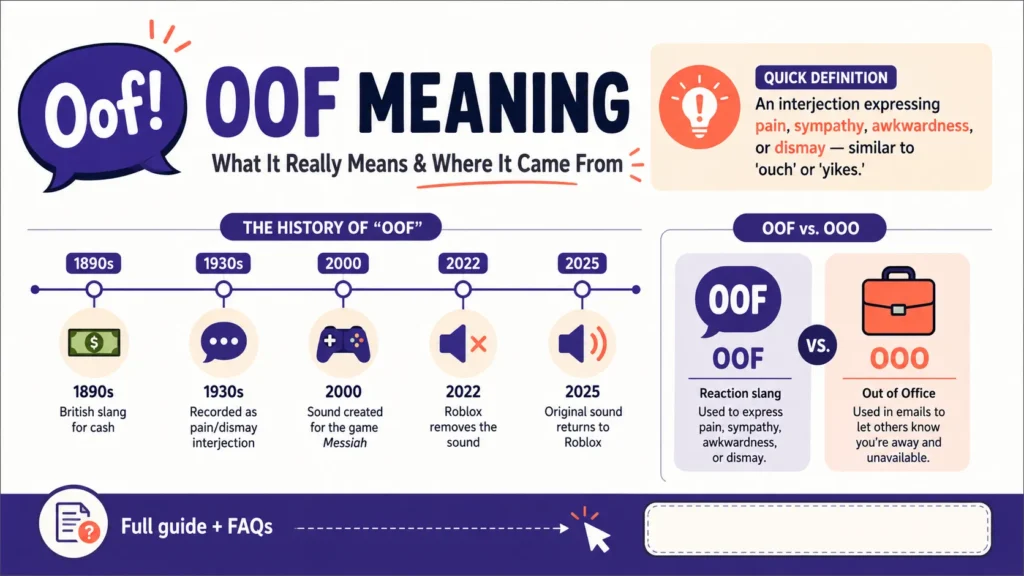
OOF Is An Informal Interjection Used to react to something painful, awkward, unlucky, or disappointing — similar to “ouch” or “yikes.” It isn’t an acronym, and depending on where you saw it, it could mean something else entirely: old-fashioned British slang for money, or a workplace shorthand for “Out of Office.”
People search this term for a few different reasons. Some just want a fast definition after seeing it in a message. Others are chasing the Roblox backstory — the sound effect that made “oof” a global meme has a genuinely wild copyright history most articles skip. And a smaller group is trying to figure out what “OOF” means on their coworker’s calendar. This guide covers all three, with real dates and real sources, not just a rehash of what every other slang site already says.
What Does OOF Mean?
In its most common modern use, OOF is an exclamation expressing discomfort, sympathy, surprise, or secondhand embarrassment. Merriam-Webster defines it as a word used to express discomfort, surprise, or dismay — and that’s exactly how you’ll see it used in texting, comments, and gaming chat.
Key things that make it distinct from similar slang:
- It’s not an acronym.
- It’s tone-flexible. It can read as sympathetic (“Oof, I’m sorry, that’s rough”), sarcastic (“Big oof for that outfit”), or purely reflexive (saying “oof” after stubbing your toe).
- It scales in intensity. A single “oof” works for something minor; “big oof” or repeated “OOF OOF OOF” signal something more serious or more embarrassing.
Quick Meaning Summary
| Meaning | Context | Status |
| Reaction to pain/embarrassment/bad news | Texting, social media, gaming | Current, mainstream use |
| “Out of Office” | Corporate email, Outlook/Teams status | Current, workplace-specific |
| Slang for money | 19th-century British English | Archaic, dictionary-recorded |
| Roblox death/reset sound | Gaming culture | Sound removed 2022, restored 2025 |
Origin and History of “OOF”
Most guides claim OOF “comes from Roblox” and stop there. That’s only the most recent chapter of a much longer story.
A natural human sound (centuries old)
People use ‘oof’ as part of a small family of words—like ‘ow,’ ‘ugh,’ and ‘argh’—that imitate involuntary reactions rather than deriving from other words.” Comic strips and early 20th-century cartoons used “OOF” as a visual sound effect for characters taking a hit, right alongside “BAM” and “POW,” long before video games existed.
OOF as British slang for money (late 1800s)
This is the piece almost every competing article misses entirely. In 19th-century Britain, “oof” meant money or cash. Etymologists writing for the Oxford University Press blog trace it to “ooftish,” itself from Yiddish/Low German oyf tish — literally “on the table,” referring to cash laid down during gambling. Collins Dictionary gives the related German root auf dem Tische (“on the table”). The word produced its own family of terms still listed in dictionaries today:
- Oofy — wealthy, rich
- Oof bird — a joking phrase for an imaginary endless source of money
- Oofless — broke, penniless
This sense shows up in Edwardian-era fiction — one 1911 novel describes a character spending “the good oof that his pater had made.” It’s archaic today, but it’s a real, dictionary-recorded meaning that predates the modern reaction-word sense by decades.
The interjection sense is recorded (1930s)
“Merriam-Webster documents the ‘expressing discomfort or dismay’ sense that people commonly use today and traces its earliest known use to the 1930s. The term originally represented the straightforward sound someone made after being winded, and people later adapted it into the online expression we recognize today.”
Video games adopt it (2000)
It originated in Messiah, a 2000 action-adventure PC game by Shiny Entertainment, credited to composer Tommy Tallarico and sound designer Joey Kuras, for the game’s small angel protagonist, Bob.
Roblox popularizes it globally (2005–2022)
Roblox’s developers used the Messiah clip as the platform’s default death/reset sound — reportedly sourced from a stock sound-effects CD, per Roblox’s own public statements. For about 14 years, hundreds of millions of players heard it every time their character died, turning it into one of the most-played sound effects in gaming history and a mainstream meme.
The copyright dispute (2019–2022)
Tallarico identified the sound as his own work in 2019 and reached a licensing deal with Roblox in late 2020 that made it a paid asset (about 100 Robux) for developers.. The move drew real backlash from longtime players, and a November 2022 video essay by creator Hbomberguy publicly challenged parts of Tallarico’s claim to have personally created the sound.
The sound returns (2025)
In July 2025, Roblox brought the original “oof” sound back via its Creator Marketplace, nearly three years after removing it — widely reported as a nostalgia win for the community.
Why Is “OOF” So Popular?
“Oof” fills a specific gap in digital communication: it lets someone acknowledge that something is bad, awkward, or unlucky without composing a full sentence or committing to a heavier emotional response. It’s short enough to type in half a second, universally understood across platforms, and flexible enough to work for everything from a stubbed toe to a rough breakup story — which is exactly why it spread from gaming chat into completely general use.
(Real Examples)
| Message | Typical OOF reply | What it signals |
| “I just called my teacher ‘mom.'” | “OOF 💀” | Secondhand embarrassment |
| “Got laid off today.” | “Oof… I’m really sorry, are you okay?” | Genuine sympathy |
| “She left me on read again.” | “Oof, that’s cold.” | Sympathetic acknowledgment |
| “I forgot the presentation was today.” | “Big Oof.” | Amplified concern, semi-humorous |
| “Lost the match in the last second.” | “OOF” | Reaction to failure/loss (gaming) |
OOF on Social Media and Gaming Platforms
- Discord / gaming chat: Its home turf — used constantly as a reaction to deaths, losses, missed shots, or bad RNG.
- TikTok / Instagram comments: A common one-word reaction under embarrassing or relatable fail clips.
- X (Twitter): Frequently used mid-sentence as a tonal beat (“…oof, that’s rough”) rather than as a standalone reply.
- Reddit: Common as a top comment reacting to a screenshot, story, or bad-decision post.
- Workplace tools (Outlook, Teams, Slack): A separate, unrelated use — shorthand for “Out of Office” in status messages, primarily inside Microsoft-adjacent workplaces.
Money Meaning (Historical)
“As covered above, speakers used oof as 19th-century British slang for cash, deriving it from the Yiddish ooftisch (“on the table”), which referred to gambling stakes. People rarely use this meaning today, but dictionaries still record it. For example, Collins Dictionary continues to list oof and oofy under this definition, making it a valuable part of the word’s history even though it no longer appears in everyday texting or conversation.
OOF vs. OOO vs. “Oaf” — Don’t Mix These Up
| Term | Meaning | Where you’ll see it |
| OOF (interjection) | Reaction to pain, embarrassment, bad news | Texting, social media, gaming |
| OOF (workplace) | “Out of Office,” mainly Microsoft/Outlook terminology | Corporate email, Slack, Teams |
| OOO | “Out of Office” — the more universally recognized version | Email auto-replies, calendars |
| Oaf | A clumsy, foolish, or slow-witted person (unrelated word) | General vocabulary; occasionally confused with “oof” in speech |
One correction worth making explicitly: OOF does not stand for “Out of Facility” — a claim that circulates on a few other slang sites“Microsoft introduced ‘OOF’ as shorthand for ‘Out of Office’ messaging in Exchange and Outlook. Although even Microsoft employees continue to debate why the company chose ‘OOF’ instead of the more obvious ‘OOO,’ the abbreviation clearly comes from ‘office,’ not ‘facility.'”
Outside Microsoft-adjacent workplaces, OOO remains the more common term for the same idea.
Common Misunderstandings
- “OOF always means Roblox.” No — Roblox popularized the sound clip, but the word itself predates the platform by close to a century in two separate senses (comic sound effect and British money slang).
- “OOF is an acronym.” It isn’t, in its slang sense. The workplace “Out of Office” use is a genuine initialism, but that’s a completely different meaning.
- “Many people assume that OOF and OOO mean the same thing everywhere. In reality, both abbreviations refer to being away from work, but Microsoft primarily uses OOF in Exchange and Outlook, while people use OOO as the broader and more widely recognized term across workplaces and platforms.”
Related Terms and Similar Expressions
| Word | Best used for |
| Yikes | Awkward, cringeworthy, or shocking situations |
| Ouch | Direct physical or emotional pain |
| Dang / Damn | Casual surprise or mild frustration |
| Whoa | Shock or disbelief |
| RIP | Sympathetic acknowledgment of failure or loss (often joking) |
| Big oof | An intensified version of “oof” itself |
| Get oofed | Slang for being defeated or eliminated, mainly gaming/meme culture |
When Not to Use OOF
A one-word “oof” can land as dismissive when someone shares something genuinely serious — a breakup, a death in the family, a real crisis. In those cases, a fuller, more empathetic response works better. Save “oof” for the lower-stakes end of bad news: awkward moments, minor mistakes, mild bad luck — things that are more funny-bad than actually-bad.
People Also Ask
No, not in its texting/slang sense — it’s an onomatopoeic interjection, not short for a phrase. The separate workplace use (“OOF” for Out of Office) is a genuine initialism, but that’s a different meaning entirely.
It’s the platform’s original death/reset sound, taken from the 2000 game Messiah. Roblox removed it in 2022 over a licensing dispute with its creator and restored the original sound in 2025.
Not exactly. Both relate to being away from work, but “OOF” is specifically associated with Microsoft/Outlook terminology, while “OOO” is the more universally recognized version. In its slang sense, “oof” is unrelated to either — it’s a reaction word.
No, it’s considered harmless, casual slang. It can feel dismissive if it’s the only response to something serious, so it’s worth reading the room.
Not the slang sense — it’s too informal. The acronym sense (Out of Office) is workplace-appropriate but company-dependent; OOO is the safer, more universally understood choice if you’re unsur
Conclusion
“OOF” carries far more history than its three letters suggest: a centuries-old grunt of pain, a piece of Victorian slang fordispute, and now one of the internet’s most versatile one-word reactions. In practice, it’s simple to use — a fast, low-effort way to say “that’s rough” without writing a full sentence. Use it freely in casual conversation, save fuller responses for anything genuinely serious, and you’ve got the full picture — modern meaning, workplace meaning, and the surprisingly deep history behind it.