
Can Dogs Have Cinnamon? Complete Vet-Backed Safety Guide
Cinnamon is one of those ingredients that feels harmless at first glance. It is warm, familiar, fragrant, and deeply connected to comfort foods like toast, oatmeal, cookies, cakes, and seasonal treats. Because it appears in so many human foods, many dog owners eventually ask the same practical question: Can dogs have cinnamon?
The answer is more nuanced than a simple yes or no.
Dogs can be exposed to cinnamon in very small amounts without immediate trouble, but that does not automatically make cinnamon a good or useful ingredient for them. The risk depends on the type of cinnamon, the quantity, the form, and the overall food it is mixed into. A tiny accidental sprinkle is very different from a cinnamon roll, a spoonful of powder, or cinnamon essential oil. Some exposures are mild and self-limiting, while others can become serious.
This guide breaks the topic down in clear, search-friendly, dog-owner-friendly language so you can understand what matters, what does not, and when a vet call is the right move.
Introduction: Why “Can Dogs Have Cinnamon” Is So Confusing
Search this topic online, and you will quickly find mixed messages. Some pages say cinnamon is fine. Others say it is toxic. Some say only a little is okay. Some say to avoid it entirely. That inconsistency makes sense once you understand the underlying reality:
Cinnamon is not one of the most poisonous ingredients dogs can encounter, but it is also not a dog food ingredient that belongs in a pet’s routine.
That single point explains most of the confusion. In everyday conversation, people often use “safe” to mean “won’t immediately poison my dog.” Veterinarians usually use “safe” more carefully, meaning “unlikely to cause harm at this dose, in this form, and in this context.”
Those are not the same thing.
A pinch of cinnamon on a homemade treat is not the same as cinnamon oil. Cassia cinnamon is not the same as Ceylon cinnamon. Cinnamon in baked goods is not the same as straight powder. Cinnamon in a diffuser is not the same as cinnamon that was accidentally licked off a countertop. The context changes the risk.
Most responsible veterinary guidance lands in the same place: tiny accidental exposure is usually not an emergency, but concentrated forms, repeated exposure, and cinnamon oils can be dangerous.
The real-world danger is often not the spice alone. It is the surrounding food or product. Sugar, butter, chocolate, nutmeg, xylitol, raisins, and heavy fats are frequently the actual hazards in cinnamon-flavored human foods. In other words, cinnamon often becomes part of a bigger problem.
So, when dog owners ask, “Can dogs have cinnamon?” what they really need is not a one-word answer. They need a practical framework. What kind of cinnamon? How much? is form? What symptoms matter? What should you do next?
That is what this guide is built to answer.
Is Cinnamon Safe for Dogs?
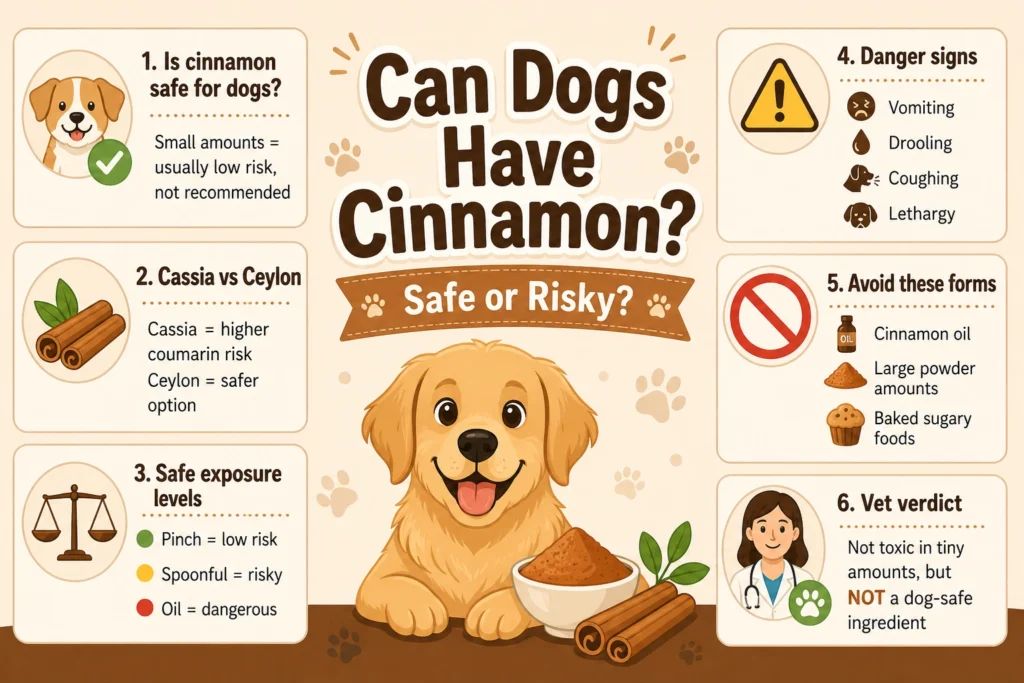
Short answer: Yes, dogs can have cinnamon in very small amounts, but that does not mean it should be intentionally added to their diet.
The simplest way to think about cinnamon is this:
- Tiny accidental exposure: usually low risk
- Moderate ingestion: may cause digestive irritation or discomfort
- Large ingestion: can become a medical concern
- Cinnamon essential oil: significantly higher risk and not appropriate for dogs
Cinnamon contains naturally occurring compounds, including cinnamaldehyde and, in some varieties, coumarin. These substances are part of what gives cinnamon its distinct aroma and flavor. In small amounts, they are not automatically dangerous. In higher amounts, they can irritate the mouth, throat, stomach and in some cases contribute to more serious issues.
A dog that licks a crumb of cinnamon toast is not the same as a dog that eats a spoonful of powder. A dog that accidentally sniffs a little powder is not the same as a dog exposed to concentrated oil. Dose matters. Form matters. Frequency matters.
Here is the practical safety picture:
| Exposure Type | Risk Level | Why It Matters |
| Tiny sprinkle on food | Low | Usually causes no issue |
| Cinnamon baked goods | Moderate | Sugar, fat, and additives may be the real danger |
| Large amount of powder | High | Can trigger irritation and illness |
| Cinnamon essential oil | Very high | Concentrated and potentially toxic |
The most important takeaway is this: cinnamon is not typically considered a “dog food” ingredient. That means it is not needed for nutrition, not required for health, and not worth deliberately using unless a vet has specifically recommended it for a reason.
Many pet owners hear the phrase “natural ingredient” and assume it must be harmless. That is a common but misleading assumption. Nature contains plenty of things that are not safe for dogs. Cinnamon sits in a middle category: not inherently catastrophic in tiny exposures, but not something to casually treat as a dog-safe supplement.
Cassia vs Ceylon Cinnamon Dogs Safety
This is one of the most important distinctions in the entire discussion, because not all cinnamon is the same.
Two major types matter here:
Cassia Cinnamon (Most Common)
Cassia cinnamon is the type most people encounter in supermarkets, packaged spice blends, bakery products, and inexpensive cinnamon powders. It has a stronger, more pungent taste and is generally cheaper and more widely sold.
The key concern with Cassia cinnamon is its higher coumarin content. Coumarin is a natural compound that, in high amounts or repeated exposures, can place stress on the liver. That does not mean a single tiny exposure is likely to cause liver failure. It does mean that repeated or substantial use is not ideal for dogs, especially smaller dogs and dogs with existing health issues.
Ceylon Cinnamon (“True Cinnamon”)
Ceylon cinnamon is often called “true cinnamon.” It has a lighter color, a milder flavor, and a more delicate aroma. It is generally more expensive and less common in everyday grocery products.
The main advantage of Ceylon cinnamon is that it contains much lower levels of coumarin than Cassia cinnamon. That makes it the safer option between the two if we are comparing cinnamon varieties. Still, safer does not mean necessary. It simply means lower concern relative to Cassia.
Comparison at a Glance
| Type | Safety Level | Main Concern |
| Cassia cinnamon | Moderate risk | Higher coumarin content |
| Ceylon cinnamon | Safer option | Still unnecessary for dogs |
So, if someone asks which cinnamon is safer for dogs, the answer is straightforward: Ceylon cinnamon is the better choice from a risk standpoint. But the deeper answer is even simpler: dogs do not need cinnamon at all.
That matters because many pet products use the word “natural” as if it automatically means beneficial. In reality, a natural ingredient can still be irritating, unnecessary, or risky in concentrated amounts.
How Much Cinnamon Can Dogs Eat?
There is no official universal veterinary dosage for cinnamon because dogs do not need cinnamon nutritionally. That means any “safe amount” is really an estimate of what is unlikely to cause harm rather than a health target.
The amount a dog may tolerate depends on:
- the dog’s size
- the cinnamon type
- whether it is powder, oil, or baked into food
- whether the dog has a sensitive stomach
- whether there are other ingredients in the same food
A tiny amount may pass through without incident. But because cinnamon is not essential for dogs, there is no reason to push the limits.
Safe Cinnamon Amounts for Dogs
| Dog Size | Approximate Small Exposure | Frequency |
| Small dogs under 10 kg | Tiny pinch only | Rarely, accidental exposure only |
| Medium dogs 10–25 kg | Up to about 1/16 teaspoon | Infrequently |
| Large dogs 25+ kg | Up to about 1/8 teaspoon | Rarely |
A useful rule of thumb: anything beyond roughly 1/4 teaspoon regularly moves into a riskier category, especially if it is Cassia cinnamon or if the cinnamon is mixed into fatty, sugary, or processed food.
That said, this is not an invitation to test your dog’s tolerance. The correct mindset is not “how much can I give?” but “does my dog need this at all?” In the case of cinnamon, the answer is almost always no.
Dogs do not have a cinnamon requirement in their diet. They do not need it for immunity, digestion, or coat health. So the issue is not providing a benefit. The issue is avoiding unnecessary risk.
Real-Life Ways Dogs Accidentally Eat Cinnamon
Most cinnamon exposure in dogs is accidental rather than intentional. That matters because the cause of the exposure often determines the level of concern.
Cinnamon Rolls & Bakery Foods
This is one of the most common scenarios.
A cinnamon roll sounds like a cinnamon problem, but the larger concern is usually the rest of the ingredients. These foods often contain sugar, butter, cream, frosting, refined flour, salt, and sometimes other harmful additives.
The risk is not just one thing. It is the combination.
Possible issues include:
- digestive upset
- diarrhea
- vomiting
- pancreatitis risk from high fat
- obesity from sugar-heavy foods
- xylitol exposure in sugar-free products
- Chocolate contamination in mixed baked goods
- nutmeg in spiced desserts
So if a dog eats a cinnamon roll, cinnamon may not be the main danger. The human dessert as a whole is often more concerning than the spice itself.
Inhaled Cinnamon Powder
Powdered cinnamon can be irritating if a dog sniffs it, inhales it, or gets it in the eyes. This can happen during baking, kitchen spills, or when a pet gets too close to food preparation.
Possible signs include:
- sneezing
- coughing
- watery eyes
- temporary irritation
- pawing at the face
In most cases, mild exposure resolves when the dog is moved away from the irritant. But if coughing or distress continues, a vet call is wise.
Cinnamon Sticks
Cinnamon sticks are not usually toxic in the same way essential oils are, but they are not safe chew toys. A dog may try to chew or swallow a stick, which creates several risks:
- choking
- mouth irritation
- intestinal blockage
- gastrointestinal injury
The danger is mechanical as much as chemical. A hard, fibrous stick can cause trouble simply because it is not meant to be chewed by dogs.
Cinnamon Essential Oil (HIGH RISK)
This is the form that deserves the most caution.
Cinnamon essential oil is highly concentrated. It should never be treated like a casual kitchen spice. Even small amounts can be problematic for Dogs, especially if ingested, applied to the skin, or diffused in poorly ventilated areas.
Possible issues include:
- vomiting
- drooling
- mouth irritation
- breathing difficulty
- skin irritation
- Neurologic signs in severe cases
- liver stress
Essential oils are potent by design. That is exactly why they deserve caution. If a dog has access to cinnamon oil, treat that exposure seriously.
Even passive exposure from strong diffusion may bother sensitive pets. Dogs have more sensitive olfactory systems than humans, and what seems faint to us can be intense to them.
Symptoms of Too Much Cinnamon in Dogs
If your dog has eaten too much cinnamon, the signs can vary based on the amount, the form, and the size of the dog.
Mild Symptoms
These are the more common warning signs after an irritating exposure:
- drooling
- mouth discomfort
- coughing
- sneezing
- vomiting
- mild diarrhea
- facial pawing
- watery eyes
These symptoms may indicate irritation rather than serious poisoning, but they still matter.
Severe Symptoms
These are more concerning and deserve prompt veterinary attention:
- weakness
- repeated vomiting
- trouble breathing
- lethargy
- Trembling
- worsening diarrhea
- collapse
- signs of liver stress
Not every serious symptom means cinnamon alone is the culprit, but it does mean the dog needs professional assessment. Sometimes the problem is the cinnamon. Sometimes it is the baked goods, oils, sugars, or other ingredients that came with it.
A good rule is this: if symptoms persist, worsen, or seem unusual for your dog, do not wait for them to “just pass.”
What to Do If Your Dog Eats Cinnamon
The right next steps depend on what your dog ate, how much, and how they are acting now. A calm, organized response is best.
Step 1: Identify the form
Ask yourself what the dog actually consumed:
- powder
- stick
- baked food
- essential oil
- a treat containing cinnamon
- a blend of spices
This is important because each form carries a different level of concern.
Step 2: Estimate the amount
Try to estimate whether it was:
- a tiny lick
- a small pinch
- a spoonful
- a large serving
- a concentrated oil exposure
A rough estimate is far better than no estimate. It helps a vet decide how worried to be.
Step 3: Remove access
Take the product away immediately so the dog cannot eat more. Clean up any residue and keep the packaging so you can check the ingredients.
Step 4: Offer water
Water may help reduce oral irritation. Do not force it. Simply make fresh water available.
Step 5: Watch for symptoms
Observe the dog closely for vomiting, coughing, drooling, lethargy, breathing changes, or unusual behavior.
Step 6: Call a vet if needed
Contact a veterinarian promptly if:
- Your dog ate a large amount
- The exposure involved cinnamon oil
- Your dog has symptoms
- The food contained other dangerous ingredients
- Your dog is a small breed, a puppy, a senior, or has a medical condition
When in doubt, a quick call is the safest move. It is always better to ask early than to wait until a mild issue becomes a bigger one.
Pros and Cons of Cinnamon for Dogs
A balanced article should look at both sides. Cinnamon does have a few theoretical upsides, but for dogs, the practical downsides usually outweigh them.
| Pros | Cons |
| Contains natural compounds | Not nutritionally necessary |
| May appear in some pet treats | Can irritate the mouth and stomach |
| Tiny amounts often cause no issue | Oil form can be dangerous |
| Seen as a “natural” ingredient | Easy to overdo |
| Mild antioxidant properties are discussed | No clear need in a dog’s diet |
The important point is that “has potential properties” is not the same as “should be used.” A lot of human ingredients have interesting biochemical traits. That does not make them useful for dogs.
Cinnamon is better understood as an ingredient to avoid intentionally, rather than a beneficial supplement to add.
Common Mistakes Dog Owners Make
Many cinnamon-related problems come from good intentions or simple misunderstandings.
Mistake 1: Assuming natural means safe
Natural substances can still irritate the stomach, inflame the mouth, or cause more serious issues at higher doses.
Mistake 2: Sharing human desserts
Cinnamon desserts are often loaded with sugar, butter, frosting, and other ingredients that dogs should not be eating.
Mistake 3: Forgetting about hidden ingredients
A “simple” cinnamon treat may also contain nutmeg, chocolate, raisins, xylitol, or high-fat fillings.
Mistake 4: Using essential oils around pets
What smells pleasant to a person can be overwhelming or risky to a dog, especially when concentrated oils are involved.
Mistake 5: Ignoring the cinnamon type
Cassia and Ceylon are not interchangeable from a risk standpoint. The coumarin content differs.
Mistake 6: Treating tiny repeated exposures as harmless
One accidental crumb is rarely the same as daily exposure. Repetition increases concern.
Breed Sensitivity Considerations
Not all dogs react the same way.
Some groups deserve extra caution:
Small Breeds
Smaller dogs have less body mass, so the same amount of cinnamon represents a larger exposure relative to size. That means a pinch may matter more for a tiny dog than for a large one.
Flat-Faced Breeds
Breeds such as Bulldogs and Pugs can be more vulnerable to respiratory irritation. If cinnamon powder or oil irritates the airway, these dogs may have a harder time coping with symptoms.
Senior Dogs
Older dogs may have less physiologic reserve and may be more sensitive to digestive upset or liver stress.
Dogs With Existing Medical Issues
Dogs with liver disease, chronic digestive problems, or a history of food sensitivities should be handled cautiously with any new ingredient, especially something nonessential like cinnamon.
The rule is simple: the more vulnerable the dog, the more carefully you should treat the exposure.
Vet Advice
Across Europe, pet care guidance generally emphasizes balanced commercial nutrition, minimizing unnecessary extras, and avoiding human foods that do not belong in a dog’s bowl.
That matters because cinnamon exposures often happen through familiar household foods rather than through raw spice on its own. In the UK, Germany, France, and many other regions, the bigger risk is usually a bakery item, a festive dessert, or a spice-heavy treat passed along from the family table.
The practical veterinary message remains consistent:
- Keep the dog on complete and balanced food
- avoid routine human food sharing
- Do not use spices as “health hacks.”
- Be careful with holiday foods
- treat oils and concentrated flavorings with extra caution
This is especially important around seasonal baking, where cinnamon frequently appears in cakes, biscuits, pastries, and spiced drinks.
FAQs
Yes, Dogs can have cinnamon in very small, occasional amounts, but that does not make it a recommended ingredient. Tiny accidental exposure is usually low risk, while frequent use, large amounts, and concentrated forms can be problematic.
Cinnamon is not usually considered highly toxic in tiny exposures, but it can still cause irritation and illness if the amount is large or the product is concentrated, especially cinnamon essential oil.
Puppies should not be given cinnamon intentionally. Their digestive systems are more sensitive, and there is no benefit to including it in their diet.
A cinnamon roll is more concerning for its sugar, fat, frosting, and possible hidden ingredients than for the cinnamon itself. The whole food matters, not just the spice.
No, cinnamon is not an essential nutrient or a necessary supplement for dogs. There is no strong reason to include it intentionally in a dog’s diet.
Yes, and it may cause coughing, sneezing, watery eyes, and irritation. Powdered cinnamon should be kept away from a dog’s nose and airway.
Ceylon cinnamon is safer than Cassia cinnamon because it contains much less coumarin. Even so, neither type is needed in a dog’s diet.
Conclusion
So, can dogs have cinnamon?
Yes, in the narrow sense that very small accidental exposure is often tolerated.
No, in the practical sense that cinnamon should not be treated as a dog supplement, a dog treat ingredient, or a routine dietary add-in.
That is the most accurate and useful answer.
The safer mindset is straightforward:
- tiny accidental exposure: usually not a major issue
- frequent exposure: unnecessary
- large amounts: risky
- essential oil: especially concerning
- Cinnamon-based human desserts: not appropriate for dogs
Cinnamon is a spice. It belongs in the human kitchen, not in a dog nutrition plan.
If you want the best outcome for your dog, the goal is not to explore how much cinnamon they can tolerate. The goal is to keep their diet simple, balanced, and free from avoidable irritants. That is the most reliable way to protect their digestion, comfort, and long-term well-being.