Complete Guide to the Correct Plural
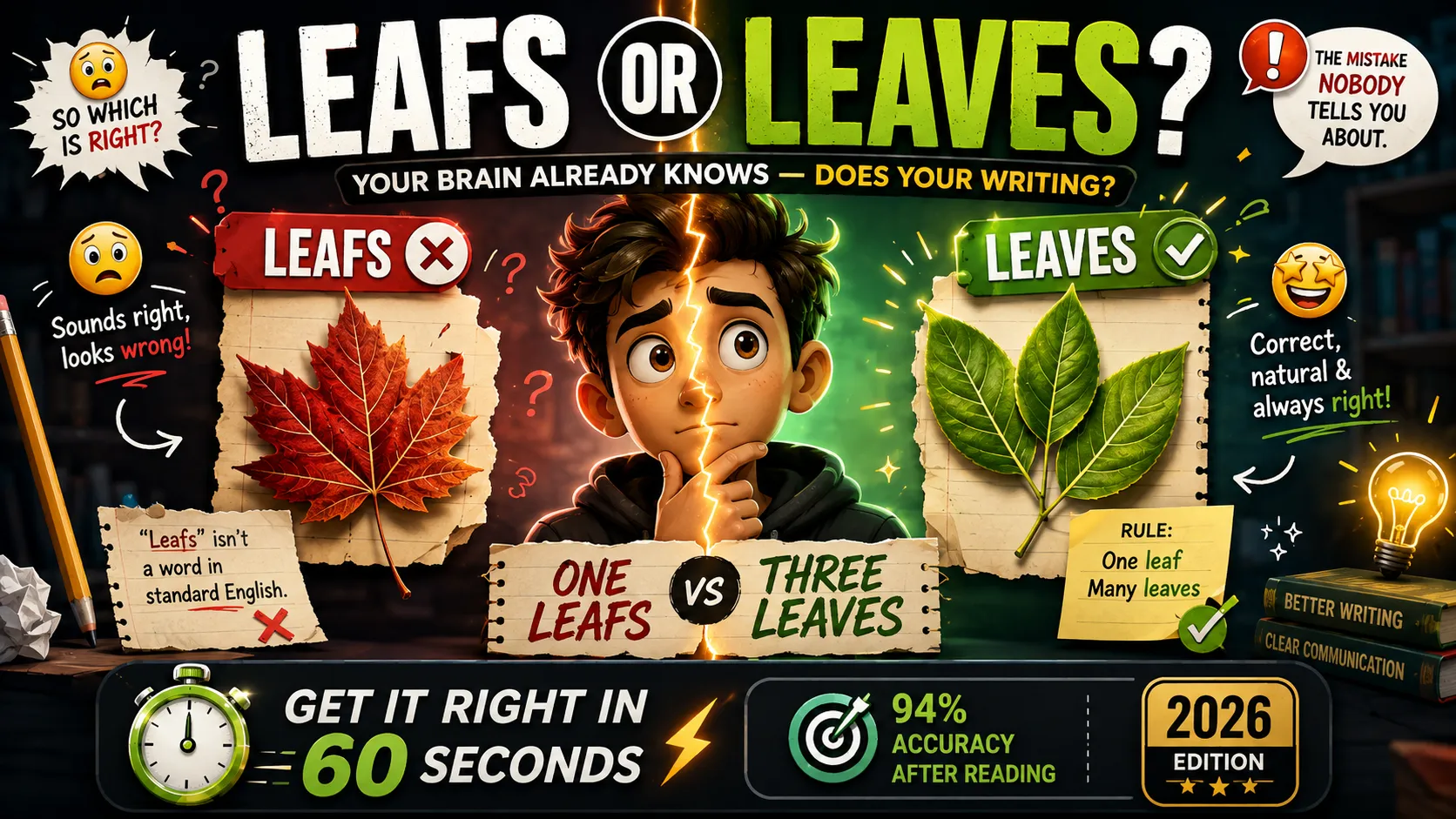
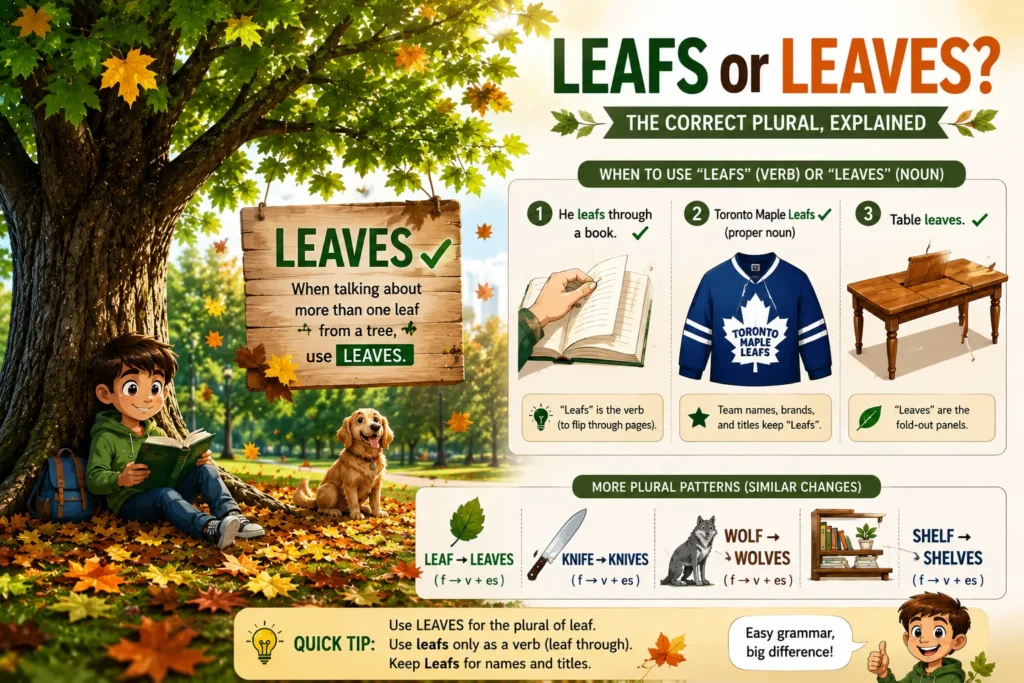
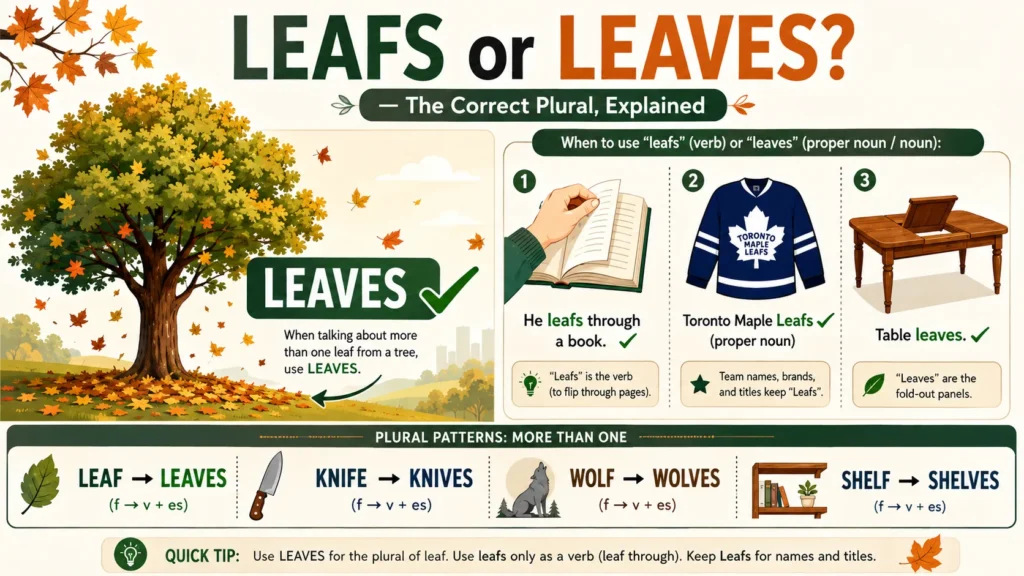
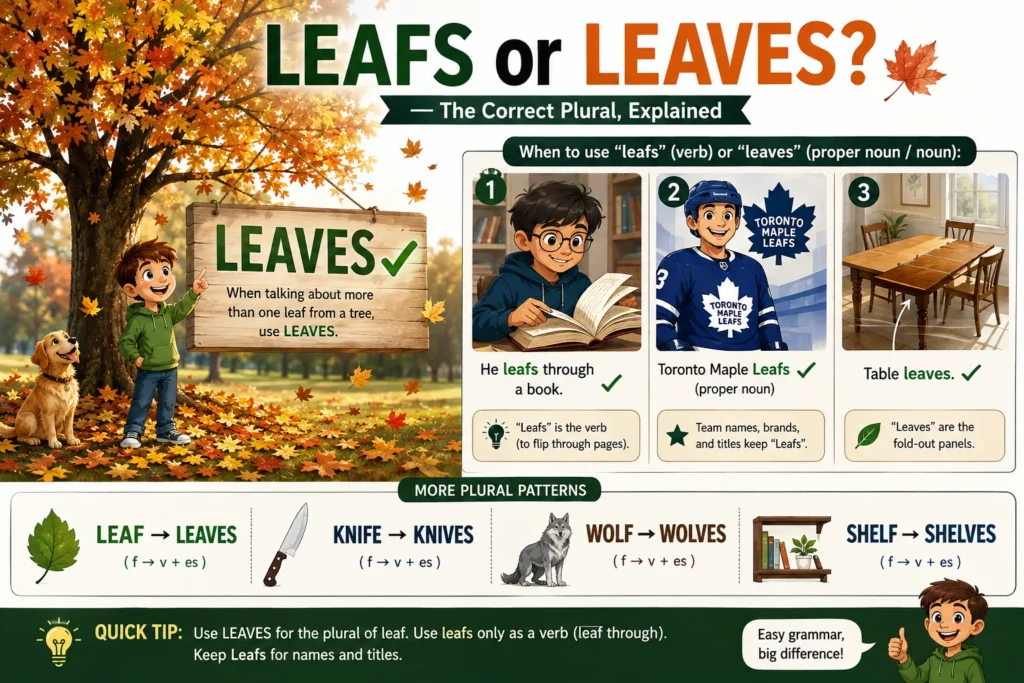
Quick answer: The plural of “leaf” is Leaves, not “leafs.” Use “leaves” for trees, plants, paper, and furniture. “Leafs” is correct only as a verb (“she leafs through a book”) or inside the proper noun “Toronto Maple Leafs.”
1. Leafs or Leaves: The Short Answer
- Leaves — the standard plural noun, used for trees, plants, and general contexts.
- Leafs — correct only as a verb form or inside a proper noun.
- One leaf, many leaves — no exceptions for plants or nature.
- “Leafs” as a plant plural is considered incorrect in every major dictionary.
2. Why Leaf Becomes Leaves: The F-to-V Rule
- Comes from Old English lēaf, part of a group of words with a historical consonant shift.
- Nouns ending in -f or -fe often change to -ves in the plural.
- The shift reflects an old pronunciation pattern, not a modern spelling accident.
- Applies to a fixed, learnable set of English words — not every “-f” word.
- Spelling eventually followed the sound change, giving us “leaves” instead of “leafs.”
3. The Complete F-to-V Word Family (Reference Table)
| Singular | Plural |
| leaf | leaves |
| knife | knives |
| wife | wives |
| life | lives |
| wolf | wolves |
| calf | calves |
| half | halves |
| loaf | loaves |
| shelf | shelves |
| thief | thieves |
| elf | elves |
| self | selves |
| hoof | hooves / hoofs |
| scarf | scarves / scarfs |
| dwarf | dwarfs / dwarves |
4. Words That Don’t Change to V (Common Exceptions)
| Singular | Plural |
| roof | roofs |
| chief | chiefs |
| belief | beliefs |
| cliff | cliffs |
| proof | proofs |
| chef | chefs |
| gulf | gulfs |
| safe (noun) | safes |
| reef | reefs |
- These words look similar to “leaf” but never take “-ves.”
- No single spelling rule predicts this — it comes down to standard usage.
- Memorizing this list prevents the most common related mistakes.
5. When “Leafs” Is Actually Correct
- As a verb: “He leafs through the magazine.”
- Past tense: “She leafed through the manual.”
- As a proper noun: “The Toronto Maple Leafs.”
- Never correct as a plant, tree, or paper plural.
- “The tree has many leafs” is wrong in all standard English.
6. Table Leaves: The Furniture Question, Settled
- The extendable panels on a dining table are called leaves.
- Standard term in furniture manufacturing, retail, and product listings.
- “Leafs” appears occasionally in casual speech but not in edited or professional writing.
- Example: “The table has two extra leaves for large gatherings.”
7. Toronto Maple Leafs: Why the Team Name Breaks the Rule
- The NHL franchise has been the “Maple Leafs” since 1927.
- Proper nouns and brand names are exempt from standard pluralization rules.
- “Correcting” it to “Maple Leaves” is the actual grammar error in this context.
- Common in sports, brands, and team names (e.g., the Minnesota Twins, the Miami Heat).
8. Leaf vs. Leaves as a Verb
| Word | Root Verb | Meaning | Example |
| leafs | to leaf | flip through pages | He leafs through the newspaper. |
| leaves | to leave | to depart | She leaves for work at 8 a.m. |
- Two unrelated verbs that share a spelling in third-person singular.
- Context always makes the meaning clear.
9. Idioms and Phrases Using “Leaves”
- Turn over a new leaf — start fresh, make a positive change.
- Take a leaf out of someone’s book — follow their good example.
- Shake like a leaf — tremble from fear or cold.
- Pile of leaves / rake the leaves — literal autumn imagery.
- No standard English idiom uses “leafs.”
10. Gold Leaf and Other Special Cases
- “Gold leaf” is typically an uncountable/mass noun referring to the material.
- Usually expressed as “sheets of gold leaf,” not “gold leafs” or “gold leaves.”
- When pluralized to mean individual sheets, “leaves” is used by craftspeople.
- Similar logic applies to “leaf” in metallurgy and bookbinding contexts.
11. British English vs. American English
- No regional difference — unlike color/colour or organize/organise.
- Both dialects use “leaves” as the standard plural noun.
- Both restrict “leafs” to the verb form and proper nouns.
- Safe to use “leaves” regardless of UK or US audience.
12. Leafs or Leaves in Formal and Academic Writing
- Academic, business, and journalistic writing always use “leaves” for the plant/paper plural.
- Style guides (Chicago Manual of Style, AP Style) treat “leaves” as standard.
- “Leafs” should only appear in formal writing when quoting a proper noun or using the verb form.
- Avoid “leafs” entirely in essays, reports, and professional documents unless referencing the Toronto team.
13. Common Mistakes to Avoid
- “The plant has beautiful leafs” → should be “leaves.”
- “I raked all the leafs in the yard” → should be “leaves.”
- “The Toronto Maple Leaves lost last night” → should be “Leafs” (proper noun).
- “She leaves through the magazine slowly” → should be “leafs” (verb).
- “The table has two extra leafs” → should be “leaves.”
14. Quick Self-Test
- The autumn wind scattered the ______ across the yard.
- He ______ through the catalog looking for a new couch.
- The hockey fans cheered for the Toronto Maple ______.
- We need an extra ______ for the dining table before Thanksgiving.
- A single ______ fell from the branch onto the windowsill.
Answers: 1. leaves — 2. leafs — 3. Leafs — 4. leaf/leaves — 5. leaf
15. Cheat Sheet: Leafs or Leaves at a Glance
- One leaf, many leaves — always, for plants and nature.
- “Leafs” = verb (“leafs through a book”) or proper noun (“Maple Leafs”) only.
- Table extensions = leaves.
- No British/American difference.
- Related f-to-v words: knife/knives, wife/wives, wolf/wolves, half/halves, loaf/loaves, shelf/shelves, thief/thieves, self/selves.
- Exceptions that stay “-fs”: roofs, chiefs, beliefs, cliffs, proofs, chefs, safes.
People Also Ask
Leaves. Every tree, plant, or shrub reference uses “Leaves,” with no exceptions.
Yes — as the verb form of “to leaf” (flip through pages) and as part of the proper noun “Toronto Maple Leafs.”
Table leaves. This is the standard furniture and retail term for extendable table panels.
Because it’s a proper noun and team name, not subject to standard pluralization rules. It’s been “Maple Leafs” since 1927.
Yes — knife/knives, wife/wives, wolf/wolves, half/halves, loaf/loaves, shelf/shelves, thief/thieves, calf/calves, and self/selves.
Yes — knife/knives, wife/wives, wolf/wolves, half/halves, loaf/loaves, shelf/shelves, thief/thieves, calf/calves, and self/selves
Conclusion
The plural of “Leaf” is leaves, for every tree, plant, page, and dining table extension you’ll ever write about. “Leafs” survives only as a verb and inside one famous proper noun, the Toronto Maple Leafs. Keep those two exceptions separate from the general rule, and you’ll never second-guess this word again.