TYP Meaning in Text: What It Really Means (2026)
If someone just texted you “Typ” and you’re staring at your screen trying to work out whether it’s a typo, a compliment, or a reply to something else entirely — you’re not alone. Every week, thousands of people type some version of “what does typ mean in text” into Google after seeing it pop up in a DM, a group chat, or a comment section, and the honest answer is: it depends.
TYP is one of those short, context-dependent abbreviations that doesn’t have a single fixed definition the way “lol” or “brb” does. Its meaning shifts depending on who sends it, what platform it shows up on, and — most importantly — what was said in the message right before it. That ambiguity is exactly why so many people end up confused, and why a lot of the existing explanations online only make things murkier by listing three unrelated meanings without ever telling you how to tell them apart.
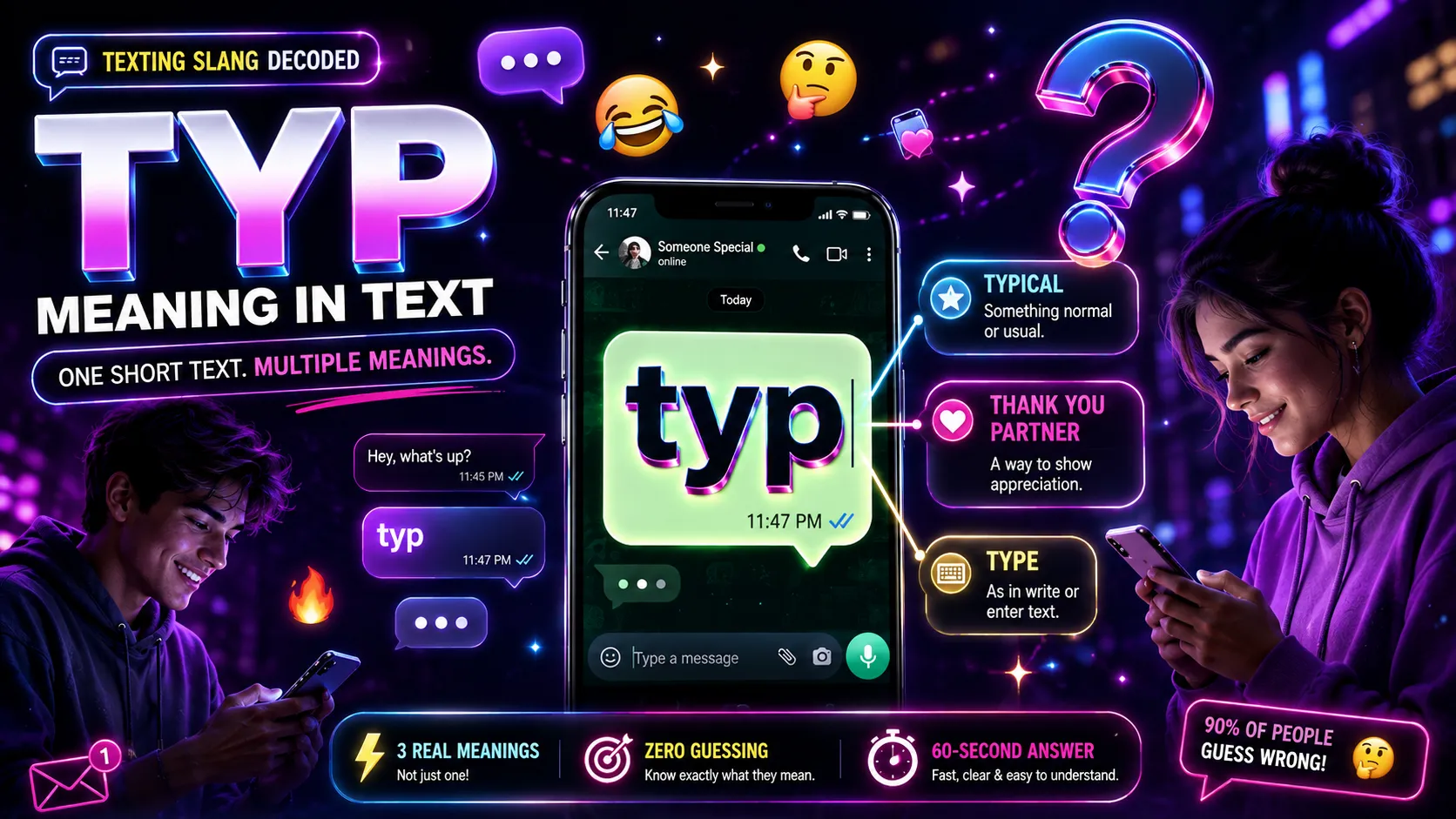
Quick answer: In most everyday texting, TYP means “type” (as in “you’re exactly my type”) or “typical” (as in “that’s so typical of him”). Less commonly, people use it as informal shorthand for “thank you partner” or “thank you, pal.” Completely separately, in engineering and technical drawings, TYP has a long-established formal meaning: “typical,” used to label repeated dimensions or features on a blueprint.
This guide walks through every real meaning of TYP, explains exactly how to tell them apart using context clues, and covers where the term shows up most — from Snapchat and TikTok to group chats, gaming servers, and even architectural drawings. By the end, you won’t just know what TYP can mean — you’ll know how to instantly figure out what it does mean in any specific conversation.
1. What Does TYP Mean in Text?
There isn’t one single meaning for TYP — it’s a context-dependent abbreviation, which is part of what makes it trickier than most texting slang. Unlike “lol” or “omg,” which mean the same thing no matter where you see them, TYP genuinely changes definition based on the conversation surrounding it.
Here’s how the three texting meanings break down, roughly ordered by how often you’ll actually run into each one in day-to-day messaging:
| Meaning | How Common | Typical Context |
| Type | Most common | Dating, attraction, personal preferences (“he’s not my typ”) |
| Typical | Common | Reacting to predictable, annoying, or repeated behavior (“typ 😭”) |
| Thank You Partner / Pal | Less common | Gratitude between close friends, teammates, or business partners |
The fastest, most reliable way to figure out which one someone means is to look at the message that came right before it — not the word itself. If the conversation is about attraction, dating, or describing the kind of person someone likes, TYP almost certainly means “type.” If it’s a reaction to someone doing something predictable or repeating a pattern, it means “typical.” And if someone just did you a favor, helped you out, or handled something for you, it’s shorthand for “thanks.”
This context-first approach is really the whole trick to understanding TYP. Reading the abbreviation in isolation — the way a lot of slang dictionaries present it, as a flat list of unrelated definitions — is exactly why people get stuck. Once you train yourself to check the sentence before it, the ambiguity mostly disappears.
2. TYP as “Type”
This is the meaning you’ll run into most often by far, especially in dating conversations and on visually driven platforms like Snapchat, TikTok, and Instagram, where conversations about attraction and preference happen constantly. People drop the “e” from “type” simply to type faster — the same logic behind “ty” replacing “thank you” or “tho” replacing “though.”
Examples:
A: What kind of people do you usually go for? B: Honestly, tall and funny is my typ.
Guy: You’re exactly my typ 😍
A: Is he your typ? B: Not really, too quiet for me. I go for more outgoing guys.
A: Be honest, do you have a typ or does it vary? B: Nah, I definitely have a type. Athletic, dark hair, good sense of humor.
You’ll also see “typ” used as a standalone compliment, without a question prompting it at all:
“ngl you’re literally my typ”
In every one of these cases, swapping “typ” back to “type” makes the sentence read completely naturally — which is a good quick test if you’re ever unsure. If “type” fits smoothly, that’s almost certainly the intended meaning.
In short: TYP = Type → a preference, category, or kind of person, almost always used in a romantic or physical-attraction context.
3. TYP as “Typical”
The second most common use of TYP, and the one most likely to trip people up if they’ve only ever seen it used in a dating context. Here, someone drops “typ” as a quick, often slightly sarcastic reaction to something predictable, annoying, or unsurprising — usually commenting on a person’s repeated behavior.
Examples:
A: He ghosted me again. B: typ 😭
A: My brother forgot my birthday. Again. B: typ of him tbh, he does this every year.
A: My WiFi crashed mid-call, of course. B: typ luck 😂
A: She said she’d be here at 7. It’s 8:15. B: typ.Always running late.
A: My boss “forgot” to CC me on the email again. B: honestly, typ at this point
Notice that in almost every example, the underlying tone is mild frustration or resigned amusement — TYP in this sense functions a lot like “of course” or “classic,” used to point out that something predictable just happened again. It’s rarely a neutral observation; it usually carries at least a little bit of eye-roll energy.
In short: TYP = Typical → used to call out predictable, repeated, or expected behavior, often with a hint of sarcasm or resignation.
4. TYP as “Thank You Partner” (or “Thank You, Pal”)
This is the older, less common definition, and it’s actually where a lot of the confusion online originates. Several dictionary-style slang sites (noslang, UrduPoint, and similar sites) list “thank you partner” as TYP’s primary meaning — when in current, everyday usage it’s actually the least common of the three. You’ll mostly see this version between close friends, teammates, or business partners as a quick, informal way of saying thanks.
Examples:
“Thanks for covering my shift. TYP!”
“Appreciate you handling that client call for me today. TYP 🙌”
Teammate: “Covered you in that last round, you’re good.” You: “TYP bro, owe you one.”
“Hey, thanks for grabbing my coffee order too. TYP!”
“Just wanted to say I appreciate everything you do for me. TYP.”
This usage tends to show up specifically when there’s an existing close relationship — the word “partner” or “pal” implies familiarity, so you’re unlikely to see a stranger or a casual acquaintance use TYP this way. It reads warmer and slightly more personal than a plain “ty,” almost like a small inside-joke shorthand between people who already text regularly.
In short: TYP = Thank You Partner/Pal → informal, warm gratitude, usually reserved for people with an existing close relationship — a friend, teammate, romantic partner, or business partner.
5. TYP in Engineering Drawings
Most slang guides only cover the texting definitions of TYP and completely skip its oldest, most formally established meaning: “typical,” used in engineering and technical drawings. This is worth knowing because if you’ve ever seen “TYP” printed on a spec sheet, blueprint, or CAD file and wondered why it didn’t match any texting definition, this is why.
On blueprints, architectural plans, and technical drawings, TYP (sometimes written “TYP.”) is a drafting abbreviation meaning “typical.” It tells anyone reading the drawing that a dimension, hole size, tolerance, spacing, or feature applies to every similar element shown on the drawing — not just the one specific spot it’s labeled next to. This saves drafters from having to repeat the same measurement dozens of times across a single sheet, which would clutter the drawing and increase the chance of a copy-paste error somewhere.
Example:
“Ø6mm TYP” written next to one hole on a drawing that shows 12 identical holes means all 12 of those holes are 6mm in diameter — not just the single one the label happens to point to.
This convention shows up constantly in mechanical engineering, electrical schematics, and architectural plans, and it’s been in standard use for decades — long before any texting-slang meaning of TYP existed. It’s a genuinely separate, formal piece of technical notation, not a slang term at all.
6. Other Formal Meanings of TYP
Beyond texting slang and engineering notation, TYP shows up as shorthand in a handful of other, narrower contexts. These are far less likely to be what you’re actually searching for if you got the abbreviation in a text message, but they’re worth knowing so you’re not caught off guard if you see “TYP” somewhere unexpected:
- Business & finance: appears occasionally as internal shorthand in some reporting or documentation contexts — this usage varies by organization and isn’t standardized across the industry the way the engineering meaning is.
- Organizations and programs: TYP is used as a name or initialism by various youth-focused and professional programs (for example, some groups branded as “The Young Professionals” go by TYP).
- German language: “Typ” is simply the German word for “type,” and it’s used internationally on some European car and product model numbers — for instance, certain Volkswagen and Škoda model designations reference a “Typ” number.
If you’re texting casually, you can safely ignore all of the meanings above — but they explain why a broader web search for just “TYP meaning” (without the word “text”) can pull up such wildly different results across dictionaries, acronym databases, and Wikipedia.
7. Where Did “TYP” Come From?
TYP isn’t a manufactured internet buzzword with one clean, traceable origin story — it’s really the product of two older, unrelated abbreviation habits colliding by coincidence.
- Vowel-dropping shorthand. Long before “typ” ever showed up in a DM, “typ.” was already standard drafting shorthand for “typical” in engineering and architecture — a genuinely old, formal abbreviation used on technical drawings for decades, well predating text messaging entirely.
- Texting’s “drop the last letter” pattern. Separately, as mobile texting and then social-media commenting took off, users started clipping “type” down to “typ” the same way “though” became “tho,” “because” became “bc,” and “probably” became “prolly” — a pure typing-speed convenience, not a deliberate coinage by any one person or platform.
The dating-slang usage — “you’re my typ” — is the newer, socially driven branch, and it’s the one that pushed TYP into much wider recognition on TikTok and Snapchat over the last several years. It’s worth stressing that this is a coincidence rather than a shared history: the engineering meaning and the texting meaning developed completely independently and just happen to land on the same three letters.
8. Why Is TYP Popular Right Now?
TYP’s current popularity tracks with two broader, ongoing trends rather than being a standalone viral moment of its own:
- Dating-preference language went mainstream. Phrases like “he’s not my type” or “that’s exactly my type” turned into a constant, casual talking point across dating apps, TikTok comment sections, Instagram captions, and group chats. “Typ” is simply the fast-typed version of that same conversation, and because dating talk is such a frequent topic online, the abbreviation gets a huge amount of natural repetition.
- Reaction culture rewards short, punchy replies. “typ” used as a one-word eye-roll (“that’s typical”) fits neatly into the same category as “smh,” “fr,” and “lol” — a low-effort, instantly understood way to react to something without typing out a full sentence.
Because it’s tied to two permanent, everyday texting habits — talking about attraction and reacting to predictable behavior — rather than one specific meme or moment, TYP isn’t the kind of slang term that’s likely to fade quickly. It’s baked into two conversation patterns that aren’t going anywhere.
9. TYP Mean in Text From a Guy vs. From a Girl
The core meaning of TYP doesn’t actually change based on who’s sending it — but the context it shows up in often does, based on common usage patterns across dating conversations.
From a guy, TYP most often shows up in dating and attraction contexts:
“You’re exactly my typ” → “You’re exactly my type.”
“Ngl you’re pretty much my typ” → a casual, low-pressure way of expressing interest.
From a girl, it’s used the same way, often to describe — or specifically rule out — someone as a match:
“He’s not really my typ” → “He’s not really my type.”
“That’s literally my typ tbh” → “That’s literally my type, honestly.”
In both cases, if the surrounding conversation isn’t about attraction at all, “typ” is far more likely to mean “typical” instead — for example, reacting to a friend’s predictable behavior — and that holds regardless of whether a guy or a girl sends it. Gender doesn’t change the underlying definition; only the topic of conversation determines which meaning applies, so it’s more useful to pay attention to what’s being discussed than who’s texting it.
10. Where TYP Shows Up Most
TYP isn’t evenly distributed across platforms — certain apps skew heavily toward one meaning over another, largely based on what people typically use each platform to talk about.
| Platform | Most Common Meaning | Example |
| Snapchat | Type | “Am I your typ? 👀” |
| TikTok (comments) | Type | “She’s literally my typ 😭❤️” |
| Instagram DMs | Type | “You’re exactly my typ” |
| Group chats / WhatsApp | Typical | “typ response from him” |
| Gaming chats (Discord, etc.) | Typical / Thanks | “typ teammate behavior” or “typ, appreciate it” |
| Engineering drawings | Typical (formal) | “6mm hole, TYP” |
Explore More: https://dogizle.com/ib-meaning-in-text/
11. Is TYP Rude?
Not inherently — tone and context are what decide whether it lands as rude or not. Used between friends reacting to a predictable, low-stakes annoyance, it’s casual and generally harmless:
“typ 😂” — light, joking, said with affection
But it can absolutely read as dismissive or sarcastic if it’s used to shut down someone who’s genuinely venting about something that’s actually bothering them:
“wow, typ of you” — comes across as a jab rather than a joke, especially without any softening emoji or follow-up
If you’re not sure how it’ll land with a particular person, it’s generally safer to use it with people you already text casually and have an established rapport with, and it’s best avoided as a response when someone is clearly upset or looking for genuine support rather than a quick reaction. Adding a laughing emoji or a follow-up sentence (“typ 😂 you okay though?”) can go a long way toward keeping the tone light rather than dismissive.
12. Can TYP Be Flirty?
Yes — this is actually one of TYP’s most common real-world uses. “You’re my typ” is a direct, low-pressure way of telling someone they match your type, and it’s a frequent line in dating-app conversations, comment sections, and DMs.
A: What’s your type? B: Honestly… you’re my typ 👀❤️
A: Do I even stand a chance with you? B: Ngl you’re kind of exactly my typ so… yeah
The abbreviated spelling actually softens the compliment a little compared to spelling out “type” in full — it reads as more casual and playful than a fully spelled-out declaration, which is probably part of why it’s become such a common flirting shorthand rather than feeling overly serious or intense.
13. TYP vs. Similar Abbreviations
People frequently confuse TYP with other short “thank you” abbreviations, partly because it visually looks like it belongs to that same family. Here’s how they actually differ:
| Abbreviation | Meaning | Notes |
| TYP | Type / Typical / Thank You Partner | Meaning depends entirely on context |
| TY | Thank You | Straightforward, no ambiguity |
| TYVM | Thank You Very Much | More emphatic thanks |
| TYSM | Thank You So Much | Very common on social media captions and comments |
| TBH | To Be Honest | Used to preface an honest opinion |
| NGL | Not Gonna Lie | Similar honesty marker, slightly more casual |
The key difference to remember: TY, TYVM, and TYSM are unambiguous — every single one of them only ever means “thank you,” in any context, on any platform. TYP is the clear odd one out in this group, because it carries three unrelated meanings depending on context, which is exactly why it trips people up far more often than any of the straightforward “thank you” variants do.
14. Real Conversation Examples
Seeing TYP used across a range of different conversation types is often the fastest way to build an intuitive feel for which meaning applies where.
Attraction context:
A: What’s your typ? B: Someone funny and a little chaotic tbh.
Reaction context:
A: She left me on read for two days then acted totally normal. B: Typp 😭 classic behavior.
Gratitude context:
A: Just sent you the notes from today’s meeting. B: TYP, saved my life honestly.
Flirty context:
A: I don’t even know why I like you this much. B: Because I’m your typ, obviously 😌
Group chat context:
A: He said he’d text back and then went dark for three days. B: typ of him, we’ve seen this movie before.
Ambiguous — needs context:
A: typ (Without a prior message, this one is genuinely unreadable — it’s a good reminder to always check what was said right before it, since “typ” on its own carries zero information about which meaning is intended.)
15. Common Mistakes and Misconceptions
A few misconceptions about TYP come up again and again, so it’s worth clearing them up directly:
- “TYP always means thank you” — Not anymore, at least not in most everyday texting. In current usage, “type” and “typical” are both significantly more common than the gratitude meaning, even though several older slang dictionaries still list “thank you partner” as the primary definition.
- “TYP is the same as TY” — No. TY is completely unambiguous and always means “thank you.” TYP is context-dependent and, in most cases, doesn’t mean thanks at all.
- “TYP is only internet slang” — It also has a completely separate, standardized, decades-old meaning in engineering and technical drawings, where it stands for “typical” and has nothing to do with texting culture whatsoever.
- “Guys and girls use TYP differently” — The underlying meaning is identical for everyone; only the topic of the surrounding conversation determines which definition applies, not the gender of the person sending it.
People Also Ask
Usually “type,” most often used in a dating or Attraction Context — e.g., “you’re exactly my type.”
Same core meaning as from a guy — “type” — typically used to describe or rule out someone as a match.
No. TY always means “thank you.” TYP is ambiguous and most often means “type” or “typical,” not thanks.
Not usually — it’s often a casual, even affectionate reaction. It can come across as dismissive if used sarcastically toward someone who’s genuinely upset.
Yes — “you’re my typ” is a common, direct way to tell someone they match your type.
“Typical” — it indicates a dimension or feature applies to all similar elements on the drawing, not just the one it’s labeled next to.
Conclusion
TYP doesn’t have one fixed meaning, which is exactly why it causes so much confusion in the first place. In everyday texting and social media, it’s almost always “type” or “typical,” and which one applies is decided entirely by what the conversation is actually about — not by who’s sending it or which platform it shows up on. The “Thank You Partner/Pal“ meaning still exists and pops up occasionally between close friends, but it’s genuinely far less common today than the two more casual definitions, despite what some older slang dictionaries suggest. And if you’ve ever seen TYP printed on a technical drawing or spec sheet, that’s a completely separate, formal, decades-old use meaning “typical” — nothing to do with texting slang at all.