SFW Meaning in Text: What It Really Means
If you’ve seen “SFW” in a text, a caption, or a group chat and want the real answer — not just three letters expanded — here it is.
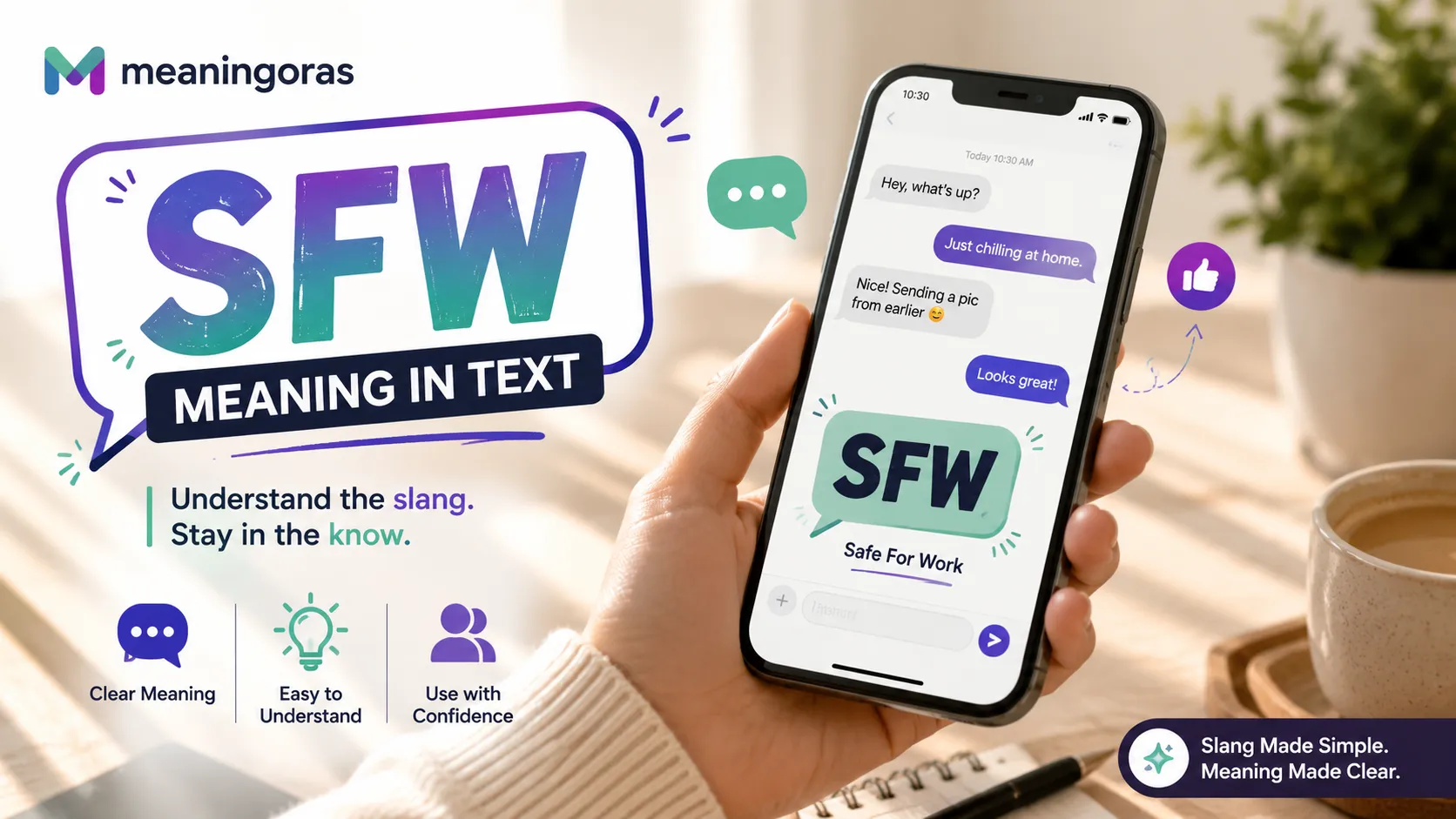
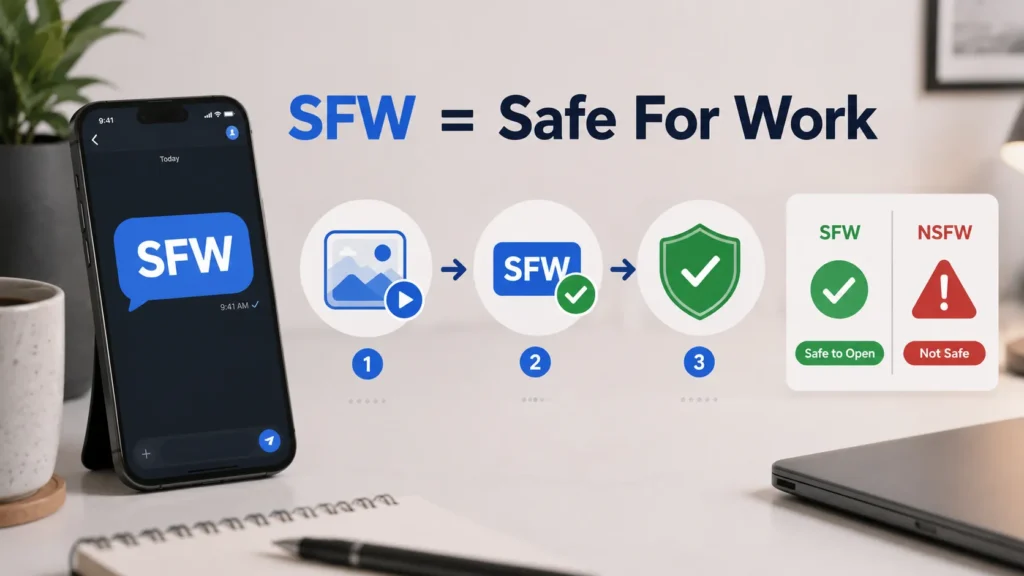
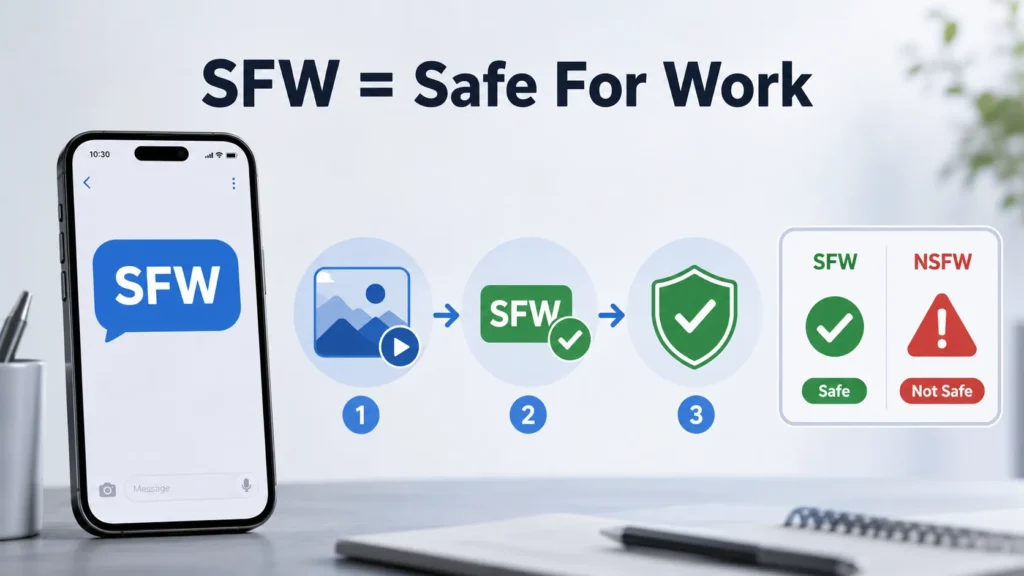
SFW Means “Safe For Work.” People attach it to a photo, video, meme, or link to tell whoever’s receiving it that the content is clean enough to open at the office, in class, or with family standing nearby — nothing sexual, graphic, or embarrassing inside.
It sounds simple, and mostly it is. But the reason so many people search this exact phrase is that the simple definition doesn’t answer the follow-up questions that actually come up: Is it rude to say? Is SFW the same as “PG”? What do I say back when someone tells me something is SFW? Does it ever mean something else?
This guide covers all of that — the definition, where the term came from, how it’s used differently across TikTok, Snapchat, Discord, and Reddit, and a quick way to judge whether your own content genuinely qualifies as SFW.
What Does SFW Mean?
SFW stands for “Safe For Work.” It’s an adjective used to label content as appropriate to open in a professional, public, or family setting.
Example: “Don’t worry, that video’s SFW — you can open it at your desk.”
Its direct opposite is NSFW (“Not Safe For Work”), which flags content as explicit, graphic, or otherwise inappropriate for a shared screen. SFW almost always shows up paired with that opposite term, since the two work as a single labeling system rather than standalone words.
Quick Meaning Summary
| Full form | Safe For Work |
| Part of speech | Adjective |
| Opposite term | NSFW (Not Safe For Work) |
| Used for | Photos, videos, memes, links, GIFs |
| Common platforms | Texting, TikTok, Instagram, Snapchat, Reddit, Discord, Slack |
| Tone | Neutral / courteous, not rude |
| First popularized | Internet forums and image-sharing communities, late 1990s–2000s |
Origin and History of SFW
SFW belongs to a small family of labeling terms that grew out of early internet forums, image boards, and discussion communities, where people routinely shared links and photos with mixed audiences — some browsing from home, many from a work computer.
As internet access spread into offices through the late 1990s and 2000s, these communities needed a fast way to flag content before someone clicked it, rather than after an awkward moment already happened. SFW and NSFW developed together as a simple two-label system solving exactly that problem.
From there, the convention spread outward — from forums into instant messaging, then into Reddit and Tumblr, and eventually into mainstream texting and Instagram captions, which is where most people encounter it today. Like “IMO” or “TL;DR,” SFW isn’t tied to one platform’s invention — it evolved by consensus across early internet culture, which is why its exact founding moment isn’t pinned to a single site or date.
Is SFW a Noun or an Adjective? (Grammar Explained)
SFW functions as an adjective — it describes the content, the same way “clean” or “appropriate” would.
- “Is this an SFW email?”
- “Send me the SFW version.”
- “That’s a pretty SFW meme.”
It doesn’t take periods (never written “S.F.W.”), and while it’s capitalized by convention, lowercase “sfw” is completely normal in casual texting. It’s also sometimes used as a stand-alone one-word reply — “SFW.” meaning this is safe, go ahead. It’s rarely used as a verb or noun; if you see it used that way, it’s likely a typo or an unrelated abbreviation.
Why Is SFW Still Popular Today?
SFW stays relevant because mixed audiences never went away. Group chats mix coworkers and friends. Instagram feeds mix family and strangers. Slack channels mix departments and seniority levels. As long as people share content across contexts where “who might see this” genuinely varies, a fast, universally understood appropriateness label solves a real, recurring problem — which is why the term hasn’t aged out the way a lot of older internet slang has.
SFW vs. NSFW vs. NSFL vs. NSFV: The Full Spectrum
Most explanations stop at SFW vs. NSFW. But labeling culture — especially on Reddit, Discord, and image boards — actually runs on a fuller spectrum.
| Term | Full Form | What It Signals | Typical Content |
| SFW | Safe For Work | Fine to open anywhere | Memes, everyday photos, general videos |
| NSFW | Not Safe For Work | Explicit, sexual, or graphic | Nudity, sexual content, strong violence |
| NSFL | Not Safe For Life | Beyond NSFW — genuinely disturbing | Extreme gore, real footage of death/injury |
| NSFV | Not Safe For Viewing | Broad catch-all, often used like NSFW | Varies by community |
Think of it as a signal ladder: SFW is a green light, NSFW is a yellow-to-red light, NSFL is a hard stop. Outside slang, ratings like PG or PG-13 describe age-appropriateness generally — a narrower, situational judgment than SFW, which is specifically about workplace and public appropriateness (a swimsuit photo might be “PG” but still not something most people would call SFW at the office).
SFW Meaning on Social Media (TikTok, Instagram, Snapchat, Reddit, Discord)
The core meaning of SFW doesn’t change app to app — but how and why people use it does.
TikTok — Creators tag #SFW in captions to reassure viewers and brands a video is fully appropriate, sometimes distinguishing themselves from “seemingly NSFW” clickbait trends.
Instagram — Common in captions, comments, and DMs, especially on reposted memes or videos that might look questionable out of context.
Snapchat — Used more as a personal, 1:1 reassurance between friends than a public label, since Snaps are often sent privately and disappear quickly.
Reddit — The most formal use of the term: many subreddits require an NSFW toggle on posts, and un-flagged posts are implicitly treated as SFW by default. Mislabeling can get a post removed.
Discord — Servers frequently enforce SFW-only channels via bot rules, with separate age-gated NSFW channels — here it’s a real rule, not just etiquette.
SFW Meaning in Texting and Workplace Chat
In workplace tools like Slack or Microsoft Teams, the term returns to something closer to its original, literal use case: flette — it can genuinely protect you from an HR conversation you’d rather avoid.
Real Conversation Examples of SFW
Between friends:
A: Check out this clip 😂 B: I’m at my desk, is it safe to open? A: Yeah, totally SFW
Workplace Slack:
“Sharing this in #general since it’s SFW — figured the team would enjoy it.”
Reddit post title:
“My cat destroyed my houseplants again (SFW)”
Discord server rule:
“Please keep #general SFW — NSFW content goes in the age-gated channel only.”
Parent-to-teen text:
“Sent you that recipe video, don’t worry it’s SFW lol”
How to Reply When Someone Says “SFW”
There’s no required response — SFW is informational, so a simple acknowledgment works fine. But tone can shift it:
Casual: “Bet, opening it now.” / “Appreciate the heads-up 😂” Professional: “Thanks for confirming, I’ll take a look.” / “Noted — appreciate you flagging it.” Playful: “Phew, my job is safe today.” / “SFW? In this group chat? Shocking.”
The “Seemingly SFW” Trend Explained
A secondary, more nuanced usage has developed around “seemingly SFW” content — images edited so they look innocent at a glance but were originally adult or suggestive material with the explicit parts cropped, covered, or edited out.
This is the reverse problem from a normal NSFW warning: instead of over-flagging, the content is engineered to slip past a casual glance. It’s worth knowing the difference between a genuine SFW label and something that’s only “technically” SFW after editing — context and source still matter.
Does SFW Ever Mean Something Else?
Almost never in everyday texting — “Safe For Work” is the meaning well over 99% of the time. Two narrow exceptions exist:
- “Software” — an informal shorthand used occasionally in IT and developer circles (paired with HW for “hardware”), essentially never seen in casual chat.
- Field-specific jargon — a few technical or scientific fields reuse the letters SFW for an unrelated internal term, but this is specialist usage, not something you’ll run into in normal conversation.
If you see “SFW” in a text, DM, or caption, “Safe For Work” is the safe default assumption.
Is SFW Rude or Offensive?
No. SFW is a courtesy label, not an insult. Saying “this is SFW” is the digital equivalent of “don’t worry, this is appropriate” — it protects the receiver from an awkward moment rather than causing one. It’s fine to use with coworkers, classmates, family, or friends, in casual or professional settings alike. The only time it reads oddly is when it’s applied to content that obviously never needed the label in the first place — and even then, it just comes across as over-cautious, not rude.
Common Misunderstandings About SFW
- “SFW means boring.” Not true — it means appropriate, not necessarily dull.
- “SFW only applies to sexual content.” It also covers violence, disturbing imagery, and heavy profanity — anything that wouldn’t fly in a shared or professional setting.
- “SFW and PG are interchangeable.” Close, but PG is an age-based rating; SFW is a workplace/public-appropriateness judgment, which is more situational and context-dependent.
Related Terms and Similar Meanings
| Acronym | Meaning |
| NSFW | Not Safe For Work |
| NSFL | Not Safe For Life |
| NSFV | Not Safe For Viewing |
| AO | Adults Only |
| PG / PG-13 | Age-based content rating (not workplace-based) |
| TW | Trigger Warning |
| CW | Content Warning |
People Also Ask
Safe For Work” — it tells you the referenced content is appropriate to open in public, professional, or family settings.
NSFW (“Not Safe For Work”), used for explicit, graphic, or otherwise inappropriate content
.
Not quite. PG is an age-based rating; SFW is specifically about whether content is safe for a workplace or public setting, which can be a narrower call.
As an adjective: “Is this an SFW link?” or “Don’t worry, the video’s SFW.”
Rarely — in tech circles it can informally mean “software,” but that’s uncommon outside specialist contexts.
No — it’s a courtesy that reassures the receiver before they open the content.
The same thing everywhere: “Safe For Work.” Only the context of use changes by platform.
Because it’s faster and universally understood — one label communicates “appropriate everywhere” without extra explanation.
Conclusion
SFW means “Safe For Work” — a short, courteous label letting someone know a piece of content is fine to open anywhere, from the office to the family group chat. Beyond that one-line definition, there’s real substance: correct grammar and usage, a genuine origin in early internet forum culture, a full labeling spectrum (NSFW, NSFL, NSFV), meaningful platform-by-platform differences, and a lesser-known “Seemingly SFW” trend worth watching for. Next time you see — or use — “SFW,” you’ll know exactly what it means and how to use it correctly.