ONG Meaning in Text: What It Really Means (2026 Guide)
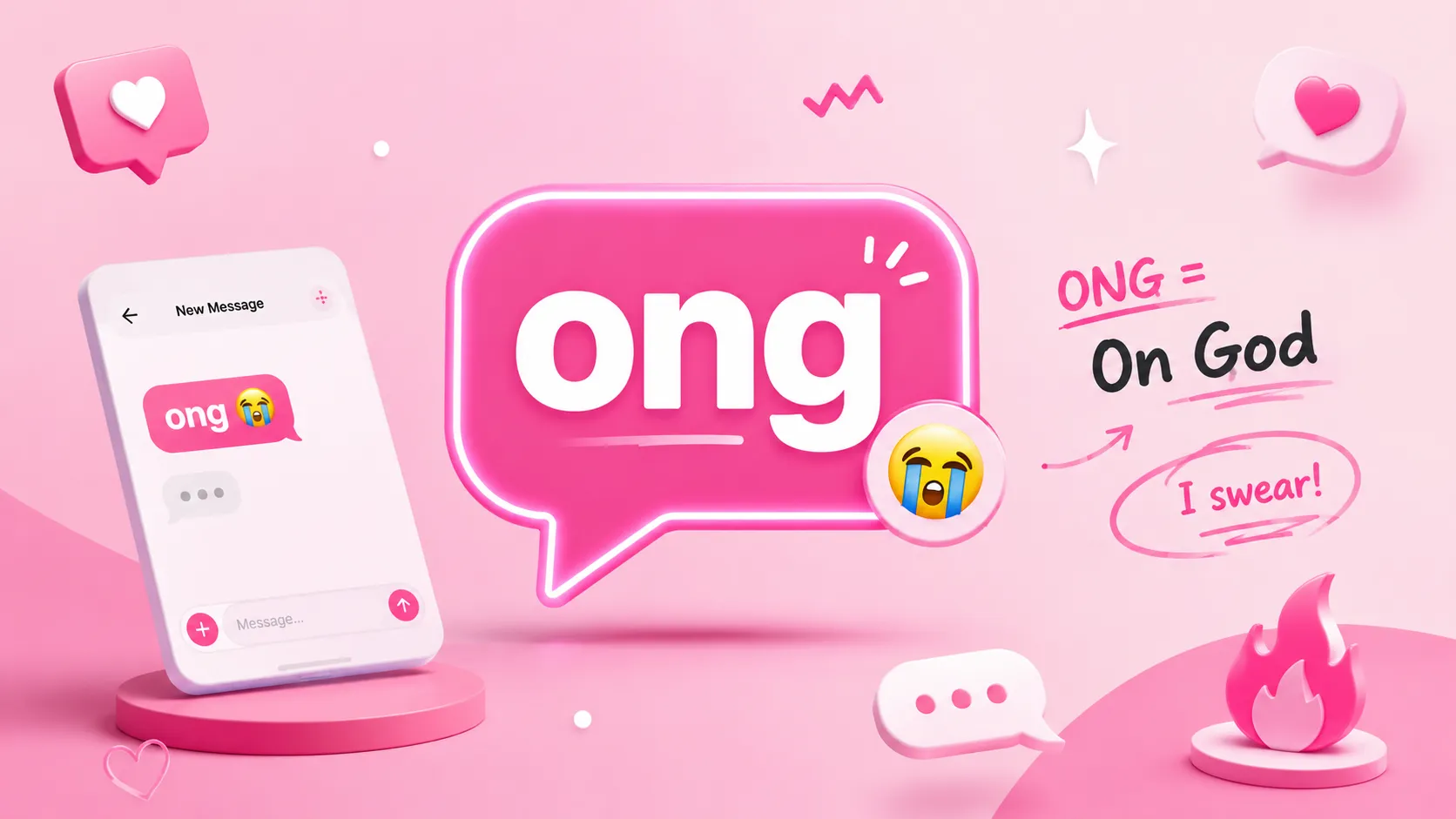
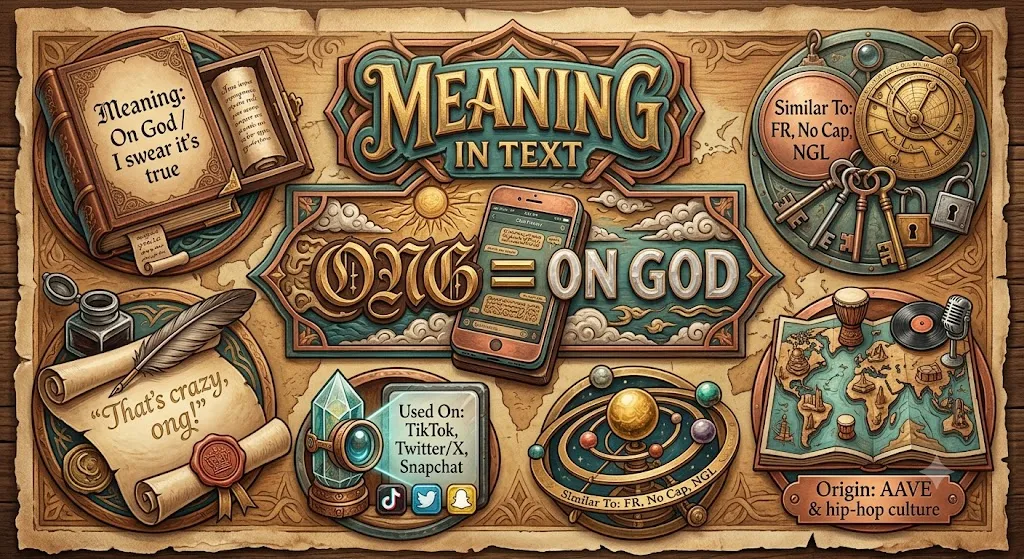
ONG Means “On God” — Gen Z slang used to swear that something is completely true, the texting equivalent of saying “I swear to God” or “for real.” People add it to the end or start of a sentence for emphasis, like “That show was actually insane, ong.”
People search this term because ONG looks like a typo of the much older “OMG” — but it isn’t. It has its own separate meaning, its own origin story, and its own set of unwritten usage rules. Below is the complete picture: where it came from, how it’s actually used across platforms, how it compares to FR and no cap, when to avoid it, and the handful of unrelated meanings ONG has outside of texting.
What Does ONG Mean?
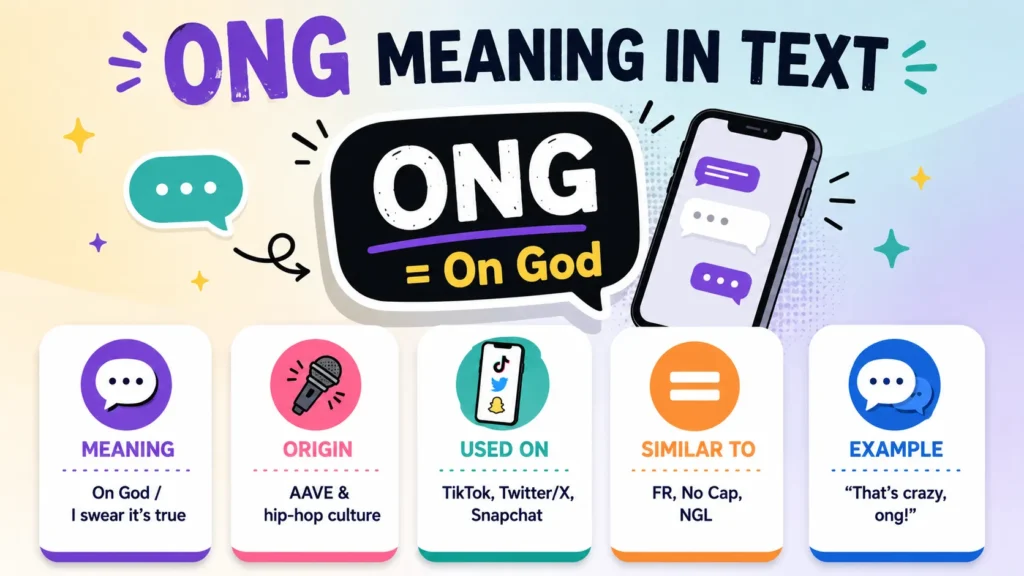
ONG = “On God.”
It’s a shortened, texting-friendly version of the spoken phrase “on God” — a way of swearing that what you just said is genuinely true. It carries more weight than a casual “trust me”; it functions almost like putting your hand up and swearing an oath.
- “I did not study for that test, ong.”
- “Ong, this is the best burger I’ve ever had.”
- “We’re actually going, ong.”
It’s an intensifier, not a meaning-changer — it doesn’t alter the sentence, it just tells the reader “I mean this, I’m not exaggerating.”
Quick Meaning Summary
| Element | Detail |
| Full form | On God |
| Meaning | Swearing something is true / sincere emphasis |
| Category | Gen Z internet slang, texting abbreviation |
| Tone | Casual, informal |
| Similar to | “I swear,” “for real,” “no cap” |
| Origin | African American Vernacular English (AAVE), spread via hip-hop and TikTok |
| Where used | Texts, TikTok, Twitter/X, Snapchat, Instagram, Discord, gaming chats |
| Formal use? | No — avoid in emails, work chat, academic writing |
Origin and History
“On God” isn’t new — it has roots in African American Vernacular English (AAVE), where swearing “on” something (on God, on my mama, on my life) has long been a way to vouch for the truth of a statement. The phrase moved into the mainstream through hip-hop lyrics throughout the 2000s and 2010s, where artists used “on God” to emphasize sincerity or conviction.
The jump from spoken phrase to the three-letter abbreviation ONG happened as the phrase migrated to texting and social media, where brevity is everything. Its viral tipping point is widely traced to a 2018 clip of internet personality Tana Mongeau, who used “on God” while discussing a boxing match between two YouTubers. The clip spread widely and helped cement “on God” — and soon its shorthand “ong” — as recognizable internet slang.
Important correction some competing pages get wrong: ONG did not start life as a typo of OMG. It has a completely separate origin and meaning.
Why Is ONG Still Popular?
TikTok, Twitter/X, and group chats carried the term from niche AAVE/hip-hop usage into mainstream Gen Z (and now Gen Alpha) vocabulary. By the early 2020s it was a fixture of everyday digital conversation, and in 2026 it’s still going strong — often stacked with other emphasis slang like “ong fr” or “ong no cap” for maximum sincerity.
How Is ONG Used?
ONG is flexible — it can sit at the end, the beginning, or stand alone as a one-word reply.
End of a sentence (most common):
- “That movie made me cry, ong.”
- “He really said that to my face, ong.”
Start of a sentence:
- “Ong I’ve never been this tired in my life.”
- “Ong wish I had a friend group like that.”
Standalone reply, agreeing with someone:
Friend A: “This is the best pizza place in the city.” Friend B: “Ong.”
Stacked with other slang for extra emphasis (very common in real usage):
- “Ong fr” — “I swear, for real”
- “Ong no cap” — “I’m swearing, I’m not lying”
- “Ong bro” — casual, emphatic agreement
Wondering what “ong” means in a text? 👀 It stands for “On God” — Gen Z’s go-to way of
swearing something’s 100% true. Here’s the full breakdown.
ONG vs. OMG: Don’t Mix These Up
This is the single most common point of confusion, and it’s worth being precise:
| ONG | OMG | |
| Stands for | On God | Oh My God |
| Meaning | Swearing something is true | Shock, surprise, disbelief, excitement |
| Function | An oath / truth-emphasizer | A reaction |
| Example | “That’s actually true, ong.” | “OMG, I can’t believe that happened!” |
They look alike because both are three letters starting with O, ending in G — and yes, ONG is sometimes misread as a typo of OMG at first glance. But OMG reacts to something surprising, while ONG vouches for something being true. They can even be combined: “OMG ong that’s crazy” — “oh my god, I swear that’s true.”
ONG vs. FR vs. No Cap vs. NGL: Comparison Table
These terms are often used interchangeably by beginners but carry slightly different shades of meaning:
| Term | Stands for | What it really signals | Intensity |
| ONG | On God | Swearing / vouching for truth | Highest — functions as an oath |
| FR | For real | Confirming truth or asking “seriously?” | High |
| No cap | No lie | Denying exaggeration (“cap” = lie) | High |
| NGL | Not gonna lie | Prefacing an honest, sometimes unflattering opinion | Medium |
| Deadass | — | Completely serious, no joke | High |
The nuance: FR simply confirms truth, while ONG adds the weight of a sworn oath — which is exactly why people stack them: “ong fr” or “ong no cap” to say “I am being as serious as I possibly can be right now.”
ONG on Social Media (Platform by Platform)
- TikTok: Extremely common in comments, captions, and duets — arguably the platform most responsible for the term going viral.
- Twitter/X: Used constantly in replies and quote-tweets to emphasize agreement or shock at something true.
- Instagram: Common in captions and comment threads, often paired with emojis (😭, 💀, 🔥).
- Snapchat: Used in chat and captions much like texting — quick, casual emphasis.
- Discord & gaming chats: Used to vouch for claims in real time — “ong I just clutched that round.”
- Reddit: Appears in comment threads for emphasis, though slightly less common than on visual/short-form platforms.
- Group texts / iMessage: The most direct “texting” use case — a one-word or end-of-sentence emphasis.
How to Reply to ONG
ONG doesn’t require a special response — you can simply continue the conversation. But if you want to match the tone:
- To agree / match energy: reply “ong” right back, or “fr fr.”
- To hype it up: “no cap??” or “wait fr??”
- To playfully doubt them: “you sure ong?” or just “cap” (teasingly accusing them of lying).
- To close it out casually: “😭 ong” or “lmaooo ong.”
Is ONG Rude, Religious, or Offensive?
No — ONG is generally considered harmless, casual slang, not a swear word or code for anything inappropriate.
Two nuances worth knowing:
- Literal religious phrasing. Because “on God” literally invokes God as a witness to truth, some people — particularly from religious backgrounds where oaths are taken seriously — may find the phrase mildly uncomfortable, even without any intended offense.
- It’s informal, not inappropriate. It’s not offensive, but it is casual — which matters in professional contexts (see below).
When NOT to Use ONG
ONG belongs in casual digital spaces — texts, DMs, social captions, gaming chat. It does not belong in:
- Professional Emails
- Work Slack/Teams messages with colleagues or clients you don’t know well
- Academic writing or formal essays
- Customer service or business communication
- Messages to teachers, professors, or authority figures — unless the relationship is clearly casual
If you’re writing to your boss, skip “ong” and use “I agree” or “that’s accurate” instead.
Other Meanings of ONG (Non-Slang / Disambiguation)
“ONG” isn’t exclusively internet slang — the same three letters show up in several unrelated contexts:
- NGO (Non-Governmental Organization): In French, Italian, Spanish, Romanian, and Portuguese, “ONG” is the standard abbreviation for what English speakers call an NGO (Organisation Non Gouvernementale in French). This is an extremely common, completely unrelated use — especially in international news or nonprofit contexts.
- Airport code: ONG is the IATA code for Mornington Island Airport in Australia.
- Energy sector: ONG is sometimes shorthand for “Oil and Natural Gas” in industry contexts, and is linked to ONE Gas (Oklahoma Natural Gas).
- Surname: Ong is a common surname, especially among Chinese and Singaporean families (a Hokkien romanization of several Chinese surnames), and also an English/Estonian surname.
- Ong’s Hat: A well-known piece of collaborative internet fiction/urban legend from the early web era.
Context makes it obvious which meaning applies — a news article about aid workers is talking about an NGO, not Gen Z slang.
swearing something’s 100% true. Here’s the full breakdown.
Common Misunderstandings
- “ONG is just a typo of OMG.” False — different phrase, different function, different origin.
- “ONG is a new word.” False — “on God” has existed in spoken AAVE for decades; only the three-letter abbreviation is relatively recent.
- “ONG is offensive or a swear word.” False — it’s casual slang, not profanity.
- “ONG only means ‘on God.'” False outside of slang contexts — in several languages it means NGO, and it has unrelated technical/geographic meanings too.
A Note for Parents
If you spotted “ong” in your kid’s texts and got worried, you can relax — it’s benign, everyday slang, not a code for anything risky. It’s the digital equivalent of a pinky promise. Understanding terms like this helps you follow your teen’s conversations without misreading them as something they’re not (like assuming they mistyped “OMG”).
People Also Ask
ONG means “On God” — slang used to swear that a Statement Is True, Similar to “I swear” or “for real.”
No. Although they look similar, ONG (“On God”) and OMG (“Oh My God”) are separate terms with different meanings — one swears something is true, the other reacts with surprise.
“Ong fr” combines “On God” and “for real” for extra emphasis — essentially, “I swear, seriously.”
It means “I swear, I’m not lying” — stacking two truth-emphasizing slang terms together.
“On God” has long existed in AAVE and hip-hop culture; its viral spread as internet slang is widely linked to a 2018 clip of Tana Mongeau, after which it spread rapidly on TikTok.
Conclusion
ONG Stands For “On God” — a Gen Z slang term used to swear that a statement is completely true. It grew out of African American Vernacular English and hip-hop culture, went viral through a 2018 Tana Mongeau clip, and is now a fixture of texting, TikTok, and social media captions everywhere. It’s harmless and casual, best saved for friends and informal chat — and it’s easy to confuse with OMG, so keep the distinction in mind. Outside of slang, the same letters also stand for “NGO” in several languages, plus a few unrelated technical and geographic uses.