Double Exclamation Mark Meaning: What !! Really Means (In Text, Chess, Math & Code)
Quick Meaning Summary: A double exclamation mark (!!) is two exclamation points placed together, most commonly used in texting and social media to intensify emotion — showing extra Excitement, Surprise, Urgency, or emphasis beyond what a single “!” conveys. Outside of texting, “!!” also has completely different technical meanings in chess (a brilliant move), mathematics (double factorial), and programming (boolean conversion).
You’ve probably seen it a dozen times today without thinking twice: someone texts back “omg yes!!” or comments “this is amazing!!” on a post. It’s such a small mark, but it changes the entire emotional temperature of a message. And if you’ve ever seen “!!” pop up somewhere unexpected — next to a chess move, in a line of code, or in a math textbook — you’ve probably wondered if it means something completely different there too. (It does.)
This guide breaks down every meaning of the double exclamation mark, where it came from, how it’s used across platforms, and why it shows up in fields as different as texting and computer science.
| Quick Meaning Table | |
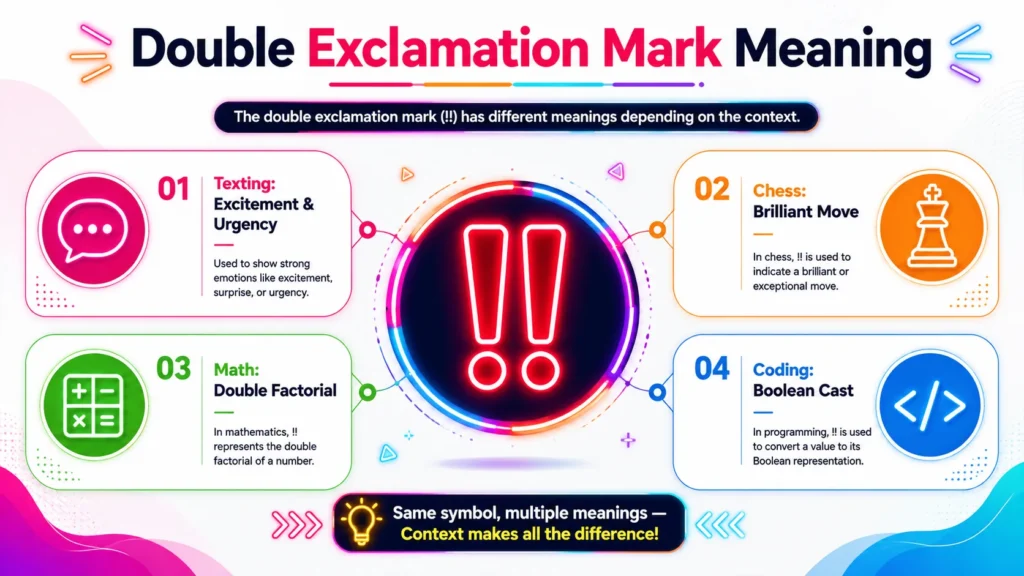
| In texting/social media | Amplified emotion — excitement, urgency, shock, emphasis |
| In chess notation | A brilliant or excellent move |
| In mathematics | Double factorial (e.g., 5!! = 5 × 3 × 1) |
| In programming (JS) | Converts a value to a strict true/false boolean |
| As an emoji (‼️) | Unicode symbol for strong emphasis or urgency, U+203C |
| In formal writing | Generally avoided — reads as unprofessional |
What Does a Double Exclamation Mark (!!) Mean?
At its core, “!!” is a punctuation intensifier. A single exclamation point already signals excitement, surprise, or a raised tone. Doubling it doesn’t add a new meaning — it turns the volume up on the same meaning. Linguists sometimes describe this as “punctuation reduplication”: repeating a symbol to represent intensity, the same way writing “sooo good” stretches a word to stretch the feeling behind it.
So when someone texts “I got the job!!” instead of “I got the job!”, they’re not saying anything different — they’re saying it louder.
Example:
“We’re getting married!!”
This reads as noticeably more thrilled than “We’re getting married!” — the second mark does emotional work that no extra words would.
Where the Exclamation Mark Comes From
The exclamation mark itself is centuries old. Most punctuation historians trace it back to the Latin interjection io, an expression of joy, which scribes eventually compressed into a stacked “I” over an “O” — and over time that stack flattened into the vertical line with a dot underneath that we use today. Medieval Italian writers gave it the formal name punctus admirativus, and it slowly spread into English typography as the “note of admiration.”
The doubled version is much newer and has no formal grammatical history — it was never a recognized part of standard punctuation. Its rise tracks almost exactly with the rise of informal written conversation: instant messaging, texting, and social media in the late 1990s through the 2000s. Before texting, doubling punctuation for emphasis showed up occasionally in personal letters and advertising copy, but it became a true convention only once ordinary people started writing to each other constantly, casually, and without an editor.
Double Exclamation Mark Meaning in Text
In everyday texting, “!!” is almost always doing one of these jobs:
- Amplifying excitement — “Can’t wait to see you!!”
- Signaling genuine surprise — “Wait, really?!” / “No way!!”
- Adding urgency — “Call me back!! It’s important”
- Reinforcing agreement or enthusiasm — “Yes!! Let’s do it”
- Softening a strong statement into something friendlier — “Miss you!!” reads warmer than a flat statement
Tone matters more than the mark itself. The same “!!” that reads as pure joy in “We won!!” can read as mild irritation in “I told you already!!” — context does the interpreting, the punctuation just turns up the intensity of whatever context is already there.
Double Exclamation Mark on Social Media
Each platform tends to use “!!” a little differently:
Instagram & TikTok captions/comments — used heavily to boost perceived enthusiasm and engagement (“obsessed with this!!”, “need this in my life!!”). It’s practically a genre convention in comment sections.
Twitter/X — often used for reactive, in-the-moment commentary, especially around live events, sports, or breaking news.
Facebook — skews slightly older-audience, and tends to appear more in personal milestone posts (engagements, new jobs, birthdays) than in reactive commentary.
Gaming chats (Discord, in-game chat) — used for quick-fire hype in the moment (“clutch!!”, “let’s gooo!!”), functioning almost like a text-based cheer.
Why We Double Up Punctuation: The Psychology
Written text strips out everything that carries emotional nuance in speech — no tone of voice, no facial expression, no pacing. Punctuation has partly stepped in to fill that gap. Repeating an exclamation mark is a Low-Effort Way to signal “I mean this more than the plain words suggest,” without needing to add extra words or emojis.
Some patterns researchers and linguists studying digital communication have observed:
- Younger users and more casual relationships tend to use doubled or tripled punctuation more freely; it reads as warm and expressive rather than unprofessional.
- In professional or unfamiliar contexts, a single “!” already signals friendliness — doubling it can come across as overly emotional or try-hard.
- Doubling can also signal urgency rather than joy — “answer your phone!!” is intensity, not necessarily happiness — so the surrounding words still carry the emotional label; the punctuation just amplifies it.
Other Meanings of “!!” Outside of Texting
This is the part most guides skip — but “!!” shows up in several technical fields with meanings that have nothing to do with emotion at all.
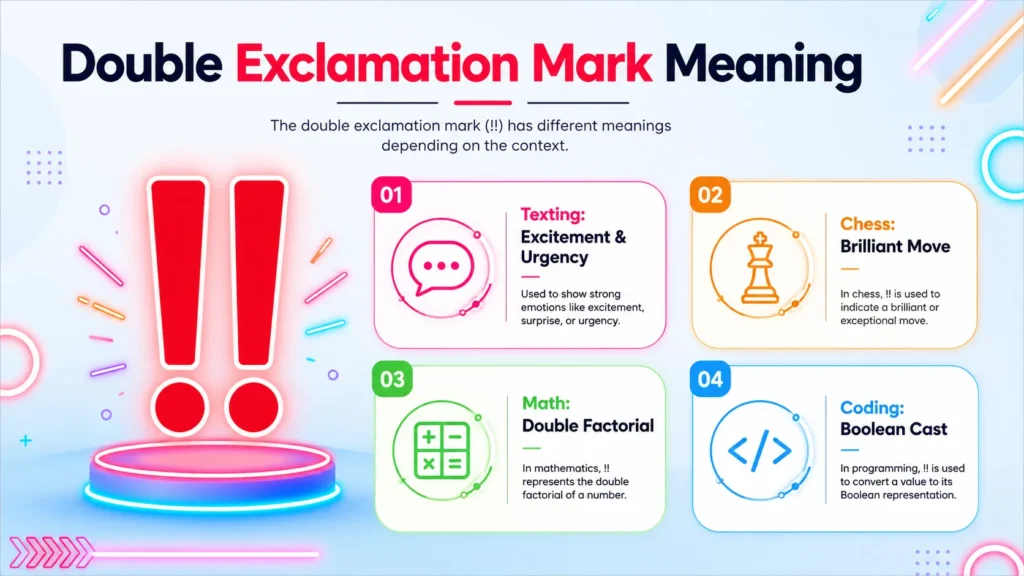
1. Chess Notation
In chess annotation, a single “!” after a move marks a good move, and “!!” marks a brilliant move — an exceptional, often unexpected play that a strong player wouldn’t have found easily. You’ll see this constantly in annotated chess games and commentary (e.g., “24. Qxh7!!”).
2. Mathematics — Double Factorial
In math, “n!!” denotes the double factorial, a variation on the standard factorial that multiplies only every other integer down to 1 or 2. For example, 5!! = 5 × 3 × 1 = 15, while a regular factorial (5!) multiplies every integer down to 1.
3. Programming — Boolean Casting
In JavaScript and several other programming languages, “!!” in front of a value is shorthand for converting that value into a strict true/false boolean. The first “!” negates the value, and the second “!” negates it again — landing back on the original truthiness of the value, but now as a clean boolean instead of the original data type. Developers use it for quick, readable type conversion.
4. Linguistics
In some academic transcription systems, “!!” (or similar double-punctuation marks) is also used to represent specific click consonants found in a small number of southern African languages — a niche but real technical use.
Seeing “!!” outside of a casual chat context? It’s very likely one of these specialized meanings rather than an emotional one.
Double Exclamation Mark Emoji (‼️) Meaning
Separate from typed punctuation, there’s also a dedicated double exclamation mark emoji (‼️) — Unicode character U+203C. Visually, it’s two bold, usually red exclamation points side by side, and it’s used to:
- Add strong emphasis to a message (“Read this ‼️”)
- Signal Urgency or importance, almost like a visual alarm
- Punctuate dramatic or surprising statements in captions and comments
It’s functionally similar to typing “!!,” but as an emoji it stands out visually and is often used in addition to text rather than replacing punctuation.
When to Use (and When to Avoid) Double Exclamation Marks
| Situation | Use “!!”? | Why |
| Texting friends/family | Yes | Reads as warm, expressive, natural |
| Social media captions/comments | Yes | Common convention, boosts perceived enthusiasm |
| Celebrating good news casually | Yes | Matches the emotional register |
| Professional emails | Avoid | Can read as unprofessional or overly emotional |
| Academic or formal writing | Avoid | Not grammatically standard; undermines credibility |
| Customer service messages | Avoid | Can seem insincere or excessive |
| Serious/sensitive conversations | Avoid | Emphasis can feel mismatched or dismissive |
Double Exclamation Mark vs. Similar Expressions
| Expression | Relative Intensity | Best Used For |
| Single “!” | Moderate | Everyday enthusiasm, general friendliness |
| “!!” | High | Amplified excitement, urgency, surprise |
| “!!!” (triple+) | Very high / can read as over-the-top | Big reactions, but risks seeming exaggerated |
| ALL CAPS | High, more forceful | Shouting, strong emphasis, sometimes anger |
| Interrobang (?!) | Shock + confusion combined | Surprised disbelief (“Wait, what?!”) |
| Emojis | Visual emotional cue | Softening tone or adding specific emotion |
People Also Ask
It Signals Amplified Emotion — usually excitement, surprise, urgency, or strong emphasis — beyond what a single exclamation mark conveys.
No, not inherently. In casual conversation, it usually reads as enthusiastic rather than rude, though in formal contexts it can come across as overly emotional.
To intensify the feeling behind the message without needing extra words — it’s a quick way to signal “I mean this more strongly.”
Yes — in chess annotation, “!!” marks a brilliant or exceptional move, unrelated to emotional emphasis.
In JavaScript and similar languages, “!!” before a value converts it into a strict true/false boolean.
Conclusion
The double exclamation mark is one of the smallest pieces of punctuation with one of the Widest Ranges Of Meaning — from pure texting enthusiasm, to a celebrated chess move, to a line of working code. In everyday digital conversation, it’s simply an emotional volume knob: it doesn’t change what you’re feeling, just how loudly you’re expressing it. Understanding the context — texting vs. chess vs. code vs. math — is really all it takes to read “!!” correctly wherever you encounter it.