“For Sure” Slang Meaning: The Complete Origin Story, Grammar Guide, and Every Variant Explained
If you’ve ever texted a friend and gotten back a simple “For Sure“, you already know what it means on the surface — yes, definitely, no argument here. But the phrase carries a lot more history, nuance, and regional flavor than a glance suggests. It’s older than you’d guess; it has a genuinely bizarre connection to Formula 1 racing, and its tone can flip from warm agreement to biting sarcasm depending on nothing but context.
This guide breaks down where “for sure” actually comes from, how linguists and dictionaries define it, why it exploded online, and exactly how to use it (and when not to).
Quick Meaning Summary
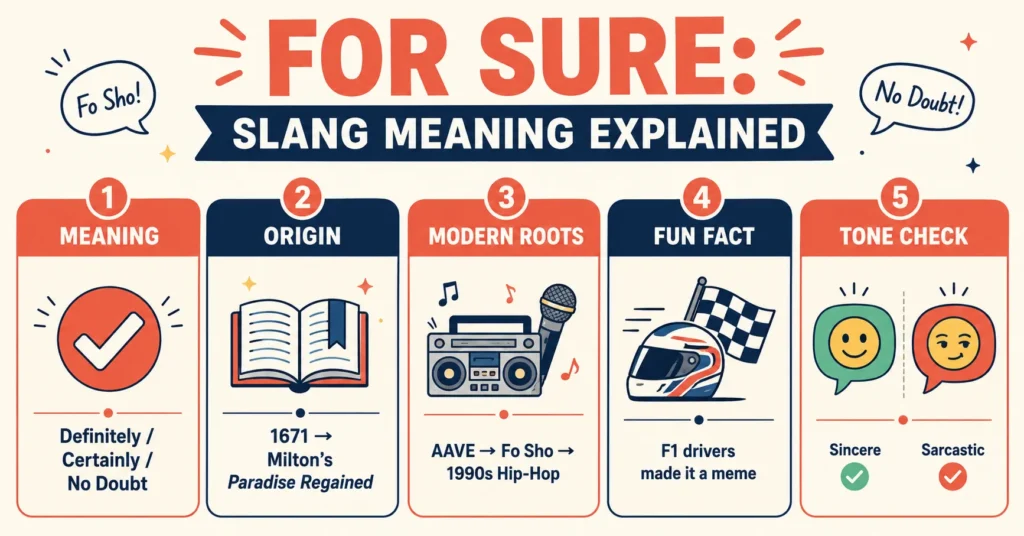
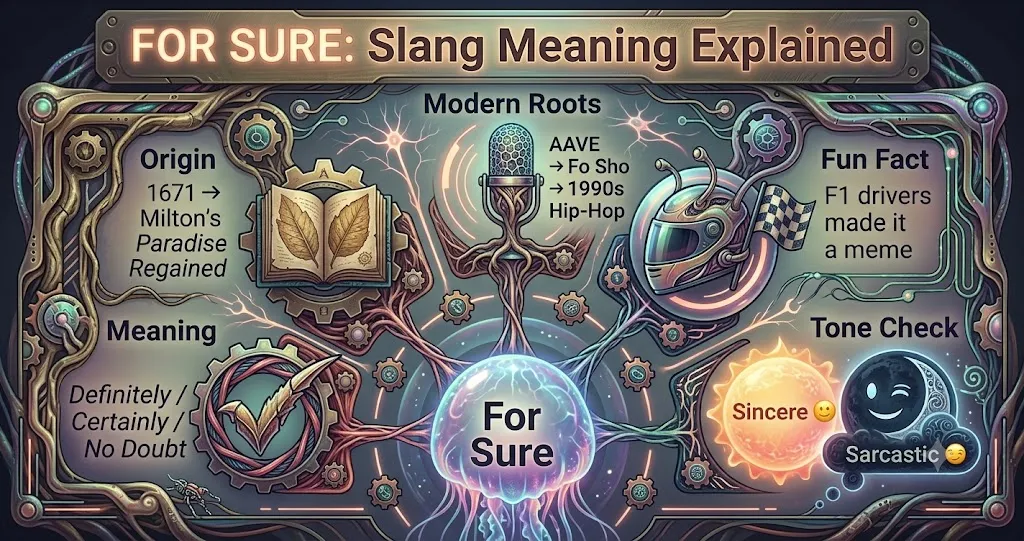
| Meaning | Definitely, certainly, without a doubt |
| Part of speech | Adverbial/adjective phrase; also used as an interjection |
| First recorded use | Late 1500s (literary); 1671 in Milton’s Paradise Regained |
| Standalone slang use recorded | By at least 1971 |
| Cultural driver of modern tone | AAVE → “fo sho” → 1990s hip-hop |
| Common variants | Fo sho, fasho, for real, deffo, 100% |
| Formality | Informal — avoid in professional/academic writing |
| Tone range | Genuine agreement to flat sarcasm, depending on delivery |
Quick Answer: What Does “For Sure” Mean?
“For sure” is an idiom meaning “definitely,” “certainly,” or “without a doubt.” It can function as:
- An adverbial phrase expressing certainty (“I’ll be there for sure”)
- A standalone interjection used to agree with someone (“Want to grab lunch?” — “For sure.”)
- An adjective phrase meaning “beyond question” (“That’s for sure”)
In casual, modern usage — especially in texting and social media — it’s simply a cooler, more relaxed way of saying “yes” or “I agree.”
“For Sure” Is Way Older Than Slang — Here’s the Real History
Most articles on this phrase treat it like a TikTok-era invention. It isn’t. Dictionary records trace the phrase back centuries before hip-hop, texting, or Urban Dictionary existed.
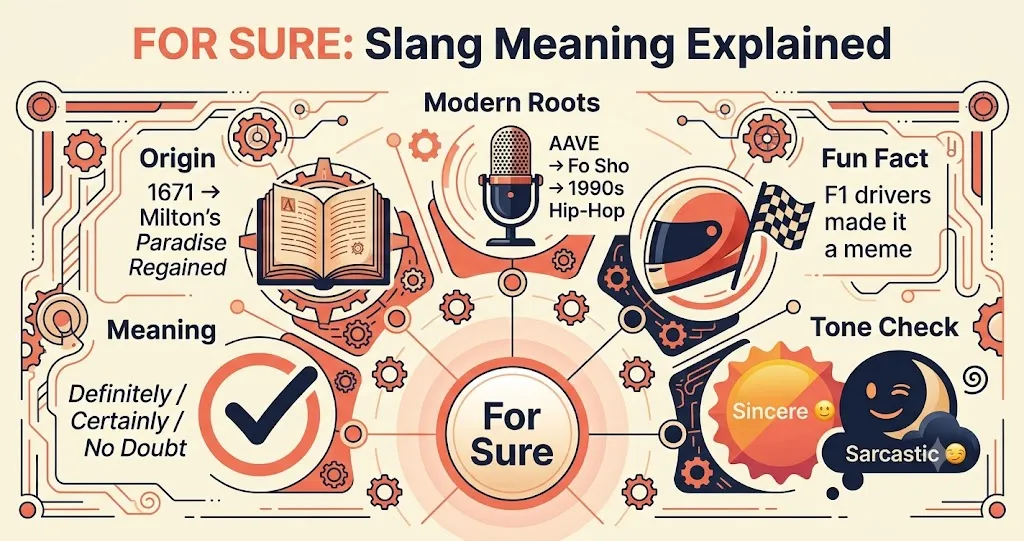
The idiom actually dates to the late 1500s in its “without doubt” sense. John Milton used it in Paradise Regained (1671), writing a line about deliverance being “for sure” at hand — proof the phrase was already established in literary English over 350 years ago.
The second, more conversational sense — using “for sure” on its own to mean “I agree” — is newer, though still not as recent as people assume. Mountaineering writer Chris Bonington used the now-familiar standalone form (“That’s for sure”) in his 1971 book Annapurna South Face, decades before it became internet shorthand.
So the “slang” version of “for sure” isn’t a brand-new phrase — it’s an old phrase that picked up a new, casual delivery.
Where the Modern Slang Version Comes From: AAVE and Hip-Hop
The breezy, affirmative “for sure” that dominates casual English today owes its tone and rhythm to African American Vernacular English (AAVE). The related pronunciation spelling “fo sho” emerged from AAVE and Southern dialects, where the “r” sound is often dropped in casual speech.
“Fo sho” moved into the mainstream through 1980s–90s hip-hop and West Coast rap culture, carried by artists whose slang got absorbed into pop culture, movies, and everyday conversation across the country. By the 2000s, “fo sho” and “for sure” were used interchangeably in music, film, and youth culture — cementing “for sure” as a phrase associated with confidence, loyalty, and casual cool rather than formal correctness.
It’s worth being upfront about this origin because a lot of competing content skips it entirely or flattens it into a vague “it’s from hip-hop” line. The AAVE lineage is the actual reason the phrase carries its relaxed, affirming tone today — not just internet trends.
The Surprising Formula 1 Connection
Here’s a piece of trivia almost nobody covers: one theory for why “for sure” surged again in a very specific, deadpan way traces back to Formula 1 driver interviews. Brazilian driver Felipe Massa reportedly used “for sure” constantly in post-race interviews — a direct translation of a common Portuguese phrase — and fellow driver Fernando Alonso began repeating it back as a good-natured joke. The phrase caught on as a mock-serious, deadpan way for drivers (and later fans) to sound extremely certain about something in press conferences, and it became a small meme within motorsport fan communities.
It’s a fun, very specific example of how a plain phrase can get a second life through repetition, imitation, and a bit of internet humor — separate from, but running alongside, its hip-hop-driven popularity.
Grammar Breakdown: Adjective, Adverb, or Interjection?
“For sure” isn’t just one part of speech — its grammar shifts with how it’s used:
| Function | Example | What it’s doing |
| Adverbial phrase | “She’s coming for sure.” | Modifies the verb, adding certainty |
| Interjection / standalone reply | “Can you help me move?” — “For sure.” | Stands alone as an agreement |
| Adjective phrase | “That much is for sure.” | Describes a noun/fact as certain |
| Sentence-starter (casual) | “For sure, I’ll be there.” | Opens a sentence, emphasizing agreement |
Dictionaries classify the core phrase as meaning “without doubt or question; certainly,” and note it functions informally the way “surely” does in more formal writing.
Tone Is Everything: Sincere vs. Sarcastic “For Sure”
This is the part most competing articles miss almost entirely, and it’s arguably the most important thing to understand about the phrase today.
Sincere “for sure” is warm and genuine:
- “This pizza is the best in town!” → “For sure, no doubt about it!”
Ironic/sarcastic “for sure” is the opposite — a flat, low-effort way to end a conversation or agree to something you don’t actually want to do, without the confrontation of saying no:
- “We should totally get drinks sometime.” → “Yeah, for sure.” (often means: probably not, but I don’t want to argue)
Tone here is carried almost entirely by delivery, punctuation, and context — a lowercase, one-word “for sure” in a text thread reads very differently from an enthusiastic “For sure!! Let’s go!!” This dual personality — genuine agreement vs. polite deflection — is what makes “for sure” such a flexible, distinctly modern piece of slang, even though the words themselves are centuries old.
Every Way to Say “For Sure”: Variants and Synonyms
“For sure” has spawned (and borrowed from) a whole family of related expressions:
| Variant | Origin/Flavor | Example |
| Fo sho | AAVE pronunciation spelling, 1990s hip-hop | “You coming tonight?” “Fo sho.” |
| Fasho / Fosho | Text-speak spelling of “fo sho” | “Fosho, I’m down” |
| Fosho (Hawaiian Pidgin) | Localized Pidgin adaptation used across Hawaii | “Fosho, braddah!” |
| For real / fr | Gen Z shorthand, similar certainty | “fr fr no cap” |
| Deffo | British informal shortening of “definitely” | “Deffo coming by 8” |
| 100% | Numeric stand-in for total agreement | “100%, let’s do it” |
| No doubt | Slightly more formal-sounding synonym | “No doubt, I’ll be there” |
| Word/bet | Older and newer slang affirmations with similar function | “Bet, see you then” |
Formal synonym lists also group “for sure” with words like certainly, surely, undoubtedly, unquestionably, and indisputably — useful if you’re looking for a less casual substitute in writing.
How to Use “For Sure” in a Sentence
As a full reply:
- “Are you free Saturday?” — “For sure.”
Mid-sentence, for emphasis:
- “That’s, for sure, the funniest thing I’ve seen all week.”
At the end of a sentence:
- “She’s talented, for sure.”
As a sentence opener:
- “For sure, I’ll send it over tonight.”
In its idiomatic negative form:
- “I can’t say for sure who’s coming to dinner.” (meaning: I don’t know with certainty)
Regional and Cultural Variants Worth Knowing
- Hawaiian Pidgin: “Fosho” is a well-established, localized adaptation used across generations in Hawaii, functioning much like “absolutely” or “you know it” in casual local speech.
- AAVE / Southern U.S.: “Fo sho” remains the defining pronunciation variant, tied closely to hip-hop culture and Black American vernacular speech patterns.
- International English learners: ESL resources commonly list “for sure” alongside “fo sho,” “for real,” “definitely,” and “deffo” as interchangeable casual affirmations.
“For Sure” on Social Media
- TikTok / Instagram: Used in captions and comments as a quick stamp of agreement or hype (“this outfit is fire for sure 🔥”), and often paired with reaction audio or a deadpan delivery for comedic effect.
- X (Twitter): Frequently used sarcastically to close out a joke or mock a claim (“yeah that’s definitely happening, for sure”).
- Discord/gaming chat: A fast, low-effort way to confirm plans (“raid at 8? for sure”) without breaking chat flow.
- Reddit: Shows up in both sincere agreement and quote-tweet-style irony, often stacked (“for sure, for sure”) to intensify sarcasm.
Across platforms, punctuation and repetition do a lot of the work — a single flat “for sure” reads differently than “FOR SURE!!” or a repeated “for sure for sure.”
When to Avoid “For Sure” I
“For sure” is strictly informal. Skip it in:
- Resumes, cover letters, and professional emails
- Academic writing and formal reports
- Legal or business documents
In those contexts, swap it for “certainly,” “absolutely,” or “without question.”
People Also Ask
It means “definitely” or “without a doubt.” Casually, it’s used as a quick, confident way to agree with someone or confirm a plan.
No — while Gen Z uses it heavily online, the phrase dates back to at least the late 1500s in written English, and its casual, standalone use goes back to at least the early 1970s. Gen Z popularized it in a new context, not from scratch.
“Fo sho” is a pronunciation spelling of “for sure” that comes from African American Vernacular English and 1990s hip-hop culture. They mean the same thing; “fo sho” just signals a more informal, stylized delivery.
Yes. Depending on tone and context, “for sure” can be a genuine agreement or a flat, noncommittal way to end a conversation without directly disagreeing.
Yes, in informal writing and speech. It functions as an adverbial or adjective phrase meaning “certainly” or “without doubt,” though it’s not appropriate for formal writing.
Depending on formality: “certainly,” “absolutely,” “no doubt,” “definitely,” “deffo,” “100%,” or “fo sho.”
“Fo sho” is a pronunciation spelling rooted in African American Vernacular English, where the final “r” sound is often dropped. It spread through 1980s–90s hip-hop and West Coast rap culture before entering mainstream slang.
The core meaning is consistent, but delivery varies by region — for example, Hawaiian Pidgin uses “fosho” as a local staple, while AAVE communities use “fo sho” as the defining pronunciation variant.
Conclusion
“For sure” Feels Like A Brand-New Piece of internet slang, but it’s really the opposite — a centuries-old phrase that keeps getting reinvented. It was formal English in Milton’s time, a plain conversational tag by the 1970s, reshaped by AAVE and hip-hop into “fo sho,” and now lives a double life online as both a warm, genuine agreement and a deadpan, sarcastic brush-off.
Understanding it means understanding all of that at once: the history, the culture behind the tone, the grammar that lets it slot into almost any sentence, and the context that decides whether it’s sincere or ironic. That’s what separates actually knowing what “for sure” means from just knowing it’s another way to say “yes.”